My Lord and My God: Saint Thomas the Apostle (John 20:19-29)
Feast of Saint Thomas, December 21. He is remembered as the doubter. But he also said let us go, that we may die with him. He asked the question that produced I am the way. And when the risen Lord appeared, Thomas gave the highest confession in John’s Gospel: My Lord and my God.
December 21, 2025, Holy Day, Saint Thomas the Apostle, Red-Letter Holy Day, Season of Advent
John 20:19–29, Psalm 126, Hebrews 10:35–11:1, Habakkuk 2:1–4,
Grace, mercy, and peace from God our Father and the Lord Jesus Christ be with you on this Feast of Saint Thomas the Apostle.
Saint Thomas is appointed for December 21, in the final days of Advent and at almost the darkest point of the year. December 21 falls at or very near the winter solstice in the Northern Hemisphere, when the days are shortest and the nights longest. That makes this a fitting place in the calendar for Thomas, not because darkness or doubt is the point of his story, but because his story passes through unbelief and arrives at one of the clearest confessions of Jesus Christ anywhere in Scripture: “My Lord and my God!” (John 20:28, ESV)
Thomas is almost universally remembered as the doubter. That reputation is not invented, because John gives us a disciple who genuinely refuses to believe the testimony of the other apostles concerning the Resurrection. But doubt is the middle of Thomas’s story, not its destination, and it is not the only thing John tells us about him. Before Easter morning ever arrives, we meet a disciple willing to follow Jesus toward danger and a disciple willing to admit openly when he does not understand. Then, after the Resurrection, we meet the same man refusing what his fellow apostles tell him until the risen Christ himself comes and brings him from unbelief into faith.
The first time Thomas speaks is in John 11. Lazarus has died, and Jesus announces that he is going back into Judea. The disciples know the danger because the authorities there have recently tried to stone him. Thomas understands what returning may mean, yet he says in verse 16, “Let us also go, that we may die with him.” (John 11:16, ESV) We cannot hear the tone of his voice. Perhaps there is courage in it, perhaps grim resignation, perhaps some mixture of both. John does not tell us enough to build an elaborate personality around one sentence, but he does tell us this much: Thomas sees the danger and goes with Jesus anyway.
The second time Thomas speaks is in the Upper Room. Jesus tells the disciples that he is going to prepare a place for them and that they know the way where he is going. Thomas answers in John 14:5, “Lord, we do not know where you are going. How can we know the way?” He does not pretend to understand what he does not understand, and Jesus answers him with one of the defining declarations of the Gospel: “I am the way, and the truth, and the life. No one comes to the Father except through me.” (John 14:6, ESV) Thomas asks for a way, and Jesus does not give him a map. He gives him himself.
There is something worth preserving in Thomas’s candor. Christian faith does not require us to pretend that we understand what we do not understand, and there is nothing faithful about dressing confusion in religious language so that it looks like certainty. But Thomas’s story also teaches us that honest questions are good when they are brought toward Christ and allowed to receive an answer. The question is not the destination. Jesus himself is.
That brings us to our appointed Gospel, John 20:19–29. On the evening of the Resurrection the disciples are gathered behind locked doors when Jesus comes and stands among them. He speaks peace. He shows them his hands and his side. They rejoice because they have seen the Lord. He commissions them, saying, “As the Father has sent me, even so I am sending you,” and breathes on them, saying, “Receive the Holy Spirit.” (John 20:21–22, ESV) It is an extraordinary scene of Resurrection, peace, mission, and new creation.
Then verse 24 gives us the detail on which Thomas’s Holy Day turns: “Now Thomas, one of the twelve, called the Twin, was not with them when Jesus came.” (John 20:24, ESV) John does not tell us why he was absent, and it is better not to speculate. We know only that Thomas did not see what the others saw. When they later find him, they bear the simplest possible Easter witness: “We have seen the Lord.” (John 20:25, ESV)
Thomas refuses their testimony. His words are stronger than ordinary uncertainty: “Unless I see in his hands the mark of the nails, and place my finger into the mark of the nails, and place my hand into his side, I will never believe.” (John 20:25, ESV) The phrase translated “I will never believe” is emphatic. Thomas has not simply said, “I am struggling with this.” He has set the conditions under which he will believe the apostolic testimony.
It is true that Thomas asks for the sort of visible encounter the others have already received. They have seen Jesus and his wounds, while he has not. That helps us understand why Christ’s response to Thomas is so personal and merciful, but it does not make Thomas’s refusal something other than unbelief. Jesus himself settles that question in verse 27 when he tells him, “Do not disbelieve, but believe.” The Gospel does not shame Thomas, but neither does it rename unbelief so that it becomes a virtue.
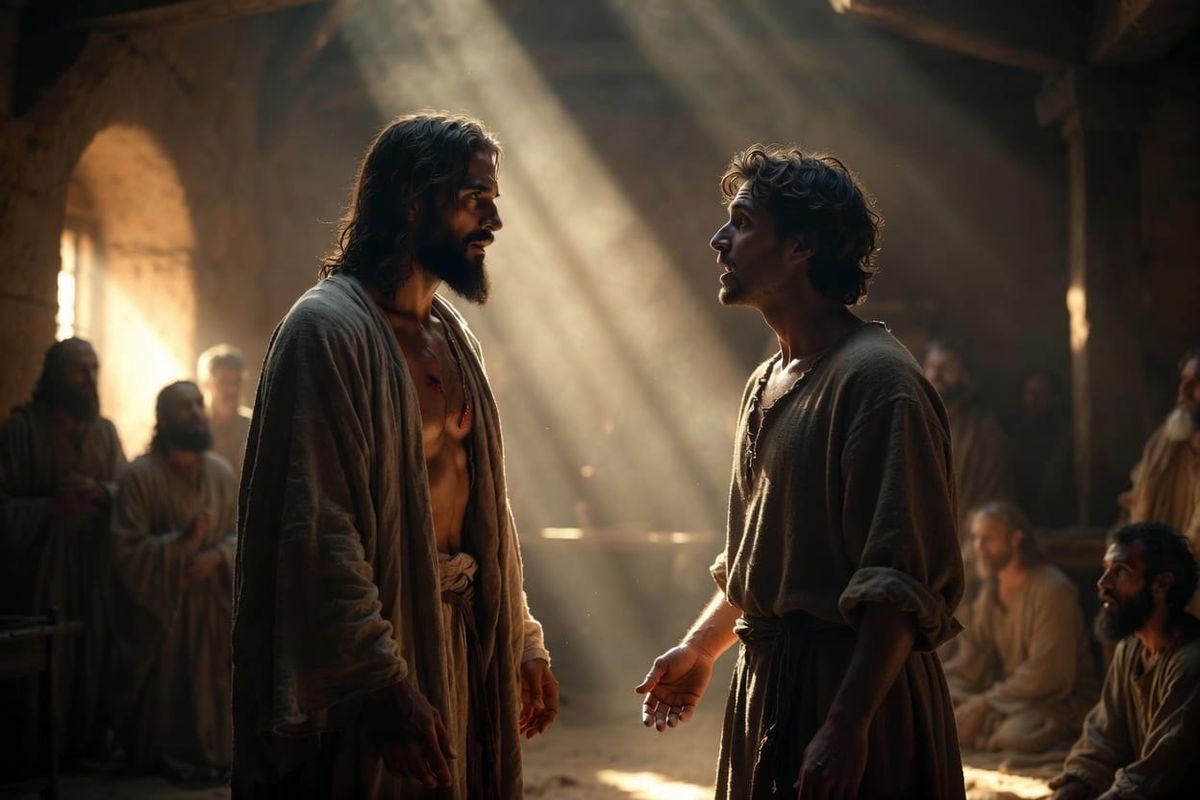
Eight days pass, and John tells us that the disciples are together again. This time Thomas is with them. Jesus comes despite the locked doors and again says, “Peace be with you.” Then, before Thomas has repeated any of his demands, Jesus turns directly to him: “Put your finger here, and see my hands; and put out your hand, and place it in my side. Do not disbelieve, but believe.” (John 20:27, ESV) Christ knows precisely what Thomas said when he was not visibly present, and he addresses the disciple at exactly the place where his faith has failed.
This is the mercy at the center of the story. Jesus does not leave Thomas to himself. He does not say that the other ten believe and one unbelieving disciple is therefore expendable. He comes again, speaks peace again, and addresses Thomas personally. Yet Christ’s mercy is not mere affirmation. He meets Thomas where he is in order to bring him somewhere else. The movement is from “I will never believe” to faith.
John does not tell us that Thomas actually touches the wounds. Christian art has often pictured his finger entering Christ’s side, but the Gospel moves directly from Jesus’ invitation to Thomas’s confession. Faced with the crucified Lord now standing before him alive, Thomas answers, “My Lord and my God!” (John 20:28, ESV)
Those words belong among the great theological high points of John’s Gospel. John began his Gospel with the declaration, “In the beginning was the Word, and the Word was with God, and the Word was God.” (John 1:1, ESV)Throughout the Gospel the identity of Jesus has been unfolded through his signs, his teaching, his conflict with the religious authorities, and his repeated declarations concerning himself. Now, near the Gospel’s conclusion, Thomas looks at the crucified and risen Jesus and addresses him directly as Lord and God.
The confession is theological, but it is also personal: “My Lord and my God.” Thomas is not merely agreeing that a proposition concerning Jesus is true. He is confessing the identity and lordship of the one standing before him. The same Jesus who was crucified is alive. The wounds are still his wounds. The body that was placed in the tomb has been raised. Resurrection has not produced another person or a merely spiritual continuation of Jesus. The crucified Jesus himself stands before Thomas, and Thomas worships him as his Lord and his God.
That is where Thomas’s story is going. We sometimes remember the sentence he spoke in unbelief more readily than the confession to which Christ brought him, but John does not allow unless I see to have the final word. Grace has the final word. Christ has the final word. And Thomas’s final great word in the Gospel is confession.
Jesus then turns the scene outward. He says in verse 29, “Have you believed because you have seen me? Blessed are those who have not seen and yet have believed.” (John 20:29, ESV) There is a correction here. Thomas has believed after seeing, but the generations that follow the apostles will ordinarily not receive the same visible encounter. Yet there is also blessing. Christ looks beyond Thomas toward a Church that will believe through the testimony of those who did see.
John immediately explains this in verses 30 and 31. Jesus did many other signs in the presence of his disciples, “but these are written so that you may believe that Jesus is the Christ, the Son of God, and that by believing you may have life in his name.” (John 20:31, ESV) Those who have not seen are not being asked to believe without testimony. They are given testimony. The apostles saw the risen Lord, and their witness has been preserved in Holy Scripture so that those who did not stand in that room may nevertheless know whom they are believing.
That places us within the blessing of verse 29. We have not seen Christ with the bodily eyes with which Thomas saw him. We were not behind those locked doors when Jesus appeared, did not hear his voice in that room, and did not see the marks of the nails. Yet we have the testimony of those who did. Thomas becomes, by grace, part of the very apostolic witness he initially refused. The man who would not receive another apostle’s Easter testimony becomes one of the apostles through whose testimony the Church receives the Easter Gospel.
Our faith therefore does not rest upon Thomas as its foundation. Jesus Christ himself is the foundation. Our faith rests upon the crucified and risen Lord whom the apostles proclaim, and Thomas belongs among those witnesses because the Lord who confronted his unbelief also made him an apostle of the Resurrection. That is a far greater transformation than turning a skeptic into a better thinker. Christ turns an unbelieving disciple into a confessor and witness.
Our other readings help us understand what that faith looks like, but we need to let each text speak on its own terms. Habakkuk 2 begins with the prophet at his watchpost: “I will take my stand at my watchpost and station myself on the tower, and look out to see what he will say to me.” (Habakkuk 2:1, ESV) Habakkuk has brought painful questions before God about evil, injustice, and divine providence, but unlike Thomas he is not refusing testimony already given to him. He is waiting for God to speak, and when God speaks the answer includes the great declaration, “the righteous shall live by his faith.” (Habakkuk 2:4, ESV)
The connection with Thomas is therefore not that both men stubbornly hold their positions until God satisfies their demands. The connection is deeper. Both passages force us to reckon with the difference between what can presently be seen and what God has spoken. Habakkuk is told to trust the Word while the vision awaits its appointed time. Thomas is brought to believe the Resurrection and then hears Christ bless those who will believe without seeing as he has seen. In both cases, the life of God’s people rests finally upon the faithfulness of the God who speaks.
Psalm 126 gives us another part of the biblical picture. It remembers a restoration so astonishing that the people say, “we were like those who dream.” It looks backward at what God has already done and forward with the prayer that he will restore again. The Psalm ends with the great promise that “those who sow in tears shall reap with songs of joy.” We should not invent tears for Thomas that John never mentions, but the Psalm belongs naturally beside the Resurrection because Easter itself turns the grief of the Cross toward a joy the disciples scarcely know how to receive.
Thomas initially stands outside that Easter joy because he refuses to believe its announcement. The others say, “We have seen the Lord,” while he says he will not believe. Yet the risen Christ comes and brings him into the joy of the Resurrection. Psalm 126 reminds us that the God who restores Zion is the God who can reverse what seems irreversible, and Easter is the supreme reversal: death itself is entered and defeated.
Hebrews then speaks directly to Christians who do not see what Thomas saw. “Therefore do not throw away your confidence, which has a great reward,” the writer says. “For you have need of endurance, so that when you have done the will of God you may receive what is promised.” (Hebrews 10:35–36, ESV) Then chapter 11 begins, “Now faith is the assurance of things hoped for, the conviction of things not seen.” (Hebrews 11:1, ESV)
That is where we stand. Thomas was permitted to see the risen Jesus. We receive the apostolic testimony and live by faith while waiting for sight. Christian faith is not wishful thinking or optimism directed toward something we hope might be true. It is trust in the God who has acted in history, raised Jesus bodily from the dead, and given witnesses to that Resurrection. We have not seen what Thomas saw, but we have not been given nothing. We have the Word God has preserved through those who did see.
The Collect for Saint Thomas interprets the whole feast with extraordinary precision: “Everliving God, you strengthened your apostle Thomas with firm and certain faith in your Son’s resurrection: Grant us so perfectly and without doubt to believe in Jesus Christ, our Lord and our God, that our faith may never be found wanting in your sight.” Notice again where the prayer begins. It does not say Thomas strengthened himself. It does not even praise him for the path by which he finally overcame his doubts. It says to God, you strengthened your apostle Thomas.
That is the grace-first center of this Holy Day. Thomas does not work himself from unbelief into faith by greater effort. The risen Christ comes to him. The Everliving God strengthens him. Then the Church asks the same God to do the same sort of work in us. We pray for faith precisely because faith is not something we can manufacture simply by commanding ourselves to feel more certain.
That matters pastorally because some Christians know what it is to sit in church surrounded by people who seem more certain than they feel. One person can sing of God’s goodness without hesitation while the person beside him is carrying grief, disappointment, unanswered prayer, illness, or a difficult question that has not gone away. Some have prayed over someone they love and watched them die anyway. Some have stood beside enough hospital beds and graves that familiar Christian words can begin to feel harder to say than they once did.
Thomas should not be turned into permission to remain permanently in unbelief, but neither should he be used as a weapon against Christians whose faith is under strain. The risen Christ does not discard him. Thomas is still among the disciples eight days later, and that itself contains pastoral wisdom. When faith is weak, the answer is not to abandon the fellowship where the apostolic Gospel is read, preached, prayed, confessed, and received. The struggling disciple belongs within hearing of the Word.
But we must also be careful what we promise. Thomas received an extraordinary visible appearance of the risen Jesus because Thomas was one of the apostles who would become a witness to the Resurrection. Christ does not promise every Christian that every question will be answered by an equally direct experience, that every darkness will lift on our schedule, or that God will meet every condition we set for belief. He gives us something Thomas did not yet have when he made his demand: the completed apostolic witness to the crucified and risen Lord.
That is why the Collect is such a good prayer for anyone whose faith feels weak. We do not pray, “Lord, give me the same experience you gave Thomas.” We pray, “Everliving God, strengthen me with firm and certain faith in your Son’s Resurrection.” We ask God to make us trust more deeply the Christ whom Thomas saw and proclaimed, so that his confession becomes ours: Jesus Christ, our Lord and our God.
Christian tradition remembers that Thomas did not remain in Jerusalem. Among the traditions connected with the Twelve, his association with India is particularly ancient and enduring. The Saint Thomas Christians of India have for centuries traced their apostolic origins to Thomas and traditionally place his arrival on the Malabar Coast in the first century. Later Christian memory associates his martyrdom with the region of present-day Chennai, often by the spear.
We cannot reconstruct every detail of Thomas’s travels or death with the certainty we have for his appearances in John’s Gospel. The ancient Acts of Thomas contains legendary material alongside its memory of mission eastward, and the precise dates and routes of his ministry cannot be demonstrated. Yet the tradition is too ancient and deeply rooted to dismiss casually. There is also a beautiful fittingness to it: the disciple who once refused the testimony of others concerning the Resurrection became remembered as the apostle who carried his own testimony to the risen Christ far beyond the world in which he first received it.
And all of this comes to us at the very end of Advent. December 21 falls at or very near the winter solstice in the Northern Hemisphere. The night is long, and the turning toward greater light has begun or is about to begin. Four days from Christmas, the Church remembers the apostle who looked upon the risen Jesus and confessed him as God. That places Christmas itself in the right frame. The Child whose birth we are preparing to celebrate is the same Lord Thomas met in the locked room. The one lying in the manger is the eternal Word who was with God and was God. The infant held by Mary is the one Thomas will one day address as “My Lord and my God.”
Advent therefore does not tell us that darkness is harmless or that every uncertainty is holy. It tells us that the Lord comes into darkness. Thomas tells us that this Lord is merciful enough to confront unbelief rather than leave us in it, and powerful enough to create the faith he commands. Christmas will tell us how far that mercy goes: the eternal Word takes flesh and comes all the way to us.
So if your faith is strong today, do not congratulate yourself. Give thanks to the God who strengthens faith. If your faith is weak, do not make weakness your identity and do not isolate yourself from the Word and the Church. Pray the Collect. Remain where Christ has promised to feed his people. Hear again the testimony given by those who saw. Ask the Everliving God to strengthen you until the confession of the apostle becomes increasingly your own.
Thomas’s story does not end in the locked room with “I will never believe.” Christ comes to him, and the story ends with worship: “My Lord and my God.” That is where the Gospel is taking Thomas, and it is where the Gospel is taking us.
In the Name of the Father, and of the Son, and of the Holy Spirit. Amen.