Saint Thomas the Apostle: An Anglican Perspective
December 21 is the Feast of Saint Thomas. He is remembered as the doubter. But he also said "let us go, that we may die with him." He asked the question that produced "I am the way." And when the risen Christ appeared, Thomas gave the highest confession in John’s Gospel: "My Lord and my God."
Saint Thomas the Apostle: An Anglican Perspective
Holy Day: December 21
The Anglican calendar is ordered by a hierarchy of holy days, each carrying a different weight of observance. Saint Thomas the Apostle, observed on December 21, belongs among the Holy Days traditionally called Red-Letter Days in the BCP 2019, specifically among the Feasts of the Apostles. The Prayer Book appoints his Collect on page 624, the Preface of Apostles, and Habakkuk 2:1–4, Psalm 126, Hebrews 10:35–11:1, and John 20:19–29 as the readings for the Holy Day.
December 21 falls in the final days of Advent, very near the winter solstice in the Northern Hemisphere, when the nights are longest and Christmas is close. That setting is fitting for an apostle whose story moves through misunderstanding and unbelief into one of the clearest confessions of Jesus Christ in the New Testament. Thomas is remembered almost universally as the doubter who refused to believe that Jesus had risen until he saw for himself, but that is only one moment in a larger story. He is also the disciple who was willing to follow Jesus toward danger, whose candid question drew from Christ the declaration that he is the way, the truth, and the life, and who finally looked upon the risen Lord and confessed, “My Lord and my God!” (John 20:28, ESV)
Thomas therefore deserves better than a caricature. The Church does not remember him because doubt is admirable in itself, nor because skepticism is a superior path to faith. His Holy Day remembers the risen Christ who did not abandon an unbelieving disciple but brought him from refusal to confession, strengthened him in faith, and included him among the apostles sent to bear witness to the Resurrection. Thomas’s story passes through darkness, but darkness is not its destination.
The Biblical Portrait
Thomas appears at several important moments in John’s Gospel, and together they give us a fuller picture than his familiar nickname suggests. His first recorded words come in John 11:16, when Jesus announces his intention to return to Judea after the death of Lazarus despite the danger there. The disciples know that the authorities have recently sought to stone Jesus, and Thomas responds, “Let us also go, that we may die with him.” (John 11:16, ESV) John does not tell us exactly what tone lies behind the words, whether courage, grim resolve, foreboding, or some mixture of them, but the essential point is clear: Thomas sees the danger and still goes with Jesus.
That moment already complicates the usual picture of Thomas as merely fearful or hesitant. Whatever he misunderstands about what lies ahead, he does not turn away when following Jesus appears dangerous. His loyalty may not yet be informed by a full understanding of the Cross and Resurrection, but it is genuine. Thomas is willing to walk toward danger with Christ before he understands where that road will finally lead.
Thomas speaks again at the Last Supper. Jesus tells the disciples that he is going to prepare a place for them and that they know the way where he is going, and Thomas answers, “Lord, we do not know where you are going. How can we know the way?” (John 14:5, ESV) Thomas refuses to pretend that he understands something he does not understand, and his question becomes the occasion for one of the defining declarations of the Gospel: “I am the way, and the truth, and the life. No one comes to the Father except through me.” (John 14:6, ESV)
There is something pastorally useful in that exchange. Thomas asks plainly what he does not understand, and Jesus answers not by giving him a map, a technique, or a secret body of spiritual knowledge, but by giving him himself. The way to the Father is not discovered by sufficient human insight. Jesus himself is the way because access to the Father comes through the Son, and no one comes to the Father except through him.
Thomas’s question is therefore useful not because uncertainty is spiritually superior to understanding, but because he brings a real misunderstanding before Jesus and receives a true answer. Christian honesty serves faith when it carries questions toward Christ rather than turning them into a permanent shelter from what Christ has revealed. Thomas does not remain indefinitely in the question. Jesus answers him, and the answer is a person.
The Apostle Who Was Absent
The appointed Gospel, John 20:19–29, begins with Thomas absent. On the evening of the Resurrection, the disciples are gathered behind locked doors when Jesus comes and stands among them, speaks peace, shows them his hands and his side, and commissions them with the words, “As the Father has sent me, even so I am sending you.” (John 20:21, ESV)Thomas receives none of this firsthand because he is not there. When he returns, the other disciples give him the simplest possible Easter testimony: “We have seen the Lord.” (John 20:25, ESV)
Thomas refuses their testimony, and the strength of his answer should not be softened. He says, “Unless I see in his hands the mark of the nails, and place my finger into the mark of the nails, and place my hand into his side, I will never believe.” (John 20:25, ESV) This is more than mild uncertainty or admirable critical inquiry. The other apostles have borne witness to the risen Christ, and Thomas refuses to believe them. Jesus himself later names the problem directly when he tells Thomas, “Do not disbelieve, but believe.” (John 20:27, ESV)
At the same time, Thomas is demanding the kind of encounter the other disciples have already received. They have seen the risen Jesus and his wounds, while Thomas has not. That does not excuse his refusal to believe their testimony, but it helps us see the particular mercy Christ shows him. Jesus does not abandon Thomas to the terms he has set for belief, nor does he leave him outside the apostolic fellowship because his faith has failed.
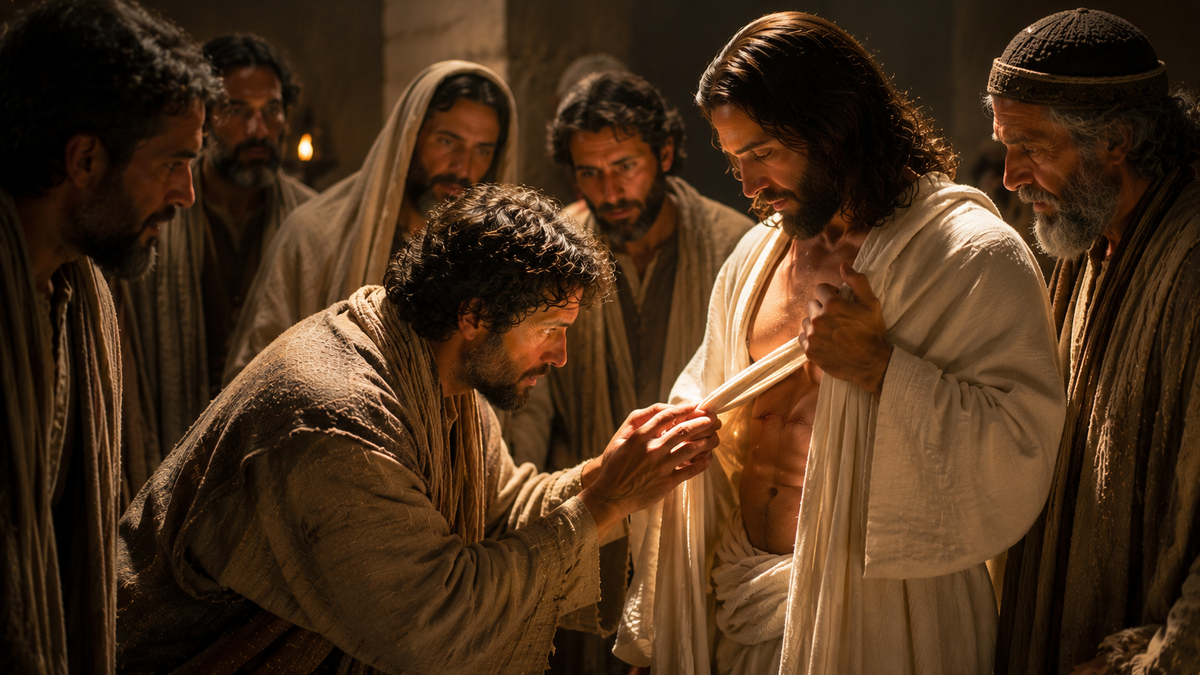
Eight days later the disciples are together again, and this time Thomas is with them. Jesus comes despite the locked doors, speaks peace, and addresses Thomas directly. He tells him to see his hands and to reach out toward his side, answering with remarkable precision the very demands Thomas had made in his absence. John does not actually tell us whether Thomas touches the wounds. Christian art and preaching have often pictured that moment, but the Gospel moves immediately from Christ’s invitation to Thomas’s confession.
The emphasis falls not upon Thomas completing an investigation but upon Christ confronting him with the reality of the Resurrection. The wounded Jesus standing before him is the same Jesus who was crucified, and yet he lives. Thomas had insisted upon the wounds because he would not accept a resurrection detached from the crucified body of his Lord. Christ now meets him as the crucified and risen one and summons him out of unbelief into faith.
“My Lord and My God”
Thomas answers Jesus, “My Lord and my God!” (John 20:28, ESV) These words stand among the theological high points of John’s Gospel because they gather into one personal confession what the Evangelist has been revealing from the beginning. John opened his Gospel by declaring, “In the beginning was the Word, and the Word was with God, and the Word was God.” (John 1:1, ESV) Near the Gospel’s conclusion, Thomas addresses the risen Jesus directly as Lord and God.
The confession is theological and personal at the same time. Thomas does not merely affirm a proposition about Jesus or concede that the Resurrection must have happened. He says, “My Lord and my God.” The disciple who had refused the testimony of the others has now been confronted by the crucified and risen Christ and responds with worshipful confession.
Thomas’s words matter not because they should be ranked competitively against every other confession in Scripture, but because of where John places them. The Gospel that begins by identifying the eternal Word as God brings one of its final great scenes to an apostle addressing Jesus as God. Thomas’s confession therefore gathers John’s Christology into the speech of a man whom Christ has brought from refusal into faith.
That movement is the real heart of Thomas’s story. The story does not celebrate a man who demanded evidence and was proven intellectually correct to do so. It celebrates the mercy and power of the risen Christ who comes to an unbelieving disciple and brings him to confession. Thomas’s final word is not unless. It is my Lord and my God.
Blessed Are Those Who Have Not Seen
Jesus responds, “Have you believed because you have seen me? Blessed are those who have not seen and yet have believed.” (John 20:29, ESV) The words turn the scene beyond Thomas toward the generations of Christians who will come after the original apostolic witnesses. John then immediately explains why his Gospel has been written: Jesus did many other signs in the presence of the disciples, “but these are written so that you may believe that Jesus is the Christ, the Son of God.” (John 20:31, ESV)
The sequence matters because Christians who have not seen the risen Lord as Thomas saw him are not commanded to believe without testimony. They are given the testimony of those who did see. The Resurrection is proclaimed by eyewitnesses, and God has preserved that apostolic testimony in Holy Scripture so that those who have not seen may nevertheless believe. Christian faith is therefore neither blind credulity nor a demand that every generation repeat the apostles’ Easter experience.
Thomas stands on both sides of that transition. At first he refuses the testimony of the other apostles because he insists upon seeing for himself. After seeing Christ, however, he becomes part of the apostolic company whose testimony is given to those who will not see in the same way. There is a beautiful reversal here: the man who once insisted that another person’s testimony was insufficient becomes one of the witnesses through whose testimony later Christians are called to believe.
That is why Thomas should not finally be remembered as the apostle of doubt. His doubt belongs to his story, but it does not define his apostolic vocation. Christ brings him through unbelief into confession and then sends him with the others as a witness to the Resurrection. The Thomas whom the Church remembers is not merely the man who said unless I see. He is the apostle who came to say my Lord and my God.
The Appointed Readings
The BCP appoints Habakkuk 2:1–4, Psalm 126, Hebrews 10:35–11:1, and John 20:19–29 for Saint Thomas. Together they place his story within the wider biblical themes of waiting, endurance, faith, restoration, and confidence in the promises of God. The readings are particularly fitting in Advent, when the Church is living by promises already given while waiting for their final fulfillment at Christ’s return.
Habakkuk begins at his watchpost. The prophet has brought difficult questions before God and now waits for God to answer: “I will take my stand at my watchpost and station myself on the tower, and look out to see what he will say to me.” (Habakkuk 2:1, ESV) God’s response includes the declaration, “the righteous shall live by his faith.” (Habakkuk 2:4, ESV) The connection with Thomas should not be forced into an exact parallel, because Habakkuk waits faithfully upon God’s Word while Thomas initially refuses the apostolic testimony given to him. What unites the texts is the truth that life rests not upon immediate sight but upon trust in what God has spoken.
Psalm 126 gives the Holy Day another register. It remembers a restoration so astonishing that it seemed like a dream and declares that those who sow in tears will reap with shouts of joy. Scripture does not tell us that Thomas spent the eight days between the appearances of Christ weeping, so we should not invent an emotional biography for him. Yet the Psalm’s movement from sorrow toward joy belongs naturally beside Easter, where grief over the crucified Lord gives way to the proclamation that he is risen.
Hebrews 10:35–11:1 then brings faith and endurance into direct focus. Christians are told not to throw away their confidence but to endure so that they may receive what God has promised, and the passage culminates in the familiar declaration, “Now faith is the assurance of things hoped for, the conviction of things not seen.” (Hebrews 11:1, ESV)Thomas believes after seeing. The Church receives the apostolic witness and is called to trust the risen Christ whom she does not presently see with bodily eyes.
The readings therefore do not turn Thomas into a symbol of skepticism. They place his story within the life of faith, where God speaks, promises, restores, and calls his people to trust him. What Thomas was permitted to see becomes part of the testimony through which later Christians live by faith while awaiting sight.
The BCP Collect and Preface
The BCP Collect gives the Holy Day its theological center: “Everliving God, you strengthened your apostle Thomas with firm and certain faith in your Son’s resurrection: Grant us so perfectly and without doubt to believe in Jesus Christ, our Lord and our God, that our faith may never be found wanting in your sight.” (BCP 2019, p. 624) The subject of the opening clause is God. God strengthened Thomas.
That order matters because the Collect refuses two opposite mistakes. It does not celebrate Thomas’s unbelief as though doubt itself produced mature faith, and it does not present faith as something Thomas eventually manufactured by an act of will. The Everliving God brings him from unbelief to firm and certain faith in the risen Son. Grace is not merely the reward awaiting Thomas after he finally gets his thinking straight. Grace is the divine action by which Christ comes to him and brings him to confession.
The title Everliving God is especially fitting for a Holy Day centered upon the Resurrection. The living God gives faith in the living Christ, and the Collect then takes Thomas’s confession and places it upon the lips of the Church: Jesus Christ is “our Lord and our God.” What was once the climactic confession of one apostle becomes the confession for which the whole Church prays. The Collect does not ask merely that we understand Thomas but that the God who strengthened him would strengthen us.
The petition is searching because the Church asks to believe “so perfectly and without doubt” that faith may never be found wanting in God’s sight. Faith can be weak, assailed, fearful, confused, and tempted toward unbelief, but the prayer directs Christians neither inward toward their ability to manufacture certainty nor outward toward doubt as a permanent identity. It directs us toward the Everliving God who strengthened Thomas and who alone can sustain the faith he gives.
The Preface of Apostles completes that movement. At the Eucharist the Church gives thanks through Jesus Christ, the great Shepherd of the flock, who after his Resurrection sent forth his apostles to preach the Gospel and teach all nations and promised to remain with them to the end of the ages. Thomas therefore does not remain forever in the locked room contemplating his own spiritual journey. The risen Christ who brings him to confession is the Lord who sends his apostles into the world.
Questions, Doubt, and the Mercy of Christ
Thomas’s Holy Day speaks naturally to Christians who struggle with questions, uncertainty, and doubt, but its pastoral usefulness depends upon telling the whole story. One error is to make Thomas the patron saint of skepticism, as though his greatness consisted in refusing to believe what others told him. The Gospel will not sustain that reading. Jesus does not congratulate Thomas for demanding proof; he commands him to move from unbelief into faith and pronounces blessed those who have not seen and yet have believed.
The opposite error is to use Thomas merely as a warning and miss the extraordinary patience of Christ. Jesus does not abandon him. Eight days later Thomas is still among the disciples, and the risen Lord comes again. Christ knows precisely what Thomas has said and addresses the weakness of his faith directly, not to confirm him in unbelief but to bring him out of it.
There are Christians who know what it is to sit among people who seem to possess a confidence they themselves do not presently feel. One person can say without hesitation that God is good while another struggles to reconcile that confession with grief, disappointment, unanswered prayer, intellectual difficulty, betrayal, or a darkness that has not yet lifted. Thomas’s story does not tell such Christians to cherish the darkness, and it does not promise that every question will receive the kind of visible answer Thomas received. It does tell them that their struggle does not place them beyond the reach of Christ.
Thomas is still with the disciples when Jesus comes again. That fact should not be turned into a formula, but it carries genuine pastoral wisdom. A Christian whose faith is under strain should not be encouraged toward isolation as though all uncertainty must be resolved privately before returning to the Church. The fellowship in which the apostolic Gospel is read, preached, prayed, confessed, and received remains precisely where the struggling disciple belongs.
Yet Thomas’s story has a destination. Christ does not meet him merely to affirm him exactly where he is. He brings him from “I will never believe” to “My Lord and my God.” Christian pastoral care should therefore make room for honest questions precisely because it hopes and prays for movement toward deeper trust in Jesus Christ. Mercy receives the struggling disciple, but mercy also leads him toward faith.
Thomas in Christian Tradition
Among the later traditions associated with the Twelve, the connection between Thomas and India is one of the oldest and most enduring. The Saint Thomas Christians of India have long traced their apostolic origins to Thomas, traditionally associating his mission with the Malabar Coast and his martyrdom with the region of present-day Chennai. These traditions are not recorded in the New Testament, but they belong deeply to the Christian memory of India and should not be dismissed casually.
The ancient Acts of Thomas, composed in the Syriac Christian world in the early centuries of the Church, also associates Thomas with mission toward India. The work contains legendary and theological material and cannot simply be read as straightforward apostolic biography, so it does not allow us to reconstruct Thomas’s travels with certainty. Its existence does show, however, that an association between Thomas and Christianity east of the Roman world is very old, and that connection became deeply rooted in Syriac and Indian Christian tradition.
The Saint Thomas Christian communities themselves possess ancient roots in India and have preserved Thomas as their apostolic father across many centuries. The exact route, chronology, churches founded, and circumstances of his ministry cannot be established with the confidence available for the events recorded in John’s Gospel. Later tradition places his martyrdom near Mylapore and commonly associates his death with a spear, but Scripture tells us neither where he finally preached nor how he died. These details are therefore best received as inherited Christian tradition rather than biblical certainty.
The broad memory nevertheless has a remarkable theological fittingness. The disciple who once refused to believe the Resurrection through the testimony of others became remembered as an apostle who carried testimony to that Resurrection far beyond the land where he had seen the risen Christ. Whether every detail of the traditional itinerary can be established or not, the Church’s memory of Thomas does not leave him in the locked room. It remembers him as an apostle sent outward with the Gospel.
Saint Thomas in Advent
Saint Thomas falls on December 21, in the final days of Advent, when the Church’s expectation has become especially intense. The placement gives his story a natural resonance with a season devoted to waiting for the coming Lord, but the analogy must be handled carefully. Advent is not a reenactment of Thomas’s eight days after Easter, and his refusal of apostolic testimony should not be turned into a model of ideal Christian waiting. The Church waits in Advent precisely because God has spoken and because Christ has already come, died, risen, ascended, and promised to come again.
Thomas nevertheless knows something of living between proclamation and sight. The other disciples tell him that they have seen the Lord, while he has not yet seen him for himself. Christians now stand in a different but related position: we receive the apostolic witness to Christ’s Resurrection, confess that he reigns at the Father’s right hand, and await the day when the Lord whom we presently know by faith will appear in glory. We believe the Resurrection while still waiting for the resurrection of the dead.
That makes Thomas particularly fitting in Advent not because doubt is the essence of Christian waiting but because faith lives by the Word of God while awaiting sight. Thomas saw and believed; the Church receives his testimony and hears Christ’s blessing upon those who have not seen and yet believe. Advent reminds us that faith is not the final state of Christian existence. We are waiting for the day when Christ appears, the dead are raised, and what is presently confessed by faith is openly revealed.
Near the darkest days of the year, Thomas therefore points beyond darkness toward sight. The Church does not pretend that every difficulty has already disappeared or that Christians never struggle to believe. She confesses instead that the Lord who came in humility and rose bodily from the dead will come again in glory. Thomas’s confession becomes an Advent confession: the one for whom the Church waits is our Lord and our God.
Saint Thomas in Anglican Worship
Red is customarily used for Saint Thomas in Anglican worship, fitting the remembrance of an Apostle sent to bear costly witness to the crucified and risen Lord. Later tradition remembers Thomas as a martyr, but the fittingness of red does not require treating every detail of that tradition as established history. The color belongs naturally with apostolic witness, mission, and the willingness to confess Christ whatever the cost.
The Collect and Preface of Apostles together give Anglican worship a remarkably balanced interpretation of Thomas. The Collect does not make doubt the theme of the Holy Day but asks for firm and certain faith, while the Preface places Thomas within the mission of the risen Christ. He is therefore not commemorated primarily because he once doubted. He is remembered because the Everliving God strengthened him to believe, because he confessed Jesus Christ as Lord and God, and because he belonged to the apostolic company sent to proclaim the Gospel.
This is why the traditional label “Doubting Thomas,” though understandable, is inadequate as the final summary of his life. Scripture does not end his story with an adjective attached to his failure. It ends the great Resurrection scene with confession, blessing, and apostolic testimony. The Church honors Thomas most faithfully by allowing Christ’s grace, rather than Thomas’s unbelief, to have the final word.
Observing This Holy Day
Saint Thomas the Apostle is observed on December 21 during Advent. The Collect is found on page 624 of the BCP 2019, the Preface of Apostles is appointed, and the readings are Habakkuk 2:1–4, Psalm 126, Hebrews 10:35–11:1, and John 20:19–29. Red is customarily used in Anglican worship. Because December 21 always falls within Advent, the Prayer Book’s ordinary calendar rules govern any coincidence with an Advent Sunday rather than the Holy Day automatically replacing the Sunday.
Begin with John 20:19–29 and read both appearances of the risen Christ together. Notice what the disciples receive while Thomas is absent, the strength of his refusal, Christ’s direct response eight days later, and the confession to which Thomas is brought. The point is neither to shame a disciple who struggles nor to turn unbelief into a virtue. The point is to watch the risen Christ bring a disciple from refusal into faith.
Then read John 11:16 and John 14:1–7 so that the Resurrection scene is not allowed to consume Thomas’s entire biblical identity. Remember the man who followed Jesus toward danger and the disciple whose honest question received the answer, “I am the way, and the truth, and the life.” Read Habakkuk 2:1–4 and Hebrews 10:35–11:1 alongside the Gospel, allowing their call to waiting, confidence, endurance, and faith to interpret Christian life between promise and sight.
The Holy Day also offers a fitting occasion to bring difficult questions before Christ. Some questions arise because we genuinely do not understand, others grow from grief, fear, disappointment, intellectual difficulty, or painful experience, and still others may become ways of postponing obedience to something Christ has already made clear. Thomas’s story does not require us to pretend that every doubt has the same source. It asks where our questions are taking us and whether we are bringing them toward Christ or using them to remain indefinitely at a distance.
Pray the Collect with that in mind. Ask the Everliving God for the firm and certain faith with which he strengthened Thomas, not for greater confidence in your own ability to believe. Ask for grace to confess Jesus Christ not merely as an object of religious interest, an admirable teacher, or even only as the risen Messiah, but with Thomas’s full confession: our Lord and our God. The destination of the Holy Day is not Thomas’s doubt. It is worship.
Conclusion
Saint Thomas the Apostle is remembered as a disciple whose story does not end with unbelief. John gives us a man willing to follow Jesus toward danger, willing to admit when he does not understand, and also genuinely unwilling to receive the testimony of the other apostles concerning the Resurrection. Christ does not leave him there. The risen Lord comes to Thomas, confronts his unbelief, and brings him to one of the clearest confessions in the Gospel: “My Lord and my God.”
The BCP Collect interprets that movement as grace. The Everliving God strengthened Thomas with firm and certain faith, and the Church therefore asks for the same gift. The Holy Day neither romanticizes skepticism nor despises the Christian whose faith is under strain. It directs both confidence and uncertainty away from ourselves and toward Jesus Christ, crucified, risen bodily from the dead, and proclaimed by the apostolic witnesses as Lord and God.
In the final days of Advent, Thomas reminds the Church that Christian faith is ultimately directed toward sight. The apostle was permitted to see the risen Christ and became part of the testimony through which those who have not seen are called blessed when they believe. We now live by that apostolic Word while waiting for the day when the Lord whom Thomas saw will appear in glory. Until then, the Church joins his confession and prays for grace to mean it ever more fully: Jesus Christ is our Lord and our God.