My Lord and My God: Thomas the Apostle (John 20:19-29)
Feast of Saint Thomas, December 21. He is remembered as the doubter. But he also said let us go, that we may die with him. He asked the question that produced I am the way. And when the risen Lord appeared, Thomas gave the highest confession in John’s Gospel: My Lord and my God.
December 22, 2025, Feast of Saint Thomas the Apostle, Season of Advent
John 20:19–29, Psalm 126, Habakkuk 2:1–4, Hebrews 10:35–11
Grace, mercy, and peace from God our Father and the Lord Jesus Christ be with you on this feast of Saint Thomas the Apostle.
The feast of Saint Thomas is appointed for December 21, the winter solstice: the shortest day and the longest night of the year. This year, December 21 falls on the Fourth Sunday of Advent, and since Advent Sundays take precedence over Red-Letter Holy Days by the rubrics of the BCP 2019, the feast is transferred to today, Monday December 22. We are in the fourth and final week of Advent, four days from Christmas. The liturgical calendar has given us one more day of waiting before the Word becomes flesh. And it has given us, on that day, the feast of the apostle who waited in the dark longer than anyone else and arrived, through that darkness, at the highest confession in John’s Gospel.
Thomas is almost universally remembered as the doubter. That memory is not entirely wrong, but it is only the middle of his story. The Thomas of John’s Gospel is, from first appearance to last, an honest and searching man who refuses to offer what he does not have. It is a character worth tracing. The Thomas of John’s Gospel appears four times, and each appearance shows the same honest, searching character refusing to offer what he does not have. The first time is in John 11:16, when Jesus announces his intention to return to Judea to raise Lazarus despite the threat to his life. The other disciples are uncertain and afraid. Thomas speaks for all of them: “Let us also go, that we may die with him.” (John 11:16, ESV) Whether we hear courage or resigned fatalism in that sentence, we hear honesty. Thomas does not pretend the danger away. The second time is in John 14:5, in the Upper Room, when Jesus speaks of preparing a place and the disciples knowing the way. Thomas asks the question the others may have been too polite to voice: “Lord, we do not know where you are going. How can we know the way?” (John 14:5, ESV) That honest question produces Christ’s greatest self-declaration: “I am the way, and the truth, and the life.” (John 14:6, ESV) Thomas’s willingness to admit what he does not know unlocks one of the most important things Jesus ever says. Honesty, in John’s Gospel, tends to do that.
Our Gospel passage is John 20:19–29. We are on the evening of Easter Sunday. The disciples are gathered behind locked doors for fear of the authorities. And Jesus comes and stands among them. The locked doors are not a problem. He shows them his hands and his side, and the disciples rejoice. He commissions them: as the Father sent me, so I send you. He breathes on them and says: receive the Holy Spirit. This is John’s account of the commission and the gift that the other Gospels place at Pentecost; John holds both events, but he frames the giving of the Spirit as the breath of the risen Christ on Easter evening. Ten of the disciples receive this that night. But verse 24 gives us the detail on which the whole feast turns: Thomas, called the Twin, in Greek Didymos (DID-ee-mos), was not with them when Jesus came.
He was absent for the appearance. We are not told why. John does not speculate. What we are told is that when the other disciples find him and say “We have seen the Lord,” Thomas sets a condition: “Unless I see in his hands the mark of the nails, and place my finger into the mark of the nails, and place my hand into his side, I will never believe.” (John 20:25, ESV) We should be careful not to judge Thomas too quickly here. What is he asking for? Exactly what the others received: to see the risen Lord. He is not asking for more than his fellow disciples were given. He is asking for the same thing. He wants the same embodied evidence the others received; he simply was not in the room when the Lord came. Thomas is not asking for proof instead of faith; he is asking for the risen Lord to meet him in the same way he met the others, and Jesus does exactly that. The problem is not the nature of his request but the timing: the Lord has come and gone, and Thomas was not there. He is holding his position in the dark while the others are already in the light. That is the shape of his suffering. Not disbelief exactly, but the anguish of the one who has not yet received what everyone around him already has.
Eight days passed. That is the detail John gives us, and it is not a small detail. Eight days is a long time to hold a position of honest waiting while the community around you has already received what you asked for and cannot stop talking about it. The other disciples were glad. They had seen the Lord. Thomas had not. He was in the room with people who had been given a joy he had not yet been given, and he held his ground. He did not pretend. He did not borrow their joy. He did not perform a faith he had not yet arrived at. He waited.
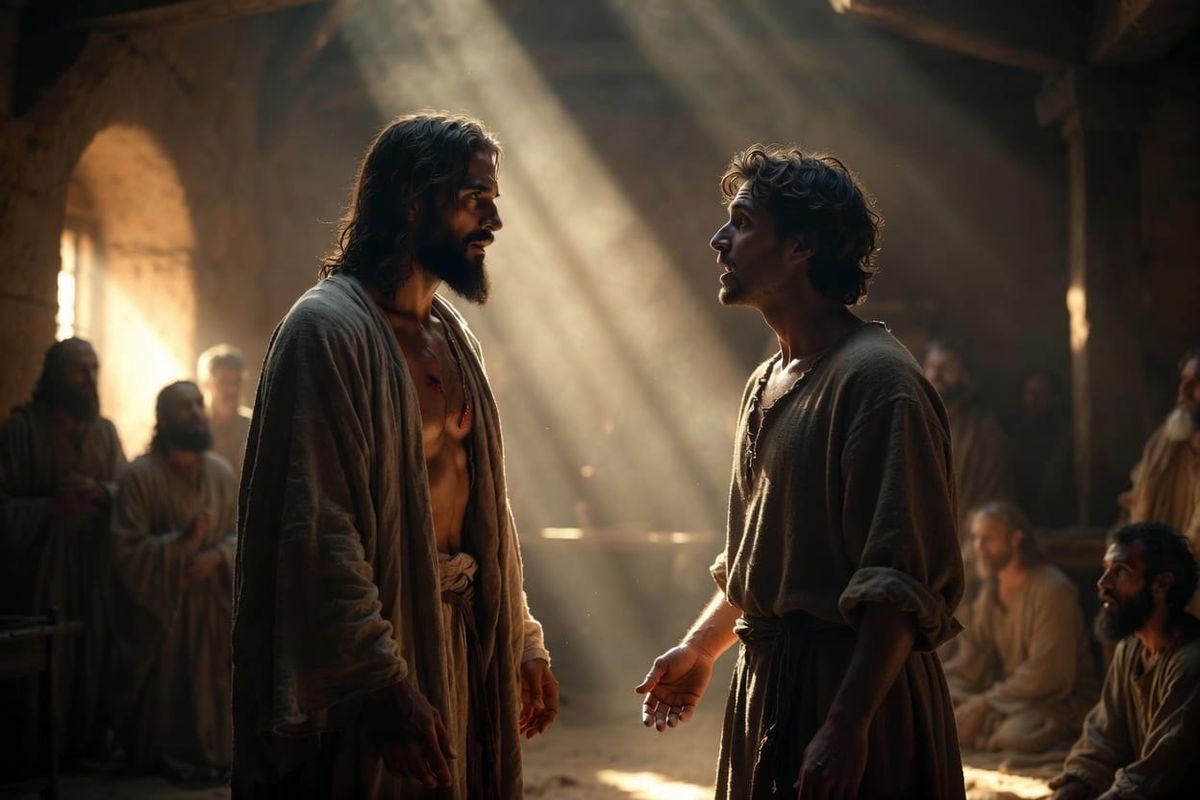
Eight days later, Jesus comes again. The doors are locked again. And this time Thomas is there. Jesus addresses him directly, before Thomas has said a word: “Put your finger here, and see my hands; and put out your hand, and place it in my side. Do not disbelieve, but believe.” (John 20:27, ESV) The risen Christ knew exactly what Thomas had said, and he offers precisely what Thomas demanded. He meets him where he is. And Thomas, faced with the one who knows his doubt and came to answer it in person, does not reach out to touch. He simply speaks: “My Lord and my God!” (John 20:28, ESV) Four words. The highest Christological confession in the entire Gospel of John. The Gospel opens in its prologue: “In the beginning was the Word, and the Word was with God, and the Word was God.” (John 1:1, ESV) Twenty chapters later, a man who has been in the dark for eight days looks at the risen Christ and says: my Lord and my God. The Gospel’s opening declaration of who Jesus is and the final apostle’s confession of who Jesus is are the same statement. Thomas took the long road to that confession. But he arrived at the destination.
Two words deserve particular attention in Thomas’s confession: the word my, which appears twice. My Lord and my God. Not: the Lord and the God, as a theological proposition. Not: a lord and a god, as one option among others. My Lord. My God. The confession is personal before it is dogmatic. Thomas is not first of all offering a theological formula. He is declaring a relationship. The one standing before him, who knows his demand and came to meet it, who has hands with nail marks and a side with a wound, who died and was buried and is now here: this one is his Lord and his God. The personal pronoun is the most important word in the confession. It is the word that will carry Thomas all the way to India.
Notice what Jesus says in verse 29 in response: “Have you believed because you have seen me? Blessed are those who have not seen and yet have believed.” (John 20:29, ESV) This verse is not a rebuke of Thomas. It is the extension of Thomas’s confession to every subsequent generation of the Church. Thomas saw. We have not seen. But we believe on the testimony of the man who did. John closes his Gospel just two verses later by saying he has written these things “so that you may believe that Jesus is the Christ, the Son of God, and that by believing you may have life in his name.” (John 20:31, ESV) Thomas is not the last person in John’s Gospel to believe. He is the last person in John’s Gospel to see. Everyone after him believes on his word. The doubter becomes the ground of our faith.
We are the people of John 20:29. We did not see the risen Christ in an upper room. We were not there when the doors opened and he appeared. We did not hear the words “Peace be with you” spoken in that locked room. What we have is the testimony of those who were there, preserved in the Gospel that John wrote so that we may believe. Thomas is the last person in that chain who saw with his own eyes. John 20:29 is the moment the Gospel turns from the eyewitnesses to the rest of us. The blessing Jesus pronounces over those who have not seen and yet believe is the blessing that covers every generation since the first Easter. We receive it, as we receive the collect’s petition for perfect and undoubting faith, knowing that the faith we are asking for is grounded in the testimony of the man who saw.
Our Old Testament reading from Habakkuk 2 places Thomas in a long prophetic tradition of those who hold their position in the dark and wait for the Lord to answer. The prophet writes: “I will take my stand at my watchpost and station myself on the tower, and look out to see what he will say to me.” (Habakkuk 2:1, ESV) Habakkuk is not passive. He is not drifting or collapsing. He is standing at his post, watching, holding his ground, demanding that God respond to a world in which the wicked seem to prosper and the faithful seem to lose. And the answer comes: “the righteous shall live by his faith.” (Habakkuk 2:4, ESV) Thomas stood at his watchtower. He set his condition and he held it. He did not pretend to believe what he had not received. And when the answer came, it exceeded everything he had demanded. The righteous shall live by faith, and Thomas’s faith, forged in the eight days of darkness after Easter, became the faith by which he lived and died.
Psalm 126, which we prayed together this morning, gives us the emotional arc of Thomas’s whole experience. It begins as the psalm of those who can hardly believe their own restoration: “When the Lord overturned the captivity of Zion, we were like those who dream.” (Psalm 126:1, ESV) And it closes with the agricultural image that the whole feast wants us to hold: “Those who sow in tears shall reap with shouts of joy! He who goes out weeping, bearing the seed for sowing, shall come home with shouts of joy, bringing his sheaves with him.” (Psalm 126:5–6, ESV) Thomas sowed in tears for eight days. He went through the dark carrying the seed of his honest demand, refusing to set it down or pretend it was something other than what it was. And then the Lord came and met him, and he came home with sheaves: my Lord and my God. The psalm was appointed for this feast deliberately. It knows exactly what kind of journey Thomas made.
Our Epistle from Hebrews 10 and 11 turns Thomas’s story into an exhortation for us. The writer says: “Therefore do not throw away your confidence, which has a great reward. For you have need of endurance, so that when you have done the will of God you may receive what is promised.” (Hebrews 10:35–36, ESV) Do not throw away your confidence. Thomas did not throw away his confidence. He set his terms and held them, and the Lord answered them. And then comes the definition that has shaped the Church’s understanding of faith ever since: “Now faith is the assurance of things hoped for, the conviction of things not seen.” (Hebrews 11:1, ESV) The Greek word translated assurance is hypostasis (hoo-POS-ta-sis): literally the substance or foundation underlying something, the solid reality beneath the surface. And conviction is elenchos (EH-len-khos): a legal term, the evidence that proves a case. Faith is not wishful thinking. It is the substance that grounds hope and the evidence that establishes what cannot be seen. Thomas saw the risen Christ. We have his testimony. That testimony is our elenchos, our evidence, the proof on which our faith rests.
The feast of Thomas has one more dimension that the calendar does not always make explicit. The tradition that Thomas carried the Gospel to India is ancient, widespread, and taken seriously by historians. The church he founded, the St. Thomas Christians of Kerala, traces its origin to his arrival on the Malabar Coast around 52 AD. If the tradition is accurate, Thomas’s missionary journey was among the most geographically ambitious of any of the Twelve, reaching the Indian subcontinent decades before anyone else. He was martyred near Chennai around 72 AD, killed by a spear while at prayer. The man who demanded to touch the wounds of the risen Christ died by the same kind of wound he once demanded to see. The vibrant Saint Thomas Christian communities of Kerala, the Syro-Malabar and Syro-Malankara Churches, still trace their bishops and their faith in an unbroken line back to him nearly two thousand years later. In Kerala, the feast of December 21 is not a minor calendar observance. It is the celebration of the father of their faith.
And here is where all four readings converge on the congregation in Advent 2025. We are in the dark. Not metaphorically, though Advent is the season of darkness and waiting. We are in the dark in the ordinary sense: the solstice has passed or is passing, the nights are long, Christmas is four days away, and many of us carry into this week something heavy: a grief that did not lift when the decorations went up, an illness that did not improve, a loneliness that the season makes worse rather than better. Thomas is the apostle for exactly this condition: the one who needs more than words, who finds himself in the dark while others seem already to be rejoicing, who cannot simply take the community’s word for the most important things. The feast does not tell him to pretend otherwise. It places him at his watchtower, as Habakkuk placed himself, and says: hold your position. The Lord knows what you have said. He will come to you. He met Thomas where Thomas was, and he will not do less for us.
Thomas is also the the apostle of those in ministry who have prayed over someone and watched them die anyway, who have preached the resurrection repeatedly and carried grief home afterward, who have stood at enough bedsides and gravesides that the words can start to feel too familiar to be fully believed. The collect does not require that we have arrived before we pray it. It asks us to pray toward the destination. Grant us so perfectly and without doubt to believe: the petition acknowledges that perfect undoubting faith is a thing to be received, not merely mustered. We pray it because we need it, not because we already have it. Thomas prayed the same thing with his body on Easter night when he was absent and on the eighth day when he was present and the Lord came anyway.
The collect for this feast prays that we might believe “so perfectly and without doubt” in Jesus Christ, our Lord and our God. That is the destination of Thomas’s road. It is not, notice, the absence of the journey. The collect does not pretend the eight days did not happen. It asks that we arrive where Thomas arrived: at the confession that no longer wavers, at the hypostasis that grounds everything, at the elenchos that has been established in the risen body of Christ and transmitted to us through the testimony of a man who saw what we have not seen and said what no one had yet said: my Lord and my God.
After December 21 the days begin to lengthen. It is almost imperceptible at first. The darkness is still extensive. But the turning has occurred. Thomas’s feast falls at the hinge between the longest night and the returning light, and that is not an accident. The apostle whose faith moved through darkness into light is celebrated at the moment when the dark is deepest and the light is about to return. Four days from now the Church celebrates the Nativity of the one Thomas called his Lord and his God. Thomas’s feast is the Church’s word to every Advent: the darkness is not the end of the story. It is the condition in which the Lord comes to find us, meets us where we are, and answers us. We are almost there. Hold your position. He is coming.
In the Name of the Father, and of the Son, and of the Holy Spirit. Amen.