The Nativity of Our Lord Jesus Christ (Christmas Day): An Anglican Perspective
The Nativity of Our Lord Jesus Christ (Christmas Day). Not a heartwarming story about a baby in a manger — the announcement that the eternal Word through whom all things were made became one of the things he made. The Word became flesh and pitched his tent among us. That is Christmas.
Principal Feast: December 25
The Anglican calendar is ordered by a hierarchy of holy days, each carrying a different weight of observance. At the very top sit the seven Principal Feasts — the highest days of the liturgical year, taking precedence over every other day or observance. They are Easter Day, Christmas Day, Ascension Day, the Day of Pentecost, All Saints’ Day, Trinity Sunday, and the Epiphany, listed on page 688 of the BCP 2019. Christmas Day stands in this company as the feast of the Incarnation — the moment the eternal Son of God took human flesh and was born of the Virgin Mary. It is, with Easter, one of the two great poles around which the entire Christian year turns.
The world that surrounds Christmas Day in December is loud, commercial, and often exhausting. The Church’s Christmas is quieter, more concentrated, and theologically far more radical than any cultural celebration. What the Nativity announces is not a heartwarming story about a baby in a manger. It is the announcement that the one by whom all things were made became one of the things he made — that the eternal Word, through whom the worlds were created, took on flesh that could be touched and held, that could feel hunger and cold and nails. Christmas is the feast of the most astonishing event in human history: God became man.
The Biblical Event
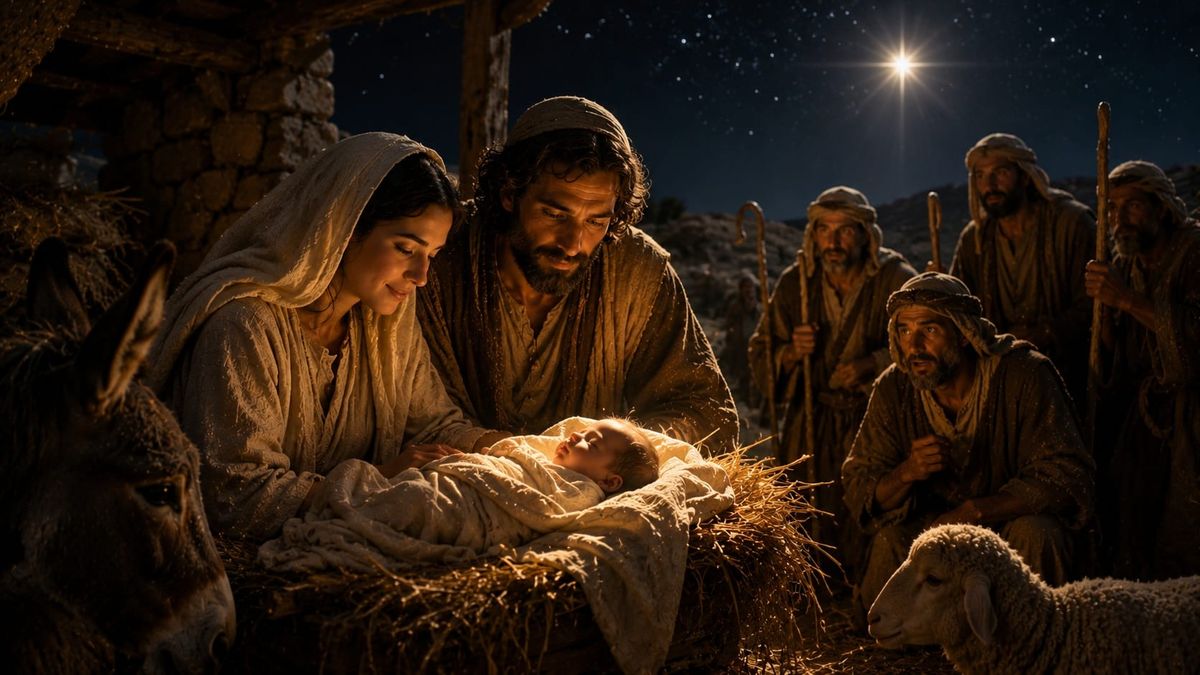
Luke 2:1–14 is the appointed Gospel for Christmas Day I and the most familiar account of the Nativity. Caesar Augustus has issued a decree that the whole world should be registered. Joseph and Mary travel from Nazareth to Bethlehem, the city of David, because Joseph is of the house and lineage of David. There, while they are there, the time comes for Mary to give birth: “And she gave birth to her firstborn son and wrapped him in swaddling cloths and laid him in a manger, because there was no place for them in the inn.” (Luke 2:7, ESV) Luke’s account is spare and unhurried. There is no drama at the moment of birth, no earthquake or supernatural sign at the manger. The Lord of heaven arrives in the most ordinary human way, in the most inconvenient of circumstances, in a place where animals are fed. The angels appear not to the powerful but to shepherds — men at the bottom of the social order, keeping their flocks in the fields — and the announcement they make is staggering in its contrast with the setting: “For unto you is born this day in the city of David a Savior, who is Christ the Lord.” (Luke 2:11, ESV) Christ the Lord. The title is deliberate. In the Roman world, Caesar was lord. The imperial decree that opened the passage sent Joseph and Mary to Bethlehem in the first place. And into that world, in a manger in a borrowed space, the one who is actually Lord is born.
John 1:1–18, appointed for Christmas Day III, gives the same event its full theological weight. John does not begin with a census or a journey. He begins at the beginning: “In the beginning was the Word, and the Word was with God, and the Word was God. He was in the beginning with God. All things were made through him, and without him was not any thing made that was made.” (John 1:1–3, ESV) The Word who was with God in the beginning, through whom all creation came into existence, is the one who became flesh in Bethlehem. Verse 14 is the hinge of the prologue and the theological center of the entire feast: “And the Word became flesh and dwelt among us, and we have seen his glory, glory as of the only Son from the Father, full of grace and truth.” (John 1:14, ESV) The Greek word for “dwelt” is eskēnosen — literally “tabernacled” or “pitched his tent.” The Word did not merely appear among us or visit us. He pitched his tent in the middle of our camp. He moved into the neighborhood. The one who filled the tabernacle with glory in Exodus 40 now fills a human body with that same glory.
The Three Masses of Christmas
Christmas Day is unique among the Principal Feasts in having three appointed sets of propers, found on page 718 of the BCP 2019. This ancient structure — called the Three Masses of Christmas in the Western liturgical tradition — reflects the inexhaustible richness of the Incarnation, which no single service can contain. Each set of propers illuminates a different dimension of the same mystery.
Christmas Day I, the midnight or early service, appoints Isaiah 9:1–7, Psalm 96, Titus 2:11–14, and Luke 2:1–14(15–20). Isaiah’s great prophetic announcement — “For to us a child is born, to us a son is given; and the government shall be upon his shoulder, and his name shall be called Wonderful Counselor, Mighty God, Everlasting Father, Prince of Peace” (Isaiah 9:6, ESV) — is fulfilled in the child in the manger. Titus 2:11–14 gives the theological summary: “For the grace of God has appeared, bringing salvation for all people.” (Titus 2:11, ESV) Psalm 96 is the great enthronement psalm — “sing to the Lord a new song” — proclaiming the Lord’s reign over all the earth. The first service of Christmas announces the birth as the appearance of grace and the inauguration of the reign of God.
Christmas Day II, the dawn service, appoints Isaiah 62:6–12, Psalm 97, Titus 3:4–7, and Luke 2:(1–14)15–20. The focus shifts to the shepherds returning, glorifying and praising God for what they have heard and seen. Titus 3:4–7 gives the soteriological heart: “But when the goodness and loving kindness of God our Savior appeared, he saved us, not because of works done by us in righteousness, but according to his own mercy.” (Titus 3:4–5, ESV) The dawn service carries the same note as the shepherds’ return: having encountered the child, we go out telling others what we have seen.
Christmas Day III, the principal daytime service, appoints Isaiah 52:7–12, Psalm 98, Hebrews 1:1–12, and John 1:1–18. This is the theological crown of the day. Hebrews 1 opens by proclaiming that God, having spoken in many ways through the prophets, has in these last days spoken through his Son — “through whom also he created the world. He is the radiance of the glory of God and the exact imprint of his nature.” (Hebrews 1:2–3, ESV) The prologue of John follows: the Word who was in the beginning, through whom all things were made, became flesh and pitched his tent among us. Isaiah 52:7—“how beautiful upon the mountains are the feet of him who brings good news” — is the herald’s cry fulfilled in the birth of the one who is himself the good news. The three sets of propers move from announcement to encounter to theological reflection, tracing the full arc from the shepherds’ field to the prologue of John.
The Theological Significance
The Incarnation is the most radical claim the Christian faith makes about God. It is not merely that God cares about human beings or that he sent a messenger. It is that the second person of the Trinity, the eternal Son through whom the universe was made, became a human being — fully and permanently. The early Church fought bitterly to protect this claim from two opposite errors: those who said Jesus was so divine he was not really human (Docetism), and those who said he was so human he was not really divine (Arianism in its various forms). The Nicene Creed, recited on Christmas Day, is the Church’s hard-won answer to both: “God of God, Light of Light, very God of very God, begotten not made, being of one substance with the Father… who for us and for our salvation came down from heaven, and was incarnate by the Holy Spirit and the Virgin Mary, and was made man.”
The stakes of this confession are soteriological. Gregory of Nazianzus stated the principle that shaped all subsequent Incarnation theology: what is not assumed is not healed. If the Son did not truly take on human flesh, human flesh is not redeemed. If he did not truly experience human life — birth, growth, hunger, suffering, death — then those dimensions of human existence are not sanctified by his presence within them. Christmas is the feast of the assumption of our humanity by the Son of God — the moment salvation became possible from the inside of the human condition rather than from the outside.
The preface names the purpose of the Incarnation with precision: he was made truly man that we might be cleansed from sin and given the right to become God’s children. The collect for Christmas Day speaks of those who have been born again and made God’s children by adoption and grace. The Incarnation makes possible a movement that runs in the opposite direction: the Son of God became human so that human beings might become children of God. Athanasius expressed this in the formula the Church has treasured ever since: “God became man so that man might become God.” He did not mean that human beings become divine in nature. He meant that they are given what only the Son possesses by right: the life and sonship of God, shared through grace with those who receive him.
The BCP 2019 Collect and Preface
The BCP 2019 appoints the following collect for Christmas Day on page 600: “Almighty God, you have given your only-begotten Son to take our nature upon him, and to be born [this day] of a pure virgin: Grant that we, who have been born again and made your children by adoption and grace, may daily be renewed by your Holy Spirit; through Jesus Christ our Lord, to whom with you and the same Spirit be honor and glory, now and for ever. Amen.” The collect holds the Incarnation and the new birth together as two sides of the same gift. God gave his Son to take our nature upon him — that is Christmas. The result is that we have been born again and made God’s children by adoption and grace — that is the Church’s life in every generation. The petition asks not for a feeling appropriate to the season but for daily renewal by the Holy Spirit. Christmas is not a moment to be experienced once a year. It is the ground of a daily reality.
A second collect is appointed for Christmas Eve on page 599: “O God, you have caused this holy night to shine with the brightness of the true Light: Grant that we, who have known the mystery of that Light on earth, may also enjoy him perfectly in heaven; where with you and the Holy Spirit he lives and reigns, one God, in glory everlasting. Amen.” The Christmas Eve collect frames the night of the Nativity as the shining of the true Light — an echo of John 1:9, “The true light, which gives light to everyone, was coming into the world.” (John 1:9, ESV) The petition looks forward: having known this mystery on earth, may we enjoy him perfectly in heaven. Christmas begins a journey that ends in glory.
The Preface of Christmas, found on page 152 of the BCP 2019, is used at the Eucharist throughout the Christmas season from December 25 through the First Sunday of Christmas: “Because you gave Jesus Christ, your only Son, to be born for us; who, by the Holy Spirit and the Virgin Mary his mother, was made truly man, yet without the stain of sin, that we might be cleansed from sin and given the right to become your children.” (BCP 2019, p. 152) The preface is the theology of the feast in miniature. He was born for us. He was made truly man — not apparently man, not partly man, but truly and completely man. He was made man without the stain of sin — not untouched by our condition, but uncontaminated by the corruption of our nature. And the purpose: that we might be cleansed from sin and given the right to become God’s children. Every word of this preface bears weight.
Christmas in Anglican Worship
Christmas Day has been observed in the Church of England since the earliest period of English Christianity and was retained through the Reformation as a Principal Feast. Cranmer’s first BCP of 1549 provided propers for Christmas and the Christmas season that have shaped Anglican worship ever since. The BCP 2019 maintains this tradition with full solemnity: three sets of propers, two collects, and the Preface of Christmas used throughout the season.
The season of Christmas, properly understood, begins on December 25 and runs for twelve days through January 5, ending on the eve of the Epiphany. This is the liturgical Christmas — not the cultural Christmas that precedes it but the Church’s sustained celebration that follows it. January 5 is the Twelfth Day of Christmas, and January 6 — the Epiphany — is the feast that crowns the entire Incarnation cycle, when the child born in Bethlehem is revealed to the nations. The twelve days are a period of continuous feast, no fasting, the Christmas collect and preface used at every Eucharist. The Epiphany is not an addition to Christmas but its culmination — the feast toward which the twelve days have been moving.
White vestments are worn throughout the Christmas season, the color of purity and feasting. The crêche — the nativity scene — has been a feature of Christian worship since Francis of Assisi popularized it in the thirteenth century, and it remains a visual catechism for the feast: the child in the manger, the mother, the shepherds, the cattle, the star above. What it teaches without a word is the humility of the Incarnation — that the one by whom all things were made entered his own creation in poverty, anonymity, and helplessness, placed in a feeding trough because there was no room for him elsewhere. The crêche is the preface made visible. The Eucharist on Christmas Day is the central act of Anglican Christmas worship — the gathering of the Church to receive in bread and wine the one whose birth is announced in the readings, to taste and see that the Lord is good.
Observing This Feast
As a Principal Feast, Christmas Day takes absolute precedence. It always falls on December 25 and requires no transfer. When December 25 falls on a Sunday, the next Sunday is either the Second Sunday of Christmas or the Circumcision and Holy Name of Our Lord Jesus Christ, depending on the year. The collect and propers for Christmas Day also serve for any weekdays between Holy Innocents’ Day (December 28) and the First Sunday of Christmas, per the rubric on page 600 of the BCP 2019.
To observe the feast fully: attend the Christmas Eve or midnight service and pray the Christmas Eve collect from BCP 2019, p. 599. On Christmas morning, pray the Christmas Day collect from p. 600. Read Luke 2:1–20 slowly — all of it, including the shepherds’ return — and notice the ordinariness of the setting against the magnitude of the announcement. Read John 1:1–18 as the prologue that interprets the manger: the Word who was in the beginning became the child who was wrapped in swaddling cloths. Read Hebrews 1:1–3 and hear the Son described as the radiance of the glory of God and the exact imprint of his nature. Recite the Nicene Creed as a confession of what the feast means: God of God, Light of Light, very God of very God, who for us and for our salvation was incarnate by the Holy Spirit and the Virgin Mary, and was made man. Let the twelve days that follow be the Church’s Christmas — the sustained feast that the world does not observe but the liturgical year does.
Conclusion
The Nativity of Our Lord Jesus Christ is the feast of the most astonishing event the universe has ever witnessed: the eternal Son of God, through whom all things were made, became one of the things he made. He was born of the Virgin Mary, wrapped in cloths, laid in a manger, announced by angels to shepherds. He was truly man — not God wearing a human costume, but God inhabiting human flesh, living a human life from the inside so that human life could be redeemed from the inside.
The collect prays that we who have been born again and made God’s children by adoption and grace would be daily renewed by the Holy Spirit. The preface announces that he was made truly man so that we might become God’s children. These two sentences are the whole of Christmas in miniature: the Son of God descended to our level so that we could be raised to his. The Word became flesh and pitched his tent among us. “And we have seen his glory, glory as of the only Son from the Father, full of grace and truth.” (John 1:14, ESV)