Pray Earnestly to the Lord of the Harvest (Matthew 9:35-10:15)
The harvest is plentiful, the laborers are few — so Jesus tells them to pray first. And they were praying for themselves without knowing it. This is how God works: the prayer for laborers equips the people praying to become them.
June 14, 2026, Year A, Proper 6, Third Sunday after Pentecost
Matthew 9:35–10:15, Psalm 100, Exodus 19:1–8
Grace, mercy, and peace from God our Father and the Lord Jesus Christ be with you on this third Sunday after Pentecost.
It is good to be back with you. We had a great time on our vacation. I trust all went well while we were gone.
The Church has had quite the season the last few weeks. Pentecost. Trinity Sunday. And just this past Thursday, the feast of Saint Barnabas the Apostle, the Son of Encouragement, the man who vouched for Paul when no one else would, the man whose appointed Gospel for his feast day is precisely Matthew 10:7–16, the very passage we are stepping into this morning. The calendar has been preparing us for today. The harvest theme has been in the air all week.
This morning we begin what I am calling Movement I of our summer journey through Matthew’s Gospel. The lectionary for the Season after Pentecost in Year A takes us straight through Matthew from chapter 9 all the way to chapter 25. That is the whole teaching ministry of Jesus, the five great discourses that echo the five books of Moses, presenting Jesus as the new Moses who fulfills and surpasses the Torah, the conflicts with the Pharisees, the parables of the Kingdom, the journey to Jerusalem. For the next several months, Matthew is our companion. And today we begin at a pivotal moment: the end of chapter 9 and the opening of chapter 10, which Matthew scholars call the Mission Discourse.
Before we get there, I want to anchor the whole morning in the reading from Exodus. Exodus 19:1–8. Israel has arrived at Sinai. They have crossed the sea. They have eaten the manna. They have drunk the water from the rock. And now they are at the mountain, and God speaks to Moses, and what he says is the vocational identity of the people of God from that moment to this one. He says: “You yourselves have seen what I did to the Egyptians, and how I bore you on eagles’ wings and brought you to myself. Now therefore, if you will indeed obey my voice and keep my covenant, you shall be my treasured possession among all peoples, for all the earth is mine; and you shall be to me a kingdom of priests and a holy nation.” (Exodus 19:4–6, ESV)
Just as Israel stood at Sinai and received her vocation, so the Twelve now stand with Jesus, the new Moses, and receive theirs. Jesus has already gone up on the mountain to teach (the Sermon on the Mount) and now, like Moses at Sinai, he commissions his people for their priestly mission in the world. This is no accident. Matthew wants us to see Jesus as the one who fulfills Israel’s calling and then extends it to his disciples, and ultimately to the Church.
A kingdom of priests. That phrase is the key. What does a priest do? A priest mediates between God and the people. A priest stands in the gap. A priest carries the name and the word and the blessing of God to those who need it. And God says: Israel, that is what you are. You are not merely a nation among nations. You are a sent people. You are a priestly kingdom. Your existence in the world has a purpose beyond yourselves.
So, let’s start Matthew in 9:35. “And Jesus went throughout all the cities and villages, teaching in their synagogues and proclaiming the gospel of the kingdom and healing every disease and every affliction.” (Matthew 9:35, ESV) This verse is Matthew’s summary of everything that has happened in chapters 5 through 9, the Sermon on the Mount, the healing narratives, the miracles of restoration. Three things: teaching, proclaiming, healing. And what drives it all? Verse 36: “when he saw the crowds, he had compassion for them, because they were harassed and helpless, like sheep without a shepherd.” (Matthew 9:36, ESV)
That phrase, harassed and helpless, like sheep without a shepherd, is almost certainly meant to make us think of Ezekiel 34, where God indicts the shepherds of Israel for precisely this failure. Ezekiel 34:5: “So they were scattered, because there was no shepherd, and they became food for all the wild beasts.” (Ezekiel 34:5, ESV) The religious leadership of Israel in Jesus’ day has, like the shepherds of Ezekiel’s day, failed the sheep. They have made the Torah a burden rather than a blessing. They have protected their own position rather than serving the people.
And Jesus looks at the crowd and feels, in his gut, the Greek word for compassion is splagchnizomai (pronounced splagk-NIZ-oh-my), a visceral word, a word from the depths of the body that speaks of a compassion so deep it moves the inner organs; he feels the weight of their lostness. This is the same word used elsewhere for Jesus’ compassion before he feeds the multitudes and heals the sick. It is divine compassion breaking into the world through a human heart. Jesus does not look at the crowds with detached pity or frustration. He is moved in the very center of his being. And what does he do with that compassion? He does not despair. He prays, and he sends.
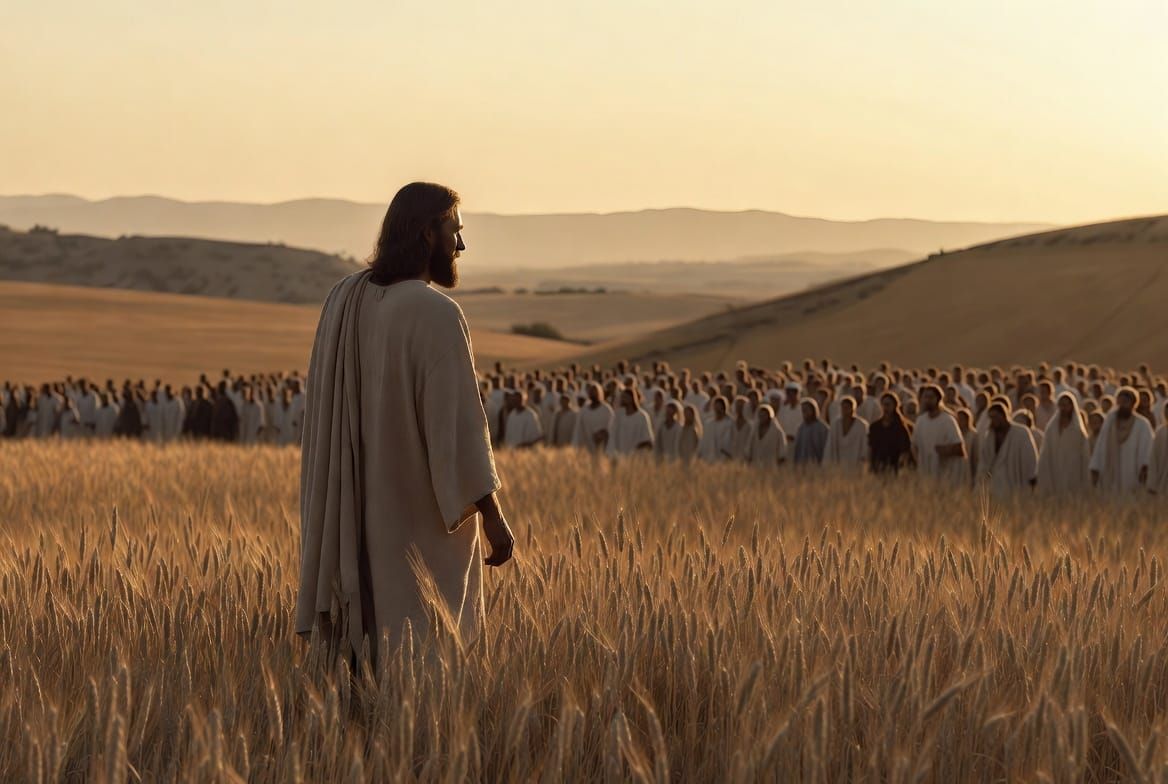
Verses 37 and 38: “The harvest is plentiful, but the laborers are few; therefore pray earnestly to the Lord of the harvest to send out laborers into his harvest.” (Matthew 9:37–38, ESV) The harvest Jesus has in view here is the present proclamation of the gospel to a needy and receptive people in Israel at that moment. The fields are white. The crops are ready. There are hungry people out there waiting for the bread of life, and there are not enough workers to bring it to them. The harvest is plentiful. The problem is not the soil and it is not the seed. The problem is laborers.
And so Jesus says: pray. Do not rush into the field half-equipped. Pray to the Lord of the harvest; notice that the harvest belongs to God, not to us; we are workers in someone else’s field; pray that he would send workers. And here is the remarkable thing: the disciples were praying for themselves without knowing it. They prayed for laborers and immediately became the answer to their own prayer. This is how God often works. He uses the act of praying to equip the ones who are praying for what they are about to be called to do.
Chapter 10:1: Jesus calls the Twelve together and gives them authority over unclean spirits and authority to heal every disease and every affliction. The same phrase Matthew used to describe Jesus’ ministry in 9:35 is now the authority he gives to the Twelve. The disciples’ ministry is an extension of the ministry of Jesus himself. They are not sent to do something different from what he has been doing. They are sent to continue it. And the Church that the apostles built, the Church that Barnabas served so faithfully, is an extension of the same mission. Whatever we do in the name of Christ in this world, whatever service, whatever proclamation, whatever healing, whatever welcome we offer to the harassed and helpless, we do it as an extension of the ministry of Jesus.
Matthew then pauses to give us the names. All twelve. Simon Peter, Andrew, James, John, Philip, Bartholomew, Thomas, Matthew the tax collector, James the son of Alphaeus, Thaddaeus, Simon the Zealot, Judas Iscariot. It is a remarkable list. A tax collector and a former Zealot, men who in any other context would have been on opposite sides of the most explosive political tension in first-century Judea, sitting at the same table, bearing the same commission. The Kingdom does not sort its workers by political party or social standing. It calls them, gives them authority, and sends them.
The scope of the mission in verses 5 and 6 may surprise us: go only to the lost sheep of the house of Israel. Not the Gentiles. Not the Samaritans. Not yet. We know from Matthew 28 and from Acts that the scope eventually expands to all nations. But here, Jesus sends the Twelve to Israel first. The Gospel is to the Jew first, as Paul will later say. The original kingdom-of-priests vocation, Israel as the nation through whom the blessing comes to all peoples, is being activated. Go to your people. Bring them the news of the Kingdom. And when the time comes, the nations will be included.
The message they are to preach is stated simply in verse 7: “The kingdom of heaven is at hand.” Four words. The long-promised reign of God, the restoration of Israel, the fulfillment of everything the prophets foretold: it has arrived. It is here. Not coming eventually. At hand. The Twelve are sent to announce what has already happened in the person of Jesus Christ, and to accompany that announcement with the signs of the Kingdom’s arrival: healing the sick, raising the dead, cleansing lepers, casting out demons. The Kingdom is not merely a future hope. It is a present reality breaking in.
And then verse 8b, one of the most important lines in the whole discourse: “You received without paying; give without pay.” (Matthew 10:8, ESV) Everything they have, the authority, the message, the power, they received as a gift. And it is to be given as a gift. The gospel of the Kingdom must never become a transaction. It cannot be monetized. It cannot be used for personal profit or social leverage. The moment the gift of salvation is turned into a commodity, something essential is lost; the very thing that makes it the gospel is gone. What God gives freely must be given freely. That is the logic of grace. Barnabas understood this when he sold his field and laid the proceeds at the apostles’ feet. He models for us what it looks like to live as a recipient of grace who then becomes a conduit of that same grace. This same principle would later shape the entire missionary enterprise of the early Church.
Verses 9 through 11 address the disciples’ provision. Travel light. No gold. No bag. No extra tunic or sandals. Find the worthy house, the household that will receive the message, and stay there. This is not poverty theology as if it were a virtue to be poor. Rather, it is trust theology. The disciples are being asked to go into the harvest completely dependent on God for their provision, with the understanding that God’s provision will come through the generosity of those who receive them. The laborer deserves his food. But the laborer is not to demand payment. He is to trust the Lord of the harvest to provide through the harvest.
Verses 12 and 13 give the disciples a liturgical frame for entering each household: greet it with peace, offer shalom (pronounced shah-LOME). That word is more than “hello.” It is the ancient Hebrew blessing of wholeness, peace with God, reconciliation, rest for the heavy-laden soul. The disciples are to enter every house with that blessing on their lips, as if it were already true, as a prayer and a proclamation at once. If the house is worthy, if the household receives them and their message, that peace comes upon it. If the house is not worthy, the peace returns to the disciples. They are not diminished by the rejection. The blessing is not wasted. It comes back to them.
And if a town refuses entirely, verse 14: shake the dust from your feet. Leave. This was a gesture Jews used when leaving Gentile territory, dissociating themselves from the unclean ground. But here, Jesus uses it for Jewish towns that reject the message. He is saying: treat the unbelieving Jewish town the way a strict Jew treats pagan land. It is a shocking statement. And it carries the weight of verse 15: on the day of judgment it will be more tolerable for Sodom and Gomorrah than for a town that was given the good news and rejected it. The stakes are not small. Heaven and hell are the horizon of the mission the disciples are being given.
So here we are. We are the Church that Barnabas helped to build, the Church that Peter and Paul died for, the Church that has been carrying this message across twenty centuries of harassed and helpless crowds. And we are still in the same mission. The harvest is still plentiful. The laborers are still few. And the Lord of the harvest is still in the business of taking ordinary people, fishermen and tax collectors, Zealots and former persecutors, old and young, the well and the unwell, giving them authority and a message, and sending them into the world he loves.
What does this mean for us, this morning and beyond?
First, we must pray earnestly. This is not a preliminary step; it is the foundational one. Before we launch new programs or recruit volunteers, we are commanded to pray to the Lord of the harvest. Pray specifically for more laborers in this parish: faithful Sunday School teachers, homebound visitors who bring the presence of Christ to those who cannot gather with us, outreach volunteers for the pregnancy center, senior ministries, and Operation Christmas Child, and servants willing to serve on the prayer team, the Call Ministry, or the Prayer Shawl Ministry. Some of you may already be feeling the quiet prompting of the Holy Spirit toward one of these areas of service. That prompting may very well be the beginning of God’s answer to our prayers.
Second, we must receive freely and give freely. The gospel can never become a commodity. This shapes everything from how we practice hospitality in our homes and at church, to how we respond to material and spiritual needs in our community, to how we speak about Jesus to our neighbors and coworkers. We are not salesmen offering a product; we are recipients of grace who freely share what we have freely received.
Third, we must travel light. Jesus’ instructions about taking no gold, no extra tunic, and no bag are not primarily about embracing poverty but about radical dependence. We are called to hold our resources, our plans, and even our preferred ways of doing ministry with open hands. This means trusting God’s provision through the generosity of this congregation rather than being paralyzed by budgets or “having everything perfectly in place.” It means stepping out in faith, whether starting a new small group, joining the men’s or women’s studies, or simply inviting someone to worship next Sunday.
Fourth, we must offer shalom. In a noisy, anxious, and divided culture, we are sent as bearers of Christ’s peace. This happens in everyday moments: in our marriages and families, in tense conversations at work, in neighborhood interactions, and even in disagreements within the church. We speak blessing. We greet people with the peace of God as if it is already true, because in Christ it is. When that peace is rejected, we shake the dust from our feet without bitterness and move forward in trust, remembering the peace returns to us.
Fifth, we must remember whose harvest it is. We are not the Lord of the harvest; we are merely laborers. This truth frees us from the exhausting pressure of results. We are not called to manufacture growth or measure our faithfulness by attendance numbers or visible success. We plant, we water, we offer the kingdom with open hands, and we trust God to give the increase. This also protects us from despair when the work feels slow or difficult.
Finally, we must live as the kingdom of priests we were made to be. Every baptized Christian shares in this ancient vocation. You do not need a collar or a title. In your workplace, your family, your neighborhood, and your daily routines, you are sent to mediate the presence, the word, and the blessing of God to a harassed and helpless world.
Psalm 100, which we prayed together this morning, names who we are in relation to all of this: “Know that the Lord, he is God! It is he who made us, and we are his; we are his people, and the sheep of his pasture.” (Psalm 100:3, ESV) We are the sheep of his pasture. The harassed and helpless crowds of Matthew 9 are the crowds into which we are sent. And the one who had compassion for those crowds is the same one who sends us. He is the Lord of the harvest. He is the great shepherd. And he says to us what he said to the Twelve: pray, and then go. Receive freely, and give freely. Travel light. Offer peace. Trust the one who sends.
One more thing, and then I am done. I mentioned that this Sunday begins Movement I of our summer in Matthew: the sending of the Twelve and the commissioning of the Church. Over the coming weeks we will walk through the rest of chapter 10, the cost of speaking the truth in a resistant world, the division the gospel can create even in families, the simple cup of cold water given in Jesus’ name, and the promise that whoever receives you receives Christ himself. All of it is ahead.
As we follow this arc, I pray we will find ourselves doing what the disciples were doing when they prayed for laborers: praying our way into our own calling, being equipped by the very prayer for what we are being asked to become. The harvest is plentiful right here in the mountains, in our homes, our neighborhoods, our workplaces, and even in the quiet struggles of our own hearts. The Lord of the harvest is faithful. Let us ask him, beginning this very week in our private prayers, in our devotions, and in our common worship, to make us ready to go.
In the Name of the Father, and of the Son, and of the Holy Spirit. Amen.