Pray Earnestly: World Mission Sunday 2026 (Matthew 9:35-38)
World Mission Sunday begins with the compassion of Jesus. He sees the crowds as sheep without a shepherd, declares that the harvest is plentiful, and tells his disciples to pray earnestly for laborers. Mission begins with God’s grace, moves through prayer, and sends the Church to make Christ known.
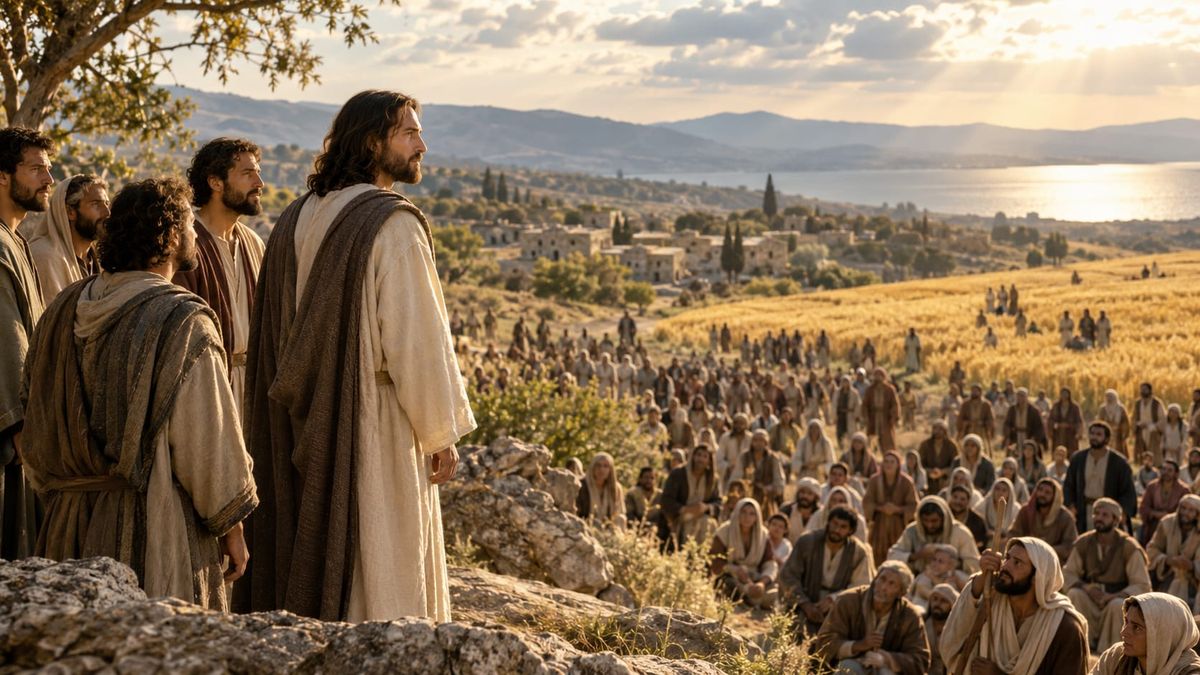
February 8, 2026, Year A, World Mission Sunday, Second-to-Last Sunday of Epiphany, Season of Epiphany
Matthew 9:35–38, Psalm 67, Acts 1:1–8, Isaiah 49:1–7
Grace, mercy, and peace from God our Father and the Lord Jesus Christ be with you on this World Mission Sunday.
For the past several weeks, the Season of Epiphany has been answering the question of who Jesus is. The Magi came from the nations to worship him. At the Jordan, the Father declared him to be his beloved Son. Since then, Christ has been manifested through his teaching, authority, healing, and works. Next Sunday, at the Transfiguration, the season reaches its summit when the glory that has been present all along shines visibly from him on the mountain. But before we get there, the Church gives us World Mission Sunday. The question shifts slightly. If this is who Jesus is, what are we supposed to do with what has been revealed?
Our Gospel gives the answer in four verses. Jesus sees the crowds, has compassion upon them, tells his disciples that the harvest is plentiful, and then gives them one command: pray. Our passage is Matthew 9:35–38.
Verse 35 begins, “And Jesus went throughout all the cities and villages, teaching in their synagogues and proclaiming the gospel of the kingdom and healing every disease and every affliction.” (Matthew 9:35, ESV) Matthew is summarizing what Jesus has been doing through the previous chapters. He has been teaching, proclaiming, and healing. The combination is worth noticing because Christian mission has sometimes been reduced either to words without mercy or mercy without words. Jesus does neither. He proclaims the Gospel of the Kingdom, and he heals the afflicted. His compassion is tangible, but he never stops proclaiming why the King has come.
The mission of the Church should retain that same shape. Christians have built hospitals, schools, orphanages, feeding programs, relief agencies, and ministries of mercy across the world, and we should thank God for them. If someone is hungry, feeding him is Christian love. If someone is sick, caring for her is Christian love. If someone is displaced, persecuted, lonely, or poor, the Church should not walk past suffering in the name of keeping its mission spiritual.
But notice again what Matthew says: Jesus was “proclaiming the gospel of the kingdom and healing.” Christian mission cannot stop with improving circumstances in this life because the deepest human need goes beyond circumstances. A person can be fed and still be separated from God. A person can receive excellent medical care and still die without Christ. If we love people as Jesus loves them, we care about the suffering we can see and the deeper need that only the Gospel can answer.
Verse 36 takes us beneath the activity of Jesus and shows us his heart: “When he saw the crowds, he had compassion for them, because they were harassed and helpless, like sheep without a shepherd.” (Matthew 9:36, ESV) Matthew does not merely say that Jesus noticed a large number of people. He saw them. A crowd can become an abstraction. We can count it, classify it, talk about demographics, or decide whether it is friendly or hostile. Jesus looks at the people within the crowd and has compassion.
The word translated “had compassion” describes something deeper than mild sympathy. Jesus is moved from within because the people are “harassed and helpless.” They are troubled, worn down, cast aside. Matthew says they are “like sheep without a shepherd.” That image reaches deep into the Old Testament. Israel had known shepherds who failed the flock. Kings, priests, and teachers had fed themselves rather than the people entrusted to them. The prophets condemned shepherds who scattered the sheep, and God promised that he himself would seek his flock and give them the shepherd they needed. Now Jesus stands before the crowds and sees the old problem still there.
This is where mission begins. It does not begin with annoyance that unbelievers do not believe what we believe, contempt for people whose lives are morally confused, or fear that another worldview is gaining influence. Christian mission begins with Christ looking upon lost people and loving them.
That does not mean Jesus approves of everything the crowd believes or does. His compassion is not sentimental affirmation. He calls sinners to repent, exposes false teaching, and warns about judgment. None of that is contrary to his compassion. It comes from his compassion, because love tells the truth when the truth is necessary for life.
We need that same vision. It is easy to see categories before people: progressive or conservative, American or foreigner, Muslim or Hindu, secular or religious, respectable or disreputable. Jesus sees sheep without a shepherd. He sees people made in the image of God who need the Shepherd who alone can bring them home.
Then, in verse 37, Jesus changes the image: “Then he said to his disciples, ‘The harvest is plentiful, but the laborers are few.’” (Matthew 9:37, ESV) The people who were sheep a moment ago are now a harvest. The sheep are lost and need a shepherd; the harvest is ready and needs laborers.
Notice what Jesus does not say. He does not say the harvest might someday become plentiful if the disciples develop the right strategy. He says it already is plentiful. The shortage is not in the harvest. The shortage is in the laborers.
That should give the Church more confidence than we sometimes have. We look at declining church attendance, cultural hostility, indifference to Christianity, competing religions, and the secularization of the West, and we begin to assume nobody wants the Gospel anymore. Jesus sees a plentiful harvest. That does not mean everyone will believe. Jesus himself will be rejected. But mission does not begin with our assessment of the market. It begins with his declaration that there is a harvest to be gathered.
Isaiah 49 gives us the same confidence. The Lord says to his Servant, “It is too light a thing that you should be my servant to raise up the tribes of Jacob and to bring back the preserved of Israel; I will make you as a light for the nations, that my salvation may reach to the end of the earth.” (Isaiah 49:6, ESV) The mission to the nations is not God improvising after Israel failed. It was already within his saving purpose. The Messiah comes from Israel, fulfills the promises made to Israel, and through him the salvation of Israel’s God reaches the nations.
Psalm 67 prays for precisely that: “May God be gracious to us and bless us and make his face to shine upon us, that your way may be known on earth, your saving power among all nations.” (Psalm 67:1–2, ESV) The psalm asks God to bless his people, but not simply so that his people can enjoy being blessed. “Bless us… that your way may be known on earth.”Blessing turns outward. Grace received becomes grace proclaimed.
That is one danger for a comfortable church. We can begin to think of Christianity chiefly in terms of what we receive: forgiveness, fellowship, worship, Scripture, Sacraments, pastoral care, and the hope of eternal life. Those are gifts worth cherishing, but Psalm 67 asks what the blessing is for. God causes his face to shine upon his people so that his saving way may be known among the nations. The light of Epiphany is not given to the Church so that we can simply sit in it and admire it.
Jesus reaches the central command of the passage in verse 38: “Therefore pray earnestly to the Lord of the harvest to send out laborers into his harvest.” (Matthew 9:38, ESV) We might expect Jesus to say, “Therefore go.” He will say that. But here, before he tells the disciples to go, he tells them to pray.
This is not a general prayer that missions would somehow go well. Jesus says, “Pray earnestly.” Ask the Lord of the harvest to send laborers. The wording matters. It is the Lord’s harvest. The Church does not own it. Missionaries, mission agencies, bishops, and priests do not own it. The people being gathered belong to God, and the field belongs to God. Mission begins with the Lord of the harvest before it ever becomes our work.
That is exactly what our Collect teaches us to pray this morning: “Almighty God, through the outpouring of the Holy Spirit, you revealed the way of eternal life to every race and nation: Pour out this gift anew, that by the preaching of the Gospel your salvation may reach to the ends of the earth.”
Listen to the grammar of the Collect. God acted first. God poured out the Holy Spirit. God revealed the way of eternal life. The Gospel reached us because God moved toward sinners before sinners moved toward him. So the Church asks him to act again: “Pour out this gift anew.”
Mission is grace before it is strategy. Missionaries should be trained, languages learned, money spent wisely, and churches thoughtful about whom they send and support. But none of that creates a harvest. None of it raises the spiritually dead or opens a human heart to believe. We preach because God has appointed proclamation as the means through which the Gospel is heard, but the power that gives faith belongs to God.
Acts 1 makes the same point. The risen Jesus tells the apostles, “You will receive power when the Holy Spirit has come upon you, and you will be my witnesses.” (Acts 1:8, ESV) The witnesses are not told to manufacture enough zeal to accomplish a global mission. They will receive power, and then they will bear witness.
The verse also gives the geography of that witness: “in Jerusalem and in all Judea and Samaria, and to the end of the earth.” The Gospel moves outward in widening circles. It begins where they are, crosses familiar territory, crosses uncomfortable boundaries into Samaria, and continues toward the nations.
That pattern guards us from two opposite mistakes. We cannot say world mission matters while ignoring the people next door. Jerusalem matters. Your family matters. Your neighbor matters. We do not need a passport before we can bear witness to Christ. But neither can we say local mission is enough. Jesus does not stop at Jerusalem. A church concerned only with its own county, state, or nation has a smaller mission than Jesus gave his Church.
This is why Christians send missionaries and support Bible translation, church planting, theological education, evangelism, and works of mercy in places we may never visit. Some Christians go, while others pray, give, encourage, and make their going possible.
But we should be careful with the word “them.” Jesus does not tell one group of professional Christians to care about the harvest while everyone else watches. He tells his disciples to pray for laborers, and the very next thing Matthew records is Jesus calling the Twelve and sending them.
The men who pray for laborers become laborers.
That makes Matthew 9:38 a slightly dangerous prayer. When we ask the Lord to send workers, we are asking him to disrupt lives. Someone may be called to leave home, enter seminary, learn another language, give more than feels comfortable, or take seriously a relationship with an unbelieving neighbor that has remained politely superficial. Some of us may discover that we have been asking God to send somebody else when he intends part of the answer to be us.
The 2025 World Mission Sunday reading from Romans put the issue another way: “How are they to believe in him of whom they have never heard? And how are they to hear without someone preaching?” (Romans 10:14, ESV) That remains true whether the mission field is across an ocean or across the street. Faith comes by hearing. At some point somebody has to speak.
We sometimes hear the saying, “Preach the Gospel at all times; when necessary, use words.” Whatever useful point it may make about consistent Christian living, it is not an adequate theology of evangelism. Words are necessary. You cannot communicate that Jesus Christ died for our sins and rose bodily from the grave simply by being kind. You cannot tell someone that Christ is Lord without eventually saying that Christ is Lord. Our lives should make our words credible, but our lives cannot replace the words.
That is increasingly important in a culture where people may know less about Christianity than we assume. People may know Christian words without understanding them, or know Christianity chiefly through caricatures. The Church must be comfortable telling people the story again: who Jesus is, what he has done, why the Cross was necessary, what the Resurrection means, why sinners need forgiveness, and how that forgiveness is received.
And the message must remain Jesus Christ. We are not sent into the nations to make the world culturally Anglican, export American politics, or teach people to admire Western civilization. We are sent to make disciples of Jesus Christ.
There is only one Gospel because there is only one Savior. Jew and Gentile do not have separate ways of salvation, and neither does any other religion offer another saving path alongside Christ. Peter says, “There is salvation in no one else, for there is no other name under heaven given among men by which we must be saved.” (Acts 4:12, ESV) That conviction is not an embarrassment to Christian mission. It is the reason Christian mission exists. If Jesus really is who Epiphany has revealed him to be, the beloved Son, the Lord, the Savior, and the Light of the world, then making him known is an act of love.
So what should we do with this Gospel? Jesus gives us the first application himself: pray earnestly.
First, pray for those already serving. Pray for missionaries by name, for their marriages, children, health, courage, financial support, and faithfulness. Pray for pastors and evangelists serving where following Christ carries social, economic, or physical danger. Pray for converts whose families may reject them, for the persecuted Church, and for peoples among whom there remains little Christian witness.
Second, pray for more laborers. Ask God to raise up missionaries, clergy, church planters, evangelists, translators, and ordinary Christian witnesses who have not yet recognized their calling. Pray for children and young adults in our churches to hear a call that may take them far from home, and pray for the Church to recognize, form, and send those whom God raises up.
When we pray that, however, we must leave room for God to answer through us. We do not retire from the Great Commission. We may reach an age when crossing an ocean is no longer realistic, but we never reach an age when prayer, generosity, encouragement, and faithful witness become irrelevant. Missionaries continue because churches pray and give. Younger Christians sometimes recognize a call because an older Christian encourages it. Unbelieving children and grandchildren may hear the Gospel from someone who has prayed for them for decades.
Finally, ask Christ to give us his compassion. Before there was a command to pray, there was Jesus looking at the crowds. Before there were laborers, there were sheep without a shepherd. Mission becomes distorted when we lose that order. We are not trying to win an argument against the world. We are asking God to save people we have learned to love.
Some will reject what we say. Some may think us narrow, foolish, or offensive. Jesus was rejected too. But the possibility of rejection cannot become an excuse for silence. We speak because Christ is worthy to be known, because the Gospel really is good news, and because the people before us are not statistics. They are sheep for whom the Shepherd had compassion.
Psalm 67 gives us a fitting prayer with which to carry this Sunday forward: “Let the peoples praise you, O God; let all the peoples praise you!” (Psalm 67:3, ESV) That is where mission is going. Isaiah says salvation reaches the end of the earth. Jesus says the harvest is plentiful. Acts says the witnesses will go to the end of the earth. The biblical story is moving toward a redeemed people gathered from every tribe and tongue and nation before the throne of the Lamb.
None of that begins with us. The harvest already has a Lord, the Gospel already has a Savior, and the Church already has the Holy Spirit. Our task is not to invent the mission but to ask the God whose mission it is to make us faithful within it.
So pray earnestly to the Lord of the harvest. Ask him to pour out the Holy Spirit anew, send laborers, open hearts, and make Christ known among the nations. Then hold that prayer with open hands, because the Lord may answer by sending someone we love, by asking more of what we possess, or by turning us toward the person who has been standing in front of us all along.
The harvest is plentiful. The laborers are few. Therefore, pray.
In the Name of the Father, and of the Son, and of the Holy Spirit. Amen.