Reconciliation of a Penitent: An Anglican Perspective
The penitent names sin honestly; the priest ministers the Gospel through counsel, direction, and absolution; and the sinner is directed away from confidence in the adequacy of his own repentance and toward the sufficiency of Christ.
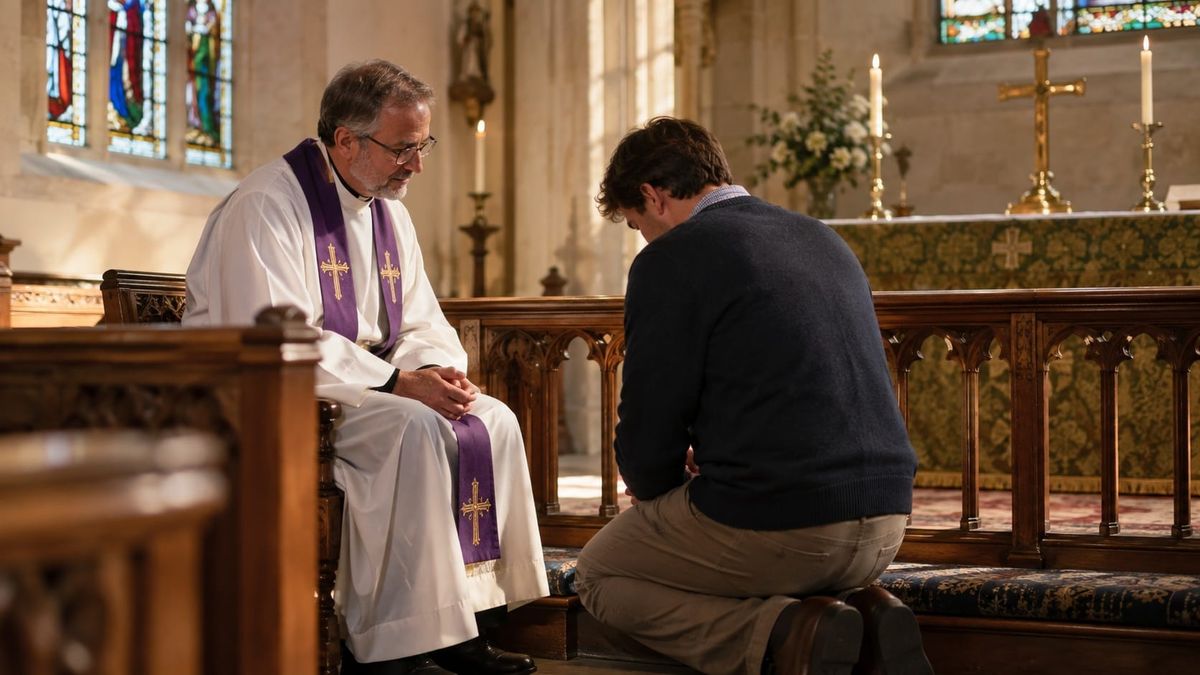
Confession, Absolution, and the Mercy of Christ for a Troubled Conscience
There are few things more difficult than naming our sins aloud. It is one thing to confess generally that we are sinners. Christians do that regularly in the Church’s worship, acknowledging that we have sinned in thought, word, and deed, by what we have done and by what we have left undone. It is another thing to say plainly before another Christian, “This is what I did. This is where I sinned. This is the burden I have been carrying.”
Yet the Anglican Church has preserved a pastoral rite precisely for such moments. The Book of Common Prayer 2019 calls it the Reconciliation of Penitents. It appears among the Rites of Healing and provides a setting in which a Christian may confess particular sins to a priest, receive counsel and direction, and, where repentance and faith are present, hear the Church’s absolution applied personally to a troubled conscience (BCP 2019, pp. 222–224).
This is sometimes called private confession or aural confession because the confession is heard. Its purpose is not to place another obstacle between the sinner and Jesus Christ. Nor does it teach that forgiveness belongs to the priest as though it were his personal spiritual possession. The penitent names sin honestly; the priest ministers the Gospel through counsel, direction, and absolution; and the sinner is directed away from confidence in the adequacy of his own repentance and toward the sufficiency of Christ.
The Reconciliation of a Penitent is therefore not a retreat from the Gospel of grace. Properly understood, it is one of the ways the Church brings that Gospel directly to a conscience burdened by particular sin.
The Rite in the Book of Common Prayer
The Prayer Book places the Reconciliation of Penitents among the Rites of Healing. It describes reconciliation, Holy Communion, prayer, anointing, and the laying on of hands within the Church’s wider ministry to those who suffer in body, mind, or spirit. It also states that absolution is among the ministries reserved to bishops and priests (BCP 2019, p. 222).
The rite itself begins on page 223. The penitent says, “Bless me, for I have sinned,” and the priest prays that the Lord would be upon the penitent’s heart and lips so that the confession may be true and humble. The penitent then confesses to Almighty God, to his Church, and to the priest, naming particular sins after the words “especially ________.” The confession continues by acknowledging sorrow for sin, expressing an intention to amend one’s life, and asking for “counsel, direction, and absolution” (BCP 2019, p. 223).
That blank for particular sins matters because the rite is not merely a general admission that human beings are imperfect. It allows the penitent to stop speaking vaguely and name what has actually been done.
After the confession, the priest may offer pastoral counsel, direction, and comfort before absolution is pronounced (BCP 2019, pp. 223–224). The movement is simple: honest confession, pastoral counsel, repentance and faith, absolution, and peace.
Nothing in that movement suggests that the sinner earns forgiveness by producing a sufficiently dramatic confession. At the same time, the rite does not treat absolution as an automatic result of reciting certain words. The confession itself assumes sorrow for sin and an intention to amend one’s life, while the absolution speaks explicitly of those who truly repent and believe.
Confession Begins with God
Private confession can be misunderstood if we imagine that the priest becomes the primary person to whom sin is confessed. The Prayer Book itself prevents that misunderstanding. The penitent says, “I confess to Almighty God, to his Church, and to you” (BCP 2019, p. 223).
The confession is first and finally before God. The priest does not replace God, and the Church does not compete with Christ for the sinner’s trust. Forgiveness comes from God because of the saving work of Jesus Christ.
Scripture repeatedly joins confession with God’s promise of mercy. Saint John writes, “If we confess our sins, he is faithful and just to forgive us our sins and to cleanse us from all unrighteousness” (1 John 1:9, ESV). David prays, “Have mercy on me, O God, according to your steadfast love” (Psalm 51:1, ESV) and later, “Create in me a clean heart, O God, and renew a right spirit within me” (Psalm 51:10, ESV). The prodigal son returns to his father confessing, “Father, I have sinned against heaven and before you” (Luke 15:21, ESV).
Why, then, involve a priest? Because Christ has not saved isolated individuals and left them to manage repentance entirely alone. He has gathered sinners into his Church and entrusted to that Church a ministry of reconciliation.
What the Priest Is Actually Doing
After his Resurrection, Jesus said to his disciples, “Peace be with you. As the Father has sent me, even so I am sending you.” He then breathed on them and said, “Receive the Holy Spirit. If you forgive the sins of any, they are forgiven them” (John 20:21–23, ESV).
Anglican Christianity has historically received this as part of Christ’s commission to his Church to minister reconciliation and absolution. That does not mean that a priest possesses forgiveness as a power belonging personally to him. The priest is not the source of forgiveness. Christ is. The priest does not determine whether Christ’s sacrifice is sufficient, because Christ’s sacrifice is sufficient. Nor does the priest generate grace by virtue of his own character or holiness.
The first form of absolution in the BCP makes the order clear. It begins, “Our Lord Jesus Christ, who has given power to his Church to absolve all sinners who truly repent and believe in him…” and then continues with the priest’s declaration of absolution by the authority committed to him (BCP 2019, p. 224).
The authority is real, but it is derived and ministerial. The forgiveness belongs to God. The priest ministers the Gospel by pronouncing and applying Christ’s promise of forgiveness to the truly repentant and believing.
This is why Anglican absolution should not be understood as though the priest were deciding personally whether to erase another person’s sins. He is declaring what Christ promises in the Gospel and what the Church has authorized him to pronounce.
A Troubled Conscience and the Need for Absolution
The BCP’s Exhortation to Holy Communion gives one of the clearest Anglican explanations for private confession.
The Exhortation tells Christians to examine their lives according to God’s commandments, confess their sins, intend amendment of life, make restitution for injuries and wrongs, and forgive those who have offended them. It then addresses those whose consciences remain burdened: “If you have come here today with a troubled conscience, and you need help and counsel, come to me, or to some other Priest, and confess your sins, that you may receive godly counsel, direction, and absolution.” The stated purpose is that confession may “satisfy your conscience and remove any scruples or doubt” (BCP 2019, pp. 147–148).
The problem being addressed is not that Christ has failed to provide enough forgiveness. The problem is that a sinner may know the Gospel intellectually while continuing to struggle beneath the weight of one particular sin.
A Christian may think, “I know God forgives sinners, but what about this?” Another may have confessed repeatedly in private prayer and yet continue to wonder whether this particular offense could truly be forgiven. Private confession does not answer such fears with a different Gospel. It brings the same Gospel directly to the wound.
The penitent names the sin. The priest hears it and considers whether the penitent’s words and intentions give reasonable evidence of repentance and faith. Where they do, Christ’s promise is spoken personally to that sinner.
“The Lord Has Put Away All Your Sins”
The BCP gives two forms of absolution. The first emphasizes Christ’s authority entrusted to his Church; the second emphasizes God’s promise of mercy to those who sincerely repent and turn to him in faith. Both forms move in the same theological direction: forgiveness belongs to God and rests upon his mercy, not upon the adequacy of the penitent’s performance (BCP 2019, p. 224).
After either absolution, the priest says, “The Lord has put away all your sins,” and the penitent responds, “Thanks be to God” (BCP 2019, p. 224).
That brief exchange captures the heart of the rite. The priest does not tell the penitent that the sin was insignificant, that the confession was impressive enough, or that some spiritual debt has finally been paid. He declares that the Lord has put away the sins. The assurance rests upon God and his mercy.
Repentance, Amendment, and Absolution
The grace of God is free, but absolution is not a mechanical transaction. The rite assumes repentance and faith. The penitent says, “I am truly sorry,” declares, “I firmly intend amendment of life,” and asks for forgiveness, counsel, direction, and absolution (BCP 2019, p. 223).
For that reason, the priest is not required to pronounce absolution simply because a person has said the formal words. If the penitent’s stated intentions or circumstances give serious reason to doubt that genuine repentance is present, absolution may need to be withheld.
The BCP 2019 does not state that point as a separate rubric within the Reconciliation rite itself. What it does state clearly is that the absolution concerns those who truly repent and believe, and elsewhere, in its ministry to a dying person, it directs that assurance of God’s mercy and forgiveness be given “On evidence of repentance” (BCP 2019, p. 242). Wider Anglican pastoral practice has likewise recognized that absolution may be withheld when repentance is not reasonably evident. That wider practice should not be confused with an additional ACNA Prayer Book rubric, but it follows the same pastoral logic already present in the BCP.
A person who effectively says, “I know this is sinful, but I intend to continue doing it,” is not presenting the repentance assumed by the rite. The same problem may arise when someone refuses an essential act of amendment. If stolen property can reasonably be returned and the penitent refuses to return it, if a lie can be corrected and the penitent refuses to correct it, or if an ongoing sinful relationship must end and the penitent intends to continue it, that refusal bears directly on whether the professed repentance is genuine.
The priest cannot read the heart infallibly. He can, however, exercise pastoral judgment concerning the words, intentions, and actions presented to him. Withholding absolution in such a case is not a demand that the sinner become worthy of grace. It is a refusal to pronounce the assurance of forgiveness where the repentance and faith assumed by the Gospel and the rite are not reasonably evident.
Repentance Is Not Payment for Forgiveness
Anglican reconciliation does not treat an assigned act of repentance as a satisfaction that completes Christ’s atonement or earns forgiveness. Christ’s sacrifice is sufficient, and nothing we do adds to his Cross.
That does not mean repentance is without consequences. A priest may require or recommend restitution, reparation, prayer, or another concrete action where such a step is necessary to demonstrate or carry forward genuine repentance. This belongs to the wider Anglican pastoral tradition and is consistent with the BCP’s own insistence upon amendment of life and restitution.
The distinction is important. Returning stolen property does not purchase absolution. Correcting a lie does not supplement Christ’s atonement. Ending an ongoing sinful relationship does not earn divine mercy. Such actions matter because genuine repentance does not intend to continue deliberately in the sin being confessed.
Repentance therefore involves more than feeling badly about consequences. It means agreeing with God about sin, ceasing to defend it, and turning toward him in faith. Amendment of life is not an alternative to grace; it is one of the fruits by which repentance begins to take visible form.
The BCP Exhortation makes the same connection when it calls Christians to confess, amend their lives, make restitution for wrongs, and forgive others before receiving Holy Communion (BCP 2019, p. 147).
We do not repair ourselves until God finally agrees to forgive us. We turn because God calls sinners to repentance and because the mercy revealed in Christ makes true repentance possible.
Counsel, Direction, and Comfort
The Prayer Book allows the priest to offer pastoral counsel, direction, and comfort as part of the movement from confession toward absolution (BCP 2019, pp. 223–224). Sometimes a person has minimized serious sin and needs to hear plainly that repentance requires change. At other times, someone may be tormented by something that is not actually sinful or may continue punishing himself for a sin that has already been confessed and absolved.
Pastoral counsel therefore helps distinguish genuine conviction from destructive accusation. The Holy Spirit convicts us of real sin and leads us toward repentance and Christ. An accusing conscience, by contrast, may keep insisting that even confessed and forgiven sin remains stronger than the mercy of God.
The Gospel does not minimize sin. The Cross prevents us from doing that. But neither does the Gospel require repentant and believing sinners to remain forever beneath condemnation.
The Seal of Confession
Private confession requires extraordinary trust, and the BCP therefore speaks with unusual force about confidentiality. It says that the contents of a confession are not normally a matter of subsequent discussion and that “The secrecy of a confession is morally binding for the confessor and is not to be broken” (BCP 2019, p. 222).
A penitent who speaks honestly before God in the pastoral life of the Church must not fear that the confession will later become parish conversation, a sermon illustration, a source of curiosity, or leverage in another dispute. The priest hears the confession for the purpose of reconciliation, counsel, and absolution.
The Prayer Book’s statement that confession is not normally a subject for later discussion is pastorally significant as well. Once a sin has been confessed and absolution pronounced, the priest does not need to keep dragging the penitent back to what Christ has forgiven.
Corporate and Private Confession
Anglican worship already gives Christians regular opportunities for corporate confession. At Holy Communion, the congregation confesses sin together and receives absolution. The Daily Office likewise teaches the Church to acknowledge sin before Almighty God.
Private confession serves a related but more particular pastoral purpose. Corporate confession teaches us that repentance belongs to the ordinary Christian life and that every Christian stands in need of mercy. Private confession allows a specific burden to be named. Corporate confession says, “We have sinned,” while private confession allows the penitent to say, “I did this.” Both direct us to the same Savior.
“All May, Some Should, None Must”
A familiar Anglican aphorism concerning private confession says, “All may, some should, none must.” Its precise historical origin is uncertain, and it does not appear in the Book of Common Prayer 2019. It should therefore be treated as a pastoral summary rather than as a Prayer Book rubric.
Even so, it captures an important Anglican balance. All may confess because private confession belongs within Anglican pastoral practice and is explicitly provided for by the Prayer Book. Some should confess because there are circumstances in which a burdened conscience, an entrenched pattern of sin, uncertainty concerning restitution, or persistent doubt about forgiveness makes private confession especially wise. The Exhortation itself directs the Christian with a troubled conscience toward confession, counsel, direction, and absolution (BCP 2019, p. 148).
None must because Anglicanism does not require every Christian to make private auricular confession according to a fixed schedule or before every reception of Holy Communion. The rite remains available not because forgiveness depends upon completing it, but because consciences sometimes need precisely the ministry it provides.
The Historical Anglican Pattern
Private confession did not begin with the English Reformation, nor did the Reformation simply abolish it.
Early Christian penitential discipline could be public, particularly in cases of grave or notorious sin. During the early medieval period, private and confidential confession increasingly developed in the Western Church, and by the end of the first millennium, private confession to a priest, followed by absolution and penitential acts, had become increasingly established in the Western Church.
The Reformation challenged important features of the medieval penitential system, especially where troubled consciences could be directed away from confidence in the sufficiency of Christ. The English Reformation did not preserve every medieval understanding of penance, satisfaction, or sacramental necessity. But neither did it conclude that Christians should never confess particular sins to a priest or receive personal absolution.
The Prayer Book tradition retained private confession especially for those whose consciences remained troubled. Its purpose was not to place a human intermediary between Christ and the sinner, but to use the Church’s pastoral ministry to bring the promises of the Gospel directly to a burdened conscience.
Anglican private confession therefore preserves an ancient Christian practice while placing its emphasis firmly on Scripture, repentance, faith, the sufficiency of Christ’s sacrifice, and the peace of the forgiven conscience.
How the Rite Is Commonly Conducted
The BCP 2019 prescribes no confessional booth, screen, or special piece of furniture. In ordinary pastoral practice, the rite is heard in a private setting where priest and penitent can speak without being overheard.
In many Anglican settings, the priest is seated while the penitent kneels nearby, sometimes in an adjacent pew or at an altar rail. Other arrangements may be used according to the church building and pastoral circumstances. This is customary practice rather than a Prayer Book rubric; the BCP makes no particular furniture or bodily posture essential.
The simplicity is fitting because the physical arrangement is secondary to the purpose of the rite: honest confession, pastoral counsel, genuine repentance and faith, and the assurance of the Gospel.
Why Lent Is an Especially Fitting Time
The Reconciliation of a Penitent belongs to the Church’s pastoral ministry throughout the year, but Lent provides an especially fitting setting for it.
Ash Wednesday summons Christians to self-examination and repentance. The season calls the Church to prayer, fasting, self-denial, Scripture, and renewed attention to sins that we often learn to excuse or hide. Joel’s call, “Return to me with all your heart, with fasting, with weeping, and with mourning” (Joel 2:12, ESV), and David’s prayer, “Create in me a clean heart, O God, and renew a right spirit within me” (Psalm 51:10, ESV), capture the penitential movement of the season.
Lent therefore invites more than vague regret. It asks us to confront pride, lust, greed, bitterness, dishonesty, prayerlessness, resentment, refusal to forgive, and other patterns we may have learned to rationalize.
For some Christians, the ordinary disciplines of Lent will uncover a burden that should no longer remain vague. Private confession can become a way of bringing that burden into the light, naming it truthfully, and receiving both pastoral direction and the assurance of Christ’s mercy.
The goal is not to achieve a more impressive Lent. The goal is reconciliation.
Not Only for Lent
The rite should not be confined to Lent. A Christian may seek it before receiving Holy Communion because of a troubled conscience, after a serious moral failure, during a recurring struggle with sin, or whenever pastoral counsel and personal absolution would be spiritually helpful.
The BCP’s Ministry to the Dying gives a particularly clear example. If a dying person is troubled in conscience, the minister should offer the Reconciliation of a Penitent, and “On evidence of repentance, the minister shall give assurance of God’s mercy and forgiveness” (BCP 2019, p. 242).
That direction shows that Reconciliation belongs wherever a sinner needs the mercy of Christ applied to a particular burden. Lent simply gives the Church an annual season in which we are especially encouraged to stop hiding.
What Happens Practically?
For someone who has never made a private confession, the prospect can feel intimidating, but the rite itself is simple.
The penitent normally arranges a private time with a priest and explains the desire to make a confession. The priest can explain the rite beforehand. In a church, the confession may take place with the priest seated and the penitent kneeling nearby, or at an altar rail where sufficient privacy can be maintained. No special booth or screen is required.
The penitent does not need literary eloquence. It is generally better simply to name sins plainly without excuses, elaborate self-defense, or a catalogue of other people’s failures.
The priest may ask questions where clarification is necessary, offer pastoral counsel, discuss restitution or amendment of life, and consider whether the penitent’s words and intentions provide reasonable evidence of repentance and faith. If an essential act of repentance or amendment has been refused, absolution may be delayed. Where repentance and faith are reasonably evident, the priest pronounces absolution.
The rite ends not in continued humiliation but in peace. The Prayer Book’s dismissal says, “Go in peace, and pray for me, a sinner” (BCP 2019, p. 224). The priest who hears the confession therefore stands under the same mercy he proclaims.
Confession Is Not Spiritual Self-Punishment
Private confession can be distorted if it becomes an exercise in endless self-accusation. A person prone to scrupulosity may feel compelled to confess every doubtful thought, every possible motive, every forgotten detail, or sins that have already been confessed and absolved.
That is not the purpose of the rite. The BCP Exhortation specifically presents confession as a means by which a troubled conscience may be relieved of “scruples or doubt” (BCP 2019, p. 148).
The penitent should be honest, but honesty is not the same thing as obsessive self-examination. The Prayer Book itself recognizes the limits of human memory when its confession includes sins that the penitent cannot now remember (BCP 2019, p. 223).
The Christian is not saved by producing a flawless inventory of every sin. Christ’s mercy is greater than our memory.
Reconciliation with God and Neighbor
The title of the rite matters. It is the Reconciliation of Penitents, not merely “Private Confession.”
Sin ruptures fellowship first of all with God, but it also wounds marriages, families, friendships, parishes, and communities. The absolution addresses the sinner’s need before God, yet genuine repentance may also send us outward toward those whom we have wronged. Jesus says, “First be reconciled to your brother” (Matthew 5:24, ESV).
That does not mean every damaged relationship can immediately be restored to what it once was. Forgiveness, reconciliation, and restored trust are related but not identical. Some situations require boundaries, some harms have lasting consequences, and reconciliation may require the willing participation of another person.
But repentance does not permit us to call estrangement peace when we are the ones refusing to make right what can rightly be repaired. The reconciled sinner becomes, by grace, a person who seeks reconciliation.
The Gospel for a Burdened Conscience
There are sins we wish we had never committed, words we cannot unsay, memories we would erase if we could, and consequences that may remain even after forgiveness.
Christian faith does not require us to pretend those things are insignificant. The Cross tells the truth about the seriousness of sin, but it also tells a greater truth about the mercy of God. Christ died for actual sinners, including sinners ashamed of what they have done.
That is why absolution matters. The penitent who has confessed honestly, turned from sin in repentance, and placed his trust in Christ hears the Church pronounce what the Gospel promises. The assurance does not rest upon the priest’s independent power, the penitent’s spiritual performance, or some additional payment offered to God. It rests upon Jesus Christ.
Conclusion
The Anglican rite of Reconciliation of Penitents is a pastoral ministry of the Gospel. It does not provide another way of earning forgiveness, nor does it ask a priest to create a mercy that belongs to him. It brings a particular sinner, a particular confession, and the promises of Jesus Christ together.
The penitent comes honestly before God, names the sin, receives counsel and direction, and, where repentance and faith are present, hears the Church pronounce the forgiveness Christ promises. Amendment and restitution may sometimes be necessary, not as payment for mercy, but because genuine repentance turns from sin rather than planning to remain in it.
During Lent, this ministry can become especially precious as the Church calls us to examine ourselves and return to God. But the mercy proclaimed in the rite belongs to no single season.
We do not confess in order to persuade God to become merciful. We confess because in Jesus Christ God has revealed himself as merciful to sinners.
And when sin has been honestly confessed, repentance and faith are present, and absolution has been pronounced, the burdened conscience is not left to measure the strength of its own feelings. It is given a word from outside itself, a word grounded in Christ and stronger than accusation: “The Lord has put away all your sins.” The Christian can answer simply, “Thanks be to God” (BCP 2019, p. 224).