Friday Fasting: An Anglican Perspective
Friday fasting gives the Christian week a regular rhythm of repentance, prayer, self-examination, and mercy. The BCP 2019 encourages Fridays outside Christmastide and Eastertide as days of fasting, returning the Church again and again to the Cross of Christ.
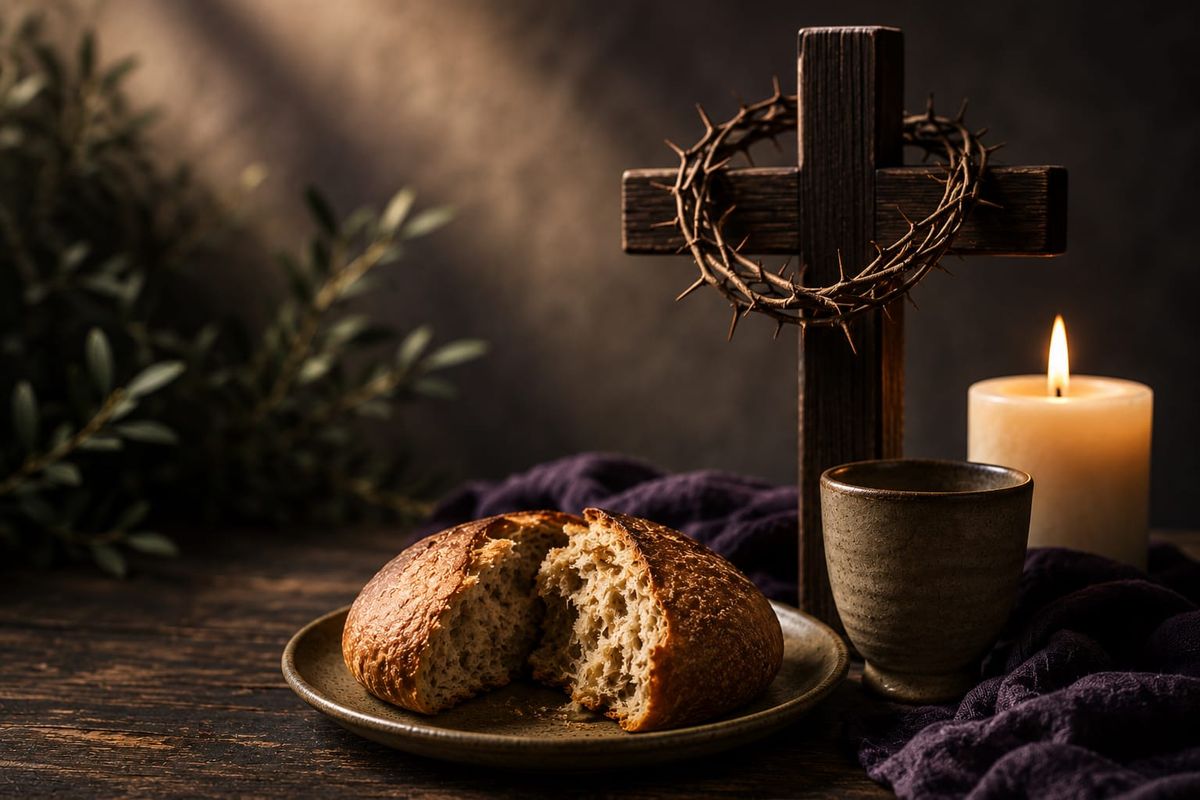
Days of Discipline, Denial, and Special Prayer
The Anglican calendar does more than tell Christians when to celebrate. It also teaches them when to fast. Alongside the great feasts and seasons, the BCP 2019 identifies Days of Discipline, Denial, and Special Prayer, times in which the Church deliberately interrupts ordinary patterns of consumption and living in order to turn more attentively toward God. Among these are Ash Wednesday and Good Friday, the weekdays of Lent, Ember and Rogation Days where appropriately observed, and nearly every Friday of the year.
The BCP 2019 says that “the weekdays of Lent and every Friday of the year (outside the 12 Days of Christmas and the 50 days of Eastertide) are encouraged as days of fasting.” It then explains that fasting, “in addition to reduced consumption, normally also includes prayer, self-examination, and acts of mercy.” (BCP 2019, p. 689) Friday fasting is therefore not an eccentric devotion reserved for unusually austere Christians. It belongs to the ordinary ascetical rhythm the Prayer Book commends to the Church.
Why Friday? Because Friday is the day of the Cross. Just as every Sunday recalls the Resurrection, the weekly Friday fast remembers the Passion and death of Jesus Christ. The Christian week therefore contains a small Paschal rhythm of its own: Friday turns toward the Cross through discipline and prayer, while Sunday gathers the faithful around the risen Lord in Word and Sacrament. The fast makes sense because Christ has died; the feast makes sense because Christ has risen.
An Ancient Christian Practice
Friday fasting did not begin with medieval Christianity or as a distinctively Anglican custom. Its roots reach into the earliest post-apostolic Christian tradition. The Didache, one of the earliest surviving Christian writings outside the New Testament, instructs Christians not to follow the Monday and Thursday fasts it associates with others, but instead to fast on Wednesday and on “the Preparation,” the usual designation for Friday, the day of preparation before the Sabbath.
The significance is considerable. At a very early stage in Christian life, particular weekdays were already being marked by fasting. Later Christian tradition connected Wednesday especially with the betrayal of Christ and Friday with his Passion and death. The weekly fast developed alongside the weekly Lord’s Day as part of the Church’s way of allowing the saving events of Christ’s life to shape ordinary time.
That rhythm continued through the ancient Church. Leo the Great, for example, explicitly exhorted Christians to fast on Wednesday and Friday and repeatedly joined bodily fasting with prayer and almsgiving. He also insisted that the fast of the body should be accompanied by restraint from sinful desires and generosity toward the poor. Fasting was not meant to turn Christians inward upon the achievement of personal austerity. The whole person was to turn more deliberately toward God and neighbor.
The English Reformation did not abandon this inheritance. The classical Prayer Book tradition continued to recognize Fridays among the Church’s days of fasting or abstinence, while Anglican teaching resisted both the notion that particular foods were spiritually unclean and the belief that ascetical practices could earn justification. The 1662 Prayer Book famously listed “All the Fridays in the Year, except Christmas Day” among its days of fasting or abstinence. The BCP 2019 stands in that same broad tradition while giving the current Anglican pattern its own form, exempting the Twelve Days of Christmas and the Fifty Days of Eastertide from the ordinary Friday fast.
Why the Day of the Cross?
The Christian week is not spiritually featureless. Sunday has always carried particular weight because Jesus rose from the dead on the first day of the week. Christians gather on Sunday because the Resurrection has reordered time itself.
Friday carries a corresponding, though different, memory. The Gospels place the Crucifixion on the day of preparation before the Sabbath. Jesus is condemned, crucified, dies, and is buried as the Sabbath approaches. Friday fasting therefore turns Christian attention toward his saving death without pretending that Christ is somehow crucified again each week.
This is remembrance, not repetition. The sacrifice of Jesus Christ is once for all. Hebrews declares that Christ “has appeared once for all at the end of the ages to put away sin by the sacrifice of himself.” (Hebrews 9:26, ESV) Friday fasting adds nothing to that finished sacrifice. It allows the body and the calendar to remember what salvation cost.
Paul expresses the same Gospel center when he writes, “God shows his love for us in that while we were still sinners, Christ died for us.” (Romans 5:8, ESV) The Friday fast is therefore not fundamentally a meditation upon our own capacity for self-denial. It is a weekly return to the Cross, where sinners encounter the love of God given in the crucified Son.
That distinction protects Christian fasting from becoming self-centered. If Friday becomes primarily a test of how disciplined we can be, the practice has lost its center. The point is not the impressive Christian who goes without food. The point is Jesus Christ who gave himself for sinners.
What Does the BCP Mean by Fasting?
The BCP 2019 gives unusually helpful guidance because it refuses to reduce fasting either to a rigid dietary formula or to an entirely metaphorical idea. It speaks first of “reduced consumption.” Fasting therefore retains its ordinary bodily meaning. It involves eating less.
That matters. In contemporary Christian speech, almost any voluntary abstinence can be called a fast: a social-media fast, television fast, shopping fast, or news fast. These disciplines may certainly be useful forms of self-denial, especially where a habit has acquired an unhealthy hold upon us. But expanding the word fasting until it simply means giving up anything difficult risks losing the biblical and historic practice.
In Scripture and historic Christian usage, fasting properly concerns abstinence from or reduction of food. The body experiences hunger, and that hunger itself becomes part of the discipline. Other forms of self-denial may accompany the fast, but they are better understood as related disciplines rather than substitutes that redefine the word.
At the same time, the Prayer Book does not prescribe one universal Friday menu or require every Anglican to keep the fast according to one particular historical dietary formula. It does not mandate a precise number of meals or prescribe abstinence from one specific kind of food. The Prayer Book preserves the bodily reality of fasting while leaving considerable room for disciplined pastoral judgment.
For one Christian, a Friday fast may mean omitting a meal and eating more simply during the remainder of the day. For another, it may mean noticeably reducing the quantity eaten. Some may combine reduced consumption with abstinence from meat according to longstanding Christian custom. The appropriate form may vary, but the discipline should involve genuine bodily restraint rather than merely renaming an ordinary day a fast.
Fasting Is More Than Eating Less
The Prayer Book immediately prevents another misunderstanding by adding that fasting “normally also includes prayer, self-examination, and acts of mercy.” (BCP 2019, p. 689) Reduced consumption belongs to fasting, but Christian fasting is not simply dieting with a religious label.
Prayer turns hunger toward God. Without prayer, eating less may accomplish little more than physical discomfort. The sensation that ordinarily sends us toward the refrigerator can instead become a summons to remember that we are creatures who depend upon God and that “man shall not live by bread alone.”
Self-examination turns fasting toward repentance. Appetite is one of the ordinary places where human beings discover how easily desires can become masters. The discomfort of a fast may expose irritability, entitlement, impatience, or the expectation that every desire deserves immediate satisfaction. The point is not to discover that food is bad. Food is a gift of God. The point is to learn again that created gifts must not rule those who receive them.
Acts of mercy turn fasting toward the neighbor. Isaiah condemns a religious fast that leaves injustice and selfishness untouched. God asks whether the fast he chooses is not also “to share your bread with the hungry and bring the homeless poor into your house.” (Isaiah 58:7, ESV) A Christian who spends less because of simpler Friday eating may direct what is saved toward someone in need. The fast then moves naturally from restraint to generosity.
Prayer, repentance, and mercy prevent fasting from curling inward upon the self. The discipline becomes not simply What am I giving up? but Toward whom is this hunger turning me?
Grace Before Discipline
Any Christian account of fasting must say clearly what fasting cannot do. It cannot justify the sinner. It cannot purchase forgiveness. It cannot make God love us more. It cannot place God in our debt.
The Gospel order runs in the opposite direction. Christians practice discipline because they have received mercy. Paul writes, “There is therefore now no condemnation for those who are in Christ Jesus.” (Romans 8:1, ESV) The Christian does not fast on Friday in the hope that sufficient hunger will finally persuade God to become gracious.
Nor is fasting a punishment by which Christians repay some portion of a debt Christ left outstanding. There is no unpaid balance. Christ’s sacrifice is sufficient. The Friday fast remembers the finished work of Jesus rather than supplementing it.
Grace therefore gives fasting both freedom and seriousness. Because fasting does not save us, we do not need to turn it into a competitive spiritual achievement. Yet because grace restores us to a life of obedience, bodily discipline should not be dismissed as legalism merely because it requires effort.
Paul himself speaks in ascetical terms when he says, “I discipline my body and keep it under control.” (1 Corinthians 9:27, ESV) The body is not evil, but neither should bodily appetite become sovereign. Grace teaches Christians both to receive created goods gratefully and to abstain from them freely when obedience and love call for it.
Friday Fasting and Christian Freedom
The weekly fast raises an important Anglican question about Christian freedom. The BCP says that Fridays “are encouraged as days of fasting.” That wording should be preserved rather than strengthened into a claim the Prayer Book itself does not make.
The Church commends a discipline without turning one particular modern manner of keeping it into a test of salvation or authentic Christianity. Christians should therefore resist two opposite errors. One is legalism, in which the exact form of the fast becomes a measure by which we judge our righteousness or the seriousness of others. The other is indifference, in which Christian freedom becomes an excuse never to discipline appetite at all.
Paul’s teaching in Romans 14 remains useful here. Christians must not despise or condemn one another over food: “For the kingdom of God is not a matter of eating and drinking but of righteousness and peace and joy in the Holy Spirit.”(Romans 14:17, ESV) Yet Paul’s insistence that food does not justify us does not abolish fasting. It places fasting where it belongs, within the freedom of those already justified by grace.
Christian freedom therefore does not mean merely being free from discipline. In Christ we become free to receive created things without being mastered by them, free to abstain without fear, and free to receive them again with thanksgiving.
Why Christmas and Easter Are Different
The Prayer Book explicitly exempts the Twelve Days of Christmas and the Fifty Days of Eastertide from the ordinary Friday fast. This is not an arbitrary exception. It reveals something important about Christian fasting itself.
Fasting serves the Gospel; it does not rule over the Gospel. There are times when the Church’s calendar teaches that feasting is the more fitting theological act. During the Twelve Days of Christmas, the Church rejoices in the Incarnation of the eternal Son. During the Fifty Days of Eastertide, she celebrates Christ’s bodily Resurrection and victory over death.
The ordinary weekly remembrance of the Cross therefore yields during these sustained festal periods to the mysteries toward which the Cross itself leads. The Church knows how to fast because she also knows how to feast.
This keeps Christian asceticism from becoming suspicious of creation. Christianity does not regard food, pleasure, or embodied life as inherently unclean. The Son of God took flesh, ate and drank with his disciples, turned water into wine at a wedding, fed hungry crowds, and after the Resurrection ate with his followers. The final Christian hope is not escape from bodily existence but the resurrection of the body and the renewal of creation.
A discipline that teaches Christians never to enjoy created goods would therefore be as distorted as one that teaches them never to deny themselves anything.
Friday and Sunday
The relationship between Friday and Sunday gives Christian life a particularly beautiful weekly rhythm. Friday remembers the Cross. Sunday celebrates the Resurrection.
The two days interpret one another. Friday fasting without Sunday feasting can deteriorate into religious severity. Sunday celebration without any discipline can become shallow, forgetting the Cross through which resurrection victory came.
Christian worship holds both together. Paul summarizes the Gospel as the proclamation “that Christ died for our sins in accordance with the Scriptures, that he was buried, that he was raised on the third day.” (1 Corinthians 15:3–4, ESV)Cross and Resurrection belong to one saving work.
A weekly Friday fast therefore need not be dramatic. Its quiet repetition may be precisely its strength. Week after week, the body is reminded that discipleship includes self-denial, that salvation came through the Cross, and that appetite is not lord. Then Sunday comes, and the Church hears again that death did not have the final word.
Fasting With Wisdom
Because fasting concerns the body, Christian wisdom must take bodily circumstances seriously. Age, pregnancy, illness, medication, a history of disordered eating, strenuous physical labor, and other legitimate circumstances may make ordinary food restriction inappropriate or require significant modification.
The point of fasting is not bodily injury. The body is God’s creation and belongs to Christ. Paul reminds Christians that “your body is a temple of the Holy Spirit within you.” (1 Corinthians 6:19, ESV) Ascetical discipline should therefore be real without becoming reckless.
A Christian who cannot safely omit meals is not spiritually inferior. Simpler food, a medically appropriate reduction, or another carefully chosen form of bodily restraint may preserve the intention of the practice where ordinary fasting would be unwise. When circumstances are complicated, appropriate pastoral and medical counsel are better guides than spiritual competitiveness.
The same principle should not be used in the opposite direction as a universal excuse. Those who can fast should not assume that because exceptions exist no bodily discipline is ever appropriate. Wisdom is not a euphemism for avoidance. The discipline should be proportionate to circumstances, but it should remain a discipline.
Friday Fasting Outside Lent
One reason Friday fasting deserves attention in its own right is that fasting can easily become associated entirely with Lent. The Prayer Book does not restrict it to that season. Nearly every Friday throughout the Christian year is encouraged as a day of fasting, apart from those falling within the Twelve Days of Christmas and the Fifty Days of Eastertide.
Friday fasting therefore accompanies the long green Season after Pentecost as well as Advent and the weeks following Epiphany. Repentance and self-discipline are not seasonal concerns that disappear when purple vestments are put away.
The weekly rhythm may actually become especially helpful outside Lent. Lenten discipline comes with a strong communal and liturgical structure. Ordinary Fridays arrive quietly. No ashes appear, no special season begins, and no cultural reminder announces the fast. Remembering Friday therefore becomes a small but deliberate act of Christian attention.
This is one of the gifts of the liturgical calendar. It does not rely upon Christians spontaneously remembering every good discipline. It places reminders into time itself.
Observing the Friday Fast
Friday fasting need not begin with an elaborate rule. Begin with the Prayer Book’s own pattern: reduced consumption joined to prayer, self-examination, and acts of mercy. Choose a form of bodily restraint that is real, sustainable, and appropriate to your circumstances rather than an ambitious regimen likely to disappear after two weeks.
Let the fast remember the Cross. Read a portion of one of the Passion narratives, perhaps the Crucifixion account from one Gospel. Pray before a crucifix or simple cross if that helps focus attention. Use a Psalm, the Daily Office, or a simple prayer of thanksgiving for Christ’s saving death to anchor the discipline in something more substantial than hunger. The earlier website version referred to a particular “Collect for Fridays from the Daily Office,” but I have removed that wording because the BCP 2019 does not identify a general Daily Office collect by that formal title.
Allow hunger to prompt prayer rather than resentment. When the body asks for what has deliberately been withheld, receive the interruption as a reminder to turn toward God. A simple prayer such as Lord Jesus Christ, who gave yourself for me upon the Cross, have mercy upon me and teach me to follow you can transform an ordinary moment of appetite into recollection.
Make room for self-examination. Ask where desires have begun governing you rather than serving their proper place. The Friday fast can expose patterns that ordinarily remain hidden because daily life satisfies them immediately.
Join the fast to mercy. Give away what is saved through simpler eating, or deliberately perform another act of generosity. Remembering the crucified Christ should open the Christian outward rather than producing fascination with personal discipline.
And where Friday falls within the Twelve Days of Christmas or the Fifty Days of Eastertide, receive the Prayer Book’s exemption gratefully. The calendar itself is teaching the proper relationship between discipline and joy.
Conclusion
Friday fasting is one of the quietest practices in the Anglican calendar, and perhaps for that reason one of the easiest to lose. It requires no special service, vestment change, or elaborate ceremonial. A Friday arrives, the Christian eats less, prays more deliberately, examines the heart, shows mercy to another, and remembers that on a Friday the incarnate Son of God stretched out his arms upon the Cross for the salvation of sinners. The practice is small enough to disappear from notice and substantial enough to shape a life through years of repetition.
Its center must always remain Christ rather than the fast itself. Hunger cannot atone for sin. Self-denial cannot justify the ungodly. Jesus Christ has accomplished what no ascetical discipline could accomplish, bearing sin once for all and reconciling sinners to God through his blood. Christian fasting therefore begins on the far side of grace. We deny ourselves not to make Christ merciful but because the crucified Christ has already shown mercy to us.
The weekly rhythm finally points beyond itself. Friday remembers the Cross, but Sunday is coming. The Church disciplines appetite because she is free, mourns sin because it has been forgiven, practices mercy because she has received mercy, and remembers death beneath the promise of Resurrection. Week after week, the Friday fast quietly places the body within the pattern of the Gospel: Christ crucified, Christ risen, and a people being formed by grace to follow him.