Rogation Sunday: An Anglican Perspective
In an age that hides dependence behind supply chains and packaged goods, Rogation Sunday does something quietly subversive: it takes us outside, sets us on our feet, and teaches us to ask, holding out empty hands to the Lord of heaven and earth.
The Sixth Sunday of Easter
The Sixth Sunday of Easter occupies a distinctive place in the Anglican liturgical year. It is not a Principal Feast and not a Red-Letter Holy Day. It is a Sunday within the Great Fifty Days of Easter, and the BCP 2019 names it Rogation Sunday. The Prayer Book appoints its Collect on page 613 and its three-year lectionary on page 724, and immediately after the Collect notes that Monday, Tuesday, and Wednesday of that week are the traditional Rogation Days.
The word rogation comes from the Latin rogare (roh-GAH-ray), meaning “to ask” or “to beseech.” Rogationtide places the Church in the posture of creatures before their Creator, asking for his mercy and providence, for the fruits of the earth and the seas, for fruitful human labor, and for the daily bread that comes ultimately from his hand. In an age when food can seem to originate in a grocery store and human technology can foster the illusion of independence from creation, Rogation Sunday offers a distinctly Christian correction. We cultivate, build, transport, harvest, and work, but we do not create the earth, command the rain, give life to seed, or sustain creation from one moment to the next.
Its place within Easter is especially fitting. The God from whom the Church asks daily provision is the Father who raised Jesus Christ from the dead. The risen Lord is not detached from the created order but is the eternal Son through whom all things were made and in whom all things hold together. Rogation Sunday anchors Resurrection hope firmly to the earth, reminding us that redemption does not teach Christians to despise creation but to receive it gratefully from the God who made it and who promises finally to renew it.
Historical Origins
The Rogation Days before Ascension have their roots in fifth-century Gaul. Mamertus, Bishop of Vienne, established days of prayer, fasting, and procession in response to calamities afflicting the region sometime before his death in the later fifth century. The observance spread, and the Council of Orléans in 511 prescribed Rogation observances throughout the churches of Gaul. By the beginning of the ninth century, during the pontificate of Leo III, the practice had also been received at Rome.
A related but distinct observance, traditionally called the Major Rogation, was kept at Rome on April 25. It should not simply be attributed to Gregory the Great as though he created it. The observance appears to have preceded him, and Gregory regulated an existing custom. It eventually shared April 25 with the Feast of Saint Mark, although the two observances had different origins.
Rogation customs also became well established in England. Processions through the parish developed in which clergy and people prayed for God’s blessing upon the land, crops, and community, and the practice became associated with walking parish boundaries. The older procession was suppressed during the Reformation and restored in a reformed form in 1559. Anglican practice retained the central concern of asking God’s blessing upon creation, human labor, and the welfare of the community.
The BCP 2019 receives this inheritance explicitly. It names the Sixth Sunday of Easter Rogation Sunday, identifies the following Monday, Tuesday, and Wednesday as the traditional Rogation Days, provides two Rogation Collects under the heading Agriculture and Industry, supplies two sets of Rogation Day readings, and describes the Great Litany as “especially appropriate for Rogation days.”
Rogation Sunday Within Easter
Rogation Sunday falls immediately before the three Rogation Days and only four days before Ascension Day. The Church is therefore still fully within the Easter feast while beginning to look toward the Ascension of the risen Christ.
That location helps prevent Rogation from becoming a merely agricultural observance. Christians do not pray to a generic deity of weather and harvest. They ask the Father through Jesus Christ. The Creator to whom they entrust the fields is the God who raised the crucified Son, and the Lord who will ascend to the Father’s right hand is the Lord through whom creation itself came into being.
Rogation Sunday consequently holds creation and redemption together. The Resurrection does not remove Christians from creaturely dependence. It teaches us more fully the identity of the God upon whom we depend. The Father who gives daily bread is the Father of our Lord Jesus Christ. The Son who conquered death is the Son through whom all things were made. The Spirit who gives new life is the Lord and giver of life.
The Easter setting also gives Rogation prayer a future horizon. Creation is not merely a supply of resources to be consumed until Christ returns. Paul describes creation itself as groaning and awaiting liberation from its bondage to corruption. (Romans 8:19–23) Christians therefore pray for the earth as people who know both its present goodness and its present brokenness and who await the renewal God has promised.
The Appointed Readings
The BCP 2019 appoints a distinct set of readings for each lectionary year. In Year A the readings are Acts 17:(16–21)22–34 or Isaiah 41:17–20, Psalm 148 or 148:7–14, 1 Peter 3:8–18, and John 15:1–11. Year B appoints Acts 11:19–30 or Isaiah 45:11–13, 18–19(20–25), Psalm 33 or 33:1–8, 18–22, 1 John 4:7–21, and John 15:9–17. Year C appoints Acts 14:8–18 or Joel 2:21–27, Psalm 67, Revelation 21:1–4, 22–22:5, and John 14:21–29. (BCP 2019, p. 724)
The alternative first readings allow different dimensions of the day to emerge without separating them. Acts emphasizes the Gospel moving into the world of the nations, while the Old Testament alternatives speak more directly of God as Creator, giver, and provider. Both belong within Easter. The risen Christ sends witnesses into a world that remains entirely dependent upon the God who made it.
Year A makes that dependence especially vivid. Isaiah 41 promises water for the thirsty and growth in desolate places. God declares that he will put cedar, acacia, myrtle, and olive in the wilderness so that people may “see and know, may consider and understand together, that the hand of the LORD has done this.” (Isaiah 41:20, ESV) The passage names the theological center of Rogation plainly: the hand of the Lord gives what creation cannot give itself.
The Gospel intensifies that truth. Jesus says, “I am the vine; you are the branches. Whoever abides in me and I in him, he it is that bears much fruit, for apart from me you can do nothing.” (John 15:5, ESV) The agricultural image is immediately intelligible. A branch possesses no independent source of life. Its fruitfulness comes from remaining joined to the vine. Yet Jesus is saying more than that agricultural dependence resembles spiritual dependence. He places himself at the center of life and fruitfulness. The branch receives before it bears. Life comes before fruit.
God Gives the Growth
Rogation Sunday therefore offers a particularly clear occasion to recover the biblical order of grace and creaturely action. Human work is real, necessary, and good, but it is never ultimate. God is the first mover and sustaining giver. We work within a creation we did not make, with bodies we did not create, using capacities we received, depending every moment upon conditions we can influence but never finally control.
Paul expresses the same order when he writes concerning ministry, “I planted, Apollos watered, but God gave the growth.” (1 Corinthians 3:6, ESV) The statement concerns the growth of the Church, but the agricultural image works precisely because its creational truth is obvious. Planting and watering matter, and human labor is real, yet neither Paul nor Apollos can make life emerge.
Rogation prayer therefore does not compete with responsible work. It places work within the truth. The farmer should plant wisely, the fisherman should know the water, the builder should learn his craft, the truck driver should make the delivery, the scientist should study the created order, and the business owner should labor faithfully. None of this diminishes providence. Secondary causes are genuine because God created a world in which genuine creaturely action occurs.
Beneath every secondary cause, however, stands the Creator who gives being, sustains life, and makes fruitfulness possible. Christian prayer acknowledges aloud what remains true whether we acknowledge it or not. Dependence upon God should therefore never be confused with passivity. Rogationtide does not teach Christians to ask for harvest and then refuse to sow. It teaches them to sow without imagining that sowing makes them sovereign.
The Land Belongs to God
Traditional Rogation processions through fields and along parish boundaries expressed another biblical truth: the earth is not finally ours.
Psalm 24 begins, “The earth is the LORD’s and the fullness thereof, the world and those who dwell therein.” (Psalm 24:1, ESV) Christian stewardship begins there. The earth belongs to God before it belongs to landowner, farmer, government, corporation, or nation. Human possession always exists beneath the deeper sovereignty of the Creator.
Genesis describes humanity as given genuine authority within creation while simultaneously being placed within the garden “to work it and keep it.” (Genesis 2:15, ESV) Biblical stewardship therefore resists opposite errors. Creation is not divine and must not be worshiped, but neither is it merely raw material without moral significance. It is God’s creation entrusted to human beings for faithful use and care.
Rogation Sunday can therefore speak naturally about agriculture, conservation, water, land, work, food systems, and the responsible use of created resources without turning the Church into an environmental advocacy organization. The controlling confession is theological rather than ideological: the earth is the Lord’s. That confession also disciplines human appetite. If creation belongs to God, neither greed nor waste nor careless exploitation can be defended simply because we possess the legal power to do them. Christian stewardship asks how the Creator would have his gifts received and used.
Beating the Bounds
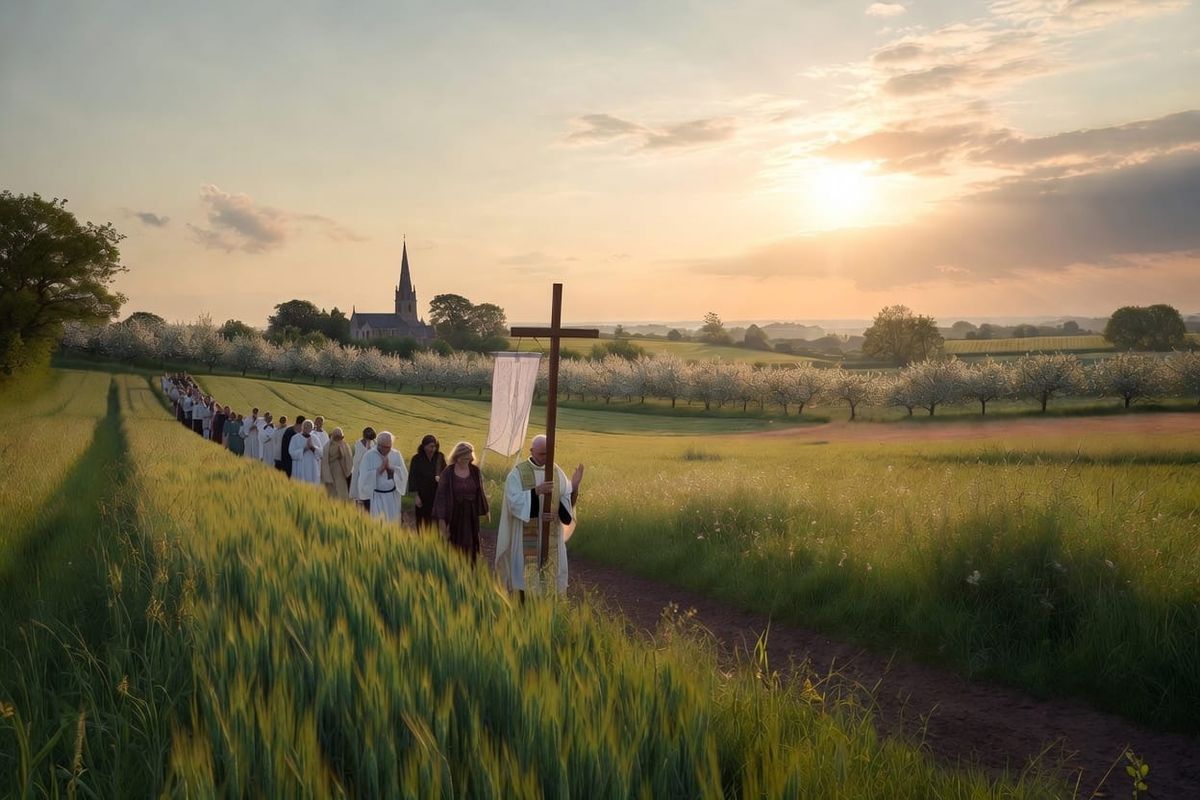
One of the best-known Rogation customs is beating the bounds, a procession around the boundaries of a parish. In earlier centuries such walks had obvious practical usefulness when written maps and permanent boundary markers were less reliable. Communities preserved knowledge of where one parish or property ended and another began.
But the procession also acquired theological meaning. The people walked through the actual place in which God had planted them. Fields, streams, roads, homes, and boundaries became places of prayer. The parish was not an abstraction but a particular Christian community occupying particular ground.
The Church of England’s account of Rogationtide notes that George Herbert understood the procession as serving several purposes together: asking God’s blessing upon the land, preserving knowledge of boundaries, encouraging reconciliation among neighbors, strengthening fellowship, and providing charity for the poor.
Adapted Rogation walks can still serve that purpose. A rural parish may walk through fields, gardens, farms, or woodland. A suburban or urban congregation might pray near a community garden, food pantry, business district, school, industrial area, watershed, or transportation hub. The point is not antiquarian reenactment, but to learn again to pray for the actual place in which God has placed us.
The Great Litany and the Rogation Days
The BCP 2019 specifically identifies the Great Litany as “especially appropriate for Rogation days.” It may be used as an independent rite or with Morning or Evening Prayer, giving contemporary Anglican observance a clear Prayer Book anchor.
The Great Litany teaches the Church to ask widely. Its petitions move far beyond immediate private concerns and place human life before God in its full vulnerability. Rogation prayer belongs naturally within such comprehensive intercession because harvests, weather, disease, disaster, labor, commerce, government, peace, and the needs of the poor are never truly isolated from one another.
The three weekdays following Rogation Sunday are the traditional Rogation Days. The BCP places them among the Days of Discipline, Denial, and Special Prayer. It identifies their particular purpose as asking for God’s blessing upon agriculture and industry and says that Rogation Days may be kept with fasting.
This is an important distinction. The ordinary Friday fasting discipline is suspended during the Fifty Days of Eastertide, but the Prayer Book separately permits Rogation Days to be kept with fasting. Rogation fasting is therefore optional rather than mandatory, and it is not contrary to Easter joy. It is a voluntary discipline of prayerful dependence upon God.
The BCP provides two sets of Rogation Day propers rather than a separate set for each of the three weekdays. Rogation Days I appoints Deuteronomy 11:10–15, Psalm 147, Romans 8:18–25, and Mark 4:26–32. Rogation Days II appoints Ecclesiasticus 38:27–32, Psalm 107:1–9, 1 Corinthians 3:10–14, and Matthew 6:19–24.
The first set emphasizes God’s providence over the land, the groaning and promised liberation of creation, and the mysterious growth of the seed. The second gives particular dignity to craftsmanship and human labor while warning the heart against earthly treasure. Together they hold the essential Rogation balance: God gives, and human beings faithfully work within what he gives.
The BCP 2019 Collect
The BCP appoints this Collect for Rogation Sunday on page 613: “O God, you have prepared for those who love you such good things as surpass our understanding: Pour into our hearts such love towards you, that we, loving you in all things and above all things, may obtain your promises, which exceed all that we can desire; through Jesus Christ our Lord, who lives and reigns with you and the Holy Spirit, one God, for ever and ever. Amen.” At first glance, the Collect may seem surprisingly unrelated to Rogation. It does not mention rain, fields, crops, work, or harvest. Instead it asks for love of God, love so rightly ordered that God is loved “in all things and above all things.”
That is precisely the prayer Rogation needs. Creation is gift, but the gift must never replace the Giver. Harvest is good, but abundance can become an idol. Work is honorable, but work can become the source from which we attempt to derive identity and security. The Church therefore begins not by asking for more things but by asking God to order our love.
Even here God acts first: the Church does not promise to manufacture sufficient love for him. It asks, “Pour into our hearts such love towards you.” The love by which we love God is itself sought as his gift. Divine grace precedes the rightly ordered response.
Only then can Christians love God in all things without mistaking those things for God, and above all things without despising the good things he has made. The Collect gives Rogation Sunday a deeply Augustinian grammar: receive the gifts gratefully, but love the Giver supremely.
The Rogation Collects
The BCP provides two Collects specifically for the Rogation Days under the heading Agriculture and Industry on page 635. The first begins, “Almighty God, Lord of heaven and earth: We humbly pray that your gracious providence may give and preserve to our use the harvests of the land and of the seas, and may prosper all who labor to gather them, that we, who are constantly receiving good things from your hand, may always give you thanks.” This prayer gives Rogationtide its practical theology in remarkably compact form. God is “Lord of heaven and earth.” His providence gives and preserves. Human beings labor to gather what God provides. We are “constantly receiving good things” from his hand, and our proper response is thanksgiving.
The second Collect widens the focus explicitly to industry and commerce. It remembers that Jesus Christ “in his earthly life shared our toil and hallowed our labor,” and asks God to be present with his people where they work, to order industry and commerce according to his will, and to grant a just return for labor. Rogation in the BCP is therefore deliberately broader than agriculture alone. The Prayer Book itself joins the harvests of land and sea to the ordinary world of human work.
Both prayers preserve the same order: God gives; human beings receive and work. Creaturely labor matters precisely because it takes place within divine providence.
The BCP also provides a supplemental Proper Preface titled Rogation Days or Thanksgiving Day. It gives thanks because the wonders of creation reflect God’s goodness and beauty and because his gifts of sun and rain, seed-time and harvest manifest his constant love and care for all that he has made. The Rogation Collects themselves direct the celebrant to use the Preface of the Season, but this supplemental text gives the Church an especially fitting Eucharistic expression of Rogation thanksgiving.
The Preface of Easter
Rogation Sunday itself remains wholly within Easter, and the BCP appoints the Preface of Easter. The Preface praises God for the glorious Resurrection of Jesus Christ, confesses Christ as the true Paschal Lamb, and declares that by his death he destroyed death and by his rising to life again won everlasting life.
The Easter Preface keeps Rogation Sunday from becoming merely seasonal gratitude for springtime. Christians pray for land and labor in the light of the Resurrection. The Creator has acted decisively to redeem his fallen creation in Jesus Christ.
Rogation Sunday therefore does not step outside Easter to talk for a week about earthly matters. It reveals that earthly matters belong within Easter. Christ’s Resurrection concerns embodied creatures and finally the renewal of creation. The Church asks for daily bread while awaiting the day when death itself will be no more.
The Liturgical Character
Rogation Sunday remains an Easter Sunday, and white is fittingly used as the festal color of Eastertide. The Sunday does not become a penitential observance merely because the Rogation Days that follow may include fasting.
That distinction matters because Rogation Sunday celebrates the Resurrection while teaching the Church to ask. Monday through Wednesday then become particular Days of Discipline, Denial, and Special Prayer devoted especially to agriculture and industry and optionally accompanied by fasting.
The Easter setting therefore remains visible even while the Church prepares to pray for rain, harvest, fruitful labor, and daily provision. Christians ask not as people abandoned in an uncertain universe but as people whose Lord has risen from the dead.
Rural, Urban, and Ordinary Work
Rogation Sunday can seem immediately relevant in agricultural communities because weather, soil, planting, livestock, and harvest remain visible parts of daily life. Farmers know with particular clarity how much work can be done faithfully while remaining vulnerable to frost, drought, disease, flood, and conditions no human being finally commands.
Yet Rogation is no less relevant in a city. Urban life can simply hide the chains of creaturely dependence. Food still comes from soil and sea. Water must still be available. Goods must still be produced and transported. Electric grids, warehouses, roads, ports, stores, kitchens, hospitals, factories, and businesses depend upon human labor and material conditions human beings did not create.
The Prayer Book itself prevents Rogation from being confined to rural life by naming its particular concern agriculture and industry. The first Rogation Collect remembers harvests of land and sea and those who gather them. The second explicitly prays for those engaged in industries and commerce. Rogation belongs wherever human beings receive the gifts of creation and turn them through labor toward human need.
In a modern economy that circle includes the farmer, fisherman, processor, mechanic, truck driver, dockworker, grocer, cook, engineer, manufacturer, merchant, and countless others. Christian gratitude should learn to see those hands without confusing them with the ultimate Hand from which every good thing comes.
Observing This Sunday
Rogation Sunday is the Sixth Sunday of Easter. The Collect is found on page 613 and the three-year lectionary on page 724 of the BCP 2019. Begin by praying the Sunday Collect and noticing that its central petition is not for successful labor but for rightly ordered love. Ask God to teach you to love him in the gifts he gives without loving any gift above him.
Read the appointed lessons for the year rather than limiting Rogation to a generic harvest theme. In Year A, the Church hears of God bringing water and growth into a barren land and of Christ the true Vine apart from whom his people can do nothing. Year B draws together the mission of the Church, God’s sovereign work as Creator in Isaiah, Christian love, and Christ’s command that his disciples love one another. Year C hears apostolic witness among the nations alongside Joel’s promise of restored fruitfulness and looks toward the new creation in which death, mourning, and pain are finally overcome.
Pray one or both of the Rogation Collects on page 635 and give thanks for the actual people and processes through which daily provision reaches you. Where appropriate, pray the Great Litany, which the BCP explicitly commends for Rogation Days. A congregation may also walk through its parish or community, pray for farms and businesses, pray over seeds, tools, workplaces, and the work of human hands, remember those whose livelihoods depend upon uncertain conditions, and ask God for faithful stewardship of the place he has given.
Then continue the observance on Monday, Tuesday, and Wednesday if possible. The BCP says that the Rogation Days may be kept with fasting, so those who choose to fast can join bodily self-denial to the Church’s prayers for agriculture, industry, provision, and faithful work. Rogation Sunday introduces the asking; the Rogation Days allow the Church to linger in it before Ascension Day.
Conclusion
Rogation Sunday is not a separate feast or Red-Letter Holy Day. It is the Sixth Sunday of Easter, standing immediately before the traditional Rogation Days and only days from the Ascension. Yet its long history and explicit place in the BCP give it a distinctive purpose: the Church stands before God as a creature and asks.
That asking is not a denial of work, knowledge, technology, planning, or human responsibility. It places all of them where they belong. We plant and water, but God gives the growth. We labor and gather, but we are constantly receiving good things from his hand. We exercise stewardship, but the earth remains the Lord’s. We ask because we are creatures, and we ask confidently because the Creator has revealed himself as the Father of Jesus Christ.
The Sunday Collect finally guards even our asking from becoming idolatrous. Before we ask God to give us his gifts, we ask him to give us love for himself: “Pour into our hearts such love towards you, that we, loving you in all things and above all things, may obtain your promises, which exceed all that we can desire.” (BCP 2019, p. 613) Rogation begins with open hands, but the greatest gift those hands receive is not rain, harvest, prosperous labor, or even daily bread. It is God himself.