Saint James of Jerusalem, Bishop and Martyr, Brother of Our Lord: An Anglican Perspective
James therefore gives us a vivid picture of grace coming first. He does not reason his way from family familiarity into Christian faith. The risen Christ comes to him. Before James becomes leader, reconciler, bishop, or martyr, he is the recipient of resurrection grace.
Feast Day: October 23
The Anglican calendar is ordered by a hierarchy of holy days, each carrying a different weight of observance. At the top stand the seven Principal Feasts, the highest-ranking days of the liturgical year. Below them are the Red-Letter Holy Days appointed in the BCP 2019 with their own Collects and propers. The Feast of Saint James of Jerusalem, Bishop and Martyr, Brother of Our Lord, observed on October 23, is one of these Red-Letter Holy Days. The BCP appoints his Collect on page 633, directs the Preface of Apostles, and appoints Acts 15:12–22a, Psalm 1, 1 Corinthians 15:1–11, and Matthew 13:54–58 as the readings for the feast.
James emerged after the Resurrection as the leading figure in the Church at Jerusalem. Paul names him among the Church’s “pillars,” and Acts presents him in a central role at the Jerusalem Council, gathering the argument together and proposing the judgment the assembled apostles, elders, and Church then adopt. Early Christian tradition remembered him as the first bishop of Jerusalem and called him James the Just, while Hegesippus also remembered him as a man of extraordinary prayer. His story is especially striking because the Gospels place him among the brothers of Jesus who did not believe during our Lord’s earthly ministry, while Paul later tells us that the risen Christ appeared specifically to James. The brother who had not believed became a pillar of the Church because the risen Lord came to him in grace.
James of Jerusalem is distinct from James son of Zebedee, the apostle honored on July 25, and from James son of Alphaeus, one of the Twelve. James of Jerusalem was not numbered among the Twelve during Jesus’ earthly ministry, yet the BCP itself calls him “your apostle James the Just,” reflecting the wider New Testament and early Christian use of apostolic language beyond the Twelve. His importance does not rest merely upon biological kinship with Jesus, but upon the grace of the risen Christ, the witness entrusted to him, and the leadership he exercised within the mother Church at Jerusalem.
Brother of the Lord
The New Testament repeatedly identifies James through his relationship to Jesus. Paul writes in Galatians 1:19 that during his visit to Jerusalem he saw “James the Lord’s brother,” while Matthew 13:55 names James among the brothers of Jesus together with Joseph, Simon, and Judas.
The BCP 2019 Collect calls James the kinsman of our Lord. Christian traditions have understood the precise family relationship in different ways, and the Prayer Book wisely does not require the feast to settle that question. What matters for the article is the biblical testimony itself: James belonged to Jesus’ family and was known to the apostolic Church as “the Lord’s brother.”
What Scripture makes especially clear is that natural closeness to Jesus did not itself produce saving faith. John tells us plainly, “For not even his brothers believed in him.” (John 7:5, ESV) Familiarity with Jesus was not enough. James needed what every sinner needs: the gracious self-revelation of the Lord and the faith that comes from God’s prior action.
From Unbelief to Pillar
Paul gives us the decisive turning point in his account of the Resurrection appearances: “Then he appeared to James, then to all the apostles.” (1 Corinthians 15:7, ESV) Scripture does not tell us what passed between the risen Jesus and James, but the transformation that follows is unmistakable.
After the Resurrection, Acts places Jesus’ brothers among the praying community gathered with the apostles and Mary his mother. Paul later encounters James as a recognized leader in Jerusalem, names James, Cephas, and John as “pillars,” and by Acts 15 James stands at the center of the Church’s deliberation over the Gentile mission.
James therefore gives us a vivid picture of grace coming first. He does not reason his way from family familiarity into Christian faith. The risen Christ comes to him. Before James becomes leader, reconciler, bishop, or martyr, he is the recipient of resurrection grace. Everything he later becomes grows out of the prior action of Jesus Christ.
This makes James’s story especially pastoral. Long exposure to Christianity, a Christian family, familiarity with Scripture, or proximity to holy things cannot substitute for the gracious work of Christ. James had been closer to Jesus naturally than almost anyone, yet natural closeness did not create faith. The risen Lord revealed himself, and the unbelieving brother became one of the chief leaders and witnesses of the early Church.
James the Just and the Jerusalem Church
Paul names James first among the three “pillars” of the Jerusalem Church in Galatians 2:9. Acts likewise presents him as its principal resident leader. When Paul later returns to Jerusalem, Acts tells us that “Paul went in with us to James, and all the elders were present.” (Acts 21:18, ESV) The New Testament does not itself give James the later technical title bishop of Jerusalem, but his leading pastoral role is unmistakable.
Early Christian tradition consequently remembered him as the first bishop of Jerusalem. Eusebius, drawing upon earlier sources, speaks of the episcopal seat at Jerusalem as having been entrusted to James, and later records Symeon as succeeding him after his martyrdom. That traditional title is therefore a reasonable description of the pastoral leadership Scripture itself already shows, provided we do not imagine that the first-century structure must have looked in every detail like later diocesan organization.
Early Christian tradition also remembers him by the title James the Just. Hegesippus, whose account is preserved by Eusebius, portrays James as a man of extraordinary prayer and says that his knees had become hardened through continual intercession for the people. The image is memorable because it corresponds so naturally with the Collect’s petition that the Church would “give itself continually to prayer.”
We should not turn every detail of Hegesippus’s portrait into established biography, but the tradition tells us something important about how the early Church remembered James: not merely as an administrator, but as a pastor whose leadership was rooted in prayer. His governance of the Jerusalem Church was remembered as leadership exercised before God for the sake of the people entrusted to his care.
The Jerusalem Council
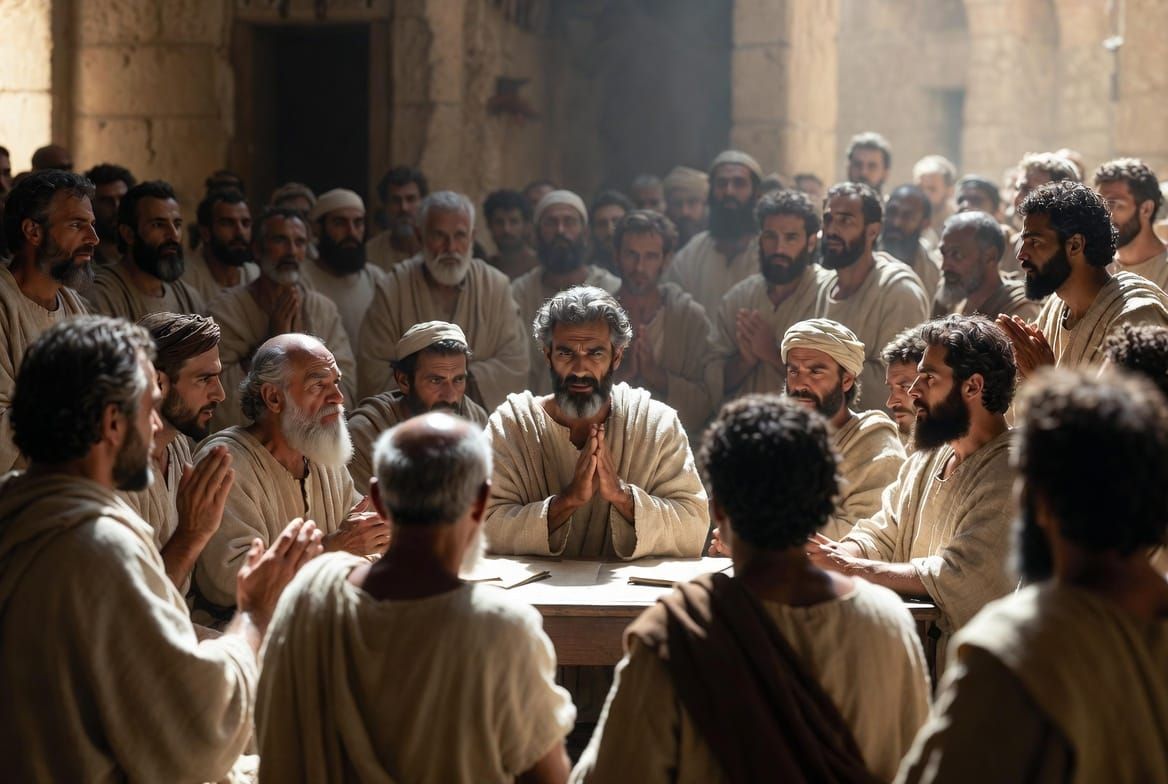
The Jerusalem Council in Acts 15 gives us the clearest biblical picture of James’s public leadership. The controversy is fundamental: must Gentile converts be circumcised and required to keep the Law of Moses in order to belong fully to the people of God?
Peter gives the theological heart of the answer when he declares, “We believe that we will be saved through the grace of the Lord Jesus, just as they will.” (Acts 15:11, ESV) Paul and Barnabas then recount the signs and wonders God has done among the Gentiles. After they finish, James gathers the testimony together, appeals to the prophets, and proposes the judgment the assembled Church adopts.
James says, “Therefore my judgment is that we should not trouble those of the Gentiles who turn to God.” (Acts 15:19, ESV) Gentile believers are not required to become Jews first. Circumcision and submission to the Mosaic covenant cannot be imposed as conditions of justification or entrance into Christ’s people. Salvation rests upon the grace of the Lord Jesus.
At the same time, James does not turn grace into moral indifference. He proposes that Gentile Christians abstain from things polluted by idols, sexual immorality, what has been strangled, and blood. These requirements address the concrete life of converts emerging from pagan worship and also serve the fellowship of Jewish and Gentile believers within one Church. They do not function as additions to justification but as part of the ordered life of those whom grace has received.
Acts 15 therefore gives the Church a striking picture of the reconciling ministry for which the Collect gives thanks. James does not act as a solitary ruler imposing a private decision. Peter has spoken, Paul and Barnabas have testified, Scripture is brought to bear, James offers his judgment, and then the apostles, elders, and whole Church act together. Truth is not surrendered, grace is not compromised, and a potentially church-dividing dispute is addressed within the fellowship of Christ.
James’s leadership is therefore neither authoritarian nor evasive. He listens, weighs testimony, interprets Scripture, speaks clearly, and helps the Church come to a common judgment faithful to the Gospel.
Prayer and Reconciliation
The Collect for James names two particular disciplines: continual prayer and “the reconciliation of all who are at variance and enmity.” Those two petitions fit the biblical and traditional memory of James with remarkable precision.
Prayer comes first because Christian reconciliation cannot be manufactured merely through technique. The Church does not reconcile people simply by finding the least offensive compromise or avoiding difficult truths. Reconciliation begins in the peace Christ has made and depends upon grace capable of changing hearts.
Acts 15 demonstrates that genuine reconciliation can include serious theological disagreement. The early Church does not preserve unity by pretending the question does not matter. The apostles and elders address it openly because the truth of the Gospel is at stake. Yet neither do they permit disagreement to destroy communion unnecessarily.
That remains a demanding model for the Church. Reconciliation does not mean declaring doctrinal differences meaningless, nor does faithfulness require treating every disagreement as grounds for permanent division. James reminds us that Christian leadership requires enough conviction to speak truth, enough humility to listen, and enough love to seek the peace and unity of Christ’s people.
The Appointed Readings
The BCP 2019 appoints Acts 15:12–22a, Psalm 1, 1 Corinthians 15:1–11, and Matthew 13:54–58 for Saint James of Jerusalem. Together they trace James from his place in Jesus’ earthly family, through the Resurrection, into the prayerful and reconciling leadership by which the Church remembers him.
Acts 15 displays James at the height of his public ministry. Peter has testified to salvation by the grace of Jesus Christ, Paul and Barnabas have described God’s work among the Gentiles, and James draws the evidence together in light of Scripture. The text gives us neither a solitary ruler nor an insignificant participant. It gives us a leading pastor whose judgment helps shape the common decision of the apostles, elders, and Church.
Psalm 1 provides the liturgical portrait through which the Church contemplates James the Just: the righteous man who delights in the law of the LORD and is like a tree planted beside streams of water, bearing fruit in season. We need not turn the Psalm into a literal biography of James to see why it belongs on his feast. The man remembered as the Just is placed before the Church alongside Scripture’s picture of steadfast righteousness rooted in God’s Word.
First Corinthians 15 gives the theological center of the feast. Paul begins with the Gospel he received and handed on: Christ died for our sins according to the Scriptures, was buried, was raised on the third day, and appeared to his witnesses. Then Paul adds the detail that gives James’s life its decisive turning point: “Then he appeared to James.” Before James becomes leader, reconciler, or martyr, he receives the risen Christ.
Matthew 13:54–58 places James within Jesus’ earthly family as Nazareth stumbles over the familiarity of the carpenter’s son. Read beside 1 Corinthians 15, the contrast becomes striking. Natural familiarity did not produce faith, but the risen Christ’s gracious self-revelation transformed the unbelieving brother.
James and the Epistle That Bears His Name
Christian tradition has long identified James of Jerusalem with the James who wrote the New Testament Epistle bearing his name. That traditional identification fits naturally with the prominence of James in Acts and Galatians and with the letter’s address to “the twelve tribes in the Dispersion.” The Epistle itself simply identifies its author as “James, a servant of God and of the Lord Jesus Christ,” so its authorship should be received as the Church’s ancient identification rather than presented as though the letter explicitly says, I am James of Jerusalem.
The Epistle emphasizes steadfast faith under trial, care for the poor, restraint of the tongue, resistance to partiality, prayer, repentance, and works flowing from genuine faith. Its famous insistence that faith without works is dead does not contradict salvation by grace through faith. James rejects a barren profession that merely claims faith while producing no living obedience. Paul rejects works as the ground of justification. Both oppose human boasting and place the Christian life beneath the grace of God.
That practical moral seriousness accords well with the ancient memory of James the Just. The same Church that remembers him as a leader of reconciliation also receives under his name a letter that refuses to separate confession from conduct. Grace receives sinners freely, and the grace that saves also bears fruit in a changed life.
The BCP 2019 Collect and Preface
The Collect on page 633 prays, “Grant, O God, that, following the example of your apostle James the Just, kinsman of our Lord, your Church may give itself continually to prayer and to the reconciliation of all who are at variance and enmity; through Jesus Christ our Lord, who lives and reigns with you and the Holy Spirit, one God, now and for ever. Amen.” It then directs the Preface of Apostles.
The prayer directs the Church’s attention toward God and asks him to form in us the virtues displayed in James. Even imitation is placed within grace. The Collect does not merely command us to pray more or become better reconcilers. It asks God to grant that his Church may do these things.
That order matters. James himself became what he became because Christ first came to him. The Church likewise cannot manufacture prayerfulness, wisdom, faithfulness, or reconciliation from its own resources. The God who called and transformed James must work in his people now.
The Preface of Apostles, whose full Proper Preface heading is Apostles and Ordinations, is also appointed for the feast. James was not one of the Twelve, yet the BCP itself calls him an apostle and places his feast beneath this Preface. That usage appropriately recognizes the wider apostolic company of the earliest Church while preserving the unique identity of the Twelve.
The Preface also keeps James beneath Christ. Apostolic ministry exists because the risen Lord sends, the Gospel belongs to him, and the Church depends upon his promise to remain with his people. James’s authority is real, but it is received authority exercised within the Church of the risen Jesus.
James’s Martyrdom
The New Testament does not record James’s death, but ancient testimony places it in Jerusalem in the first century. The principal early non-Christian source is Josephus, who reports that after the death of the Roman governor Festus and before his successor Albinus arrived, the high priest Ananus assembled the Sanhedrin and brought before it “the brother of Jesus, who was called Christ, whose name was James,” together with others. Josephus says they were accused as lawbreakers and delivered to be stoned. He also records that respected citizens protested the action and that Ananus was subsequently removed from office.
The Christian account preserved by Hegesippus and quoted by Eusebius is considerably fuller. James publicly confesses Jesus, is cast down from the Temple, survives the fall, prays while being stoned, and is finally struck by a fuller’s club. Hegesippus also gives the celebrated portrait of James as a man of exceptional prayer and righteousness.
These accounts should not simply be blended into a single seamless narrative. Josephus gives the earlier and more restrained historical notice: James was condemned under Ananus and stoned. Hegesippus supplies additional Christian traditions about the circumstances of his martyrdom. Both nevertheless converge on the important historical point that James, the brother of Jesus and leader of the Jerusalem Church, died violently in Jerusalem.
His martyrdom crowns rather than creates his witness. The theological center of James’s life lies earlier, when the risen Christ appeared to him. The man who once did not believe eventually died as one of the great leaders of the Church gathered in the very city where Jesus had been crucified and raised.
Saint James of Jerusalem in Anglican Worship
Saint James of Jerusalem has long been honored within Christian tradition as a leading pastor of Jerusalem, apostolic witness, and martyr, and the BCP 2019 observes October 23 as a Red-Letter Holy Day. The feast falls within the Season after Pentecost, when the Church is especially attentive to the long work of discipleship, mission, and growth in holiness.
Red is customarily used for Saint James of Jerusalem in Anglican worship, fitting his martyrdom and his place within the apostolic witness of the early Church. The ancient Church’s remembrance of him as the first bishop of Jerusalem also gives the feast a particular resonance for pastoral ministry. James represents leadership rooted not primarily in status but in prayer, Scripture, discernment, reconciliation, and faithful witness to the risen Christ.
His feast therefore speaks not only to bishops and clergy but to the whole Church. Every congregation knows something of disagreement. Every Christian community requires prayer. Every believer lives among relationships in which variance and enmity can take root. The Collect places those realities before God and asks him to make James’s pattern of prayerful reconciliation fruitful among us.
Observing the Feast
Saint James of Jerusalem is observed on October 23. The Collect is found on page 633, the appointed readings are Acts 15:12–22a, Psalm 1, 1 Corinthians 15:1–11, and Matthew 13:54–58, and the Preface of Apostles is appointed. Red is customarily used in Anglican worship.
The most fruitful way to observe the feast is to hold John 7:5 and 1 Corinthians 15:7 together. Jesus’ brothers did not believe during his earthly ministry, yet the risen Christ appeared specifically to James. From that act of grace came a life of leadership, prayer, reconciliation, witness, and finally martyrdom. Natural proximity to Jesus did not create faith. Christ came to James.
Then read Acts 15 and notice how reconciliation actually works. The Church does not avoid the difficult question. Peter speaks, Paul and Barnabas testify, James appeals to Scripture and offers judgment, and the Church comes to a common decision. Grace and truth are not competitors. The salvation of Gentiles is grounded entirely in the grace of Jesus Christ, yet that same grace orders the life of the people it receives.
Pray Psalm 1 and ask for the kind of rootedness Scripture associates with faithful life: delight in God’s Word, stability under pressure, and fruit borne in season. Then pray the Collect and allow its two petitions to examine the Church directly. Are we giving ourselves continually to prayer? Are we genuinely seeking reconciliation where variance and enmity have taken root, without compromising the truth in order to achieve a superficial peace?
Finally, remember the order of James’s life. Christ appeared. James believed. Grace bore fruit in leadership, prayer, reconciliation, witness, and martyrdom. Do not reverse the sequence.
Conclusion
The Feast of Saint James of Jerusalem is the story of the Lord’s brother who did not believe during Jesus’ earthly ministry and who, after the risen Christ appeared to him, became the leading figure in the Church at Jerusalem. The change did not begin with James’s natural closeness to Jesus, strength of character, reputation for righteousness, or ability to govern. It began with Christ coming to him.
That grace then bore remarkable fruit. James became a pillar of the Church, a pastor remembered for prayer, a leader whose judgment helped preserve the unity of Jewish and Gentile believers, and a martyr who remained faithful in the city where his Lord had been crucified and raised. His life demonstrates that grace does not merely forgive and leave us where we were. The risen Christ calls, transforms, and appoints his servants for work they could never have accomplished by natural strength alone.
The Collect therefore asks for something more profound than admiration of an early Christian leader. It asks God to form the Church according to the same pattern of grace: rooted in prayer, governed by the truth of the Gospel, patient amid disagreement, and committed to the reconciliation of those who are at variance and enmity. James the Just is worth remembering because his life points beyond himself to the Lord who appeared to an unbelieving brother and made him a faithful witness.
The brother who did not believe became the pillar, but the first and decisive action belonged to Christ. That is the heart of the feast and the source of its hope for the Church today.