Render to God What Is God's (Matthew 22:15-22)
Jesus neither denies Caesar's authority nor makes it absolute. His opponents want to force him to choose between competing loyalties. Instead, he places earthly duty beneath the greater claim of God. First, then, what do we legitimately owe to civil government?
October 18, 2026, Year A, Proper 24, Twenty-first Sunday after Pentecost, Season after Pentecost
Matthew 22:15–22, Psalm 96, Malachi 3:6–12
Grace, mercy, and peace from God our Father and the Lord Jesus Christ be with you on this Twenty-first Sunday after Pentecost.
Over the past several Sundays, we have followed Jesus as he has drawn nearer to the cross. Now he is in Jerusalem. The religious leaders have challenged his authority, and through a series of parables he has exposed their refusal to receive the kingdom of God. Today they change their tactics. Rather than challenging his authority openly, they attempt to trap him with a question about taxes.
At first glance, this morning's Gospel appears to concern religion and government, and Jesus certainly teaches us something important about that relationship. But his answer reaches far beyond our obligation to pay taxes. It confronts us with the rightful claims of God upon our lives. Caesar has a legitimate claim, but a limited one. God's claim extends to everything.
In verse 15 Matthew tells us, “Then the Pharisees went and plotted how to entangle him in his words” (Matthew 22:15, ESV). These men are not sincerely seeking guidance. They have already decided that Jesus must be discredited, and they believe they have found a question he cannot answer without getting into trouble.
In verse 16 they send their disciples together with the Herodians. The Pharisees were concerned with Jewish religious observance, while the Herodians were associated with rulers whose authority depended upon Rome. These groups did not ordinarily share the same interests, but they found common cause against Jesus. They begin with flattery, praising his truthfulness and impartiality. What they say about him is true, but their intentions are dishonest.
Then, in verse 17, comes their question: “Tell us, then, what you think. Is it lawful to pay taxes to Caesar, or not?” (Matthew 22:17, ESV) This was a Roman tribute tax, a reminder that Israel lived under foreign rule. Many Jews resented paying it, not merely because it cost them money, but because it symbolized submission to a pagan empire. If Jesus endorses the tax, his opponents can portray him as supporting Roman domination. If he rejects it, they can accuse him of encouraging rebellion. Either answer seems dangerous.
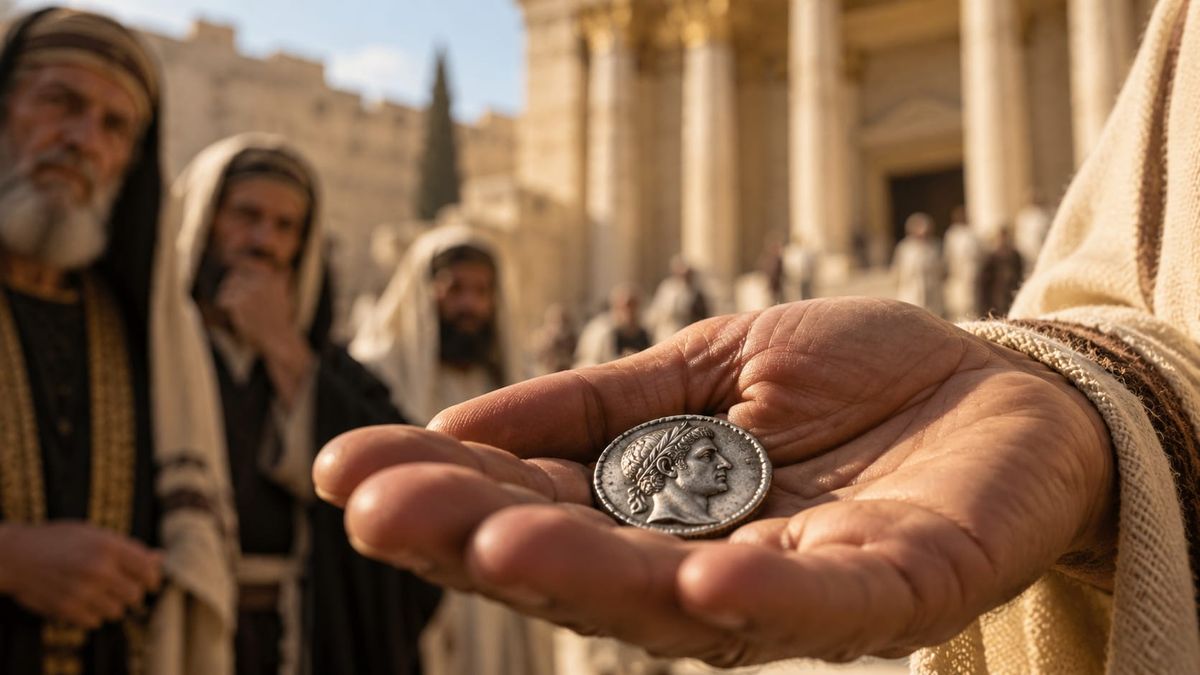
Jesus sees through their trap. In verse 18 he asks, “Why put me to the test, you hypocrites?” (Matthew 22:18, ESV) Then he calls for the coin used to pay the tax. They bring him a denarius, a Roman silver coin. In verse 20 he asks, “Whose likeness and inscription is this?” (Matthew 22:20, ESV) They answer, “Caesar's” (Matthew 22:21, ESV). And Jesus replies, “Therefore render to Caesar the things that are Caesar's, and to God the things that are God's” (Matthew 22:21, ESV).
Notice the word render. Jesus does not merely say that we may choose to give Caesar something. To render is to give what is due, to discharge an obligation. The tax is not a gift for which Caesar must be grateful. But Jesus also commands us to render to God what is God's. Those words ask something more searching than whether we have paid a bill. What is rightfully God's, and have we withheld it?
Jesus neither denies Caesar's authority nor makes it absolute. His opponents want to force him to choose between competing loyalties. Instead, he places earthly duty beneath the greater claim of God. First, then, what do we legitimately owe to civil government?
In Romans 13 Paul teaches that governing authorities have been instituted by God to restrain wrongdoing and preserve public order. He writes, “For because of this you also pay taxes, for the authorities are ministers of God, attending to this very thing” (Romans 13:6, ESV). He then instructs Christians to pay the taxes, revenue, respect, and honor that are owed.
Remember the government under which Paul wrote. Rome was not a Christian nation. Its rulers could be corrupt, its laws unjust, and its emperors could claim honors belonging to God alone. Nevertheless, Paul recognized legitimate civil authority even when its officers were not faithful to God.
Our Anglican formularies recognize this distinction. Article XXXVII of the amended Thirty-Nine Articles, Of the Power of the Civil Magistrates, teaches that civil authority extends to clergy and laity alike in temporal matters, but has no authority in things purely spiritual. It also teaches that Christians owe respectful obedience to civil authority regularly and legitimately constituted.
Civil government has responsibilities proper to its office, but it has not been entrusted with the ministry of Christ's Church. It cannot preach the Gospel in her place, administer her sacraments, or determine what she must believe. Nor should the Church confuse proclaiming the kingdom of God with seeking earthly political power. Her calling is faithfulness to Christ whether those governing are friendly or hostile to the faith.
We are not excused from civic duties because we belong to Christ. We owe obedience to legitimate laws, respect to lawful authority, and payment of taxes. We may work lawfully to change policies with which we disagree, but disagreement itself does not cancel our responsibilities. Do we respect authority only when its officers share our convictions? Are we conscientious in fulfilling our duties even when we strongly object to the government's decisions? Our heavenly citizenship should make us more responsible, not less, in our earthly citizenship.
Yet that is not the whole biblical teaching about government. The same Scriptures that command respect for civil authority warn that government can become corrupt, oppressive, and openly hostile to God. Romans 13 describes the proper purpose of civil authority. Revelation 13 warns what political power can become when it demands the worship and allegiance that belong to God alone.
John sees a beast wielding terrifying power and demanding worship. Later, Babylon appears as a corrupt power associated with idolatry, wealth, and persecution. These images warn against political authority that exalts itself above the Lord. Government entrusted with restraining evil can itself become an instrument of evil. Scripture permits neither contempt for all earthly authority nor unquestioning trust in it.
Respectful obedience is not unconditional obedience. Caesar's authority is real, but never ultimate. When human authorities command what God forbids or forbid what God commands, we must obey God. The Hebrew midwives refused Pharaoh's order to kill Israelite children. Daniel continued to pray despite the king's decree. And when the apostles were ordered to stop proclaiming Christ, Peter answered, “We must obey God rather than men” (Acts 5:29, ESV). They refused commands that would require unfaithfulness to God, even when refusal carried a cost.
This matters in our own lives. Christians believe that abortion takes innocent human life. If a physician, nurse, or other healthcare worker is ordered to participate directly in an abortion, that Christian is compelled by obedience to God to refuse. No government can make the taking of innocent life morally acceptable or require us to violate God's commandments. We must never confuse honoring lawful authority with doing evil at its command.
But what if the government uses our tax dollars to fund practices contrary to God's law? That is a different question. Suppose paying taxes made us personally responsible for every expenditure supported by public revenue. Governments spend money on many things Christians conscientiously oppose. Some expenditures are wasteful, some fraudulent, some unjust, some enriching the politicians and their friends, and others contrary to God's commandments. If each objection excused us from paying, we might conclude that we never owed taxes at all.
But, that cannot be Jesus' meaning. Rome collected taxes while supporting pagan worship, conquest, and practices contrary to God's commandments. Jesus knew the empire under which his hearers lived, yet commanded them to render to Caesar what was Caesar's. Meeting a legitimate tax obligation is not the same as approving every decision about how that revenue is spent. Nor is a taxpayer's responsibility identical to that of an official who authorizes or carries out an unjust act. The officials in questions will be judged by God, not us.
We can conscientiously oppose government funding of abortion, seek changes in the law, and refuse direct participation in wrongdoing while still paying the taxes we lawfully owe. This does not excuse governmental evil or mean that conscience never demands civil disobedience. We must distinguish resisting an unjust command from disregarding every law of a government that acts unjustly.
And we should ask ourselves whether we have begun to place more confidence in earthly power than in the Lord who reigns over every nation. Do we look to political leaders for the security, righteousness, or salvation that only God can give? Does our peace rise and fall with the fortunes of those who hold political office? When obedience to Christ carries a cost, are we prepared to remain faithful? Our allegiance cannot depend on who holds power.
Caesar may require lawful obedience and taxes, but never our worship or ultimate allegiance. Yet the question Jesus leaves before us is not only whether we have given Caesar too much. It is whether we have given God what we owe him.
Return to the coin. Jesus asks whose likeness appears upon it. Caesar's image identifies the authority represented by the coin. Scripture tells us that another image has been placed upon something more valuable than silver. In Genesis 1 God declares, “Let us make man in our image, after our likeness” (Genesis 1:26, ESV). God created mankind in his own image, male and female. Every human being bears that image because God is our Creator.
Here is a deeper implication of Jesus' answer. If the coin bears Caesar's image, what bears God's image? We do. And so does Caesar himself. The emperor whose likeness appears on the coin is accountable to his Creator. Whatever authority Caesar possesses is subordinate to God. He may claim the coin bearing his image, but even Caesar belongs to the Lord as an image bearer. And so do we. The image invites us to consider the Creator's greater claim.
God's claim is not limited to money or religious observances. Our time, abilities, possessions, relationships, and obedience belong to him. What, then, are we withholding? Is there a relationship in which we refuse to forgive, a habit we will not surrender, a responsibility we neglect, or a command of Scripture we would rather evade? Do we offer God our Sunday mornings while treating the rest of the week as our own? There is no corner of our lives over which our Creator has no rightful claim.
This makes our reading from Malachi more than an additional lesson about giving. Israel was not merely failing to contribute enough money. God's people were withholding from him what already belonged to him. In Malachi 3:8 the Lord asks, “Will man rob God? Yet you are robbing me” (Malachi 3:8, ESV). When they ask how, he answers, “In your tithes and contributions” (Malachi 3:8, ESV). Their failure exposed a deeper reluctance to acknowledge the giver of everything they possessed.
Several years ago, preaching this Malachi passage, I emphasized that income taxes do not remove our responsibility to give to God, nor can the state fulfill what the Church has been called to do. That remains true. Caesar cannot take over the Church's calling to proclaim the Gospel, administer the sacraments, and make disciples. The tithe, giving one-tenth of our income to God, is a biblical discipline of faithful stewardship. It trains us to give deliberately, regularly, sacrificially, and first, not merely whatever remains. The New Testament likewise teaches us to support the Church's ministry and care generously for those in need.
We should examine how we use everything God entrusts to us. Do we make supporting the Church a deliberate priority? The first priority? Are we generous toward people in need? Do our spending and saving show that we regard our possessions as gifts from the Lord? Even if we give one-tenth, the other nine-tenths does not cease to belong to him. Christian stewardship concerns our whole lives, not merely what we place in the offering plate.
And we never give to purchase blessings or earn salvation. No amount of money can reconcile sinners to God. Our giving responds to grace already given in Christ. Notice where Malachi begins. Before confronting his people, the Lord declares, “For I the LORD do not change; therefore you, O children of Jacob, are not consumed” (Malachi 3:6, ESV). His covenant faithfulness, not their perfect obedience, is why they have not been consumed. He calls them to return because he has not abandoned them.
Psalm 96 places this obligation beneath God's sovereign reign. In verse 8 we hear, “Ascribe to the LORD the glory due his name; bring an offering, and come into his courts!” (Psalm 96:8, ESV) But the psalm is about more than offerings. Verse 10 declares, “Say among the nations, ‘The LORD reigns!’” (Psalm 96:10, ESV) Caesar governs a nation; the Lord reigns over every nation. The worship we owe God is not one compartment of life but the acknowledgment that he is Lord of all.
Yet Jesus' words expose a contradiction in our hearts. We can pay taxes faithfully while resisting God's commandments. We can contribute generously while withholding ourselves. We can attend worship, confess the Creed, and receive Holy Communion while refusing to forgive a neighbor or repent of a cherished sin. Outward obedience matters, but it cannot substitute for hearts turned toward the Lord.
That was the deeper problem with the religious leaders. They debated what should be rendered to Caesar while standing before the Son of God and plotting his destruction. They were eager to trap him in a question of obligation while rejecting the one to whom they owed everything. In verse 22 Matthew says, “they marveled. And they left him and went away” (Matthew 22:22, ESV). They admired his answer, but Matthew tells us nothing of their repentance.
We should not assume we are different. We may see clearly the moral failures of government while excusing sin in ourselves. We may publicly defend biblical truth while privately resisting it. Which of us has loved God with all our heart, soul, mind, and strength? Which of us has rendered him the obedience, trust, and love he deserves? Jesus' answer exposes not only Caesar's limits but our need for mercy.
This is why today's Collect asks our loving Father to set us free from the bondage of our sins and, in his goodness and mercy, give us the liberty of abundant life made known in Jesus Christ. We do not merely need relief from earthly burdens. Our deeper bondage is to sin, and we cannot free ourselves. True Christian liberty is not freedom from God's authority, but freedom from sin to live gladly under his gracious rule.
Here is the good news. The one who commands us to render to God what belongs to God is the faithful Son who has rendered to his Father everything that was due. Jesus obeyed perfectly where we have failed. He loved without selfishness, fulfilled the righteousness we could not fulfill, and willingly offered himself upon the cross for our salvation.
Earthly rulers would exercise their power against him. He would be condemned under human authority and crucified by Roman hands. Yet Caesar did not have the final word. Through the sacrifice of his Son, God accomplished our redemption, and on the third day the Father raised him from the dead. Through faith in Christ we receive forgiveness we could never earn and righteousness we could never produce ourselves.
And consider whose image is being restored in us. Christ is not simply another bearer of God's image like us. Scripture calls him “the image of the invisible God” (Colossians 1:15, ESV). He is the eternal Son who perfectly reveals the Father. By his Spirit, he renews those who belong to him, so that our lives increasingly reflect the Lord whose image we bear. Our obedience is the fruit of grace, never its purchase price.
The Pharisees came with a question about a coin, but Jesus' answer confronted them with a question about their allegiance. It confronts us as well. What are we withholding from the God to whom we owe everything?
So let us render to Caesar what legitimately belongs to Caesar. Let us fulfill our responsibilities as citizens and stewards. But above all, let us remember whose image we bear. The coin bears Caesar's likeness, but we bear the image of God. And Jesus Christ, the perfect image of the invisible God, has redeemed us so that we may live as his own. Our lives belong to the Lord, not because we have earned his acceptance, but because he has first loved us and given himself for us. May we render to God what is God's, trusting in the grace of our Savior.
In the Name of the Father, and of the Son, and of the Holy Spirit. Amen.