Saint Peter and Saint Paul, Apostles: An Anglican Perspective
Saint Peter and Saint Paul therefore give the Church not two foundations but two great apostolic witnesses standing upon the same one: Jesus Christ.
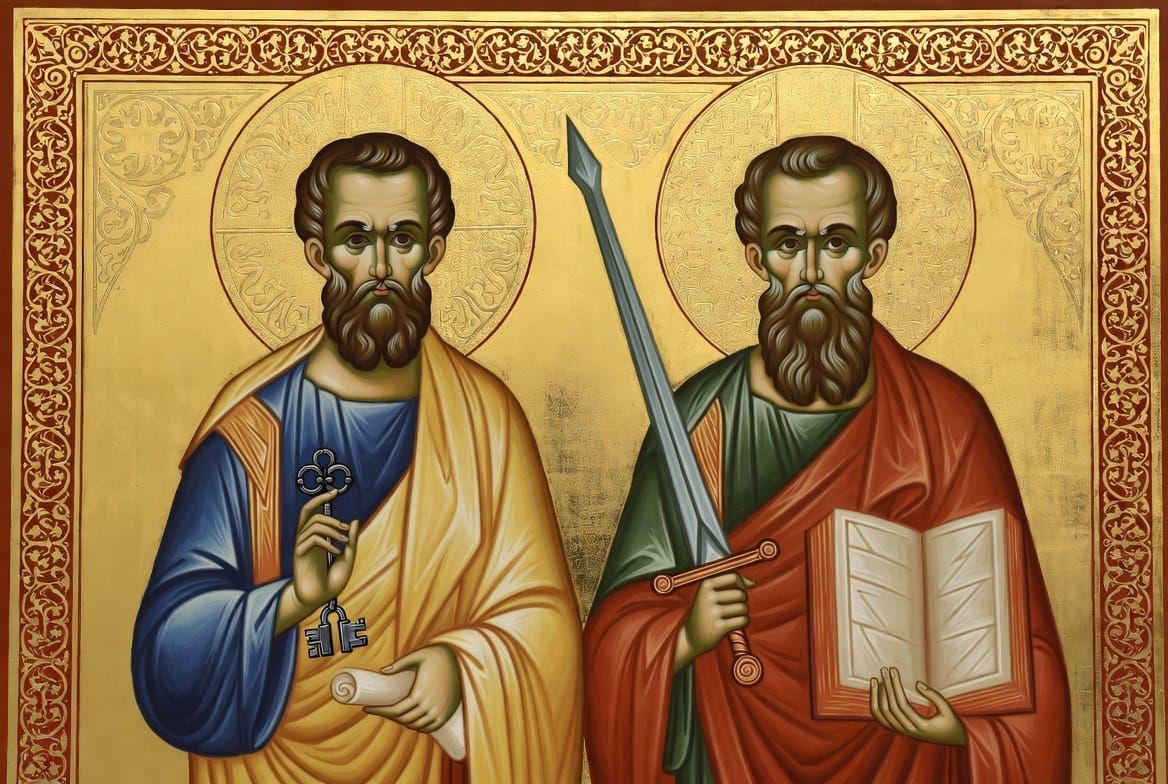
The Anglican calendar is ordered by a hierarchy of holy days, each carrying a different weight of observance. At the top stand the seven Principal Feasts, the highest-ranking days of the liturgical year. Below them are the Red-Letter Holy Days appointed in the BCP 2019 with their own Collects and propers. Saint Peter and Saint Paul, Apostles, observed together on June 29, are commemorated on one of these Red-Letter Holy Days. The BCP appoints their Collect on page 630 and their readings in the Holy Day lectionary on page 731. The appointed Proper Preface is Apostles and Ordinations.
The pairing is ancient and theologically fitting. Peter and Paul are not interchangeable, and the New Testament does not flatten their different callings, personalities, or histories. Peter belongs to the Twelve and stands prominently among them from the beginning of Jesus’ ministry. Paul enters the apostolic story later as a persecutor confronted, converted, and commissioned by the risen Christ. Peter is especially associated with the Gospel’s movement among Israel and Paul with the mission to the Gentiles, though neither man’s ministry can be confined completely to one group. Together they display the breadth of Christ’s apostolic mission and, even more importantly, the grace by which Christ takes sinful and failing men and makes them servants of his Church.
Their feast is therefore not ultimately about two great religious personalities. The BCP Collect deliberately places both beneath Christ, praying that the Church may be “instructed by their teaching and example,” “knit together in unity” by the Holy Spirit, and remain firm upon “the one foundation, which is Jesus Christ our Lord.” The apostles matter because they bear witness to the Lord who called, restored, converted, sent, sustained, and finally received them.
An Ancient Joint Feast
The joint commemoration of Peter and Paul on June 29 is among the earliest securely attested saints’ observances in the Western Church. The Depositio Martyrum, preserved in the Roman Chronography of AD 354, records Peter and Paul under June 29 and associates the day with Roman sites connected to their commemoration. Its consular dating points to AD 258, probably marking an important stage in the Roman commemoration or the treatment of their remains rather than proving that both apostles died on June 29.
Ancient Christian testimony strongly associates both Peter and Paul with martyrdom at Rome during the reign of Nero. Clement of Rome, writing near the end of the first century, presents Peter and Paul as exemplary apostles who suffered for their witness. Later witnesses become more explicit about Rome. Eusebius reports the established tradition that Peter was crucified there and Paul beheaded under Nero. He also preserves Origen’s report that Peter was crucified head downward. That detail is ancient, but later than the earliest testimony to Peter’s martyrdom, so it should be received as ancient Christian tradition without assigning every detail the same historical certainty.
The feast does not depend upon proving that Peter and Paul died on the same calendar day. Their memories became joined in the Church of Rome because both were remembered there as great apostolic witnesses who sealed their testimony with their blood. Their lives converge in Rome and martyrdom, but more fundamentally they converge in the Gospel they preached and the Lord for whom they died.
Peter: Confession, Failure, and Restoration
Simon Peter is the most prominent of the Twelve throughout the Gospels. He is frequently named first, speaks for the group, witnesses decisive moments in Jesus’ ministry, and receives responsibilities of particular importance. At Caesarea Philippi he confesses, “You are the Christ, the Son of the living God.” (Matthew 16:16, ESV) Jesus answers that this confession has not arisen from “flesh and blood” but from the Father in heaven, and says, “You are Peter, and on this rock I will build my church.” (Matthew 16:17–18, ESV)
Peter’s prominence is real, and Anglican interpretation need not minimize it in reaction to later Roman claims. He is first among the Twelve in a meaningful sense, entrusted with a leading apostolic role and given the keys of the Kingdom. Yet Peter never becomes the foundation in a way that displaces Christ or the apostolic confession of Christ. The same New Testament that gives Peter great prominence also shows him being corrected by Jesus, denying the Lord, being restored by grace, and later being opposed by Paul when his conduct compromised the truth of the Gospel.
Anglican theology therefore has no reason either to diminish Peter or to turn his prominence into an exclusive jurisdiction automatically transmitted to one later episcopal see. Peter’s greatness is apostolic and Christ-centered, exercised under the Chief Shepherd whose Church it remains.
The Gospels also refuse to let Peter’s confession become a story of uninterrupted spiritual success. Soon after Caesarea Philippi, Peter rebukes Jesus for speaking of the Cross and receives the severe answer, “Get behind me, Satan!” (Matthew 16:23, ESV) On the night of Jesus’ arrest, the man who promised to remain faithful even unto death denies three times that he knows him. Peter therefore stands before the Church as both a genuine apostolic leader and a profound example of grace. His failure is real, but his failure is not the end of his calling.
Feed My Sheep
The appointed Gospel, John 21:15–19, gives the feast its central Petrine scene. After the Resurrection, Jesus asks Peter three times, “Simon, son of John, do you love me?” Each answer is met by a pastoral commission: “Feed my lambs,” “Tend my sheep,” and “Feed my sheep.” (John 21:15–17, ESV) The threefold exchange naturally answers Peter’s threefold denial with a threefold restoration and commission. Jesus does not merely assure Peter that his sin is forgiven. He restores the fallen disciple to the work of shepherding Christ’s flock.
The restoration is both personal and vocational. Jesus entrusts the sheep to the man who denied him, but the sheep never become Peter’s possession. They remain Christ’s: my lambs, my sheep. Peter is a shepherd only because the Good Shepherd restores and sends him.
This makes the appointed Old Testament reading, Ezekiel 34:11–16, especially powerful. There God promises, “I myself will search for my sheep and will seek them out,” and says that he will seek the lost, bring back the strayed, bind up the injured, and strengthen the weak. (Ezekiel 34:11, 16, ESV) In John 10 Jesus identifies himself as the Good Shepherd, and in John 21 the risen Shepherd gives Peter a subordinate pastoral vocation within his own shepherding work. Peter feeds the flock because Jesus tells him to do so, and the flock remains Jesus’ own.
The passage then moves directly from pastoral commission to suffering. Jesus tells Peter that when he is old another will stretch out his hands and carry him where he does not wish to go, and John explains that Jesus said this “to show by what kind of death he was to glorify God.” (John 21:19, ESV) The final command is again, “Follow me.” Peter’s restoration does not lead back to safety. Grace restores him to a discipleship that will eventually cost his life.
Peter and the Keys
Because Peter’s feast inevitably raises questions about his place in the Church, the image of the keys deserves careful treatment. In Matthew 16 Jesus tells Peter, “I will give you the keys of the kingdom of heaven,” and gives him authority to bind and loose. (Matthew 16:19, ESV) Peter’s role is particular and should not be explained away. The image carries the background of delegated stewardship found in Isaiah 22, where the steward of the royal house receives authority to open and shut.
Peter receives genuine ministerial authority under Christ to bind and loose: to proclaim and apply the Gospel, teach the faith Christ has given, pronounce forgiveness to the penitent and judgment upon the impenitent, exercise pastoral discipline, and order the life of the Church according to the Word of her King. The authority is real, but it is delegated. The steward does not own the house, and Peter does not own the Kingdom.
Nor is the ministry represented by this authority Peter’s private possession. In Matthew 18:18, Jesus gives authority to bind and loose to the disciples corporately, and in John 20:21–23 the risen Christ commissions the apostolic company with authority concerning the forgiveness and retention of sins. Peter’s reception of the keys therefore belongs within his particular leading role among the apostles, while the ministerial authority they signify belongs to the apostolic Church under Christ and his Word.
The most classically Anglican way to receive Peter is therefore neither by denying his primacy of place among the Twelve nor by importing later papal claims back into the first century. Peter can rightly be described as first among equals: genuinely prominent in leadership within the apostolic company, yet still an apostle under Christ and among apostles, capable of error, correction, failure, and restoration. The keys signify ministerial and derivative authority, not sovereign power or an exclusive Petrine jurisdiction standing apart from the apostolic faith.
Paul: The Persecutor Called by Grace
Paul enters the apostolic story from the opposite direction. He is not one of the original Twelve, did not accompany Jesus during his earthly ministry, and was not chosen with Matthias to restore the number of the Twelve. He appears first as Saul, approving Stephen’s death and then “breathing threats and murder against the disciples of the Lord.” (Acts 9:1, ESV)
His encounter with Christ on the road to Damascus is therefore not the culmination of an earnest spiritual search. Saul is moving against Jesus when Jesus lays hold of him. The risen Lord asks, “Saul, Saul, why are you persecuting me?” (Acts 9:4, ESV) The persecutor discovers that violence against Christ’s people is violence against Christ himself.
Paul later describes his apostolic calling entirely in the language of grace. After listing appearances of the risen Jesus to Cephas, the Twelve, James, and the apostles, he says that Christ appeared also to him. He calls himself “the least of the apostles, unworthy to be called an apostle, because I persecuted the church of God,” and then gives the explanation for everything that followed: “But by the grace of God I am what I am.” (1 Corinthians 15:9–10, ESV)
God is unmistakably the first mover. Christ confronts an enemy, gives him mercy, calls him, and sends him. Paul’s enormous labor is real, but Paul immediately adds that it was “not I, but the grace of God that is with me.” (1 Corinthians 15:10, ESV)
The Anglican calendar rightly gives this decisive event its own feast on January 25, the Conversion of Saint Paul. June 29 then places the converted apostle beside Peter and allows the Church to see the larger arc: the fisherman whom Christ restored and the persecutor whom Christ converted are both made servants of the same Gospel.
Paul’s Apostolic Calling and Finished Race
Paul’s status differs from Peter’s, but it is no less genuinely apostolic. He repeatedly defends his apostleship on the ground that the risen Christ appeared to him and commissioned him. In 1 Corinthians he asks, “Am I not an apostle? Have I not seen Jesus our Lord?” (1 Corinthians 9:1, ESV) In Galatians he insists that his apostleship is “not from men nor through man, but through Jesus Christ and God the Father.” (Galatians 1:1, ESV)
This does not make Paul an independent Christian authority free from the Church or from the apostolic Gospel. Galatians itself shows him going to Jerusalem, laying before recognized leaders the Gospel he preached, and receiving the right hand of fellowship from James, Cephas, and John. (Galatians 2:1–10) His calling originates directly in Christ, while his mission exists within the one apostolic Church.
Paul also recognizes a differentiation of missionary emphasis. Peter was entrusted particularly with the Gospel to the circumcised while Paul was entrusted with the Gospel to the uncircumcised. (Galatians 2:7–8) This does not create two Gospels. The distinction concerns mission, not saving truth.
The appointed Epistle, 2 Timothy 4:1–8, places that apostolic calling at the end of its earthly course. Paul commands Timothy to “preach the word” in season and out of season, to reprove, rebuke, and exhort with patience, because a time will come when people will not endure sound teaching. (2 Timothy 4:2–3, ESV) Faithful teaching and costly witness belong together. Paul does not measure success by whether his message remains culturally welcome.
He then turns toward his own death: “I am already being poured out as a drink offering, and the time of my departure has come.” He continues, “I have fought the good fight, I have finished the race, I have kept the faith.” (2 Timothy 4:6–7, ESV) Those words are not self-salvation by achievement. The crown of righteousness is given by “the Lord, the righteous judge,” and Paul extends the promise beyond himself to “all who have loved his appearing.” (2 Timothy 4:8, ESV) The grace that called Paul also kept him through the race.
Peter hears, “Follow me,” knowing the road will end in death. Paul reaches the end of his road able to say that, by grace, he has kept the faith. One receives the prophecy of costly following; the other looks back upon a life in which that cost has nearly reached its end.
Peter and Paul at Antioch
A joint feast of Peter and Paul must also reckon honestly with Galatians 2. Paul recounts an episode at Antioch in which Peter had been eating with Gentile Christians but withdrew when certain men arrived from James because he feared the circumcision party. Paul says he opposed Peter “to his face, because he stood condemned.” (Galatians 2:11, ESV)
The disagreement is not evidence that Peter and Paul preached fundamentally different religions. Paul’s argument assumes that Peter knows the same Gospel and is acting inconsistently with it. The problem is not doctrinal diversity that must simply be celebrated. Paul says their conduct was “not in step with the truth of the gospel.” (Galatians 2:14, ESV)
Nor should the episode be minimized merely because later Christians find apostolic disagreement uncomfortable. Peter could act wrongly. Paul could correct him publicly when the truth of the Gospel was at stake. Apostolic unity is not the absence of correction but common submission to the Gospel of Christ.
This makes the Collect’s prayer that the Church may be “knit together in unity by your Spirit” especially rich. Christian unity does not mean pretending differences, sins, or errors do not exist. The unity given by the Spirit is unity in truth, under Christ, and within the one Gospel. No apostle, not even Peter, stands above correction by that Gospel, and no apostle, not even Paul, stands as a private source of Christianity detached from the Church. Both stand beneath Christ.
One Foundation and One Apostolic Faith
The central theological phrase of the BCP Collect is that the Church may “ever stand firm upon the one foundation, which is Jesus Christ our Lord.” The language echoes Paul’s statement, “For no one can lay a foundation other than that which is laid, which is Jesus Christ.” (1 Corinthians 3:11, ESV)
Other New Testament passages can speak of the apostles themselves as foundational. Ephesians says that the household of God is “built on the foundation of the apostles and prophets, Christ Jesus himself being the cornerstone.” (Ephesians 2:20, ESV) Revelation depicts the New Jerusalem with twelve foundations bearing the names of the twelve apostles of the Lamb. (Revelation 21:14) There is no contradiction. Christ is the ultimate and indispensable foundation, while the apostles are foundational as his commissioned witnesses whose teaching bears authoritative testimony to him.
This distinction helps interpret both Peter and Paul. Peter’s rock imagery cannot be used to make Christ secondary, and Paul’s authority cannot be used to detach apostolic teaching from the historical Church Christ founded. Their authority is derived, received, and ordered toward Christ. Historic continuity of ministry serves apostolicity only when it remains ordered to the faith once delivered rather than becoming a substitute for it.
Peter and Paul therefore remind the Church that apostolic Christianity is something received rather than reinvented. Paul tells Timothy to preach the Word even when people will not endure sound teaching. Peter exhorts elders to shepherd the flock of God while awaiting the appearance of the Chief Shepherd. (1 Peter 5:1–4) Both understand ministry as stewardship.
The Church has no authority to transform the historic apostolic faith into something more acceptable to each passing culture. She may translate, explain, defend, contextualize, and apply the Gospel, but she may not replace it. Apostolicity necessarily includes fidelity to the teaching handed down from those whom Christ commissioned.
This should not produce arrogance. Peter received his confession by revelation from the Father, and Paul describes himself as an unworthy persecutor saved and commissioned by grace. The Church can therefore confess without apology while remaining humble, standing not upon her own brilliance but upon Jesus Christ.
The Appointed Readings
The BCP appoints Ezekiel 34:11–16, Psalm 87, 2 Timothy 4:1–8, and John 21:15–19 for Saint Peter and Saint Paul. These readings are found on page 731.
Ezekiel 34 places pastoral ministry beneath God’s own shepherding action. God seeks, gathers, feeds, binds, and strengthens his sheep. John 21 then gives Peter a real pastoral share in that care under the risen Christ. The readings protect the Church from imagining pastoral authority as possession or domination. Shepherds serve sheep who belong to God.
Psalm 87 widens the horizon from shepherding to the nations. Zion is pictured as the city in which peoples once identified as outsiders or enemies are counted among those who belong to God. Rahab, a poetic name for Egypt, appears alongside Babylon, Philistia, Tyre, and Cush within the Psalm’s extraordinary vision of the nations incorporated into Zion. Read on the feast of Peter and Paul, the Psalm naturally resonates with the Gospel’s movement beyond ethnic Israel.
Peter’s ministry to Cornelius in Acts 10 marks a decisive moment in the reception of Gentiles, while Paul becomes the great missionary apostle among the nations. The Psalm’s vision of the nations belonging to God therefore provides an appropriate biblical horizon for their apostolic work.
Second Timothy gives the charge and the finished race; John 21 gives restoration, shepherding, and the beginning of Peter’s final following. Together the readings move from the Shepherd who owns the flock, to the nations gathered into God’s city, to apostolic faithfulness unto death.
The BCP 2019 Collect and Proper Preface
The Collect on page 630 prays, “Almighty God, whose blessed apostles Peter and Paul glorified you by their martyrdom: Grant that your Church, instructed by their teaching and example, and knit together in unity by your Spirit, may ever stand firm upon the one foundation, which is Jesus Christ our Lord; who lives and reigns with you, in the unity of the Holy Spirit, one God, now and for ever. Amen.”
The prayer does not celebrate apostolic greatness in isolation. Even their martyrdom glorifies God. Their teaching and example are received for the Church’s good, but the Spirit must create the unity for which the prayer asks. Finally, Peter and Paul themselves cannot become the Church’s ultimate foundation. Jesus Christ remains the one foundation.
The grace-first pattern is especially clear when the Collect is read alongside their lives. Peter does not restore himself after denying Christ. Jesus comes to him. Paul does not reason his way from persecution to apostleship. Christ stops him. Neither man makes himself an apostle. Both are called and sent. Their obedience is nevertheless real. Grace does not eliminate human faithfulness. It creates and sustains it.
The appointed Proper Preface is Apostles and Ordinations. It gives thanks through Jesus Christ, the great Shepherd of his flock, who after his Resurrection sent forth his apostles to preach the Gospel and teach all nations and promised to be with them to the end of the ages. The Preface places the feast firmly under the authority of the risen Christ. Peter and Paul are sent men before they are celebrated men.
Unity Without Uniformity
The joint feast carries an important ecclesial lesson. Peter and Paul are different men with different stories, different missionary emphases, and at least one serious recorded conflict. Their unity therefore cannot mean sameness.
The Church likewise does not need every Christian to possess the same temperament, gifts, vocation, or manner of service. Peter’s pastoral and missionary role is not simply Paul’s role reproduced. Paul’s extraordinary theological and missionary calling does not make Peter redundant. The Spirit can give different gifts while maintaining one faith.
Yet diversity has boundaries. Peter and Paul do not symbolize an open-ended pluralism in which contradictory Gospels can coexist indefinitely. Paul says explicitly, “even if we or an angel from heaven should preach to you a gospel contrary to the one we preached to you, let him be accursed.” (Galatians 1:8, ESV) Christian unity is unity around the truth revealed in Christ.
This makes the feast particularly relevant to a Church tempted either by needless division or doctrinal indifference. The answer to division is not to make apostolic teaching optional, and the answer to disagreement is not to pretend that truth does not matter. The Collect prays for a Church simultaneously instructed by their teaching, knit together in unity by the Spirit, and standing upon Christ. Doctrine, unity, and Christ belong together.
The Liturgical Character
Red is customarily used for Saint Peter and Saint Paul in Anglican worship. It is particularly fitting because the feast’s own Collect explicitly commemorates the two apostles as martyrs and recalls the costly witness by which both glorified God.
June 29 always falls after Pentecost and therefore within the Season after Pentecost. The customary red of the feast interrupts the green ordinarily associated with the long season, placing before the Church the apostolic witness upon which her ordinary discipleship rests. The Spirit who forms Christians in patient, ordinary obedience is the same Spirit who sustains martyrs when ordinary obedience becomes extraordinarily costly.
When June 29 Falls on Sunday
Saint Peter and Saint Paul is a Red-Letter Holy Day rather than a Principal Feast, so the BCP’s rules of precedence govern its observance when June 29 falls on Sunday. Because June 29 always falls after Pentecost, it does not encounter the Advent, Lent, or Easter restrictions that govern some other fixed Holy Days.
Under the Prayer Book rubric, when June 29 falls on an ordinary Sunday in the Season after Pentecost, the feast may be observed on that Sunday or transferred to the nearest following weekday. Its fixed date should therefore not be permanently tied to any particular numbered Proper.
This keeps the observance within the same hierarchy of holy days that governs the rest of the Anglican calendar: Peter and Paul are honored fully, but always within the ordered worship of the Church and beneath the Lord to whom every feast ultimately belongs.
Observing This Feast
Saint Peter and Saint Paul are observed together on June 29. The Collect is found on page 630, the appointed Proper Preface is Apostles and Ordinations, and the readings are Ezekiel 34:11–16, Psalm 87, 2 Timothy 4:1–8, and John 21:15–19.
Begin with John 21 and resist the temptation to read the passage only as a leadership text. Peter is being restored by the Lord he denied. His pastoral vocation begins again in forgiveness. Ask what this says about Christ’s ability to restore sinners without trivializing their sins and about the dependence of every shepherd upon the mercy of the Chief Shepherd.
Then read 2 Timothy 4 and hear Paul’s charge before hearing his farewell. The apostolic task is not merely to finish a personal race but to keep and proclaim the faith when hearers would prefer something else. Ask whether the Church is prepared to preach the Word “in season and out of season.”
Read Galatians 2 as well, even though it is not among the appointed lessons. The joint feast becomes more meaningful, not less, when we remember that Peter and Paul genuinely disagreed and that Paul publicly corrected Peter when Gospel fellowship was at stake. Christian unity does not depend upon pretending there has never been conflict.
Finally, pray the Collect slowly. Its three movements provide an examination for the whole Church: Are we being instructed by apostolic teaching and example? Are we seeking the unity that only the Spirit can give? Are we actually standing upon Jesus Christ rather than upon personalities, institutions, movements, political allegiances, or ecclesiastical pride?
Conclusion
Saint Peter and Saint Paul stand together in the calendar not because their differences disappear but because one Lord claimed them both. Peter confesses Christ and then misunderstands him. He promises loyalty and then denies him. The risen Jesus restores him, entrusts him with the care of the flock, and calls him again to follow. Paul begins as an enemy of the Church, and the risen Jesus confronts him in the middle of his rebellion, gives him mercy, and sends him to bear the Gospel among the nations.
Neither story begins with human adequacy. Peter’s confession is revealed by the Father, his restoration is given by Christ, and his shepherding ministry is entrusted to him. Paul’s conversion interrupts active hostility, and his own explanation remains, “By the grace of God I am what I am.” (1 Corinthians 15:10, ESV) God acts first.
Grace then bears fruit in costly obedience. Peter follows the Shepherd toward the death Jesus foretold. Paul reaches the end able to say that he has fought the good fight, finished the race, and kept the faith. Ancient Christian testimony places both at Rome, bearing witness to Christ unto death under Nero.
Yet their feast does not ask the Church to stand upon Peter or Paul. The Church receives their teaching, learns from their example, prays for unity in the Spirit, and stands upon “the one foundation, which is Jesus Christ our Lord.” Peter is not the Gospel, and Paul is not the Gospel. Their differences remain and their callings are distinct, but their confession converges upon one Lord and their ministry serves one Gospel.
Saint Peter and Saint Paul therefore give the Church not two foundations but two great apostolic witnesses standing upon the same one: Jesus Christ.