Worthy of Me (Matthew 10:34-42)
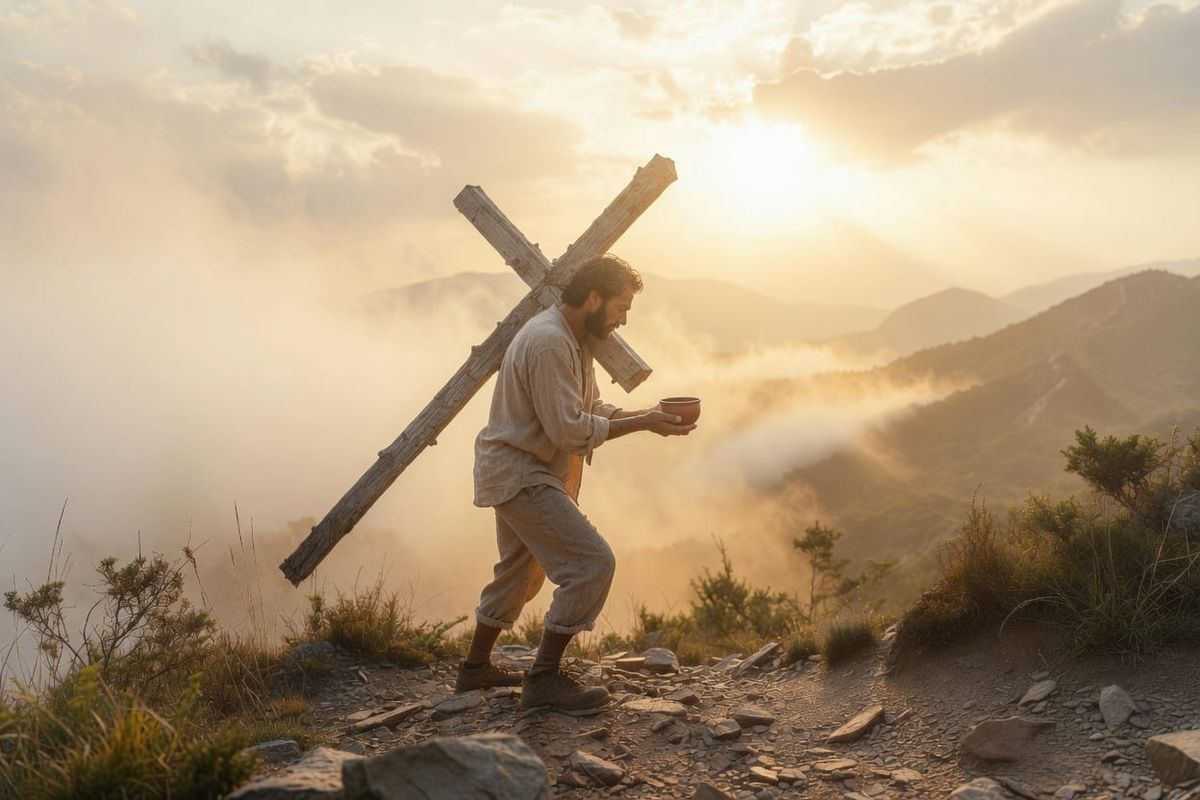
Proper 8. The cross-bearing of verses 37–39 is our calling as little ones. A cup of water given because a person belongs to Christ will by no means lose its reward. A double negative in the Greek: absolutely not, under any circumstances. No act of faithful service is forgotten.
June 28, 2026, Year A, Proper 8, The Fifth Sunday after Pentecost
Matthew 10:34–42, Psalm 89:1–18, Isaiah 2:10–17
Grace, mercy, and peace from God our Father and the Lord Jesus Christ be with you on this Fifth Sunday after Pentecost.
We have been in Matthew’s Mission Discourse for three Sundays now. On Proper 6 we watched Jesus look at the crowds with compassion, pray for laborers, and then make the disciples the answer to their own prayer. On Proper 7 we heard the honest price tag: sheep among wolves, courts and floggings, families divided, the demand to confess Christ before men and the threefold call to have no fear.
The passage moves from the hardest sentence in the discourse to the most tender. It opens with a sword. It closes with a cup of cold water. And the movement between them is not a contradiction but a single coherent vision of what it means to follow Jesus in the world.
Verse 34: “Do not think that I have come to bring peace to the earth. I have not come to bring peace, but a sword.” (Matthew 10:34, ESV) This is the sentence that stops us. The Jews of Jesus’ day expected the Messiah to overthrow the Roman occupation, assume the throne of David, and bring political peace and prosperity. That was a reasonable reading of the Old Testament prophets. But Jesus had said already in John 18:36 that his kingdom is not of this world. And many of us carry a modern version of the same misreading: that following Jesus ought to make life easier, smoother, and more manageable. Jesus cuts that expectation off before it takes root.
Before we go further, we should note what Jesus does not mean. He does not mean that he brings no peace at all. The peace that passes all understanding, the peace of reconciliation with God through the forgiveness of sins, that peace is real, and it is offered in the middle of a world at war. His name is Emmanuel: God with us. The New Testament promise is not that life will be easy but that Jesus will be present through all of it. The sword he describes is not the peace of God. It is the effect of the Gospel on the allegiances of men.
The sword is not a weapon Jesus wields against people but the truth he declares about them and about himself. The Gospel first condemns before it offers hope. As the writer of Hebrews says, the word of God is “sharper than any two-edged sword, piercing to the division of soul and of spirit, of joints and of marrow, and discerning the thoughts and intentions of the heart.” (Hebrews 4:12, ESV) The Gospel hurts before it heals, like surgery without anesthesia. Many will not stay for the healing because the initial wound is too great to bear. They will refuse to accept that they are sinners, that their own righteousness is not enough. And that refusal will make them hostile to the messenger. Expect opposition. Jesus says so twice, and we should pay attention.
He quotes Micah 7:6 in verses 35 and 36: “For I have come to set a man against his father, and a daughter against her mother… And a person’s enemies will be those of his own household.” (Matthew 10:35–36, ESV) Micah wrote these words describing the total corruption of Judah in the days of King Ahaz, when idol worship and the desecration of the Temple were tearing the kingdom apart from within. Jesus reaches for that image to describe what the Gospel does to close relationships: the disruption it brings can have a collapsing effect, particularly in households where some members confess Christ and others do not.
It is worth pausing on what Jesus says twice. He covered the division of families in verses 21 and 22 last week, and he returns to it here. When the Lord says something twice, we are meant to pay attention. He cannot be more serious about the reach and intensity of the opposition the Gospel provokes. And notice the specific quality of this opposition: it comes from within the household. Not first from strangers or governments but from people we love. That is the hardest kind.
We should also be honest about what this does not mean. Some people take this passage as license to be at odds with anyone who does not share their faith, even provoking division as though it were a mark of faithfulness. That is not the point. The sword Jesus brings is not ours to wield; he carries it. Our posture toward unbelieving family members and neighbors is not combative but patient. We would do well to see unbelievers not as enemies but as captives: the lost sheep, the lost coin, the son who is still a long way off. The Gospel is divisive enough without us making it worse, and the division it creates is the consequence of their response to the truth, not the product of our aggression.
Our reading from Isaiah 2 gives this demand its cosmic frame. Isaiah 2:10–17 is the prophet’s vision of the Day of the Lord: “The haughty looks of man shall be brought low, and the lofty pride of men shall be humbled, and the Lord alone will be exalted in that day.” (Isaiah 2:11, ESV) The Lord alone will be exalted. Everything human and self-constructed will be brought low. And what Matthew 10 demands at the personal level is simply the lived application of what Isaiah declares at the cosmic level. If the Lord alone will be exalted, then he alone must hold the place of first love in the lives of those who follow him.
Now verse 37: “Whoever loves father or mother more than me is not worthy of me, and whoever loves son or daughter more than me is not worthy of me.” (Matthew 10:37, ESV) The word worthy, the Greek axios (AHX-ee-os), appears twice here and once more in verse 38. Jesus is not saying that family love is wrong or that we are to love our families less. He is commanding that we love him more. There is a ranking of loves, and he insists on occupying the top of it. The person who loves father or mother or son or daughter above Jesus has given the first place to a created love and the second place to the Creator. That inversion makes them unworthy, not because their family love is evil but because their ultimate allegiance is misplaced.
Jesus also alludes in Matthew 19:29 that Christians may need to leave their families for his name’s sake and that those who do will receive a hundredfold and inherit eternal life. He is not calling for a boisterous or unloving attitude toward family or toward unbelievers. On the contrary, our relationships should flourish and love should abound within them. It is simply that the reverence and love of Christ must not be eclipsed by any other love, however natural and good.
This is the Great Commandment applied to the life of the disciple. Love the Lord your God with all your heart and soul and might. That kind of love does not leave room for a competing first place. And the competing loves that most endanger us are rarely enemies of the faith. They are often good things that have been given a rank they were not meant to hold. For the parents among us, consider how easily the love of our children, beautiful and right in its proper place, can slide into what we might call childolatry: the child on the throne ahead of Jesus. Those parents are in danger of surrendering their loyalty to Christ for the sake of their children when it comes to a moment of real conflict. Jesus is not asking us to love our children less. He is asking that the love of him not be eclipsed by any other love, however good.
Then verse 38: “And whoever does not take his cross and follow me is not worthy of me.” (Matthew 10:38, ESV) Taking up the cross does not mean enduring some unpleasant circumstance or condition that has been imposed on our lives. It means willfully dying to self: radical obedience to and identification with Jesus, even when it puts us at odds with the world, our families, our neighbors, or costs us everything. The Anglican bishop J.C. Ryle observed that nothing damages the cause of the faith more than the love of the world, the fear of the world, the cares and pleasures of the world, and the desire to remain comfortable within it. Many begin as Abraham or Moses and end as Lot’s wife. The cross is the alternative to that ending. Jesus first, always.
And then the great paradox, verse 39: “Whoever finds his life will lose it, and whoever loses his life for my sake will find it.” (Matthew 10:39, ESV) The word translated life is the Greek psyche (SOO-khay): it can mean life, soul, or self. Those who lose their psyche, whether through martyrdom or the daily discipline of dying to self so that Christ may have his way in their lives, will find what they surrendered and more, in the age to come. Those who organize their existence around protecting and advancing their own interests, who keep what they have at the expense of their relationship with Christ, will not find it there.
Psalm 89, which we prayed this morning, gives us the ground on which this surrender is possible: “I will sing of the steadfast love of the Lord, forever; with my mouth I will make known your faithfulness to all generations.” (Psalm 89:1, ESV) The God to whom we surrender the psyche is the God of steadfast love and faithfulness across every generation. We can release what we cannot keep because the one we release it to is trustworthy.
The pastoral weight of verse 39 should not be missed. This instruction is not given to people in a comfortable season. It is given to people about to be sent as sheep among wolves, who will face household division, courts, and the demand to confess Christ before men. Jesus is not asking for the surrender of the psyche from people who have nothing at stake. He is asking for it from people who have everything at stake. And the promise he attaches is proportionate: the one who surrenders most will find most. This is not a call to resignation but to trust: releasing what we cannot ultimately keep to the one who is faithful to all generations.
The passage turns at verse 40 and the register changes entirely: “Whoever receives you receives me, and whoever receives me receives him who sent me.” (Matthew 10:40, ESV) The disciples are not merely representatives in some political sense. When they are received, Christ is received; and when Christ is received, the Father is received. The chain of reception runs from the disciple all the way to the throne of heaven.
Then verses 41 and 42 extend this logic to its most precise and tender conclusion. The phrase little ones in verse 42 does not refer to children. In Matthew 10 the little ones are the disciples themselves, described as little because they are insignificant in the world’s estimation: lacking the education, the finances, and the social standing that the world calls great. We are little ones in this same sense: not necessarily because we lack education or resources, but because the world regards those who follow Christ as foolish, as irrelevant, as obstacles to its agendas. The world does not honor those who carry the Gospel. But the Lord most notices precisely those whom the world most overlooks.
And what is required of the person who encounters a little one? Not a significant offering. Not a public act of sponsorship. A cup of water, given because the one receiving it belongs to Christ. The smallest act of hospitality extended to a disciple because he is a disciple is noticed and remembered. Jesus says: “he will by no means lose his reward.” (Matthew 10:42, ESV) The Greek is a double negative, as emphatic as the language allows. This will not be forgotten, not under any circumstances, not ever.
Here is how the passage lands on us. We are the little ones. We are the sent ones, the cross-bearers, the disciples who are insignificant in the world's estimation. The cross-bearing of verses 37 and 38 is our calling: the preference set aside, the complaint swallowed, the agenda surrendered. And the promise of verses 40 through 42 is our encouragement: everyone who receives us because we belong to Christ, everyone who shows us even the smallest hospitality for his sake, will not lose their reward. We are not the givers of the cup in this passage. We are the ones to whom the cup is given. And that is a more humbling and more comforting position than it first appears.
The call to extend that same hospitality to our fellow believers is real, and Scripture is clear about it. Paul writes in Galatians 6:10: “So then, as we have opportunity, let us do good to everyone, and especially to those who are of the household of faith.” (Galatians 6:10, ESV) We are both recipients of the promise in Matthew 10 and givers of the kind of hospitality Paul describes in Galatians 6. But the two passages carry different emphases, and it matters to keep them distinct. Matthew 10 is spoken to encourage disciples who are about to be sent into a world that may not receive them well. The promise is: your smallness is seen, your witness carries weight, and those who welcome you will not go unrewarded. That encouragement belongs to us as we go.
The encouragement of verse 42 is this: our smallness does not disqualify us. The world regards those who follow Christ as little, as lacking, as irrelevant. And Jesus says that anyone who gives a cup of water to one of these little ones because he is a disciple will by no means lose his reward. The one who receives us is receiving Christ. That means our presence among people, our witness, our ordinary faithfulness, carries more weight than the world assigns it. Christ is in us, and therefore with us, and therefore the smallest act of welcome extended to us for his sake reaches all the way to the throne.
There is a tendency in the Church to think of the cross as the dramatic kind: the martyr’s death, the family rupture, the public confession that costs everything. Those are real, and they happen. But for most of us, the cross is the daily kind. It is the discipline of preferring the neighbor over the self, the brother over the schedule, the little one over the comfort. Both the dramatic and the daily cross are covered by verse 38. Both are the path that leads through losing the psyche to finding it. And both are the life that will, on the other side of the age to come, look far more significant than it appeared in the ordinary week in which it was lived.
Tomorrow, June 29, the Church keeps the feast of Saint Peter and Saint Paul, Apostles, and there is no better pair of faces to put on this passage. The feast day article will be on the website this week. Peter took up his cross in the most literal sense, crucified under Nero, asking to be crucified upside down because he did not consider himself worthy to die as his Lord had died. Paul’s testimony from the inside: “I have been crucified with Christ. It is no longer I who live, but Christ who lives in me. And the life I now live in the flesh I live by faith in the Son of God, who loved me and gave himself for me.” (Galatians 2:20, ESV) That is not a mystical abstraction. It is the autobiography of a man who lost his psyche and found it. Both apostles lived verse 39. Both were little ones to the world. And neither one will lose his reward.
Movement I of our summer in Matthew closes today. Three weeks: the harvest and the compassion and the commissioning; then the cost of speaking and the threefold call to have no fear; then the full personal cost of discipleship and the promise that no cup of water given in his name will be forgotten. Next Sunday, Movement II begins: “Come to me, all who labor and are heavy laden, and I will give you rest.” (Matthew 11:28, ESV) The one who asked us to take up the cross now says his yoke is easy and his burden is light. The cross does not crush; it is carried by the one who bore it first.
The collect for this Sunday asks God to put away from us all hurtful things and give us those things that are profitable for us. By this passage’s reckoning, the hurtful things include everything we love more than Christ and every comfort we protect at the cost of faithfulness. And the profitable things include the cross, the surrendered psyche, and the cup of water that will by no means lose its reward. That is what it means to be worthy of him: not perfect, not fearless, not without doubt or difficulty, but ordered rightly, with Christ at the top, following where he leads. Jesus first, always.
In the Name of the Father, and of the Son, and of the Holy Spirit. Amen.