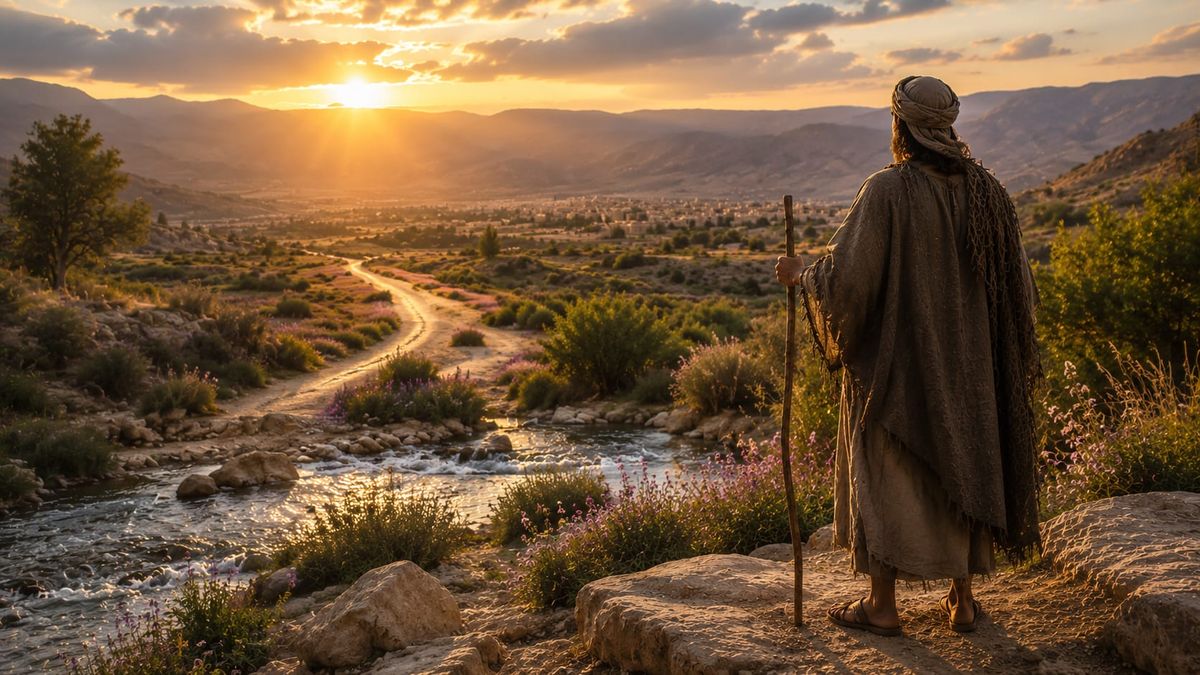
The Highway to Holiness (Isaiah 35:1-10)
That matters because biblical hope is never sentimental. Isaiah does not say, “Cheer up, things may get better.” He says, “Behold, your God will come.” Christian hope rests not in our ability to improve the wilderness, but in the promise that God himself comes to save.
December 14, 2025, Year A, The Third Sunday in Advent
Matthew 11:2–19, Psalm 146, Isaiah 35:1–10
Grace, mercy, and peace from God our Father and the Lord Jesus Christ be with you on this Third Sunday in Advent.
On this Third Sunday in Advent, often called Gaudete Sunday, we are invited to rejoice in the midst of our watchful waiting. The rose candle on our Advent wreath flickers with a lighter hue, reminding us that the joy of Christ’s coming pierces the shadows of anticipation. Yet our joy is not naive. It is rooted in the promises of Scripture, promises that stretch from ancient prophecy to the incarnate Word and onward to the consummation of all things.
Today we will look primarily at the radiant vision of Isaiah 35, a chapter that bursts forth like a desert spring after the darkness of judgment. Here the prophet paints a picture of transformation so vivid that it stirs the soul: barren lands blooming, weak hands strengthened, feeble knees made firm, the afflicted healed, and the ransomed returning home with songs of joy. Isaiah’s words do not stand alone. They echo in Psalm 146 and in the Gospel account of Matthew 11:2–19, where Jesus points to his own works as the answer to John the Baptist’s question.
Let us begin in Isaiah 35. The chapter opens with a declaration of reversal in verses 1–2: “The wilderness and the dry land shall be glad; the desert shall rejoice and blossom like the crocus; it shall blossom abundantly and rejoice with joy and singing” (Isaiah 35:1–2a, ESV). Imagine the Judean wilderness, a parched expanse where life clings to rock and sand. Isaiah, speaking hope after the darkness of judgment, foresees a day when desolation erupts in floral splendor, echoing the glory of Lebanon, Carmel, and Sharon.
The prophet continues in verse 2: “The glory of Lebanon shall be given to it, the majesty of Carmel and Sharon. They shall see the glory of the Lord, the majesty of our God” (Isaiah 35:2b, ESV). The transformation is tied to the revelation of God’s glory. What was barren becomes beautiful because the Lord comes near. What seemed abandoned becomes a witness to the presence and faithfulness of God.
Then Isaiah turns from the land to the people in verses 3–4: “Strengthen the weak hands, and make firm the feeble knees. Say to those who have an anxious heart, ‘Be strong; fear not! Behold, your God will come with vengeance, with the recompense of God. He will come and save you’” (Isaiah 35:3–4, ESV). These are words for people whose hands have grown weak under oppression and whose knees have nearly buckled beneath fear and judgment. God’s coming is both salvation and judgment. He comes to save his people, and he comes to set right what evil has made crooked.
That matters because biblical hope is never sentimental. Isaiah does not say, “Cheer up, things may get better.” He says, “Behold, your God will come” (Isaiah 35:4, ESV). Christian hope rests not in our ability to improve the wilderness, but in the promise that God himself comes to save.
The heart of the chapter lies in verses 5–6: “Then the eyes of the blind shall be opened, and the ears of the deaf unstopped; then shall the lame man leap like a deer, and the tongue of the mute sing for joy. For waters break forth in the wilderness, and streams in the desert” (Isaiah 35:5–6, ESV). Isaiah is promising real restoration: blind eyes opened, deaf ears unstopped, lame bodies made strong, mute tongues singing. And those bodily signs also point beyond themselves to the full healing of God’s people and creation when all that sin has disordered is finally made whole.
The waters breaking forth in the wilderness belong to that same picture of life where there had been death. As the canon unfolds, those waters also call to mind the life-giving work of the Holy Spirit, poured out upon God’s people. The desert does not save itself. Life comes because God gives it.
Then in verse 8 Isaiah describes a highway in the wilderness: “And a highway shall be there, and it shall be called the Way of Holiness; the unclean shall not pass over it. It shall belong to those who walk on the way; even if they are fools, they shall not go astray” (Isaiah 35:8, ESV). Verse 9 tells us that this road is safe from predators: “No lion shall be there, nor shall any ravenous beast come up on it” (Isaiah 35:9a, ESV). This is not merely a road out of danger. It is the road by which the redeemed come home.
Verse 10 gives us the destination: “And the ransomed of the Lord shall return and come to Zion with singing; everlasting joy shall be upon their heads; they shall obtain gladness and joy, and sorrow and sighing shall flee away” (Isaiah 35:10, ESV). Zion is the holy city, the place of God’s dwelling with his people. And as the whole story of Scripture unfolds, Zion opens out into the people of God gathered in Christ and finally into the New Jerusalem, where God dwells with his people and sorrow and death are no more.
That is why the Gospel appointed today matters so much. John the Baptist, imprisoned by Herod, sends disciples to ask Jesus, “Are you the one who is to come, or shall we look for another?” (Matthew 11:3, ESV) John had announced the Messiah’s arrival with fiery urgency. He had preached of the one who would baptize with the Holy Spirit and fire and whose winnowing fork would separate wheat from chaff (Matthew 3:11–12). From prison, John’s question brings into view the tension between what he proclaimed and what he now sees.
Jesus does not dismiss him. He answers with evidence: “Go and tell John what you hear and see: the blind receive their sight and the lame walk, lepers are cleansed and the deaf hear, and the dead are raised up, and the poor have good news preached to them” (Matthew 11:4–5, ESV). Jesus is pointing John back to Isaiah. The signs are here. The kingdom has come near. The blind see, the lame walk, the deaf hear, and good news is preached to the poor.
But not everything Isaiah describes has happened yet. Sorrow and sighing have not fled away. Bodies still fail. The wilderness is not yet entirely in bloom. Jesus’ first coming brings the kingdom truly, but not yet in its final fullness. Christ has come, defeated sin and death by his cross and resurrection, and reigns now. Yet we still await his return, the resurrection of the body, the judgment of the world, and the renewal of all things.
That is the historic Anglican hope. We do not look for a future earthly thousand-year reign before the final resurrection and judgment. In the historic amillennial reading long common in Anglicanism, the thousand years of Revelation are understood symbolically as Christ’s present reign, while we await his visible return in glory. Christ reigns now through his Word, his Spirit, and the life of his Church, and at his return Isaiah’s vision will reach its final fulfillment: creation renewed (Romans 8:19–23), bodies raised in glory (1 Corinthians 15:42–44), justice fully established, and everlasting joy in the New Jerusalem (Revelation 21:1–4).
Psalm 146 gives us the same hope from another angle. The psalmist begins, “Praise the Lord! Praise the Lord, O my soul! I will praise the Lord as long as I live; I will sing praises to my God while I have my being” (Psalm 146:1–2, ESV). Then he gives a warning we desperately need to hear: “Put not your trust in princes, in a son of man, in whom there is no salvation. When his breath departs, he returns to the earth; on that very day his plans perish” (Psalm 146:3–4, ESV). Earthly rulers may promise much, but none of them can bear the weight of our ultimate hope.
In contrast, the Lord does not fail: “Blessed is he whose help is the God of Jacob, whose hope is in the Lord his God, who made heaven and earth, the sea, and all that is in them; who keeps faith forever; who executes justice for the oppressed, who gives food to the hungry” (Psalm 146:5–7a, ESV). Then the psalm sounds like Isaiah again: “The Lord sets the prisoners free; the Lord opens the eyes of the blind. The Lord lifts up those who are bowed down; the Lord loves the righteous. The Lord watches over the sojourners; he upholds the widow and the fatherless, but the way of the wicked he brings to ruin” (Psalm 146:7b–9, ESV).
In Herod’s day, an earthly ruler imprisoned John, but Herod did not have the final word. In our day, political leaders may sometimes act in ways that accord with justice and human flourishing, and at other times they may do the opposite. We should pray for those in authority (1 Timothy 2:1–2) and act faithfully as citizens, but Psalm 146 will not let us make princes into saviors.
Jesus then goes on in Matthew 11 to expose another kind of unbelief. He says, “But to what shall I compare this generation? It is like children sitting in the marketplaces and calling to their playmates, ‘We played the flute for you, and you did not dance; we sang a dirge, and you did not mourn’” (Matthew 11:16–17, ESV). John came in austerity, and they rejected him. Jesus came eating and drinking, and they rejected him too. The problem was not the style of the messenger. The problem was the refusal to receive God’s wisdom.
Jesus then says, “For John came neither eating nor drinking, and they say, ‘He has a demon.’ The Son of Man came eating and drinking, and they say, ‘Look at him! A glutton and a drunkard, a friend of tax collectors and sinners!’ Yet wisdom is justified by her deeds” (Matthew 11:18–19, ESV). John’s question brings the “already but not yet” tension into sharp focus, but Jesus’ answer is not abstract. He points to what God is actually doing in him.
That brings us back to the Highway of Holiness. In Christ’s first coming, Isaiah 35 begins to be fulfilled. The blind see, the lame walk, the deaf hear, and the poor hear good news. The waters of life begin to flow, and the Highway of Holiness finds its fulfillment in the one who says, “I am the way, and the truth, and the life” (John 14:6, ESV). The way is holy because it belongs to God and because he has redeemed the people who walk upon it.
Advent is therefore not merely a season for contemplating distant promises. It is a season for being changed by them now. The Third Sunday in Advent Collect asks Christ, who sent the prophets “to preach repentance and prepare the way for our salvation,” to make ready his way among us so that “at your second coming to judge the world, we may be found a people acceptable in your sight” (BCP 2019, p. 599). That is exactly the movement of Isaiah 35. God makes the road, God saves the ransomed, and those who belong to him are called to walk in holiness while they wait.
So what does that look like for us? First, like John, we may find ourselves asking hard questions when God’s timing confounds us. Perhaps we pray for healing that tarries, justice that seems delayed, reconciliation that does not come, or peace in a world that remains violent. John’s question from prison reminds us that faithful disciples can find themselves asking difficult questions. Jesus’ answer points us back to himself and to the works that reveal who he is.
Second, we are called to walk the Highway of Holiness. Isaiah’s road is not a path we build for ourselves. It is God’s road for the redeemed, and because it belongs to him, we are called to walk it in repentance and obedience. Holiness is not the price of admission to God’s kingdom. It is the life of those whom God has ransomed and brought home.
Third, we are called to bear witness to the healing kingdom of Christ in a still-broken creation. The miracles of Jesus are previews of the kingdom he brings, and the Church is sent to bear witness to that kingdom through mercy, prayer, service, and the proclamation of the Gospel. We cannot open blind eyes by our own power or raise the dead, but we can refuse to look away from suffering, pray boldly, serve faithfully, and point people to the Savior who will one day make all things new.
Consider the teenager who can no longer see hope because every screen tells him he is not enough. Consider the widow whose world has grown suddenly small, or the person whose body has become frail and whose future feels uncertain. This Advent, whose burden might be lightened by our presence, our prayer, our willingness to listen, our practical help, and our words of Gospel encouragement?
Fourth, we must learn to lament honestly and hope audaciously. From Herod’s prison John sends a raw question to Jesus, and Jesus answers him with the evidence of the kingdom. We do not need to pretend that everything is fine. We can name the wars, the griefs, the disappointments, and the prayers that seem unanswered, and then read Isaiah 35 again as God’s answer that has already begun and will not fail.
Lament without hope curdles into cynicism, and hope without lament becomes sentimentality. Advent teaches us to hold both together. We cry, “How long, O Lord?” (Psalm 13:1, ESV) while clinging to the promise, “Behold, I am making all things new” (Revelation 21:5, ESV).
Fifth, we must reorder our trust away from princes and toward the coming King. One election cycle promises to deliver us into the Promised Land, and the next delivers us into the wilderness. Leaders, conservative, liberal, or otherwise, will disappoint us if we ask them to be what only Christ can be.
Psalm 146 is blunt: “When his breath departs, he returns to the earth; on that very day his plans perish” (Psalm 146:4, ESV). So pray earnestly for those in authority, but pray even more earnestly that our hearts would be detached from the rise and fall of earthly kingdoms. Fast from the twenty-four-hour news cycle for a day and spend that time in Revelation 21–22 instead. Let the vision of the city whose gates are never shut discipline our fears and reorder our hope.
Finally, dear friends, let us prepare room for joy. Isaiah’s desert does not merely survive. It rejoices with joy and singing. The ransomed return to Zion with everlasting joy upon their heads (Isaiah 35:10). In the midst of honest lament, faithful service, repentance, and watchful waiting, the Church is called to practice resurrection joy now. Light the rose candle and mean it.
The one who began this good work in the manger and carried it through the cross and empty tomb has promised to bring it to completion at his appearing. He who made the lame walk will one day raise our bodies in glory. He who opened blind eyes will wipe every tear from the eyes of his people. And at the end of the Highway, we long to hear the words of the Master in Jesus’ parable: “Well done, good and faithful servant… Enter into the joy of your master” (Matthew 25:23, ESV).
Therefore, brothers and sisters, “be strong; fear not! Behold, your God will come” (Isaiah 35:4, ESV). He has come. He is coming. And when he does, “sorrow and sighing shall flee away” (Isaiah 35:10, ESV). Everlasting joy shall be upon our heads.
In the Name of the Father, and of the Son, and of the Holy Spirit. Amen.