Stephen, Deacon and Martyr: An Anglican Perspective
December 26: the feast of Stephen, the first martyr. The day after Christmas, the Church moves from the cradle to the stones. The child laid in the manger is the Lord for whom Stephen dies. The Incarnation was never going to be safe.
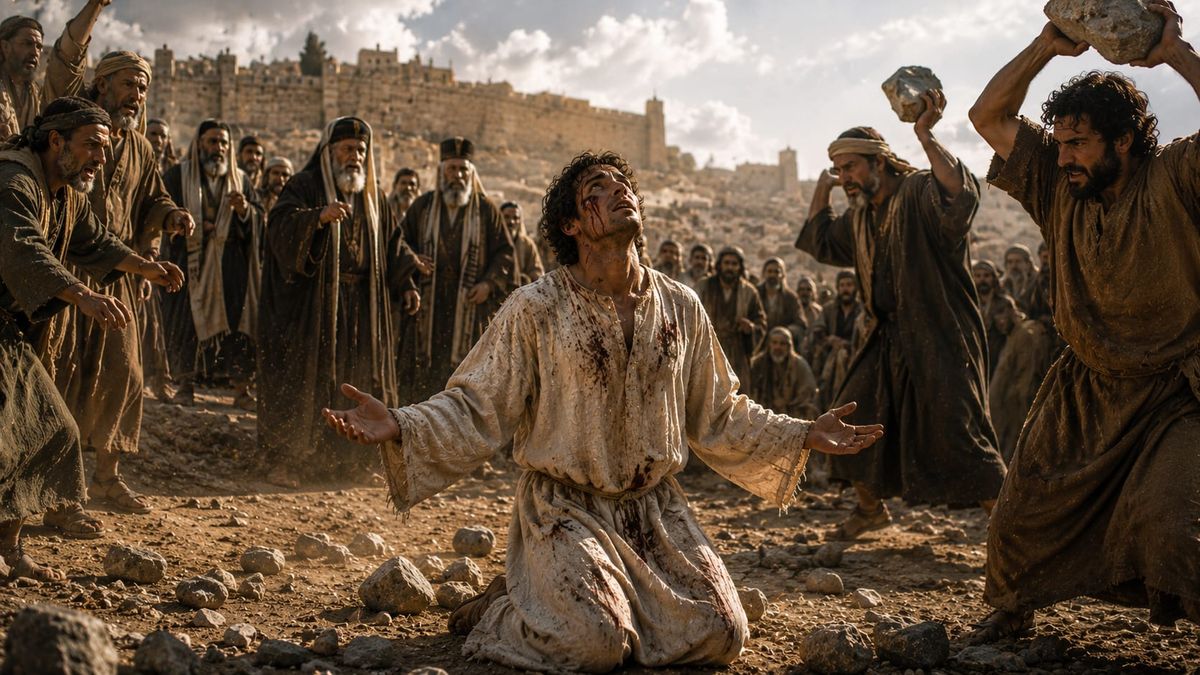
Feast Day: December 26
The Anglican calendar is ordered by a hierarchy of holy days, each carrying a different weight of observance. At the top sit the seven Principal Feasts — the highest days of the liturgical year. Below them are the Red-Letter Holy Days, appointed in the BCP 2019 with their own collects, propers, and lectionary readings, listed on page 688. They are called Red-Letter Days because, in the tradition of printing church calendars, these days appear in red ink, distinguished from the Optional Commemorations which appear in ordinary type. The feast of Stephen, Deacon and Martyr, observed on December 26, is one of these Red-Letter Holy Days.
December 26 is the day after Christmas. The Church moves from the birth of the Word made flesh to the death of the first Christian martyr without pausing. This juxtaposition is not accidental. The days immediately following Christmas have always been days on which the Church honors those who bore witness to and died for the child born on December 25 — Stephen on the 26th, John the Apostle on the 27th, the Holy Innocents on the 28th. The cradle and the stones are not in tension. They are the same story at its beginning and its first costly consequence. The Incarnation was never going to be safe. The one who came to give his life a ransom for many would gather a company of those willing to do the same.
The Biblical Portrait
Stephen appears in Acts 6, introduced as one of the seven men chosen to serve the Jerusalem church in its daily distribution of food. The appointment addresses a complaint from the Hellenistic Jewish Christians that their widows were being overlooked in favor of the Hebrew-speaking widows. The apostles propose a solution: seven men of good repute, full of the Spirit and of wisdom, should be appointed to this service so that the apostles themselves can devote their attention to prayer and the ministry of the Word. Stephen is named first in the list of seven, described as “a man full of faith and of the Holy Spirit.” (Acts 6:5, ESV)
But the narrative moves immediately past the table service. Acts 6:8 opens a new paragraph: “And Stephen, full of grace and power, was doing great wonders and signs among the people.” (Acts 6:8, ESV) The man appointed to wait on tables is doing miracles. His diaconal appointment does not limit him; it grounds him. He is challenged in the synagogue by those who cannot withstand the wisdom and Spirit with which he speaks, and they bring him before the Sanhedrin on false charges — the same charges brought against Jesus: speaking against the temple and the law. As he stands before the council, Luke records: “All who sat in the council saw that his face was like the face of an angel.” (Acts 6:15, ESV)
The speech that follows in Acts 7 is the longest in the book of Acts — a panoramic retelling of salvation history from Abraham through Moses through David and Solomon, arriving at the accusation that the council has received the law as delivered by angels and has not kept it, has always resisted the Holy Spirit, has betrayed and murdered the Righteous One. The council’s response is fury. They rush at Stephen, drag him out of the city, and stone him. And as the stones fall: “But he, full of the Holy Spirit, gazed into heaven and saw the glory of God, and Jesus standing at the right hand of God. And he said, ‘Behold, I see the heavens opened, and the Son of Man standing at the right hand of God.’” (Acts 7:55–56, ESV) The Son of Man is standing. Elsewhere in the New Testament he is seated at the right hand of the Father. Here, at the death of the first martyr, he stands — as if to receive him. Then Stephen kneels and cries out: “Lord, do not hold this sin against them.” (Acts 7:60, ESV) And he dies. His last prayer mirrors his Lord’s last prayer from the cross. The first martyr dies the way his Lord died: forgiving.
A young man named Saul is standing nearby, holding the cloaks of those doing the stoning, consenting to the execution. It is the first appearance in Acts of the man who will become Paul the Apostle. The seed planted in Saul’s conscience on this day — the face like an angel, the vision of the opened heavens, the prayer for the killers — will bear fruit on the Damascus road. Stephen’s death is not a defeat. It is the first link in a chain that will carry the Gospel to the Gentile world.
The Theological Significance
Jeremiah 26:1–15, the appointed Old Testament reading from the propers on page 730 of the BCP 2019, places Stephen in the long line of prophets condemned by the religious establishment for speaking God’s word faithfully. Jeremiah stands before the priests and prophets who want him killed for prophesying the destruction of the temple, and he says: “Truly the Lord sent me to you to speak all these words in your ears.” (Jeremiah 26:15, ESV) Stephen’s speech before the Sanhedrin follows exactly this pattern: the faithful witness who speaks what God has given him to speak, condemned by those whose authority his message threatens. Matthew 23:29–39, the appointed Gospel, is Jesus’ lament over Jerusalem — “O Jerusalem, Jerusalem, the city that kills the prophets and stones those who are sent to it!” (Matthew 23:37, ESV) — the prophetic tradition of rejected witnesses that Stephen is about to join. The feast of Stephen is the feast of what happens when the Word of God meets human resistance at its most violent: the witness is killed and the word goes on.
Psalm 31:1–6, the appointed psalm, contains the verse that links Stephen’s death to the death of Jesus: “Into your hand I commit my spirit; you have redeemed me, O Lord, faithful God.” (Psalm 31:5, ESV) These are the words Jesus quotes from the cross in Luke 23:46. Acts 7:59 records Stephen’s dying prayer: “Lord Jesus, receive my spirit.” The psalm that Jesus prayed as he died is the psalm Stephen prays as he dies. The first martyr’s death is a deliberate echo of his Lord’s. The Church that sings Psalm 31 on the feast of Stephen is singing the dying prayer of both.
The appointed Epistle is Acts 6:8–7:2a, 51–60 — the account of Stephen’s ministry, arrest, speech, and death. This is the feast’s primary narrative text. It does not need supplementation; it simply needs to be heard. But Hebrews 12:1–2, though not appointed, resonates with the vision Stephen receives as he dies: the great cloud of witnesses, and Jesus, the founder and perfecter of faith, “who for the joy that was set before him endured the cross, despising the shame, and is seated at the right hand of the throne of God.” (Hebrews 12:2, ESV) Stephen sees exactly this vision — and sees the seated one standing. He is the first to join the cloud of witnesses by dying for the faith he professed.
Stephen, the Diaconate, and Anglican Order
Stephen is not only the first martyr. He is a deacon — one of the seven appointed in Acts 6 to the service of the Church’s practical ministry. The BCP 2019 makes the connection between Stephen’s office and his feast explicit in the Ordinal, the service for the Ordination of a Deacon. The prayer on page 475 addresses God: “Almighty God, by your divine providence you appointed various Orders of Ministers in your Church, and you inspired your Apostles to appoint to the Order of Deacons the first martyr Stephen, with others: mercifully behold these your servants now called to the same office and administration.” (BCP 2019, p. 475) The deacon is ordained into the same order as the first martyr. Stephen’s feast on December 26 is therefore a feast that speaks with particular force to the theology of the diaconate — the order of those who serve at table, serve the poor, and are prepared by that service to speak with the Spirit’s wisdom when called to account.
Stephen’s ministry demonstrates that the diaconal vocation is not administrative rather than spiritual, but that the two belong together. He was appointed to serve tables and ended up moving the powers of heaven. His full character — full of faith, full of the Holy Spirit, full of grace and power — was expressed through both the service and the testimony. Anglicanism’s three-fold ordering of ministry — bishops, priests, and deacons — places Stephen at the foundation of the third order. His feast invites the Church to ask whether its deacons are shaped by the same fullness of Spirit that made a table-server into the Church’s first martyr.
The BCP 2019 Collect and Preface
The BCP 2019 appoints the following collect for the feast on page 624: “O Glorious Lord, your servant Stephen looked up to heaven and prayed for his persecutors: Grant that in all our sufferings here upon earth we may love and forgive our enemies, looking steadfastly to Jesus Christ our Lord, who sits at your right hand and intercedes for us; and who lives and reigns with you and the Holy Spirit, one God, now and for ever. Amen.” The collect is anchored in two actions: Stephen looked up to heaven, and he prayed for his persecutors. Both are asked of the Church in the petition that follows. Looking steadfastly to Jesus Christ — the one who sits at the right hand and intercedes — is the source and ground of the forgiveness that the Church is asked to extend to its enemies. Stephen could forgive because he saw the one who forgives. The collect asks that the same vision would sustain the same response in those who suffer for the faith.
The Preface of Christmas, found on page 152 of the BCP 2019, is appointed for this feast — the same preface used on Christmas Day itself: “Because you gave Jesus Christ, your only Son, to be born for us; who, by the Holy Spirit and the Virgin Mary his mother, was made truly man, yet without the stain of sin, that we might be cleansed from sin and given the right to become your children.” (BCP 2019, p. 152) The use of the Christmas preface on Stephen’s feast is the calendar’s quiet theological statement: the Incarnation and the martyrdom belong together. The one born for us on December 25 is the one for whom Stephen died on December 26. The Word made flesh is the Word worth dying for. The preface of the cradle governs the feast of the stones.
Stephen in Anglican Worship
The feast of Stephen has been observed on December 26 since antiquity and was retained in the Church of England at the Reformation as a Red-Letter Holy Day. Its placement the day after Christmas has always carried the same theological message: Christmas is not a comfortable or safe announcement. The Word became flesh in a world that would resist and reject him, and the first person to die for that Word did so within twenty-four hours of the calendar’s celebration of his birth.
Red vestments are worn on Stephen’s feast, even within the Christmas season. Red is the color of the martyr’s blood and of the Holy Spirit’s fire, and on December 26 it honors the first person to die for the child born two days before. The Christmas season continues in every other respect — the Preface of Christmas is used, the season’s joy frames the commemoration — but the vestments name honestly what December 26 is: the feast of a martyr.
In England, December 26 is also known as Boxing Day, the traditional day for giving to the poor — a custom rooted in the practice of opening the church’s alms box on the day after Christmas and distributing its contents to those in need. Whether or not this custom was always consciously connected to Stephen’s feast, the connection is fitting: Stephen was appointed precisely to ensure that the poor were not overlooked in the Church’s daily distribution. The deacon who served the widows of Jerusalem is honored on the day the English tradition sets aside for charity to the poor. The theology and the custom, whatever their separate origins, belong together.
December 26 often falls on a Sunday, particularly in years when Christmas falls on a Saturday. When it does, the feast may be observed on that Sunday or transferred to the nearest following weekday, per the rubrics on page 689 of the BCP 2019. The Christmas season continues regardless: the preface remains, the white vestments remain, and the celebration of the Incarnation is not interrupted by the martyr’s feast but deepened by it.
Observing This Feast
To observe the feast: pray the collect from BCP 2019, p. 624. Read Acts 6:8–7:60 — the full account of Stephen’s ministry, arrest, speech, and death — and notice the face like an angel, the vision of the opened heavens, and the prayer for his killers. Read Jeremiah 26:1–15 as the Old Testament portrait of the faithful prophet condemned by the religious establishment. Pray Psalm 31:1–6 as the dying prayer that links Stephen to his Lord. Read Matthew 23:29–39 and hear Jesus name the pattern into which Stephen’s death will fall. And sit for a moment with the young man named Saul, standing at the edge of the crowd, holding the cloaks — the future Paul, who would later write that he was the chief of sinners, consenting to this death before the Lord arrested him on the Damascus road.
Conclusion
Stephen, Deacon and Martyr, is the first to follow the Word made flesh to death. He dies with his Lord’s prayer on his lips, his Lord’s psalm on his tongue, and his Lord’s vision before his eyes. He dies forgiving. And his death plants a seed in the conscience of Saul of Tarsus that will grow, over years and a blinding light on a road to Damascus, into the apostolate that carried the Gospel to the Gentile world. The stones do not end the story. They begin it.
“O Glorious Lord, your servant Stephen looked up to heaven and prayed for his persecutors: Grant that in all our sufferings here upon earth we may love and forgive our enemies, looking steadfastly to Jesus Christ our Lord.” (BCP 2019, p. 624)