The Word Became Flesh: Christmas Day 2025 (John 1:1-18)
Christmas Day: The baby in the manger is no ordinary child; he is the eternal Word, the radiant glory of God, who upholds the universe yet became flesh to dwell among us. Through John 1, Hebrews 1, and Psalm 98, we behold a God full of grace, truth, and unending love.
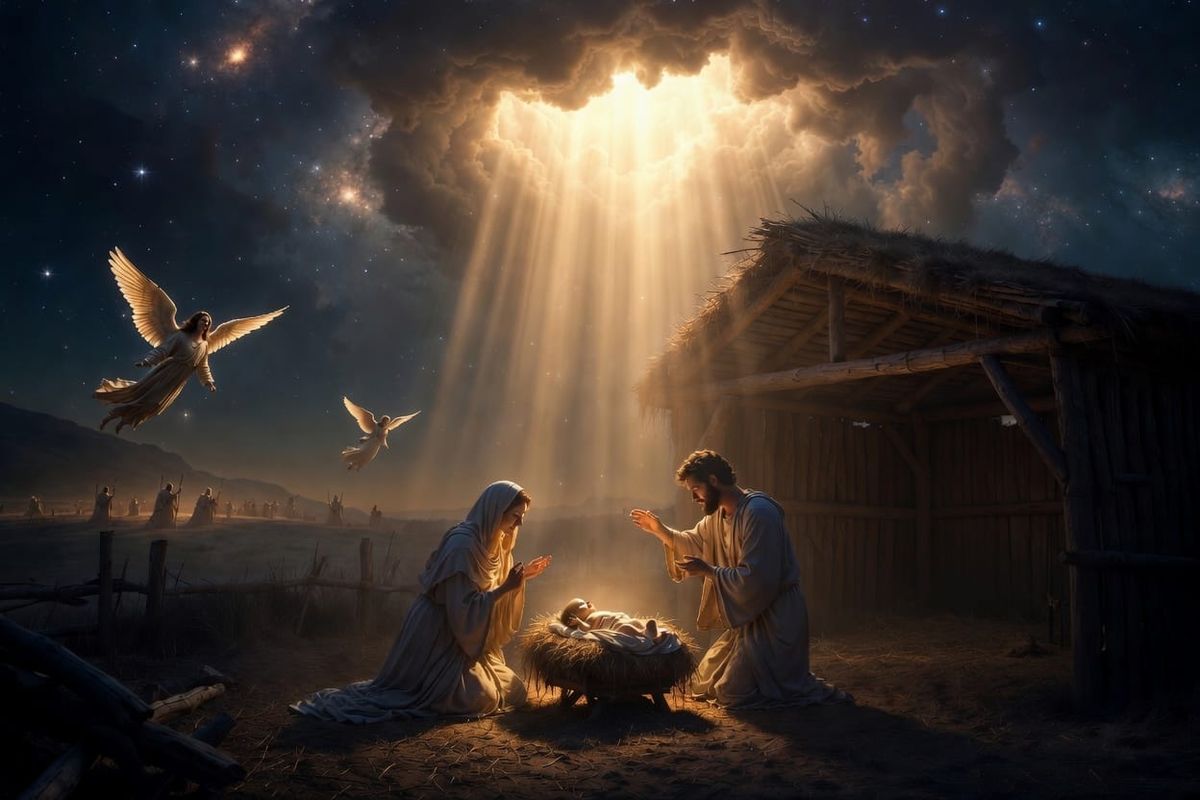
December 25, 2025, Christmas Day, Principal Feast, Season of Christmas
John 1:1–18, Psalm 98, Hebrews 1:1–12
Merry Christmas!
This morning feels different from Christmas Eve. Last night we gathered in the glow of the Nativity story and heard Isaiah announce that the people walking in darkness had seen a great light. We went with Luke to Bethlehem, heard the angels proclaim the birth of the Savior, and looked upon the Child lying in the manger. This morning the Church asks us to look at that same Child again, but from another direction. John takes us behind Bethlehem and before creation itself, while Hebrews lifts our eyes from the manger toward the eternal glory of the Son. The question this morning is not simply, “What happened at Christmas?” It is, “Who is this Child who has been born?”
John answers by beginning where Scripture itself begins: “In the beginning.” But unlike Genesis, John does not immediately tell us what God created. He tells us who was already there: “In the beginning was the Word, and the Word was with God, and the Word was God.” (John 1:1, ESV) Before Bethlehem, before Abraham, before Adam, before light was spoken into the darkness, the Word was.
John is careful with every phrase. The Word was with God, personally distinct from the Father, and the Word was God, fully sharing the divine nature. He is not a creature who came into existence before the rest of creation. John immediately rules that out in verse 3: “All things were made through him, and without him was not any thing made that was made.”Everything that belongs to the category of created things came into being through him. The Word himself belongs eternally on the Creator’s side of that distinction.
That means the Child whose birth we celebrated last night is the eternal Son through whom the world exists. The stars above Bethlehem were made through him. The hills surrounding the town were made through him. Mary and Joseph were made through him. The wood of the manger existed through him. John wants us to feel the weight of the confession before he ever tells us that the Word became flesh.
Then he adds in verse 4, “In him was life, and the life was the light of men.” The light we celebrated last night is not merely a metaphor for hope or optimism. Christ is the source of life itself. John continues, “The light shines in the darkness, and the darkness has not overcome it.” (John 1:5, ESV) Christmas announces not merely that a light has appeared but that the eternal Light has entered the darkness of a fallen world, and the darkness cannot conquer him.
Then, in verse 14, John gives us the sentence upon which Christmas morning rests: “And the Word became flesh and dwelt among us.” The eternal Son did not cease to be what he eternally is. He did not surrender his divinity, nor did he merely appear to be human. He truly assumed our human nature. The one who was with God and was God became man without ceasing to be God.
The word translated dwelt is eskēnōsen (es-kay-NOH-sen), a word associated with pitching a tent or dwelling in a tabernacle. John’s language reaches back into Israel’s story, when God placed his dwelling among his people and his glory filled the tabernacle. Yet Jesus is more than another holy place in which God temporarily resides. The eternal Son himself has become man. God’s dwelling among his people has become personal.
John therefore says, “we have seen his glory, glory as of the only Son from the Father, full of grace and truth.” (John 1:14, ESV) The glory of God is revealed in the incarnate Son. Sometimes that glory will blaze forth, as at the Transfiguration. More often in the Gospel it will be seen in the words and works of Jesus, in his compassion, his authority, his holiness, his signs, and ultimately in the Cross and Resurrection.
And John tells us what characterizes that glory: grace and truth. These do not compete with one another in Christ. His grace does not require him to pretend sin is harmless, and his truth does not make him cold toward sinners. He receives the guilty and tells them the truth. He heals the broken and calls people to repentance. He forgives sinners at immeasurable cost to himself.
John brings this section to its climax in verse 18: “No one has ever seen God; the only God, who is at the Father’s side, he has made him known.” Jesus does not merely tell us things about God. The Son makes the Father known because he eternally knows the Father and perfectly reveals him. If we want to know what God is like, Christianity tells us to look to Jesus Christ.
Hebrews 1 makes the same confession in different language. The writer begins, “Long ago, at many times and in many ways, God spoke to our fathers by the prophets.” (Hebrews 1:1, ESV) God truly spoke through Moses, David, Isaiah, and the prophets. Their words were not false or defective revelations to be discarded. But Hebrews continues, “in these last days he has spoken to us by his Son.” (Hebrews 1:2, ESV) The difference is not that God once spoke falsely and now speaks truly. The difference is that the God who once spoke through servants has now spoken in the Son. Revelation has reached its fulfillment because the Son himself has come.
Hebrews then tells us who this Son is. He is the one “through whom also he created the world.” He is “the radiance of the glory of God and the exact imprint of his nature.” He “upholds the universe by the word of his power.” (Hebrews 1:2–3, ESV) John and Hebrews are making the same astonishing claim. The Child born in Bethlehem is not merely someone upon whom God has placed unusual favor. He is the eternal Son through whom creation came into being and by whose power it continues to exist.
The phrase radiance of the glory of God is especially beautiful on Christmas morning. Radiance is not something added to light from the outside. It is light shining forth. The Son eternally reveals the glory of God because he shares fully in the divine being, and he is the exact imprint of God’s nature. There is no lesser divinity in the Son, no partial image, no created approximation of God. In Jesus Christ, God has made himself known.
Yet Hebrews refuses to let us admire the Incarnation without immediately remembering why the Son came. Verse 3 says that “after making purification for sins, he sat down at the right hand of the Majesty on high.” Bethlehem already points toward Calvary. The Son became man so that in our nature he might accomplish the salvation we could never accomplish for ourselves. The one lying in the manger will bear our sins. The one whose infant voice Mary first hears will one day cry from the Cross. The hands that are small enough to wrap in swaddling cloths will be pierced, and the body born from Mary will be raised bodily from the grave.
Christmas therefore cannot finally be separated from Good Friday and Easter. The Incarnation is not an isolated miracle performed merely to demonstrate divine power. God the Son takes our nature because he has come to save people who possess that nature. Hebrews also contrasts the Son with the angels. Angels are glorious creatures and servants of God, but the Son belongs to an entirely different order. The Father says of the Son, “Your throne, O God, is forever and ever.”(Hebrews 1:8, ESV)
The heavens themselves are the work of his hands. They change and wear out like a garment, but Hebrews says to the Son, “you are the same, and your years will have no end.” (Hebrews 1:12, ESV) And Hebrews carries us beyond Bethlehem and beyond the present age. The heavens and the earth themselves are not permanent in their present form. They will wear out like a garment. The Son will roll them up, and they will be changed. But Christ remains the same. His years have no end.
Christmas therefore gives us more than comfort for one season of life. The Child born in Bethlehem is the eternal Lord who will still reign when the present order of creation has undergone the transformation God has appointed for it. Everything created is changeable. Jesus Christ is not.
Psalm 98 answers this revelation with praise: “Oh sing to the Lord a new song, for he has done marvelous things!”(Psalm 98:1, ESV) The Psalm summons the whole earth to rejoice because God has made known his salvation and revealed his righteousness before the nations. Then creation itself is drawn into the song. The sea roars, the rivers clap their hands, and the hills sing together for joy before the Lord.
And why does creation rejoice? Because “he comes to judge the earth. He will judge the world with righteousness, and the peoples with equity.” (Psalm 98:9, ESV) Modern ears sometimes hear the word judgment only as a threat, but the Psalm hears righteous judgment as good news. A world filled with evil, oppression, lies, violence, exploitation, and death needs a righteous King who will finally put things right.
Christmas tells us something remarkable about that coming Judge. Before he comes openly in glory to judge the world, he has come in humility to save sinners. The eternal Son enters the world he will judge, bears the sins of his people, and opens the way of reconciliation to God. The Judge is also the Savior.
All three readings therefore place one enormous reality before us this morning. John tells us that the Word became flesh. Hebrews tells us that this Word is the eternal Son, Creator and sustainer of all things, the one who purifies sins and remains forever. Psalm 98 tells us how creation should respond when its King comes: with praise, because his righteous rule means salvation and the setting right of all things. And these truths are not meant merely to enlarge our theology. They are meant to change the way we live.
The first thing Christmas gives us is stability in an unstable world. Hebrews tells us that everything created is subject to change. The heavens themselves will wear out like a garment, but the Son remains the same. That distinction between Creator and creation matters enormously when life feels uncertain because we live among things that can and do change. Governments rise and fall. Economies strengthen and weaken. Technologies alter the shape of daily life. Bodies age. Health changes. Relationships pass through seasons we did not anticipate. Churches and institutions experience strength and weakness. People we assumed would always be present are sometimes taken from us far sooner than we imagined.
Christmas does not promise that Christians will be insulated from any of those changes. It tells us where to stand when they come. We do not finally anchor ourselves to circumstances remaining stable. We anchor ourselves to Christ. The one born in Bethlehem is not swept along helplessly by history. History exists through him. The Son entered time freely without ceasing to be the eternal Lord of time. When everything around us feels uncertain, Hebrews says of him, “you are the same, and your years will have no end.”
That gives Christian hope a foundation deeper than optimism. We may not know what the coming year will contain. We may not know what will happen to our health, our families, our nation, or the plans we have made. But we know who Jesus Christ is. The one who upholds the universe by the word of his power will still be Lord when every present uncertainty has passed away.
The second thing Christmas calls us to is worship that becomes obedience and witness. Psalm 98 does not respond to God’s salvation with detached appreciation. The whole creation erupts. The sea roars, the rivers clap, the hills sing, and the earth makes a joyful noise before its King. Christmas worship is therefore more than nostalgia, sentiment, or affection for familiar traditions. It is awe before the eternal Word who became flesh for us.
Familiarity can make astonishing things sound ordinary. We have heard “the Word became flesh” so many times that we can say it without feeling the weight of it. But consider again what we are confessing. The eternal Son became man. The Creator entered the life of his creation without ceasing to be Creator. The one who upholds the universe was carried in his mother’s arms. The Lord who is unchanging entered our changing world. The Judge came first as Savior. If Psalm 98 summons seas and rivers and hills to praise, then surely the Church cannot respond with casual worship. Christmas calls us to sing because salvation has been revealed and to kneel because the King has come.
But Christian worship cannot stop at what happens within a church service. John tells us about John the Baptist, the man who came “as a witness, to bear witness about the light, that all might believe through him.” (John 1:7, ESV) Those who have received the Light become witnesses to the Light. The glory we confess here must shape the way we live beyond these walls. If Jesus Christ is Lord, then our speech, our marriages, our handling of money, our treatment of neighbors, our forgiveness of those who wrong us, our sexual morality, our work, and our priorities all belong under his rule.
Christmas worship becomes Christian obedience because the Child in the manger is not merely someone to admire. He is Lord. And obedience becomes witness. We live in a world that often prefers Christmas without Christ, warmth without repentance, peace without reconciliation with God, and light without the Lord who is the Light. The Church does not need to become angry about that, but neither can we become silent. Like John the Baptist, we bear witness: the Light has come, the Word became flesh, and salvation is found in him.
The third thing Christmas gives us is grace for sinners and a new identity as God’s children. John writes in verse 17, “For the law was given through Moses; grace and truth came through Jesus Christ.” (John 1:17, ESV) That does not mean the Law was a mistake or an evil thing. God gave it through Moses, and Paul tells us that through the Law comes the knowledge of sin. The Law reveals God’s holiness, names our rebellion, restrains evil, and strips away the illusion that sinners can justify themselves through their own obedience.
The Law can tell the truth about us, and we need that truth. It can say, “You shall have no other gods,” and expose the idols we have loved. It can say, “You shall not bear false witness,” and expose the ways our speech has failed. It can command us to honor, to be faithful, to refuse coveting, and to love God and neighbor, and in doing so it exposes how far short we fall. But the Law cannot make guilty sinners righteous by our keeping of it because the problem is not with the Law. The problem is with us.
What the Law reveals we need, God supplies in his Son. “Grace and truth came through Jesus Christ.” The truth about our sin is not softened, but grace has come personally to save sinners who cannot save themselves. The Word became flesh not merely to explain righteousness but to accomplish salvation.
That is why John says, “But to all who did receive him, who believed in his name, he gave the right to become children of God.” (John 1:12, ESV) Christmas is not merely the story of one miraculous birth. It leads to another birth, the new birth of those whom God receives as his children. John immediately tells us that this new birth is not produced by ancestry, human determination, or human effort. It is “of God.” (John 1:13, ESV) The Christmas Day Collect gives us the same theology. God gave his only-begotten Son to take our nature upon him and be born of a pure virgin, and we pray that those who have been “born again and made your children by adoption and grace” may be daily renewed by the Holy Spirit.
Jesus is the Son eternally and by nature, while we become sons and daughters of God by adoption and grace. That means our deepest identity is not something we manufacture. For those who are in Christ, we are not finally defined by our failures, our successes, our family history, our income, our social status, our age, or even the worst thing we have ever done. God receives sinners into his household through his Son.
It is possible, however, to admire Christmas while remaining distant from Christ. It is possible to love the carols, the lights, the meals, the family traditions, and even the manger itself while never entrusting yourself to the Lord who was born. John does not merely say that the Word became flesh. He says that those who receive him and believe in his name become children of God.
The Son came because we need saving. We have sinned against the God who made us. The Law exposes that sin, and we cannot erase our guilt by moral improvement, religious devotion, or good intentions. But the eternal Son took our nature, lived without sin, bore our sins upon the Cross, made purification for sins, and rose from the dead. So if you do not know Christ, do not stop at admiring the manger. Receive the one who lies there. Turn from your sin and trust in Jesus Christ. Come with empty hands. Salvation is not earned by becoming good enough for God. It is received by grace through faith in the Son God has given.
And if you belong to Christ already, then Christmas calls you to remember who you are. You are not merely someone who attends church or agrees with Christian doctrine. By adoption and grace you have been received into the household of God. And the Collect reminds us that this adoption leads somewhere: we ask to be daily renewed by the Holy Spirit. Grace does not merely forgive us and leave us where we were. God renews his children into the likeness of his Son.
So the three movements come together. Because the Son is unchanging, we can stand firm in an unstable world. Because the Son is glorious, we worship him, obey him, and bear witness to him. Because the Son became flesh for our salvation, sinners may receive grace, forgiveness, adoption, and new life. And all of it rests not upon what we have done for God, but upon what God has done for us in Jesus Christ.
The Word became flesh, and that one sentence gathers the whole mystery of Christmas into itself. The eternal Son has come among us. The Life and Light of the world has come among us. The radiance of the Father’s glory has come among us. The one who made purification for sins has come among us. The righteous King before whom creation rejoices has come among us, and in Jesus Christ God has made himself known.
In a few moments we will come to his Table. The Christ who feeds his Church is the same eternal Son whose birth we celebrate. We do not reenact Bethlehem, nor do we receive an infant in a manger. We receive the sacramental gift of the crucified, risen, ascended, and reigning Lord who took our nature and remains forever truly God and truly man. Christmas morning therefore leaves us with John’s simple and inexhaustible confession: “And the Word became flesh and dwelt among us.” And John tells us what happened when he did: “We have seen his glory, glory as of the only Son from the Father, full of grace and truth.”
Merry Christmas.
In the Name of the Father, and of the Son, and of the Holy Spirit. Amen.