The Baptism of Our Lord Jesus Christ: An Anglican Perspective
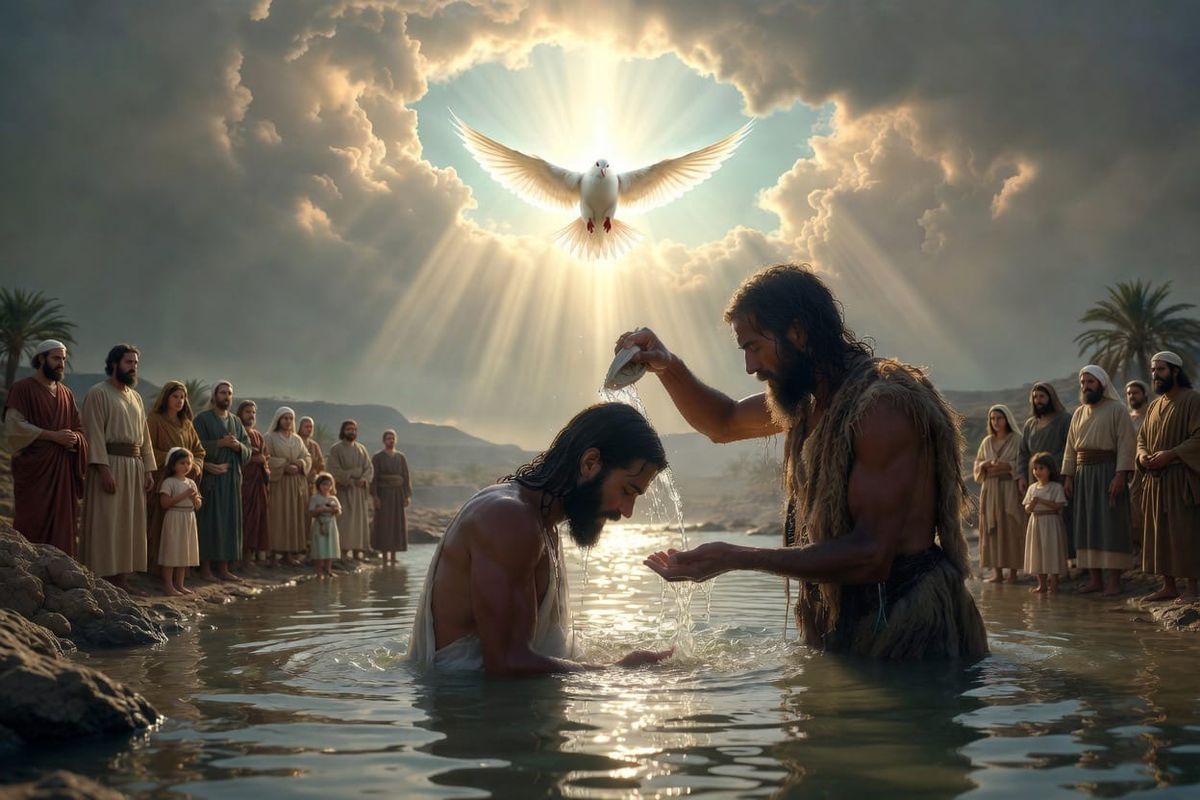
The Baptism of Our Lord. The Father speaks, the Spirit descends, the heavens open. The Father’s words at the Jordan — ‘This is my beloved Son, with whom I am well pleased’ — are the fulfillment of Isaiah’s Servant Song. The Epiphany season’s question is answered before it has properly begun.
The First Sunday of Epiphany
The First Sunday of Epiphany occupies a distinctive place in the Anglican liturgical year. It is not a Principal Feast and not a Red-Letter Holy Day, but the BCP 2019 gives the Sunday its own name, Collect, and appointed readings. The Baptism of Our Lord always opens the weekly sequence of the Season of Epiphany, with its Collect on page 601 and its lectionary on page 719.
The Baptism of Our Lord is the Sunday of Trinitarian manifestation. At the Jordan, the Father speaks, the Son stands in the water, and the Holy Spirit descends like a dove. The identity of Jesus is publicly revealed, his messianic ministry is inaugurated, and the prophetic promises concerning the Spirit-anointed Servant and Davidic King converge upon him. The Season of Epiphany is the season of manifestation, and its First Sunday gives the Church the declaration the Sundays ahead will unfold: “This is my beloved Son, with whom I am well pleased.” (Matthew 3:17, ESV)
In that sense, the Baptism of Our Lord opens Epiphany’s theological hand and shows what the season is holding. The Child born of Mary and worshiped by the Magi now stands as an adult in the Jordan. Before the Church watches him call disciples, teach, heal, confront evil, and proclaim the Kingdom, the Father tells us who he is.
The Biblical Event
The Gospel for Year A is Matthew 3:13–17. John is baptizing in the Jordan when Jesus comes to him, and John protests, “I need to be baptized by you, and do you come to me?” (Matthew 3:14, ESV) The objection is entirely reasonable. John’s baptism is a baptism of repentance, yet the one standing before him has no sin from which to repent.
Jesus answers, “Let it be so now, for thus it is fitting for us to fulfill all righteousness.” (Matthew 3:15, ESV) He is not baptized because he needs forgiveness. He enters the water in obedience to the Father, identifying himself with the sinners he has come to save and taking his place fully within the saving mission for which he has come.
The early Church also understood Christ’s descent into the Jordan as belonging to the sanctification of water within the saving economy. Gregory of Nazianzus speaks of Christ sanctifying the Jordan through his Baptism, and Cyril of Jerusalem likewise connects the Lord’s Baptism with the sanctification associated with Christian Baptism. The Fathers therefore saw the Jordan not as an isolated event but as belonging to the saving work of Christ in which water is taken up into the sacramental life of the Church.
Matthew then tells us that “the heavens were opened to him” and that Jesus saw “the Spirit of God descending like a dove and coming to rest on him.” The Father’s voice follows: “This is my beloved Son, with whom I am well pleased.”(Matthew 3:16–17, ESV) Matthew says the heavens were opened. Mark, in his parallel account, uses the stronger image of the heavens being torn open. Both proclaim that heaven itself bears witness to the Son.
Christian interpreters have often heard in the opened heavens a sign that, in Christ, humanity’s estrangement from God is being overcome. Heaven itself bears witness to the saving work now openly unfolding. The Son stands in the water, the Spirit descends, and the Father speaks. The Trinity is not merely explained here but revealed in action.
In Year B, Mark 1:7–11 gives the most compressed account. John announces the coming of one mightier than himself who will baptize with the Holy Spirit. Jesus enters the Jordan, the heavens are torn open, the Spirit descends like a dove, and the Father declares, “You are my beloved Son; with you I am well pleased.” (Mark 1:11, ESV)
In Year C, Luke 3:15–22 places the event within the people’s expectation that John himself might be the Christ. John redirects their attention toward the one who is coming and then, characteristically for Luke, tells us that Jesus is praying when heaven opens. The Spirit descends “in bodily form, like a dove,” and the Father declares the Son’s identity. (Luke 3:22, ESV) Luke thus joins manifestation to prayer: the Son lives in communion with the Father, and that relationship is publicly declared as his ministry begins.
The Servant and the King
Isaiah 42:1–9 is the appointed Old Testament reading in all three years. It begins with the First Servant Song: “Behold my servant, whom I uphold, my chosen, in whom my soul delights; I have put my Spirit upon him; he will bring forth justice to the nations.” (Isaiah 42:1, ESV)
The correspondence with the Jordan is striking. The Servant is chosen, delighted in, and endowed with the Spirit. At Jesus’ Baptism the Father declares his pleasure in the Son and the Spirit comes to rest upon him. The Father’s words therefore identify Jesus not only as the beloved Son but also as the Servant promised by Isaiah.
The Servant’s mission also reaches beyond Israel. God says, “I will give you as a covenant for the people, a light for the nations, to open the eyes that are blind, to bring out the prisoners from the dungeon.” (Isaiah 42:6–7, ESV) This belongs naturally within Epiphany. The Christ publicly manifested at the Jordan is the same Christ whose saving light extends to the nations.
Psalm 89 adds the royal dimension. The Psalm remembers God’s covenant with David and declares, “I have found David, my servant; with my holy oil I have anointed him.” (Psalm 89:20, ESV) The title Christ means Anointed One, and at the Jordan the Spirit descends upon Jesus as the true Davidic King begins his public ministry.
The Servant of Isaiah and the Davidic King therefore meet in the same Person. Jesus is the beloved Son, the Spirit-anointed Servant, and the promised King. The Father’s declaration is not an isolated heavenly compliment. It gathers together the promises of Israel’s Scriptures and identifies the one in whom they are being fulfilled.
The Beginning of Jesus’ Public Ministry
Acts 10:34–38, the appointed Epistle in all three years, shows how the apostolic Church understood the Jordan. Peter is preaching in the house of Cornelius and summarizes Jesus’ ministry by beginning with John’s baptism and the anointing of Jesus: “How God anointed Jesus of Nazareth with the Holy Spirit and with power. He went about doing good and healing all who were oppressed by the devil, for God was with him.” (Acts 10:38, ESV)
Peter does not mean that the saving Gospel begins absolutely at the Jordan. The Incarnation has already occurred, and the saving work of Christ will reach its decisive accomplishment in his Cross and bodily Resurrection. Rather, the Jordan marks the public beginning of Jesus’ messianic ministry. From this point he teaches, heals, casts out demons, gathers disciples, and openly manifests the Kingdom of God.
The Baptism therefore functions as both manifestation and commissioning. Jesus does not become the Son at the Jordan, nor does the Holy Spirit make him divine or transform him into the Messiah. He is eternally the Son and already the promised Christ. What happens at the Jordan is the public revelation and anointing of the one who already is who the Father declares him to be.
The rest of Epiphany unfolds that declaration. The Son identified at the river calls fishermen, teaches with authority, heals the sick, confronts demons, forgives, and proclaims the Kingdom. His ministry does not establish his identity; it manifests the identity the Father has already declared.
The Baptism of Christ and Christian Baptism
The BCP 2019 deliberately connects the Baptism of Jesus with the Baptism of Christians, but the connection must be stated carefully.
Christ’s Baptism and Christian Baptism are not identical. Jesus is the sinless Son who enters John’s baptism of repentance without needing repentance himself. His Baptism manifests his identity and publicly inaugurates his messianic ministry. Christian Baptism, by contrast, is the sacrament in which sinners are united to Christ, born again by water and the Spirit, incorporated into his Body, and received into the household of God as his adopted children. Christians therefore do not simply repeat what happened to Jesus at the Jordan. His Baptism belongs to the saving work of the Son into whom Christians are baptized.
Romans 6:3–4 gives the controlling New Testament pattern: “Do you not know that all of us who have been baptized into Christ Jesus were baptized into his death? We were buried therefore with him by baptism into death, in order that, just as Christ was raised from the dead by the glory of the Father, we too might walk in newness of life.” (Romans 6:3–4, ESV)
Christian Baptism unites the baptized to Christ’s death and Resurrection. Its meaning therefore reaches beyond the Jordan to the whole Paschal mystery. The font is not simply a repetition of the river; it is the sacramental place in which sinners are joined to the crucified and risen Christ.
The distinction between Christ’s sonship and ours is equally important. Jesus is the Son by nature, eternally begotten of the Father. Christians become sons and daughters by adoption and grace. The Collect preserves that distinction beautifully: the Father reveals Jesus to be his Son and then asks that those born again by water and the Spirit may be faithful as his adopted children. Christ possesses by nature what we receive by grace. That distinction does not make adoption a lesser or merely figurative gift. It makes the grace more astonishing. Those who could never possess divine sonship by nature are truly received into God’s family through union with the Son.
The BCP 2019 Collect and Preface
The BCP 2019 appoints the Collect on page 601: “Eternal Father, at the baptism of Jesus you revealed him to be your Son, and your Holy Spirit descended upon him like a dove: Grant that we, who are born again by water and the Spirit, may be faithful as your adopted children; through Jesus Christ our Lord, who lives and reigns with you and the Holy Spirit, one God, now and for ever. Amen.”
The Collect moves directly from Christ to the Church without confusing the two. At the Jordan, Jesus is revealed as the Father’s Son and the Spirit descends upon him. In Christian Baptism, those united to Christ are born again by water and the Spirit and received as adopted children.
The petition is not that the baptized would somehow repeat Jesus’ unique Baptism or reproduce his natural Sonship. It asks that those who have received adoption would live faithfully within what God has given them. Grace comes first, then faithfulness. The baptized do not obey in order to become God’s children; they are called to faithfulness because God has received them in Christ. This is one of the clearest examples in the Prayer Book of the grammar of grace: God acts and gives, and the Church then asks for grace to live faithfully within what has already been bestowed. The baptized life is therefore a response to gift rather than an attempt to earn it.
The Preface of the Epiphany is appointed for this Sunday. It gives thanks through Christ, “who took on our mortal flesh to reveal his glory; that he might bring us out of darkness and into his own glorious light.” (BCP 2019, p. 153)
The Preface fits the Jordan especially well. The one who took our mortal flesh is now publicly manifested as the beloved Son. His glory is not something hidden behind his humanity as though the humanity were merely a covering. Rather, the Father and the Spirit testify within the incarnate Son’s truly human life to the identity that belongs eternally to him.
The Baptism of Our Lord in Anglican Worship and History
The Baptism of Christ has belonged to the Church’s celebration of Epiphany from ancient times. In the Christian East especially, the Lord’s Baptism was among the central manifestations associated with January 6. In the Western liturgical tradition the observances became more clearly distinguished, and the BCP 2019 appoints the Baptism of Our Lord as the First Sunday of Epiphany.
The sequence is theologically fitting. The Magi manifest Christ to the Gentiles on January 6; the following Sunday manifests him at the Jordan as the beloved Son upon whom the Spirit rests. The Incarnation celebrated at Christmas and the manifestation to the nations at Epiphany now receive an explicitly Trinitarian declaration.
The liturgical color is white. White is fitting for the manifestation of Christ, the Father’s declaration, and the descent of the Holy Spirit. It also distinguishes this great Epiphany manifestation from the green Sundays that normally follow through the middle of the season.
The BCP 2019 names the Baptism of Our Lord as one of the most appropriate occasions for the administration of Holy Baptism, together with the Easter Vigil, Pentecost, and All Saints’ Day or the Sunday after All Saints’ Day. Baptizing on this Sunday allows the Church to place Christian Baptism beside the Gospel event that manifests the Son and shows the Spirit resting upon him.
The juxtaposition should illuminate rather than collapse the distinction. The candidate is not reenacting Jesus’ Baptism. He or she is being baptized into Jesus Christ and into the saving work that reaches from his Incarnation and Jordan ministry through his Cross and bodily Resurrection.
Renewal of Baptismal Vows
A parish may also renew baptismal vows on this Sunday. Such a renewal is a fitting Anglican practice, though it is not required by the proper of the day.
Renewal is not re-Baptism and does not make an earlier Baptism effective again. The sacrament does not depend upon periodically renewing it through sufficient sincerity. Rather, Christians remember the grace already given and renew their intention to live faithfully within the baptized life.
This is where the Collect gives the practice its proper order. Those born again by water and the Spirit do not renew their vows in order to make themselves God’s children, but because God has already acted graciously in receiving them as his adopted children in Christ. The renewal is therefore not chiefly a performance of recommitment but a response to divine grace. The appropriate baptismal question is not merely, How strong are my promises? It is first, Whose am I, and what has God given me in Christ? From that identity comes the call to faithfulness.
Opened Heavens and the Trinitarian Life
The Baptism of Our Lord gives the Church one of Scripture’s clearest narrative manifestations of the Father, Son, and Holy Spirit together. The Father is not the Son, the Son is not the Spirit, and the Spirit is not the Father. Yet the one God is at work in a single saving event.
The doctrine of the Trinity does not originate because Christians wished to construct an abstract theory about God. It arises from the scriptural revelation of God himself. The Father speaks from heaven, the Son stands in the water, and the Spirit descends like a dove.
The Jordan therefore belongs naturally to Christian Trinitarian faith. The God who saves is Father, Son, and Holy Spirit, and Christian Baptism will later be commanded by the risen Christ “in the name of the Father and of the Son and of the Holy Spirit.” (Matthew 28:19, ESV)
That Trinitarian pattern also shapes the baptized life. Christians are united to the Son, adopted by the Father, and made alive by the Holy Spirit. Salvation is not an impersonal transaction but the gracious work of the Triune God, who brings sinners into fellowship with himself through Christ.
Observing This Sunday
The Baptism of Our Lord is always the First Sunday of Epiphany. When January 6 itself falls on a Sunday, the First Sunday of Epiphany follows one week later. The Collect is on page 601 of the BCP 2019 and the Sunday lectionary is on page 719.
Pray the Collect and notice its movement from Christ’s identity to Christian adoption. The Father reveals Jesus to be his Son before the prayer turns to those born again by water and the Spirit. The order is important: Christ first, then those who receive life through union with him.
Read Isaiah 42:1–9 and hear the Father’s delight in the Spirit-anointed Servant. Pray Psalm 89 and recognize the promise of the Davidic King. Read Acts 10:34–38 and hear Peter locate the beginning of Jesus’ public ministry at the anointing of the Jordan.
Then read the Gospel appointed for the year and remain with the scene itself: the Son in the water, the Spirit descending, and the Father speaking. In Year A, hear Jesus speak of fulfilling all righteousness. In Year B, notice the heavens torn open. In Year C, notice Jesus praying as heaven opens.
If Holy Baptism is celebrated, receive the sacrament according to the distinction the Collect itself preserves. The candidate is not repeating Jesus’ Baptism but being united to Jesus Christ, born again by water and the Spirit, and received into his Body.
If baptismal vows are renewed, renew them not as though adoption rests upon the strength of human promises but because God’s prior grace calls forth a life of faithfulness. Remember what the Collect actually asks: not that Christians make themselves God’s children, but that those already received as adopted children may live according to the gift.
Conclusion
The Baptism of Our Lord is the Sunday on which the Season of Epiphany opens its theological hand and shows what it is holding. The Child worshiped by the Magi stands in the Jordan, the heavens open, the Spirit descends, and the Father declares, “This is my beloved Son, with whom I am well pleased.” (Matthew 3:17, ESV) The remaining Sundays will show what this Son does, but the Father tells the Church who he is before his public ministry unfolds.
The Jordan also teaches the Church both connection and distinction. Jesus is the eternal Son by nature; Christians become children by adoption. He enters John’s baptism as the sinless Servant and King; sinners enter Christian Baptism to be united to his death and Resurrection. The Spirit’s descent upon Christ publicly anoints him for his messianic ministry; the baptized receive the Spirit as those incorporated into Christ. The differences must remain because the grace depends upon them: salvation comes from what Christ uniquely is and accomplishes, and we receive its benefits through union with him.
The Collect therefore gives the Sunday its proper final prayer: “Grant that we, who are born again by water and the Spirit, may be faithful as your adopted children.” (BCP 2019, p. 601) Grace precedes faithfulness. The Father has spoken, the Son has entered the water, and the Spirit has descended. The Church now spends the rest of Epiphany learning what it means to belong by grace to the beloved Son and to live faithfully as the adopted children of the Eternal Father.