The Burden Is Too Heavy For Me: Wednesday of Spring Embertide 2026 (Numbers 11:16-17, 24-29)
On Spring Ember Day I, Moses admits, “The burden is too heavy for me.” God does not shame him. He provides. Pray for faithful clergy, ask what Christ has entrusted to you, and remember: we plant and water, but God gives the growth.
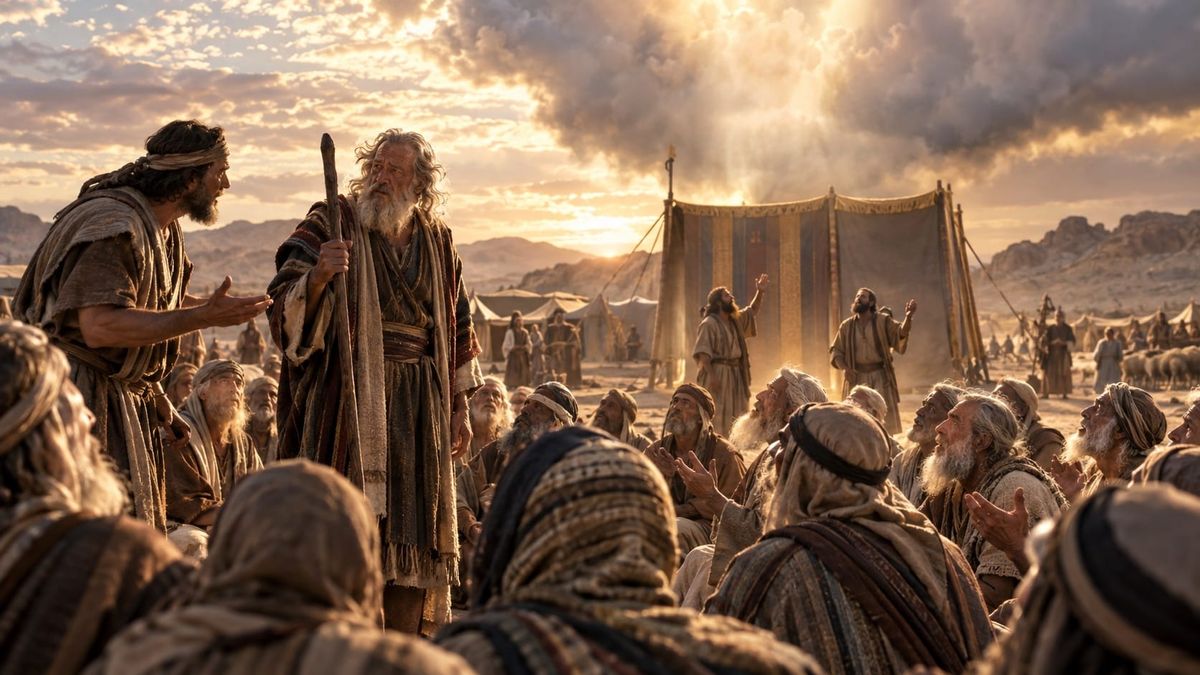
February 25, 2026, Spring Ember Day I, Wednesday of Spring Embertide, Season of Lent
Numbers 11:16–17, 24–29, Psalm 99, 1 Corinthians 3:5–11, John 4:31–38
Grace, mercy, and peace from God our Father and the Lord Jesus Christ be with you on this first Ember Day of Lent.
We have only just begun the Lenten journey. Ash Wednesday reminded us that we are dust, and the first Sunday in Lent brought us again into the wilderness with our Lord. Now the Church gives us three Ember Days, Wednesday, Friday, and Saturday, set apart especially for prayer for those called to Holy Orders. These days may also be kept with fasting, which makes their place in Lent especially fitting. As the whole Church gives renewed attention to repentance, prayer, self-examination, and self-denial, we also pray that God will raise up faithful servants for the ministry of his Church.
These three days belong together. Today Moses will teach us something about our weakness and God’s provision. On Friday Samuel will teach us to listen for the call of God. On Saturday Isaiah will show us that the servant whom God calls must also be cleansed by grace before he is sent. For today, however, we begin with a confession that may sound familiar to anyone who has ever carried responsibility for another person: “I am not able to carry all this people alone; the burden is too heavy for me.” (Numbers 11:14)
Numbers 11 finds Moses worn down. Israel has been delivered from Egypt, brought through the Red Sea, fed in the wilderness, and sustained by the mercy of God. Yet the people are complaining again. They remember the food of Egypt while conveniently forgetting the slavery, and their dissatisfaction spreads through the camp until Moses reaches the point where he finally says what he can no longer hide. The burden has become too heavy for him to carry alone.
There is something refreshingly honest about that confession. Moses does not pretend that leadership has made him superhuman, nor does he tell God that he merely needs a better plan, a better schedule, or a better attitude. He tells the truth about his limits. In that honesty, God begins to teach him something fundamental about ministry: Moses is not the savior of Israel. God is.
Moses did not create this people, redeem them from Egypt, feed them in the wilderness, or promise to bring them into the land. God did. Moses was a servant entrusted with work that ultimately belonged to God, and the same remains true for every kind of Christian ministry. The Church belongs to Jesus Christ before any part of her life or ministry is entrusted to a bishop, priest, deacon, vestry, teacher, or congregation. The Gospel is God’s Gospel, the Sacraments are Christ’s gifts, the people are his people, and the growth belongs to him.
Moses could not bear Israel’s burden by himself, and no minister can bear the deepest burden of Christ’s people either. That burden has already been borne by Jesus. He took our sins upon himself, gave his life for his sheep, rose from the dead, and remains the true Shepherd of his Church. Bishops, priests, deacons, and laypeople do not serve in order to become saviors for one another. We serve because we already have a Savior. Whatever burden Christ gives us to help carry, the work of redemption belongs to him alone.
That is an important truth to hear during Lent because Lent strips away some of our illusions about ourselves. We remember that we are creatures and not the Creator. We confess sins we cannot repair simply by trying harder, and we learn again that we need mercy we cannot provide for ourselves. Ember Days bring that same Lenten honesty into the ministry of the Church. No one enters Holy Orders because he has graduated from dependence upon grace, and no Christian ever serves faithfully by outgrowing that dependence.
Verse 16 tells us how God answers Moses. He says, “Gather for me seventy men of the elders of Israel.” (Numbers 11:16)God does not tell Moses that the burden is imaginary, and he does not simply command him to become stronger. He provides other people to share the work. Then in verse 17 God promises, “I will come down and talk with you there. And I will take some of the Spirit that is on you and put it on them, and they shall bear the burden of the people with you.”(Numbers 11:17)
Notice where the answer comes from. God speaks, God gives, and God equips. Moses and the elders will really work, and their responsibility will be real, but the provision comes first from God. That is the first lesson of these Spring Ember Days: the Lord who gives his servants work to do must also give what they need in order to do it.
That can be easy to affirm until the burden becomes personal. Anyone who serves in the Church can begin to feel as though everything depends upon that one person. Clergy can feel it, but so can lay leaders, parents, caregivers, teachers, musicians, intercessors, and those who quietly carry responsibilities few other people ever see. Anyone who has looked at a need and wondered how in the world to carry it knows something of Moses’ prayer. Sometimes faithfulness begins with admitting that a burden really is heavy. That does not mean we stop serving. It means we remember whose Church this is and whose strength ultimately sustains the work.
Verse 24 tells us that Moses obeys and gathers the elders, and then verse 25 says that “the LORD came down in the cloud and spoke to him, and took some of the Spirit that was on him and put it on the seventy elders.” (Numbers 11:25) God provides people, and God provides what they need for the task he gives them. The text is not suggesting that Moses possessed some private spiritual substance that was divided into seventy portions. The Spirit remains God’s gift. Moses’ ministry never depended upon some spiritual resource that was finally his own.
Then the story takes an unexpected turn. Two men, Eldad and Medad, remain in the camp, yet verse 26 tells us that “the Spirit rested on them.” They begin to prophesy there, and someone runs to Moses with the news. Joshua becomes alarmed and says, “My lord Moses, stop them.” (Numbers 11:28) Perhaps Joshua thinks he is protecting Moses, fearing that Moses’ authority will be diminished if others exercise Spirit-given ministry beyond the expected place.
Moses will have none of it. In verse 29 he asks, “Are you jealous for my sake?” and then says, “Would that all the LORD’s people were prophets, that the LORD would put his Spirit on them!” (Numbers 11:29) Moses is not threatened by the gifts of others. He does not need to be the center of everything, and he does not need every act of ministry to reinforce his importance. If God is giving gifts to his people, Moses can rejoice.
That is not only a word for clergy. Every baptized Christian has received something from God for the good of his Church. Some are called to teach. Some pray faithfully when almost no one knows they are doing it. Some care for the sick, welcome strangers, form children in the faith, serve the poor, give generously, repair what is broken, encourage the discouraged, or speak naturally about Christ to someone who might never walk into a church on his own. The question is not whether every Christian has exactly the same ministry. We do not. The question is whether we are faithfully offering back to Christ what he has entrusted to us.
Faithful ordained ministry should encourage that rather than suppress it. A faithful priest should rejoice when laypeople mature in faith, teach, serve, lead, pray, evangelize, care for the suffering, and take responsibility for the life and mission of the Church. He should rejoice when deacons serve well, when fellow priests preach faithfully, when younger leaders emerge, and when God gives gifts different from his own. The goal is not a congregation in which the clergy do everything. The goal is a healthy Body in which Christ gives gifts to his people and those gifts are faithfully used for the good of all.
Paul makes much the same point in our reading from 1 Corinthians. The Corinthians were dividing themselves around their favorite ministers, so Paul asks, “What then is Apollos? What is Paul? Servants through whom you believed.” Then he says, “I planted, Apollos watered, but God gave the growth.” (1 Corinthians 3:5–6) Paul planted and Apollos watered, and both mattered. Moses led and the elders bore the burden, and both mattered. Christian ministry is real work, and God truly uses human servants.
Yet none of those servants can give the growth. A preacher can proclaim the Gospel, but he cannot make a dead heart alive. A priest can faithfully administer the Sacraments, but he cannot manufacture faith. A bishop can examine and ordain, but he cannot create a divine vocation. Parents can teach their children the faith, but they cannot force belief into their hearts. A layperson can speak the truth of Christ to a friend, but cannot control how that friend will respond. A congregation can plant and water in a hundred faithful ways, but God gives the growth.
That truth is both humbling and freeing. We are responsible for faithfulness, but we are not responsible for being God. There are people we cannot fix, griefs we cannot remove, conflicts we cannot solve by force of personality, and people we love whom we cannot change. We can pray, speak truth, show mercy, remain present, and serve faithfully, but some burdens are simply too heavy for us. The good news is that they are not too heavy for God.
Our Gospel from John 4 gives us the same truth through the picture of a harvest. Jesus tells his disciples in verse 35, “Lift up your eyes, and see that the fields are white for harvest.” (John 4:35) The harvest is already there before the disciples begin working. They are being invited into something God has already begun.
Then Jesus says in verses 37 and 38, “One sows and another reaps,” and, “Others have labored, and you have entered into their labor.” (John 4:37–38) That is a healthy reminder for anyone who serves the Church. We enter work that began before us, and, unless the Lord returns first, others will continue it after us. No pastor begins the Church, and no pastor finishes the Church. Neither does any lay leader, teacher, vestry member, musician, or volunteer. We all receive work that was underway before us and entrust it eventually to those who come after us.
Someone prayed before we arrived. Someone taught the Scriptures, served the poor, cared for the sick, taught the young, gave sacrificially, and passed the faith from one generation to another. For a time, God entrusts part of that work to us, and eventually someone else will carry it. That should make us grateful rather than possessive, and it should make us ask not only, “Who will come after us?” but also, “What has God given me to do while I am here?”
That is where this Ember Day becomes personal for every Christian. The Church cannot simply assume that faithful ministers will appear when needed, so we pray for those called to Holy Orders. We ask God to raise up bishops, priests, and deacons who are sound in doctrine and holy in life. We ask him to guide those who are discerning a call and to give wisdom to bishops and others charged with examining them. We ask him to protect the Church from both desperation and carelessness, because the goal is not simply more clergy. The goal is faithful clergy.
But while you pray for those who may be called to Holy Orders, ask another question too: “Lord, what have you entrusted to me?” Ember Days are centered upon prayer for ordained vocation, but they also remind the whole Body that Christ gives gifts for service. Perhaps someone else is carrying a burden you could help bear. Perhaps there is a person you could encourage, a child you could teach, a lonely person you could visit, a ministry you could strengthen, a neighbor you could invite, a work of mercy you could undertake, or a task you have quietly assumed belongs to someone else.
Moses’ problem was not solved because he became stronger. God gave other servants, and those servants had to step into the work given to them. There is a word there for every congregation. Sometimes we pray for God to send help while overlooking the possibility that he has already placed gifts in the people sitting around us. Sometimes the faithful question is not, “Why is nobody doing this?” but, “Lord, are you asking me to help?”
The Ember Collect expresses the ordained side of that prayer beautifully. We address God as “the giver of all good gifts,”and ask him to give grace to those called to office and ministry, to fill them with “the truth of your doctrine” and clothe them with “holiness of life.” Truth and holiness belong together. The Church does not merely need impressive ministers or popular ministers. She needs servants who know the truth, love Christ, repent of sin, and walk faithfully before God.
Even here, grace comes first. Notice what the Church asks God to do: give, fill, and clothe. Study matters, discipline matters, theological formation matters, obedience matters, and holiness matters, but none of them begins in self-sufficiency. We are asking God to do in his servants what they cannot finally do for themselves, just as every Christian depends upon God to make fruitful whatever service is offered.
That makes Ember fasting especially appropriate during Lent. Fasting reminds us that we are dependent creatures, and even a little hunger can remind us that we do not sustain ourselves. On these particular days, that bodily reminder can become prayer. Pray by name for someone in ordained ministry. Pray for someone who may be discerning a call. Ask God to make that person faithful, sound in doctrine, holy in life, and humble before Christ. Then ask the Lord what he has entrusted to you. Where are you meant to plant? Where are you meant to water? Whom are you meant to encourage? What work of mercy, witness, prayer, service, or teaching has he already placed before you?
Psalm 99 gives us the right perspective for all of this. It begins, “The LORD is King; let the peoples tremble,” and later remembers Moses, Aaron, and Samuel among those who called upon the LORD and were answered. (Psalm 99:1, 6) The servants matter, but God remains King. That is where Spring Embertide begins. We do not begin by asking who seems strong enough to carry the Church. We begin by remembering that Christ already carries his Church.
Today Moses teaches us to tell the truth about our limits without falling into despair. The burden may indeed be too heavy for us. The harvest is too great for us, the needs are too deep for us, and the future of the Church is too important to rest upon human strength. Yet the God who gave Moses the seventy elders has not stopped caring for his people. The Christ who sees the harvest still sends laborers, and the Holy Spirit still gives gifts for the building up of Christ’s Body.
When we gather again on Friday, Samuel will take us one step further. If God is the one who provides his servants, then those servants must learn to hear his call, and the Church must learn to discern faithfully what God is doing. Samuel will hear a voice he does not yet recognize until he is taught to answer, “Speak, LORD, for your servant hears.” (1 Samuel 3:9) For today, however, Moses leaves us with the first Ember lesson: we cannot carry the work of God in our own strength, but neither are we called to stand aside while others carry every burden.
So let Moses’ confession become our prayer. Lord, the burden is too heavy for us, but it is not too heavy for you. Your Church is yours, the harvest is yours, the laborers are yours, and the growth is yours. Give your Church faithful bishops, priests, and deacons. Give every member of Christ’s Body grace to recognize and use the gifts you have entrusted to them. Show each of us where to plant, where to water, where to serve, and where to encourage another servant rather than guarding our own place. Then, when we have faithfully done what you have given us to do, teach us to leave the growth in your hands.
In the Name of the Father, and of the Son, and of the Holy Spirit. Amen.