The Confession of the Church (Matthew 16:13–20)
Matthew 16:13–20. The disciples worshiped Jesus in the boat two weeks ago. What is different at Caesarea Philippi? Peter adds the messianic title. There is no new miracle in this scene. And Jesus names the Father as the source: flesh and blood has not revealed this.
August 23, 2026, Year A, Thirteenth Sunday after Pentecost, Proper 16, Season after Pentecost
Matthew 16:13-20, Psalm 138, Isaiah 51:1-6
Grace, mercy, and peace from God our Father and the Lord Jesus Christ be with you on this Thirteenth Sunday after Pentecost.
We are in the third Sunday of Movement III of our journey through Matthew’s Gospel: the King Acts and Is Recognized. Three Sundays ago we watched Jesus feed five thousand people with five loaves and two fish, and twelve baskets of abundance remained. Two Sundays ago he walked on the sea toward the disciples’ battered boat, and Peter climbed over the side to meet him. Last Sunday a Canaanite woman pressed through silence and apparent refusal and received the answer she had come for. Matthew has been building a case. He has been pressing a question. And today, at Caesarea Philippi, Jesus asks the question out loud. Our passage this morning is Matthew 16:13–20.
Before we reach the confession, we need to stay in the boat two Sundays ago. When Jesus climbed in and the wind stopped, Matthew tells us the disciples worshiped him. The Greek word is prosekynei (pros-eh-KOO-nay), bowing down in an act of worship. The same word used of the Canaanite woman last week.
And the disciples said, “Truly you are the Son of God.” (Matthew 14:33, ESV) Those are not casual words. That is a genuine confession from genuinely worshiping disciples. So when Peter answers the same question at Caesarea Philippi, we might reasonably ask: what is different? They have already said Son of God. They have already worshiped. Why does Jesus respond as if something entirely new has just happened?
The answer begins in verse 13. Jesus asks: “Who do people say that the Son of Man is?” (Matthew 16:13, ESV) In verse 14 the disciples report what they have heard: John the Baptist, Elijah, Jeremiah, one of the prophets. These are not dismissive answers. They represent genuine recognition that something of ultimate significance is happening. The crowd has placed Jesus among the greatest figures in Israel’s history. But every one of those categories is too small. The crowd has made him remarkable without making him unique. They have placed him in a category that cannot hold him. Think about what those categories mean. John the Baptist is remarkable: the prophet who breaks four centuries of silence, who baptizes in the Jordan, who calls Israel to repentance. Elijah is remarkable: the man of fire and miracle, taken up in a chariot, the one whom Malachi promises will return before the great and terrible day of the Lord. Jeremiah is remarkable: the weeping prophet who carried Israel’s grief, who was rejected by his own people, who saw the destruction of the temple.
Each of those figures represents the highest category Israel knows. And every one of them is still a category that already exists.
Peter’s answer breaks every existing category. “You are the Christ” means: you are not the greatest figure in a familiar series. You are the one toward whom the whole series has been pointing.
And notice: the disciples had extraordinary firsthand evidence. They had witnessed the healings, heard the teaching, watched five thousand fed from five loaves, walked with Jesus on the water. Evidence can point us toward Christ. It can bring us to the edge of the question. But only the Father can open our eyes to recognize Jesus for who he truly is. This is why the same miracles that produced faith in the disciples left much of the crowd placing Jesus inside existing categories.
At some point the question leaves the crowd and comes to each of us directly. The question Jesus asks is the most important question any human being will ever face. It is not primarily a theological question. It is a personal one, and it requires a personal answer.
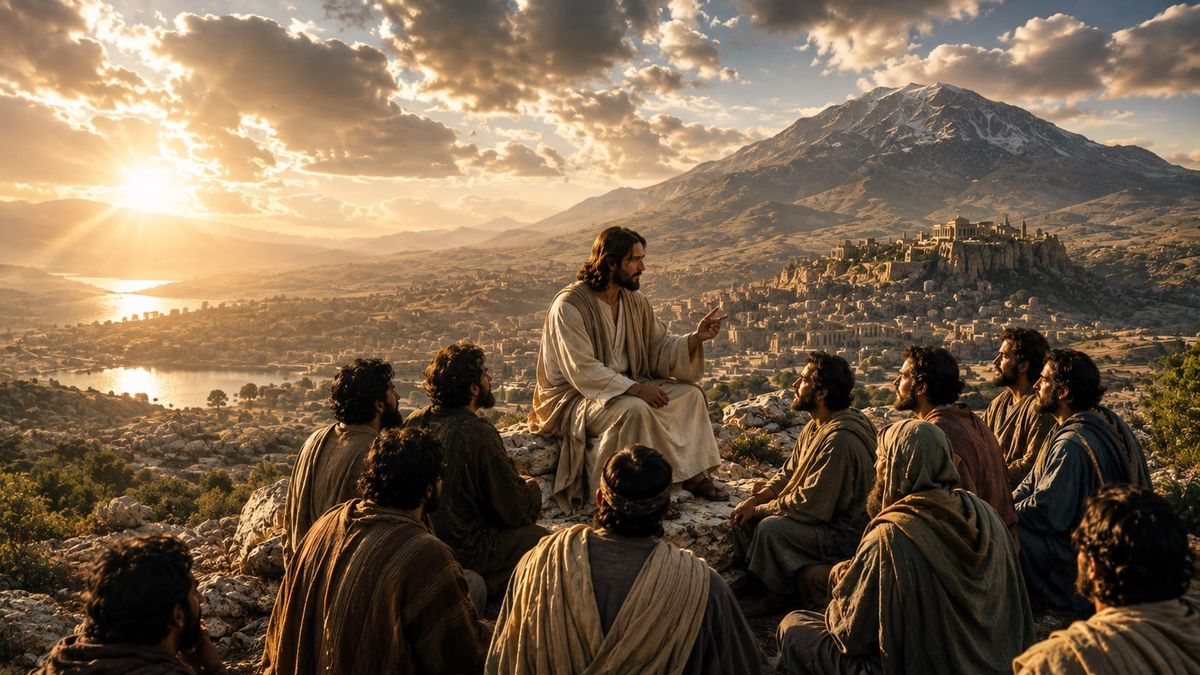
Jesus turns the question personal: “But who do you say that I am?” (Matthew 16:15, ESV) The shift from third person to second person is everything. Not who do people say. Who do you say.
And in verse 16, Peter answers: “You are the Christ, the Son of the living God.” (Matthew 16:16, ESV) Not a prophet. Not Elijah. Not one of the great figures of Israel’s past. The Christ: the anointed one, the promised King, the one toward whom the entire Old Testament has been pointing. He is identifying Jesus as the fulfillment toward which Israel’s whole story has been moving. You are the Christ. Standing right here. The Son of the living God: not a title of honor but a declaration of identity. Peter adds to the boat’s confession of Son of God the explicitly messianic title: the Christ. This is the fullest human confession of Jesus’ identity Matthew has given us up to this point.
And then verse 17, the theological center of the passage: “Blessed are you, Simon Bar-Jonah! For flesh and blood has not revealed this to you, but my Father who is in heaven.” (Matthew 16:17, ESV) Before anything is said about Peter’s role or the Church or the keys, Jesus names the source of the confession. The Father revealed it.
That is what Jesus identifies as distinctive about this confession. The boat confession arose from what the disciples had witnessed: a man walking on water, a storm stopping at a word. There is no new miracle in this scene to prompt it.
And the Father opens Peter’s eyes to see what no amount of evidence could produce on its own. When someone comes to genuine faith in Christ, it is not because they finally crossed a threshold of sufficient evidence. Evidence may point us toward Christ, but it is the Father who opens our eyes to recognize him.
That changes how we think about evangelism. We bear witness. We teach. We give reasons. We answer questions honestly. We live in such a way that the Gospel is visible. But we do not imagine that we have finally argued someone across an intellectual finish line when they come to faith. God opened their eyes.
That is why we pray before we share the Gospel and why we keep praying for people who seem closed to it. The Father is the one who reveals. We are not.
And notice: the question comes in the second person, addressed to each disciple individually. We may worship together, pray together, receive communion together, and all of that is right and necessary. But at some point the question comes to each of us personally, and asks what we actually believe about the one we have been calling Lord.
Now hear Isaiah 51:1–6, the appointed Old Testament reading. In verse 1, Isaiah calls Israel to remember its origin: “Look to the rock from which you were hewn, and to the quarry from which you were dug. Look to Abraham your father and to Sarah who bore you.” (Isaiah 51:1–2, ESV) The rock from which Israel was hewn is Abraham, one man childless and seemingly beyond hope of producing the nation God had promised. The image is deliberate: you did not make yourselves. You were quarried. You are what God has cut from an unlikely source. And in verse 6 the promise: “my salvation will be forever, and my righteousness will never be dismayed.” (Isaiah 51:6, ESV) What God builds from unlikely material, he builds to last.
Isaiah is speaking to a people in exile who wonder whether the promises of God have failed. The answer is: look where you came from. God called him, and from that one couple he multiplied a nation. The same power that called a nation from nothing sustains the Church in every generation.
The quarry image rewards close attention. A quarry is a place of extraction, not a place of finished things. You go to a quarry to see raw material, not completed work. It is being reminded of its origin: you are what God has cut and shaped from one barren man and one barren woman. The encouragement is not, look how far you have come. It is, look at the one who called Abraham and what he has done with him. If God could build a nation from such an unlikely beginning, he can sustain his Church in exile and under pressure, when the finished work is not yet visible.
Matthew 16 reconfigures this rock language. In verse 18, Jesus says: you are Petros, and on this petra I will build my Church. Two Greek words, and they are not the same word. Petros is masculine: it is Simon’s new name. Petra is feminine: the word for rock. Some have tried to drive a wedge between the two, as if Peter were a small stone and the rock something else entirely. But the wordplay only works if the two belong together: Jesus gives Simon the name Rock precisely because of the rock he is about to speak of. And yet the rock is never Peter’s achievement, and never Peter alone. It is Peter in connection with the confession the Father has revealed through him: Jesus is the Christ, the Son of the living God. Paul gives us the necessary canonical clarification in 1 Corinthians 3:11: no one can lay a foundation other than the one that is laid, which is Jesus Christ. Ephesians 2:20 places the household of God on the foundation of the apostles and prophets, with Christ Jesus himself as the cornerstone. Isaiah said look to the rock from which you were hewn. Jesus says on this rock I will build. The same God who quarried a people from one barren couple is now building his Church on one apostolic confession revealed by the Father.
In verse 19 Jesus gives the keys of the kingdom. In the ancient world, keys signified stewardship and authorized access. Isaiah 22:22 gives us the image: the key of the house of David placed on the shoulder of Eliakim, the authority to open and shut on behalf of the king. Jesus gives the keys to Peter as representative of the apostolic circle, and in Matthew 18:18 he extends the same binding and loosing language to the disciples together. In the rabbinic tradition, binding and loosing referred both to declaring what is permitted or forbidden and to the exercise of community discipline: who is included in or excluded from the covenant community. The Anglican Church understands this as the authority of the Church to proclaim and apply the Gospel: through faithful proclamation, teaching, pastoral discipline, and the ordering of the community according to the Gospel. The keys are not the private possession of any single office. They are the shared authority of the Church, received from the apostolic witness.
Still in verse 18, Jesus makes a promise: the gates of hell shall not prevail against the Church built on this confession. This is not a promise of comfort, but of ultimate victory. The Church has faced every conceivable pressure: the Sanhedrin, Nero’s Rome, persecution, heresy, internal failure, cultural contempt. None of it has prevailed.
But we should not hear this promise as a guarantee of ease. Jesus is sending his disciples out as sheep among wolves, as he told them in Matthew 10:16. Peter will walk in the midst of trouble. The Church will walk in the midst of trouble. So will we. There is a very real battle taking place, and the sheep are not the ones with the claws. The promise is not that the Church will escape suffering, persecution, or even death. The promise is that suffering, persecution, and death will not have the final word.
Gates are defensive structures. Jesus does not primarily picture hell attacking the Church while the Church desperately holds its ground. He pictures the gates of Hades, the realm of death, unable to hold against what he is building. And the reason death cannot hold Christ’s Church is that death could not hold Christ. He entered the grave and rose from it, and the Church he is building belongs to him. Those who are united to the risen Lord may die, but death cannot keep them. The grave is not the end of the Church because it was not the end of her Lord.
In verse 20, Jesus strictly charges the disciples to tell no one that he was the Christ. This catches us off guard. Peter has just made the confession of a lifetime. Jesus has just said the gates of hell will not prevail. And now: tell no one.
The reason seems to become clear immediately. The disciples know the right title, but they do not yet understand what kind of Messiah Jesus is. If they go out now proclaiming that Jesus is the Christ, there is a real danger that the crowds will hear what they expect to hear: a conquering king who will overthrow Rome and restore Israel’s political glory. Next Sunday we will hear Jesus say for the first time that the Son of Man must suffer and be killed and on the third day be raised, and we will hear Peter rebuke him for it. A confession without the cross will misrepresent the one it proclaims.
Verse 20 is not a denial of the confession. It is a protection of the confession until the cross has given it its proper shape.
Psalm 138, the appointed psalm for this Sunday, is the psalm of those who called and were answered. Verse 3: “On the day I called, you answered me; my strength of soul you increased.” (Psalm 138:3, ESV) The psalm speaks of the God who answers when his people call. Peter’s confession reminds us that God’s answer does not always come as a change in circumstances. Sometimes his answer is that he opens our eyes to who Jesus is. The Father had already answered Peter by revealing what flesh and blood could not see.
The psalm also says in verse 7: “though I walk in the midst of trouble, you preserve my life.” (Psalm 138:7, ESV) Peter will walk in the midst of trouble. The Church will walk in the midst of trouble. So will we. The psalm’s confidence is not in the strength of the confessor. It is in the faithfulness of the one who answers when we call and preserves those who walk through the trouble.
The Lord is high. He regards the lowly. Psalm 138:6: “though the Lord is high, he regards the lowly.” The Church at Caesarea Philippi was a handful of Galilean fishermen. The Church in Hiawassee is a small congregation in the mountains. He builds from quarries.
Three things this passage asks of us.
First: the confession must be received before it is made. In the boat the disciples confessed what they had seen. The Father can work through what we see and experience. But the kind of confession on which Jesus builds his Church is not ultimately grounded in our experience alone. It is grounded in what the Father has revealed. We cannot manufacture this confession by working harder at our faith or accumulating more religious experience. We receive it. When our faith feels thin or our confidence in the confession is weak, the first move is not self-examination but prayer: Father, reveal your Son to us. Not: We will try harder to believe. But: open our eyes to what flesh and blood cannot see on its own. That is the prayer Caesarea Philippi teaches. So let us make it concrete this week. Think of one person: a child, a neighbor, a friend who has drifted, someone who seems closed to the Gospel. Before our next conversation with them, let us stop and pray for them by name. Not that we would find the winning argument. That the Father would open their eyes, as he opened Peter’s.
Second: we are what the rock produces, not the rock itself. Israel did not cut itself from the quarry; God did the cutting. The Church did not create its own foundation; the Father revealed it. We are the building, not the foundation. We are the people hewn from the rock, not the rock. That means our confidence is not in the size or health or cultural influence of this congregation, and small churches in small towns feel the pull to measure themselves by exactly those things: the attendance, the budget, the programs. When that anxiety comes, and it will come, the answer is to look where Isaiah tells us to look: at the rock from which we were cut, and at the one who does the cutting. The confession the Father revealed through Peter is what gives the Church its identity. We are the vessel, not the treasure. He does not need a showroom. He works in quarries.
Third: the witness of the Church is cross-shaped. Verse 20 is not just a historical curiosity. It is a word for us. There is a temptation to think that the Church’s task is to announce Christ as loudly and publicly as possible at every opportunity, and there is a time for that. But the timing and shape of the witness matters. A Christ without the cross is not the Christ of Matthew 16. The keys of the kingdom are used faithfully when we proclaim the whole: the Christ who came, who suffered, who died, who rose, and who is coming again.
We live in our own Caesarea Philippi: a world full of competing allegiances and steady pressure to make Jesus smaller, safer, and more palpable, i.e, Jesus as a buddy, a life coach, or guru, with no conversation about sin, the atonement, and judgement; love only, acceptance only, basically half of the gospel. Our own lives and witness matter too. Have we been shaped by the cross and confession as well? So let us ask ourselves: where is our Caesarea Philippi? For one of us it may be the workplace, where faith is welcome only if it stays private. For another, the family table, where naming Jesus as Lord would change the atmosphere in the room. For another, a friendship we do not want to risk. Caesarea Philippi is wherever the answer costs something. The question of verse 15 has not gone away. It is asked of this congregation, and through this congregation it is asked of every person in this town. The Church’s answer must be the same answer Peter gave, shaped by the same cross, empowered by the same Spirit, and grounded in the same revealed truth.
“But who do you say that I am?”
“Blessed are you, Simon Bar-Jonah! For flesh and blood has not revealed this to you, but my Father who is in heaven.” (Matthew 16:17, ESV)
In the Name of the Father, and of the Son, and of the Holy Spirit. Amen.