Great Is Your Faith (Matthew 15:21-28)
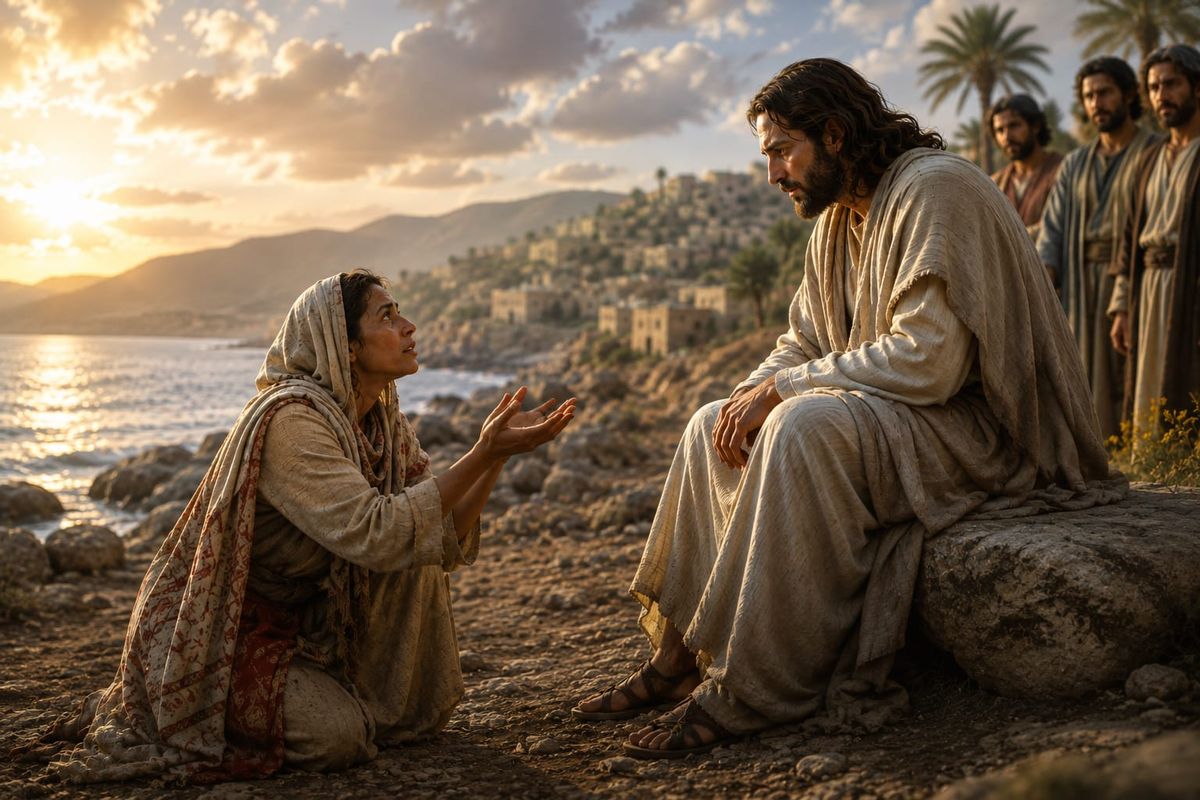
"Great Is Your Faith." Matthew 15:21–28. A Canaanite woman comes to Jesus in Gentile territory. He does not answer her. The disciples want to send her away. She kneels and says: Lord, help me. And he calls her faith great.
August 16, 2026, Year A, Twelfth Sunday after Pentecost, Proper 15
Matthew 15:21-28, Isaiah 56:1-8, Psalm 67
Grace, mercy, and peace from God our Father and the Lord Jesus Christ be with you on this twelfth Sunday after Pentecost.
Yesterday the Church observed the feast of the Virgin Mary, Mother of Our Lord Jesus Christ. Mary said yes before she knew the full cost of what she was saying yes to. She was told a sword would pierce her own soul. She said yes anyway. Today we read about another woman: a Canaanite, a Gentile, someone with no covenant claim as a member of Israel. She came with a desperate need, met what looked like refusal, and refused to let go. Yesterday’s woman and today’s woman, one day apart, are portraits of the same thing: a faith that holds when everything is telling it to let go.
We are in the third Sunday of Movement III: the King acts, and is recognized. Two weeks ago the disciples asked, Who is this? Last week they answered, from the boat, after the storm: “Truly you are the Son of God.” (Matthew 14:33, ESV) This week a Gentile woman answers the same question before she has seen a fraction of what they have seen. She has not watched Jesus feed the five thousand. She has not been in the boat when the wind ceased. She has only a daughter severely oppressed by a demon and the report that there is a man called Jesus who heals. That is all she has. And from that she forms a faith that Jesus himself calls great.
Before we enter the passage, notice what Matthew has placed immediately before it. In Matthew 15:1–20, the Pharisees come from Jerusalem with a complaint. They have the law, the lineage, the covenant, the credentials, and they are using all of it to dispute with Jesus over externals: hand-washing, the tradition of the elders, ritual purity. Jesus tells them that what defiles a man comes from within, from the heart. They miss this entirely and are offended. Matthew then places this story immediately after that confrontation. The Pharisees, with every credential that ought to have made them receptive, are disputing about externals. The outsider, a Canaanite woman with no covenant claim, comes from the margins and worships. She has need and faith. Matthew wants us to feel the weight of that contrast before we hear a word of her exchange with Jesus.
Verse 21: Jesus withdraws from there and goes to the district of Tyre and Sidon. This is Gentile territory. He has crossed a boundary that would have been significant to every Jewish reader of Matthew’s Gospel. Tyre and Sidon were ancient cities on the Phoenician coast, long associated in the Old Testament with pagan worship and Israel’s corruption. Jesus goes there deliberately. He withdraws, Matthew says, as he withdrew in chapter 14 after John’s death. The word for withdrawal is the same. He is not on a mission tour. He has stepped outside the boundaries of Israel, and what happens next happens there.
Verse 22: A Canaanite woman from that region comes out and cries to him. Matthew’s word choice is pointed. He does not call her a Phoenician or a Syrian. He calls her a Canaanite. The Canaanites were the traditional enemies of Israel in the biblical story, the people of the land before the conquest, associated with the idolatry that corrupted Israel throughout its history. Matthew appears to be employing an archaic biblical designation to carry that weight into the present scene. For a Jewish reader, Canaanite woman is not a neutral description. It is a loaded one. And out of that loaded identity comes a cry that is thoroughly Jewish in its vocabulary: “Have mercy on me, O Lord, Son of David.” (Matthew 15:22, ESV) Lord, Son of David: these are the titles of Israel’s Messiah. Son of David is the designation of the expected Davidic King, the same title the blind men cry out in Matthew 9:27, the same title the crowd shouts at the Triumphal Entry in Matthew 21:9. She is not simply saying: I have heard this man heals people. By calling him Son of David, she acknowledges him as Israel’s promised King. Whether or not she would have used that term, her words amount to a striking messianic acknowledgment from a Canaanite. She is claiming for Jesus a title that belongs to Jewish hope and applying it to him from outside that hope, from Gentile territory, before receiving any personal demonstration of his power. Her faith precedes any evidence directed at her personally.
Verse 23: But he did not answer her a word. This is the hardest line in the passage, and we should not rush past it. Jesus, who has healed lepers and blind men and paralytics, who has fed five thousand people and walked on the sea, says nothing. The disciples, perhaps embarrassed by her persistence or simply wanting to move on, ask him to send her away. She is crying out after us, they say. She is making a scene. The impulse is recognizable: the people closest to Jesus are trying to manage access to him, trying to determine who qualifies for his attention.
Verse 24 is where Jesus explains his initial silence: “I was sent only to the lost sheep of the house of Israel.” (Matthew 15:24, ESV) This is not a dismissal of the woman as a person. It is a statement about the shape of the redemptive mission. Jesus had given the disciples the same instruction in Matthew 10:5–6: go nowhere among the Gentiles, but go to the lost sheep of the house of Israel. The covenant promises were being fulfilled in Israel first, the same sequence Paul describes as to the Jew first and also to the Greek. But the inclusion of the Gentiles is already anticipated within that mission. The Magi, the Roman centurion of Matthew 8, and now this Canaanite woman are foretastes of what Christ’s cross and resurrection accomplish. Ephesians 2:14 declares that Christ has broken down the dividing wall through his flesh. What happens in Tyre and Sidon is a glimpse of that coming reality, granted to one woman before the cross and resurrection open its full implications to the nations.
Notice also the grammar of her cry. She does not say: have mercy on my daughter. She says: have mercy on me. Her daughter is severely oppressed by a demon. The suffering belongs to the daughter, but the anguish belongs to both of them. She has come for her daughter and she has come for herself, because they cannot be separated. When someone we love is in torment, we are in torment. Her prayer is the honest prayer of a mother whose wound is her child’s wound. She does not pretend to be a detached advocate filing a request on someone else’s behalf. She is coming with the full weight of what this has cost her.
She comes and kneels before him in verse 25: “Lord, help me.” (Matthew 15:25, ESV) The Greek word Matthew uses for “knelt” is prosekynei (pros-eh-KOO-nay), a word Matthew regularly uses for bowing down in worship. Matthew uses it of the magi before the infant Jesus in Matthew 2:11. He used it last week of the disciples in the boat after Peter’s rescue in Matthew 14:33. This Canaanite woman is not merely asking. She falls before him in a posture that Matthew’s language consistently associates with worship. She has come to the King of Israel as a Gentile supplicant and she is offering him this posture before she has received anything from him. Four words. The silence has not moved her from her position. The disciples’ dismissal has not moved her. She has simply found a shorter, more urgent way to say the same thing.
And then Jesus says what sounds, to modern ears, like the hardest thing in the passage: “It is not right to take the children’s bread and throw it to the dogs.” (Matthew 15:26, ESV) The word Matthew uses for dogs is kynaria, referring to little or household dogs rather than the scavenging dogs of the streets. It softens the image somewhat, but it does not erase the distinction Jesus is drawing: the children have the first place at the table, while the dogs receive what falls beneath it.
She does not flinch. She does not leave. She does not argue that the comparison is unfair. She accepts the priority Jesus has named and then presses the metaphor further: “Yes, Lord, yet even the dogs eat the crumbs that fall from their masters’ table.” (Matthew 15:27, ESV) Yes, Lord. She concedes the point. She is outside the household of Israel. She has no covenant claim as a member of Israel. She is not disputing any of that. She is only pointing out that even outsiders benefit from the abundance of what falls from the table, and that what falls from his table is more than enough for her need. That word, yet, carries more theological weight than almost any other word in the passage. She has taken the priority Jesus named and pressed the metaphor further: even within his own analogy, there is room for her.
And remember what Matthew has just shown us: in chapter 14, Jesus fed five thousand people with five loaves and two fish, and twelve baskets of abundance remained. This woman is asking for crumbs from a table whose surplus fills twelve baskets. Matthew has just shown us how great the abundance of this Messiah is: what falls from his table is sufficient for her daughter. The disciples have witnessed twelve baskets of leftover bread and still struggle to understand who Jesus is. This woman has seen nothing, and she trusts that even the crumbs from his table are sufficient. That is why he calls her faith great.
And then verse 28, the climax of everything: “O woman, great is your faith! Be it done for you as you desire.” (Matthew 15:28, ESV) Great is your faith. Not: your persistence has worn me down. Not: I will make an exception. Not even: I have decided to extend the mission to the Gentiles. He is responding to something he sees in her, something he names plainly and publicly: great faith. This is one of the strongest commendations Jesus gives anyone in the Gospels. Jesus gives the same extraordinary commendation to the Gentile centurion in Matthew 8:10: “with no one in Israel have I found such faith.” In both cases, Matthew places remarkable faith outside the boundaries where we might expect to find it. The insiders are struggling; the outsiders are seeing clearly. He says it here about a Canaanite woman in Gentile territory who came with nothing but need and refused to leave without an answer.
What makes her faith great? Not its quantity. Not some special religious gift she possesses. Her persistence is one expression of her great faith. She refuses to let go of the right person because she trusts that his mercy is greater than the obstacle in front of her. Her faith also consists in recognizing who he is, submitting to his lordship, and trusting that his mercy is sufficient. Great faith in Matthew’s Gospel is not reducible to persistence, but persistence is what great faith looks like when circumstances are pushing back. She came to Jesus. She stayed with Jesus. She turned everything he gave her, even what sounded like refusal, back toward him. That is what great faith does.
Isaiah 56:1–8, the appointed Old Testament reading, is the prophetic ground on which this scene stands. Isaiah names the foreigners, the people excluded from full participation in the assembly of Israel, and speaks God’s word over them: “these I will bring to my holy mountain... my house shall be called a house of prayer for all peoples.” (Isaiah 56:7, ESV) The Canaanite woman is Isaiah 56 beginning to come into view. She is the foreigner who comes not with credentials but with faith. And she receives mercy from the Messiah of Israel.
The feast of the Virgin Mary and this Sunday’s Gospel happen to stand side by side in our calendar, and together they give us a striking picture that neither gives alone. Mary said yes to something she did not fully understand, at a cost she could not fully see. This woman said yes, Lord, even when yes looked like conceding a diminishment. Both women model a faith that is not dependent on favorable circumstances. Both came anyway. Both held on. One is surrender. One is persistence. Both are addressed to the right person. Both are received. Both become examples of great faith.
What does this passage ask of us? Four things.
First: great faith knows who to go to. She did not go to the disciples, who would have turned her away. She went to Jesus. When we are in the kind of need this woman was in, when someone we love is suffering in ways we cannot fix and cannot explain, the temptation is to try everything available and then, if nothing works, bring it to prayer. She came to the right person first. That is not a small thing. It is the beginning of everything else in this story. The application is direct: whatever we are carrying today, whoever we are carrying today, the first move is to bring it to the right person. Not after we have tried everything else. First.
In practice this means bringing things to God before we have fully processed them ourselves. The Canaanite woman did not wait until she had exhausted her options. She came to Jesus with raw need, without waiting to have everything figured out. Great faith does not require having things sorted. It only requires knowing where to go with what is unsorted.
Second: great faith persists through silence. Jesus did not answer her a word. There will be seasons in our lives when we pray and hear nothing, when the request goes up and no answer comes back, when God seems to be doing what Jesus did in verse 23: saying nothing. The temptation in that silence is to conclude that the door is closed, that we are not the right kind of person, that God has more important things to attend to. She drew none of those conclusions. She came back. She knelt. She said Lord, help me.
There is a version of this silence that is very common: we pray for someone we love, faithfully and over a long period, and nothing seems to change. The Canaanite woman prays for us in those seasons too. Her daughter is not the one who comes. Her mother comes for her. The silence is not necessarily a verdict. Whatever the silence means, the Canaanite woman teaches us not to stop coming to Jesus. The person who finds a reason to keep praying even after apparent refusal is praying the way this woman prays.
Third: great faith trusts the abundance of Christ’s mercy. She had no covenant claim. She had no credentials. What she had was a conviction that his mercy was so great that even the overflow exceeded her need. The disciples had watched twelve baskets of bread remain after five thousand were fed and were still working out who Jesus was. This woman had seen nothing and trusted that even the crumbs were sufficient. That is not desperation. That is a profound confidence in the character of the one she is addressing.
Fourth: great faith intercedes. She came for her daughter and she came for herself, and we cannot finally separate those two. The best intercessory prayer is not the detached request of a lawyer filing a brief. It is the desperate cry of someone whose own heart is broken open by the suffering of the one they love. There are people in our lives who cannot come to Jesus on their own right now: because of illness, because of unbelief, because of addiction or despair or a wound that has closed them off from anything that looks like God. They need someone to stand at the door and refuse to leave until the answer comes. The Canaanite woman is the model. She came with the full weight of what her daughter’s suffering had cost her, and she would not go home without the answer. That kind of intercession, costly and persistent and honest about its own anguish, is what great faith looks like when it prays for someone else.
We are not bystanders in the lives of the people we love. We are the ones who can come when they cannot. We are the ones who can kneel when they will not. We are the ones who can say Lord, help me, and mean both ourselves and them in the same breath. The early Church understood this instinctively: they gathered to pray for Peter when he was in prison, and the text says they were praying earnestly to God for him. (Acts 12:5, ESV) That is the kind of prayer that does not easily release its hold. That is the prayer this woman prays for her daughter. That is the prayer the Church prays for its own. Great faith shows up for the people it loves.
Yesterday, we began with Mary. Today it ends with this woman. Between them they have covered the ground of what faithful prayer looks like: Mary’s “Let it be to me according to your word” (Luke 1:38, ESV) and this woman’s “Yes, Lord, yet even the dogs eat the crumbs.” One is surrender. One is persistence. Both are addressed to the right person. Both are received.
“O woman, great is your faith! Be it done for you as you desire.” (Matthew 15:28, ESV)
In the Name of the Father, and of the Son, and of the Holy Spirit. Amen.