The Season of Christmas: An Anglican Perspective
The Season of Christmas begins on December 25 and runs for twelve days. The Church’s Christmas does not peak on the 25th and recede. It begins there and holds — through Stephen’s red, John’s white, the Innocents’ red, and twelve days of the preface: he was born for us.
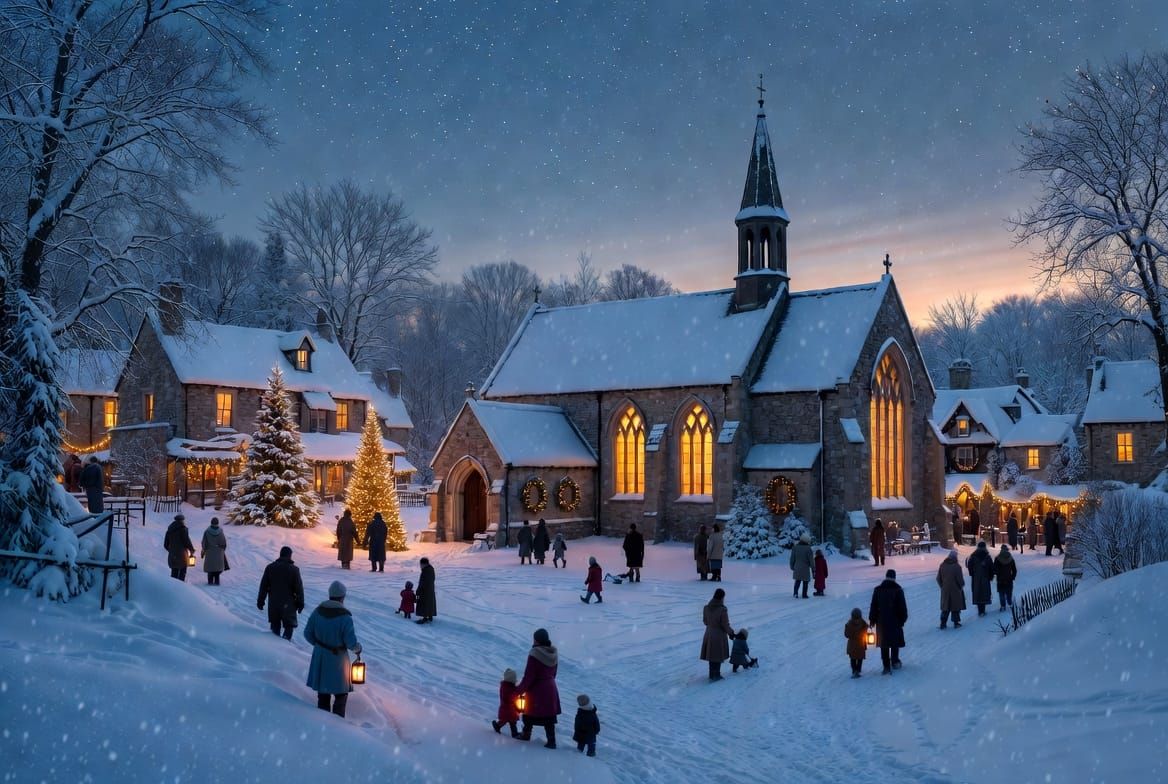
The Twelve Days of the Incarnation
The Season of Christmas, traditionally called Christmastide, is the Church’s sustained celebration of the Incarnation. It begins on December 25 and lasts for twelve days through January 5, ending as the Church arrives at the Epiphany on January 6. Where the surrounding culture often treats December 25 as the climax and conclusion of Christmas, the Church begins her Christmas celebration there and allows the mystery of the Word made flesh to remain before her for nearly two weeks. The BCP 2019 explicitly describes the Season of Epiphany as following “the twelve days of the Christmas season (Christmastide),” and provides the Christmas propers, Holy Days, and Sundays through which those twelve days unfold.
The Season of Christmas is a season of joy, but it is not sentimental joy. Within its opening days the Church remembers Stephen, the first Christian martyr; John, the Apostle and Evangelist whose long life bore witness to the incarnate Word; and the Holy Innocents, the children slaughtered because Herod sought to destroy the newborn King. January 1 then gives the Church the Circumcision and Holy Name of Our Lord Jesus Christ. The cradle and the stones occupy the same season, and the angels’ song is followed almost immediately by martyrdom and lamentation. The Light has come into the world, and the darkness has not overcome it, but Christmas does not pretend that darkness quietly withdrew when Christ was born.
That gives the season what might be called an honest joy. Christmas rejoices because God has acted decisively in Jesus Christ, not because suffering has temporarily disappeared. The eternal Son has entered the very world in which death, tyranny, grief, and sin remain present, and his coming announces that none of them will have the final word.
The Twelve Days of Christmas
The twelve days of Christmas are December 25 through January 5. January 5 is traditionally known as the Twelfth Day of Christmas, and customs surrounding Twelfth Night have often marked the transition toward the Epiphany on January 6. Epiphany is closely bound to Christmas but is not itself one of the twelve days. It is a distinct Principal Feast that follows Christmastide and opens the Season of Epiphany.
This distinction matters because Advent, Christmas, and Epiphany are easily collapsed into one long cultural holiday. The Christian calendar gives each its proper work. Advent waits for the Lord who comes; Christmas celebrates the Word made flesh; Epiphany manifests that incarnate Lord to the nations and begins a season in which his identity and glory continue to be revealed.
The BCP also protects the festal character of these twelve days through its fasting discipline. Every Friday of the year outside the twelve days of Christmas and the fifty days of Easter is encouraged as a day of fasting, so the ordinary Friday discipline is suspended throughout Christmastide. Christmas is therefore not merely a single feast followed immediately by ordinary time but a genuine season of celebration and thanksgiving.
That does not mean every day within Christmas has precisely the same emotional or liturgical character. Stephen brings martyrdom into the season, the Holy Innocents bring lamentation, and the Holy Days possess their own emphases and traditional colors. The unity of Christmastide is deeper than emotional uniformity because all of these observances are being interpreted by the same great mystery: the eternal Son has truly become man.
The Holy Days Within the Season
The days immediately following Christmas are unusually dense with Red-Letter Holy Days. Rather than allowing the Church to remain before the manger in uncomplicated warmth, the calendar begins showing what the coming of Christ means in a world that receives him with both faith and hostility. The result is not a departure from Christmas but a fuller account of what the Incarnation means within fallen human history.
December 26 is the Feast of Saint Stephen, Deacon and Martyr. Acts presents Stephen as a man full of grace and power who bears witness to Christ and is stoned after seeing the Son of Man standing at the right hand of God. His placement immediately after Christmas gives Christmastide its first sharp note of martyrdom. The Word made flesh has entered a world that will crucify him and persecute those who belong to him, yet Stephen dies looking toward the enthroned Christ and praying for his persecutors.
The juxtaposition is not an interruption of Christmas but one of its interpretations. The child born in Bethlehem is worth dying for because he is not merely the center of a beautiful birth story. He is the crucified, risen, ascended, and reigning Lord for whom Stephen gives his life.
December 27 is the Feast of Saint John, Apostle and Evangelist. The traditional identification of John as the Beloved Disciple and the apostolic author standing behind the Gospel and Johannine Epistles gives his feast an unusually close relationship to the Incarnation. His Gospel begins before Bethlehem with the eternal Word who was with God and was God, then announces the mystery around which Christmastide revolves: “And the Word became flesh and dwelt among us.” (John 1:14, ESV)
John’s witness differs from Stephen’s. Christian tradition remembers him as one who suffered for Christ but did not die a martyr’s death, so his witness became the long testimony of an apostolic life. He lived to teach and bear witness to what he had heard, seen, and touched concerning the Word of life. Christmastide therefore moves from Stephen’s witness unto death on the twenty-sixth to John’s sustained apostolic witness on the twenty-seventh.
December 28 is the Feast of the Holy Innocents, the children of Bethlehem killed at Herod’s command when he sought to destroy the child whom the Magi had identified as King of the Jews. Their feast is one of the most difficult days in the Christmas calendar because it refuses to protect Christmas joy from grief. Jesus escapes into Egypt; the other children do not, and Matthew does not explain away that terrible asymmetry. He gives the Church Rachel weeping for her children. (Matthew 2:18)
The Innocents have traditionally been honored as martyrs, although they could neither consciously confess Christ nor choose their suffering. Their connection with martyrdom rests upon the cause of their deaths: Herod killed them because he was seeking Jesus. The Church therefore remembers within Christmas those whose vulnerability was caught in the world’s violent resistance to the newborn King.
The sequence of Stephen, John, and the Holy Innocents gives the first days of Christmas a remarkable shape. Stephen bears voluntary witness unto death, John gives the long witness of an apostolic life, and the Innocents suffer without the capacity to choose or speak. The Church is reminded almost immediately that the Incarnation enters actual human history, with all its beauty, danger, faithfulness, tyranny, and grief.
January 1 brings the Circumcision and Holy Name of Our Lord Jesus Christ. Luke tells us that “at the end of eight days, when he was circumcised, he was called Jesus, the name given by the angel before he was conceived in the womb.” (Luke 2:21, ESV) The child born under the Law receives the covenant sign of Israel and the Name by which his saving mission had already been announced.
The BCP Collect emphasizes both dimensions, confessing that Christ fulfilled the covenant of circumcision for our sake and received the Name above every name. The Church then asks for grace faithfully to bear his Name and worship him with pure hearts according to the New Covenant. Christmas therefore moves naturally from the birth of the Child toward his place within Israel’s covenant history and toward the saving Name by which he will be proclaimed throughout the world.
The Christmas Lectionary
The BCP 2019 provides three sets of propers for Christmas Day, all fixed across the three-year lectionary cycle. Christmas Day I appoints Isaiah 9:1–7, Psalm 96, Titus 2:11–14, and Luke 2:1–14, with verses 15–20 optionally included. Christmas Day II appoints Isaiah 62:6–12, Psalm 97, Titus 3:4–7, and Luke 2:15–20, with the earlier portion of Luke’s Nativity account optionally included. Christmas Day III appoints Isaiah 52:7–12, Psalm 98, Hebrews 1:1–12, and John 1:1–18.
Taken together, these readings give Christmas its full biblical scale. Isaiah announces the Child and the coming reign of God; Luke places us in Bethlehem with Mary, Joseph, the shepherds, and the angels; Titus interprets the coming of Christ as the appearance of God’s saving grace and mercy; Hebrews identifies the Son as the radiance of God’s glory; and John carries us behind the manger into eternity, where the Word already was before anything had been made.
The First Sunday of Christmas continues that theological movement with Isaiah 61:10–62:5, Psalm 147:12–20, Galatians 3:23–4:7, and John 1:1–18. Galatians gives the season one of its clearest explanations of why the Son was born: “when the fullness of time had come, God sent forth his Son, born of woman, born under the law, to redeem those who were under the law, so that we might receive adoption as sons.” (Galatians 4:4–5, ESV)
The Incarnation is therefore not simply the means by which God came near enough for human beings to admire him. The Son is born of woman and born under the Law in order to redeem those under the Law and give them adoption. Christmas leads directly from Incarnation toward salvation.
The Second Sunday of Christmas appoints Jeremiah 31:7–14, Psalm 84, and Ephesians 1:3–14, with the appointed Gospel varying through the lectionary cycle. Ephesians gives this Sunday an enormous horizon because before the foundation of the world God’s saving purpose in Christ already included the adoption of his people and the gathering up of all things in him. The infant of Bethlehem therefore belongs to a purpose older than creation itself, and the events surrounding his infancy unfold within the eternal counsel of God.
The Collects of Christmas
The BCP Collects for Christmas move the Church from the event of the Incarnation toward its saving effect in those who receive Christ. The Christmas Day Collect asks that those who have been “born again and made your children by adoption and grace” may be daily renewed by the Holy Spirit. (BCP 2019, p. 600) The petition refuses to make Christmas merely an annual memory. The Incarnation establishes a saving reality in which Christians live every day.
The First Sunday of Christmas Collect continues with the imagery of light. It remembers that God has poured upon us the new light of his incarnate Word and asks that this light, kindled in our hearts, may shine forth in our lives. (BCP 2019, p. 600) The movement is from divine gift toward Christian fruit: God pours out the light, and Christians ask that the light received may become visible in the life that follows.
The Second Sunday of Christmas Collect reaches still further: “O God, who wonderfully created, and yet more wonderfully restored, the dignity of human nature: Grant that we may share the divine life of him who humbled himself to share our humanity.” (BCP 2019, p. 601) The prayer joins creation, fall, restoration, Incarnation, and participation within a few lines. Its language of sharing the divine life does not mean that creatures cease to be creatures or become divine by nature. It speaks of the life given through union with Christ, adoption, sanctification, and ultimately glorification.
Ancient Christians sometimes described this gracious participation with the word theosis (thee-OH-sis), or deification. Properly understood, this does not mean becoming God by nature but participating by grace in the life God gives through the incarnate Son. The Prayer Book’s own language is especially helpful and safe: Christ humbled himself to share our humanity so that, united to him, we may share his divine life by grace.
The Preface of Christmas
The Proper Preface of Christmas on page 152 gives the season its Eucharistic theology. God gave Jesus Christ, his only Son, to be born for us, and by the Holy Spirit and the Virgin Mary his mother he “was made truly man, yet without the stain of sin,” so that we might be cleansed from sin and given the right to become God’s children. (BCP 2019, p. 152)
The BCP appoints the Preface of Christmas for Christmas Day and the Sundays of Christmas, as well as for Saint Stephen, Saint John, and the Holy Innocents. The Circumcision and Holy Name on January 1 has the Preface of the Presentation. It is therefore most accurate to say that the Christmas Preface pervades Christmastide rather than that it governs literally every Eucharistic celebration within all twelve days.
Its theological force is unmistakable. Christ was born for us. He was made truly man rather than merely appearing human, and he shares our humanity while remaining without sin. The purpose is salvation: cleansing from sin and adoption into the family of God. The Preface therefore keeps the season centered upon Christ rather than Christmas as an atmosphere. The Church sustains twelve days of celebration because the mystery being celebrated cannot be exhausted in a single morning.
A Season of Honest Joy
Christmas joy becomes distorted when it is treated as a requirement to feel cheerful. The calendar itself prevents that mistake because Christmastide contains both Stephen and the Holy Innocents. One dies praying for his murderers while another feast gives voice to Rachel weeping for her children. These observances do not prove that Christmas joy was naïve; they show that Christian joy is strong enough to tell the truth.
The angels announced “good news of great joy” (Luke 2:10, ESV) not because Bethlehem had suddenly ceased to contain tyrants, bereaved parents, poverty, fear, sickness, or death, but because a Savior had been born into that world. Christian joy rests first upon what God has done rather than upon the emotional circumstances in which the announcement is received.
That distinction matters pastorally. Christmas can be a painful season for people grieving someone who is no longer at the table, living with family estrangement, facing illness, carrying financial anxiety, or remembering losses associated with the season itself. The Church should not require such Christians to pretend sadness has disappeared in order to participate faithfully in Christmas.
Christmastide offers something deeper than compulsory happiness. It announces that God has entered the world in which those sorrows occur and that sorrow does not possess the final interpretation of reality. The same season can sing with the angels and weep with Rachel because both are brought before Jesus Christ. The light shines in the darkness precisely because there really is darkness, and Christmas proclaims that the darkness has not overcome the Light.
Christmas in Anglican Worship
White is customarily used during Christmas in Anglican worship, fitting the joy, light, purity, and glory of the Incarnation. The season is visually bright after Advent’s preparation, while the Holy Days within it may introduce their own traditional colors. Saint Stephen and the Holy Innocents are commonly associated with the red of martyrdom, while Saint John is traditionally kept in white as an apostle who was not killed for the faith. These changes need not be understood as interruptions of Christmas but as different witnesses to the mystery being celebrated.
The crèche (kresh), or Nativity scene, is also commonly retained through Christmastide in many churches and homes. The BCP does not require this custom, but it can serve as useful visual catechesis when Scripture remains its interpreter. The Child, Mary, Joseph, manger, and shepherds keep the humility of the Incarnation before the eyes, while the Magi are sometimes added as Epiphany approaches according to local custom.
Keeping the Nativity scene beyond December 25 can make a simple theological point against the cultural tendency to remove Christmas almost as soon as the day itself has passed. The Church has not finished with the manger on the morning of December 26. She is still contemplating who this Child is and what his birth means.
Christmas and Epiphany
The Season of Christmas ends as the Church reaches the Epiphany on January 6. Epiphany is not part of the twelve days but a distinct Principal Feast and the beginning of its own season. The BCP itself describes the Season of Epiphany as following the twelve days of Christmastide.
Christmas and Epiphany nevertheless belong closely together within the Incarnation Cycle. Christmas announces that the eternal Word has become flesh; Epiphany announces that this incarnate Lord is manifested to the nations. The movement is from birth toward manifestation, from the manger toward the Gentiles who come to Israel’s King.
It is better, however, not to say that Epiphany simply “completes” everything belonging to the Incarnation. The Season of Epiphany continues the manifestation of the incarnate Son through his Baptism, ministry, teaching, signs, and finally the Transfiguration. January 6 is therefore both the feast toward which the twelve Christmas days naturally point and the doorway into a further season of revelation. Advent waits, Christmas receives, Epiphany reveals, and the Church follows the one Christ through each movement.
Observing the Season
To observe the Season of Christmas, begin by allowing Christmas actually to begin on Christmas Day. This does not require hostility toward the cultural celebrations that precede December 25, but it does mean allowing Advent to retain its own character so that Christmas arrives as a feast rather than as the exhausted conclusion of a month-long celebration. The Church’s calendar makes room for expectation before December 25 and sustained celebration afterward.
Keep the twelve days deliberately. Pray the Christmas Collects, gather for the Eucharist as the Church provides opportunity, and allow the readings appointed for Christmas Day and the Sundays of Christmas to deepen the meaning of the Incarnation beyond Luke’s familiar manger scene. John, Galatians, Hebrews, and Ephesians make clear that Bethlehem belongs to the eternal purposes of God and to the redemption and adoption of sinners.
Receive the Holy Days rather than regarding them as awkward interruptions. On December 26, let Stephen teach what costly witness to the incarnate Lord can mean. On December 27, receive John’s long testimony to the Word made flesh. On December 28, allow the Holy Innocents to keep grief within Christmas prayer rather than safely outside it. On January 1, hear again the saving Name of Jesus and the obedience of the Son born under the Law.
Allow the ordinary Friday fast to remain suspended during these twelve days as the BCP provides, and let meals, hospitality, generosity, rest, and thanksgiving express the festal character of the season. Christian feasting is not simply excess with religious permission. It is the grateful reception of created gifts before the God whose eternal Son entered creation and sanctified our humanity by assuming our nature.
If a crèche is part of your home or church tradition, consider allowing it to remain through Christmastide rather than disappearing immediately after Christmas Day. Let the visual scene continue asking its quiet theological question: who is this Child? Scripture answers across the twelve days that he is the Son of David, the Word made flesh, the Lord for whom Stephen dies, the Light John proclaims, the King Herod fears, and the Savior who bears the Name above every name.
As January 5 arrives, Twelfth Night may serve as a fitting conclusion to Christmastide rather than an arbitrary stopping point. The Church has spent twelve days receiving the mystery of the Incarnation. On January 6 she turns toward the manifestation of that same Christ to the peoples of the earth.
Conclusion
The Season of Christmas is the Church’s sustained reception of the Incarnation. For twelve days, the calendar refuses to hurry away from the astonishing claim proclaimed on December 25: the eternal Son of God has taken our nature from the Virgin Mary and entered the world he made. Yet Christmastide is not protected from the world’s pain. Stephen’s stones, John’s long witness, Herod’s violence, Rachel’s tears, and the Holy Name all belong within the same season because the Word became flesh in this world rather than in an imaginary one untouched by sin and death.
The BCP Collects and Proper Preface give that mystery its saving purpose. The Son was made truly man so that sinners might be cleansed and made God’s children; the new light of the incarnate Word is meant to shine through the lives of those who receive him; and the humanity Christ assumed is restored so that his people may share his divine life by grace. Christmas therefore moves continually from gift to grace, from Incarnation to adoption, and from the light given in Christ toward the life that light produces.
The joy of Christmas is consequently deeper than seasonal cheerfulness. It can endure martyrdom and grief because it rests upon what God has done rather than upon what Christians presently feel. The twelve days teach the Church to remain for a little while with the mystery Advent prepared her to receive: the Word has become flesh and dwelt among us, the darkness has not overcome his light, and the Son who entered our world for our salvation will finally make all things new.