The Voice Still Cries: Repent! (Matthew 3:1-12)
The kingdom has drawn near in Jesus Christ, and that means we cannot remain neutral. When the true King comes near, every rival kingdom is exposed, the kingdom of self, the kingdom of money, the kingdom of pleasure, the kingdom of political power, the kingdom of religious respectability.
December 7, 2025, Year A, The Second Sunday in Advent
Matthew 3:1–12, Psalm 72:1–15, Romans 15:1–13
Grace, mercy, and peace from God our Father and the Lord Jesus Christ be with you on this Second Sunday of Advent.
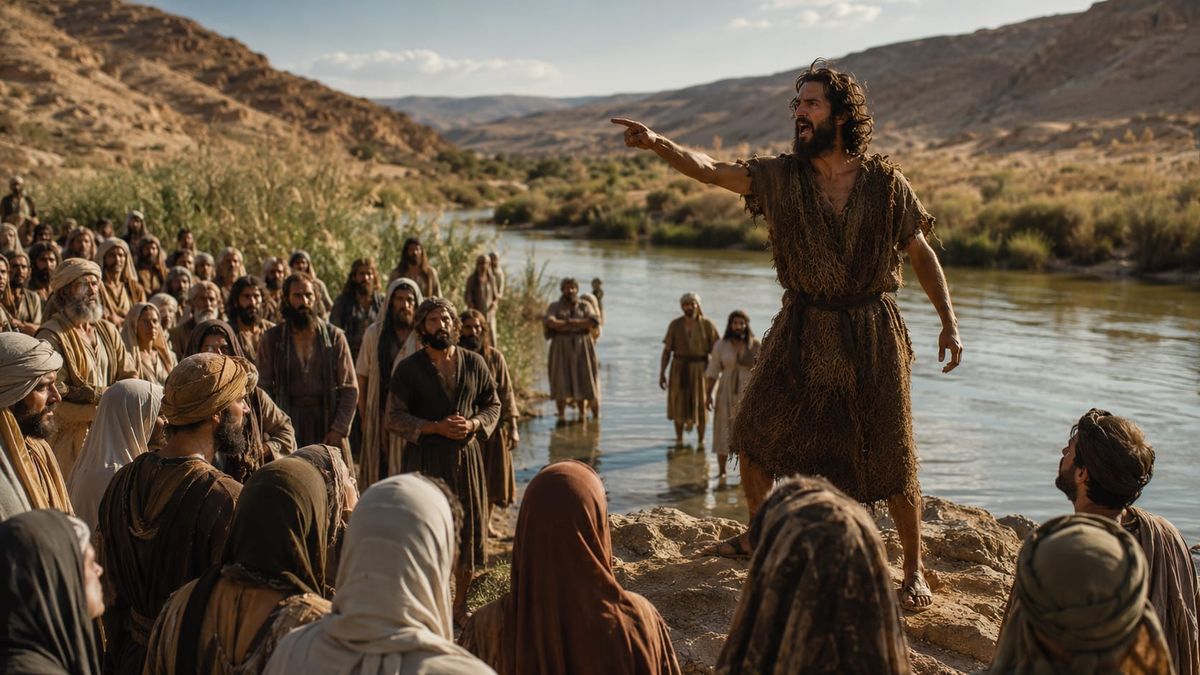
On this Second Sunday of Advent, the Church does not lead us first to the stable, but to the riverbank. We are not invited first to gaze at the child wrapped in swaddling clothes. Instead, the lectionary takes us into the Judean wilderness to stand before a prophet dressed in camel’s hair, with a leather belt around his waist, eating locusts and wild honey, and crying out the word that still echoes across the centuries: “Repent, for the kingdom of heaven is at hand” (Matthew 3:2, ESV). Please turn with me to Matthew 3:1–12.
His name is John the Baptist, the last of the Old Covenant prophets, the hinge between the ages, the forerunner appointed by God to prepare the way of the Lord. John stands with one foot in the long prophetic history of Israel and the other at the threshold of the Gospel. Everything in his ministry points away from himself and toward the one who is coming. Advent does not let us rush to Christmas without first hearing the voice in the wilderness.
In verse 1 we read, “In those days John the Baptist came preaching in the wilderness of Judea” (Matthew 3:1, ESV). Why the wilderness? Why not the temple courts, the synagogues, or the seats of power in Jerusalem? Because the wilderness is where God so often strips away the illusion that we are self-sufficient. Israel learned there that we do not live by bread alone but by every word that comes from the mouth of God (Deuteronomy 8:3). Elijah fled there and heard the Lord after wind, earthquake, and fire had passed (1 Kings 19:11–13). Israel’s idolatry was exposed there, the golden calf was destroyed there, and the covenant was renewed there. Jesus himself entered the wilderness and chose obedience to his Father rather than the lies of the tempter (Matthew 4:1–11). The wilderness is where false refuges begin to look like what they really are.
John does not accommodate himself to our desire for comfortable religion. He stands in a place of desolation and calls people away from their securities, their pedigrees, their reputations, and their excuses. That is one of the gifts of Advent. It does not begin with sentiment. It tells the truth. Before we celebrate the coming of the Savior, we must hear what the Savior has come to save us from.
The heart of John’s preaching comes in verse 2: “Repent, for the kingdom of heaven is at hand” (Matthew 3:2, ESV). The kingdom has drawn near in Jesus Christ, and that means we cannot remain neutral. When the true King comes near, every rival kingdom is exposed, the kingdom of self, the kingdom of money, the kingdom of pleasure, the kingdom of political power, the kingdom of religious respectability. All of them are shown to be too small to bear the weight we put on them.
And the proper response to the nearness of the kingdom is repentance. Repentance is more than regret, more than feeling bad, more than making a resolution that fades when the feeling passes. It is a turning of the whole person toward God. John’s message is not, “Try harder to feel guilty.” His message is, “Turn around.” The road we are on apart from God leads to destruction, and the King is calling us onto another road.
That means repentance is concrete. It reaches into the grudges we have learned to justify, the habits we excuse because everyone else does them, the bitterness we have nursed so long that it feels like part of our personality, the money we refuse to place under God’s lordship, the lust we secretly protect, the pride that always needs to be right, and the fear that keeps us from obeying what we already know God has said. Repentance is not vague sorrow over being imperfect. It is naming sin as sin and turning from it toward Christ.
In verses 5–6, Matthew tells us that “Jerusalem and all Judea and all the region about the Jordan were going out to him, and they were baptized by him in the river Jordan, confessing their sins” (Matthew 3:5–6, ESV). Luke tells us that tax collectors and soldiers were among those asking what repentance should look like in their lives. They came acknowledging their need and submitting to John’s baptism of repentance. Repentance was not theoretical for them. It meant bringing real sins into the light and asking what a changed life should look like tomorrow morning.
Then in verses 7–10, the tone sharpens. Many of the Pharisees and Sadducees, religious insiders with confidence in their place among God’s people, came to John’s baptism. John said to them, “You brood of vipers! Who warned you to flee from the wrath to come? Bear fruit in keeping with repentance. And do not presume to say to yourselves, ‘We have Abraham as our father,’ for I tell you, God is able from these stones to raise up children for Abraham” (Matthew 3:7–9, ESV). John will not allow inherited privilege to become a substitute for repentance.
That is chilling, because religious people are very good at finding substitutes. We can trust in our church membership, our baptism, our family history, our orthodoxy, our morality, our years of service, or the fact that we know how the liturgy works. Those are not bad things. Some of them are genuine gifts from God. But none of them can become a shield behind which an unrepentant heart hides. John’s question is not whether we have religious credentials. It is whether repentance is bearing fruit.
John continues in verse 10: “Even now the axe is laid to the root of the trees. Every tree therefore that does not bear good fruit is cut down and thrown into the fire” (Matthew 3:10, ESV). The warning is not superficial. The axe is at the root. John is announcing that the coming of the King exposes what is alive and what is dead, what is genuine and what is merely outward.
Advent therefore refuses to let us coast on yesterday’s faithfulness. It will not let us hide behind a baptismal certificate, a family tree, decades in the Church, or correct doctrine defended loudly. John’s voice still calls us to “bear fruit in keeping with repentance” (Matthew 3:8, ESV). The question is not whether repentance can earn God’s mercy. It cannot. The question is whether those who have received mercy are being turned by that mercy.
That distinction matters. We do not bear fruit in order to convince God to save us. We bear fruit because God’s grace does not leave us where it found us. The tree is not alive because it produces fruit. It produces fruit because it is alive. Christian obedience is not the price we pay for salvation. It is the evidence that grace is at work within us.
John then makes his own place perfectly clear in verses 11–12: “I baptize you with water for repentance, but he who is coming after me is mightier than I, whose sandals I am not worthy to carry. He will baptize you with the Holy Spirit and fire. His winnowing fork is in his hand, and he will clear his threshing floor and gather his wheat into the barn, but the chaff he will burn with unquenchable fire” (Matthew 3:11–12, ESV). John can call people to repentance and baptize with water, but the one coming after him does what John cannot do. Jesus gives the Holy Spirit, and Jesus brings judgment.
The same Jesus who gives the Spirit is also the Judge. There is no spiritual Switzerland in John’s preaching. The wheat is gathered into the barn and the chaff is burned. Yet even here we must keep the order straight. Fruit does not earn a place in the barn. Fruit is what living repentance and faith begin to produce because God has acted first.
That is why Advent is serious without being hopeless. Christmas is not finally about a harmless baby. The child in the manger is the sovereign King who comes to save, to judge, and to make all things new. Yet the question is not whether we can make ourselves ready enough for him. We cannot. The question is whether we will receive the mercy he brings and let that mercy turn us.
That is where Romans 15 helps us. Paul says in verses 1–3, “We who are strong have an obligation to bear with the failings of the weak, and not to please ourselves. Let each of us please his neighbor for his good, to build him up. For Christ did not please himself” (Romans 15:1–3, ESV). Romans shows us one important shape that the fruit of repentance takes. Grace creates a people who stop living only for themselves.
This is cruciform love, love that bears with the weak, builds up the neighbor, and refuses to make self-protection the highest good. Paul does not begin with our achievement. He begins with Christ. “Christ did not please himself” (Romans 15:3, ESV). Before Paul tells us to bear with the weak, he reminds us of the Christ who bore with us.
That changes the application. Christian patience is not gritting our teeth and tolerating difficult people until they become less annoying. Christian generosity is not proving that we are better people. Christian forgiveness is not pretending that sin did not matter. All of it grows from remembering how patiently Christ has dealt with us, how freely he has given to us, and how much mercy we ourselves have received.
Paul then turns outward in verses 8–12. Christ became a servant to confirm God’s promises and “in order that the Gentiles might glorify God for his mercy” (Romans 15:9, ESV). Paul gathers Scripture after Scripture until he reaches Isaiah: “The root of Jesse will come, even he who arises to rule the Gentiles; in him will the Gentiles hope” (Romans 15:12, ESV). The King John announces is not only Israel’s hope. He is the hope of the nations.
John’s warning and Paul’s hope belong to the same coming kingdom. Christ judges evil, and Christ gathers a redeemed people from every nation. Paul closes the passage with words that could have been written for Advent itself: “May the God of hope fill you with all joy and peace in believing, so that by the power of the Holy Spirit you may abound in hope” (Romans 15:13, ESV). Repentance is not sustained by terror alone. It is sustained by hope in the King who saves. We turn from sin not only because sin destroys, but because Christ is better.
Psalm 72 gives us a portrait of that King. The Psalm prays, “Give the king your justice, O God, and your righteousness to the royal son! May he judge your people with righteousness, and your poor with justice!” (Psalm 72:1–2, ESV) This King does not use power to feed himself. He uses power for the good of those who cannot protect themselves.
The Psalm continues, “He delivers the needy when he calls, the poor and him who has no helper. He has pity on the weak and the needy, and saves the lives of the needy” (Psalm 72:12–13, ESV). This is no partisan strongman and no cosmic tyrant. This is the righteous King whose justice and mercy are not enemies. His coming means judgment for evil and hope for the crushed.
Human power so often flows toward the already powerful. The influential get access, the wealthy get heard, the connected find doors opening. Psalm 72 imagines the opposite. The King bends his attention toward the person who has no helper. He regards the life of the needy as precious. That is the King John says is coming.
That is why repentance can be more than fear. We turn from sin because the King who calls us is good. We have seen something better than the idols we are asked to leave behind. We have seen the one who defends the weak, bears with sinners, keeps his promises, and gives his Spirit to make obedience possible.
The Collect for this Second Sunday of Advent asks God to grant that, through Holy Scripture, we may “embrace and ever hold fast the blessed hope of everlasting life” (BCP 2019, p. 598). That prayer fits Romans 15 exactly. We hear the Word, we are called to repentance, and the God of hope fills his people with joy and peace in believing. Scripture does not merely expose us. God uses his Word to lead us toward the hope he has given us in Jesus Christ.
So what does it mean for us to prepare the way of this King? First, we hear the wilderness voice and refuse to silence it. Where is the Spirit exposing pride, greed, lust, bitterness, indifference, cowardice, or self-righteousness in us? We do not negotiate with sin. We confess it, forsake it, and flee to Christ.
Second, we renounce every false ground of confidence. Not our heritage, not our sacraments, not our orthodoxy, not our activism, not our morality. These may be gifts, and some are means by which God strengthens his people, but none is the ground of our justification. Only Christ can save us, and only his righteousness can stand before the judgment we deserve.
Third, we bear visible fruit in keeping with repentance. Romans gives us one shape of that fruit: bearing with the weak instead of despising them, building up rather than tearing down, serving rather than insisting on our own way. Psalm 72 gives us another: concern for the poor, the weak, and the needy. Repentance turns us toward God, and that turning begins to change how we live with our neighbors.
That means we should be able to point to places where grace has made us different. Perhaps we are slower to speak and quicker to listen. Perhaps we finally make the apology we have postponed. Perhaps we stop rehearsing the offense and begin praying for the person who caused it. Perhaps we become more generous because we are less afraid of scarcity. Perhaps the fruit is simply that we stop defending what God has already told us to confess.
Fourth, we live as people of hope. The world may unravel around us, our own failures may discourage us, and some sins may need to be confessed again with tears. Yet Paul does not say that the God of hope fills only the impressive with joy and peace. He fills those who believe, by the power of the Holy Spirit, so that hope becomes something God gives rather than something we manufacture.
And fifth, we become voices ourselves. John’s ministry was unique, but every Christian bears witness to the one John announced. In our homes, workplaces, friendships, and ordinary conversations, we can still say, “Behold, the Lamb of God, who takes away the sin of the world!” (John 1:29, ESV) There is mercy for sinners. There is hope for the nations. The King has come, the King reigns, and the King is coming again.
In a few moments we will come to the Lord’s Table. Here Christ meets us with the fruits of his once-for-all sacrifice. The judgment we deserved fell on him at the cross, and he gives us the bread of life and the cup of the new covenant. We come not because we have made ourselves worthy, but because the one who calls sinners to repent is the same Savior who gave himself for sinners.
So come, all who are weary of pretending everything is fine. Come with the sins you can name and the weakness you cannot fix. Come with the places where repentance has been slow and hope has grown thin. The kingdom of heaven is at hand. The King is mightier than John, mightier than sin, and mightier than death itself. His winnowing fork is in his hand, yes, but his nail-pierced hands are stretched out in welcome.
Repent and believe the Gospel. Bear fruit worthy of repentance, abound in hope, and worship the Lamb who was slain and who lives forever. As Paul says in verse 13, “May the God of hope fill you with all joy and peace in believing, so that by the power of the Holy Spirit you may abound in hope” (Romans 15:13, ESV). May he keep us in that hope until the King comes in glory and makes his blessings flow far as the curse is found.
In the Name of the Father, and of the Son, and of the Holy Spirit. Amen.