Thomas the Apostle: An Anglican Perspective
December 21 is the Feast of Saint Thomas. He is remembered as the doubter. But he also said ‘let us go, that we may die with him.’ He asked the question that produced ‘I am the way.’ And when the risen Christ appeared, Thomas gave the highest confession in John’s Gospel: My Lord and my God.
Feast Day: December 21
The Anglican calendar is ordered by a hierarchy of holy days, each carrying a different weight of observance. At the top sit the seven Principal Feasts — the highest days of the liturgical year. Below them are the Red-Letter Holy Days, appointed in the BCP 2019 with their own collects, propers, and lectionary readings, listed on page 688. They are called Red-Letter Days because, in the tradition of printing church calendars, these days appear in red ink, distinguished from the Optional Commemorations which appear in ordinary type. The Feast of Saint Thomas the Apostle, observed on December 21, is one of these Red-Letter Holy Days.
December 21 is the winter solstice — the shortest day and longest night of the year in the Northern Hemisphere. It is a fitting day for the feast of the apostle whose faith moved through darkness into light. Thomas is remembered almost universally as the doubter, the one who would not believe until he had seen and touched. But that reputation, however earned, is only the middle of the story. The Thomas of John’s Gospel is also the one who said “let us also go, that we may die with him,” the one whose honest question produced Christ’s greatest self-declaration, and the one who spoke the highest Christological confession in the entire Fourth Gospel. He is the apostle of the darkness that becomes dazzling faith.
The Biblical Portrait
Thomas appears four times in John’s Gospel, and each appearance reveals a different facet of the same honest, searching character. The first is in John 11:16, when Jesus announces his intention to return to Judea to raise Lazarus, despite the threat of death from the authorities there. The other disciples are uncertain and afraid. Thomas speaks for all of them: “Let us also go, that we may die with him.” (John 11:16, ESV) Interpreters have read this remark differently. Some hear courage — Thomas accepting the danger and committing to follow regardless. Others hear dark irony or resigned fatalism — something closer to “fine, then let us all go get ourselves killed.” John gives us no tone markers. What is clear is that Thomas does not dissemble. He names the reality — death — and whatever the emotional register of his words, he goes. The honesty that will mark his response to the resurrection is already present here.
The second appearance is in John 14:5, at the Last Supper in the Upper Room. Jesus has spoken of going to prepare a place for his disciples and of their knowing the way. Thomas asks the question that the others are perhaps too polite or too proud to voice: “Lord, we do not know where you are going. How can we know the way?” (John 14:5, ESV) It is a fully honest question. Thomas will not pretend to understand what he does not understand. And it is precisely his honest question that draws from Jesus the declaration that has shaped Christian theology ever since: “I am the way, and the truth, and the life. No one comes to the Father except through me.” (John 14:6, ESV) Thomas’s refusal to feign understanding was the occasion for one of the most important statements Jesus ever made. The Church owes something to Thomas’s honesty.
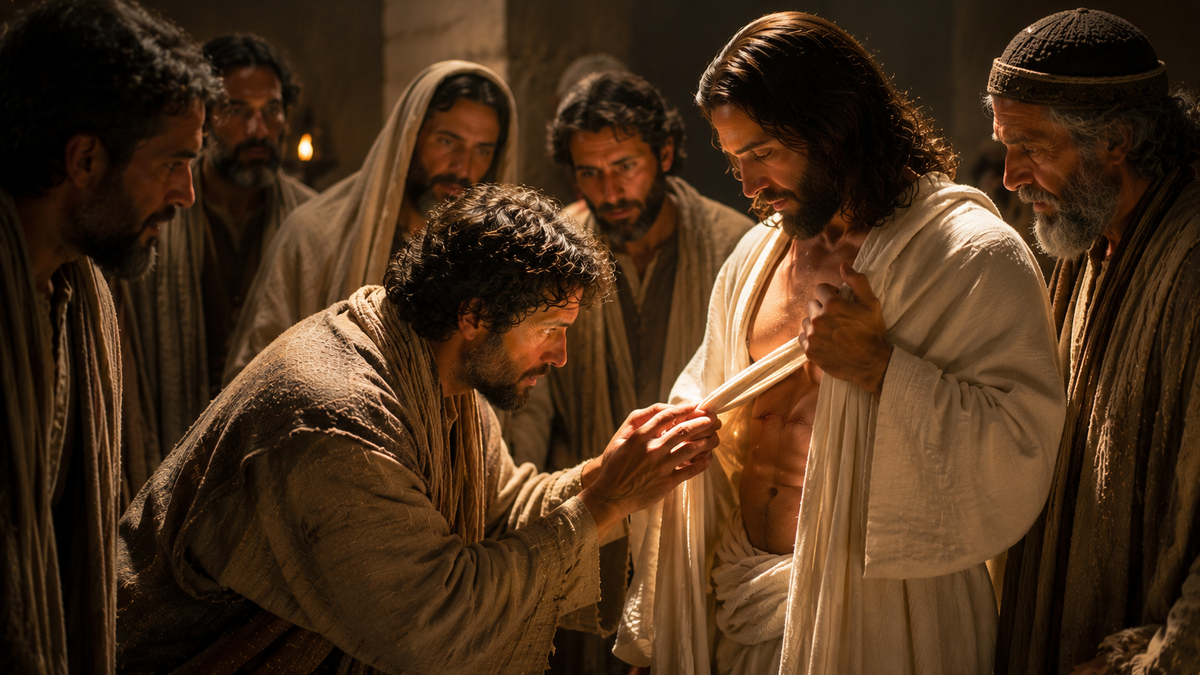
The third appearance is the famous one — John 20:19–29, the appointed Gospel for this feast. The passage begins not with Thomas but without him. On the evening of the resurrection, the disciples are gathered behind locked doors for fear of the Jews. Jesus appears among them, shows them his hands and his side, breathes on them, and gives them the Holy Spirit and the apostolic commission: “As the Father has sent me, even so I am sending you.” (John 20:21, ESV) They see the risen Lord. They receive the Spirit. They are sent. All of this happens, and Thomas is not there. When the others tell him, his response is not gentle skepticism but a precise statement of exactly what it would take: “Unless I see in his hands the mark of the nails, and place my finger into the mark of the nails, and place my hand into his side, I will never believe.” (John 20:25, ESV) He is not asking for more than the other disciples received. He is asking for what they received — the sight of the wounds, the presence of the risen Christ. The collect describes what happens next as God “strengthening him with firm and certain faith” — which means the strength of Thomas’s eventual faith was proportionate to the honesty of his demand.
Eight days later, Jesus appears again — this time with Thomas present. He offers Thomas exactly what Thomas asked for, and the response is the fourth and climactic appearance: “Thomas answered him, ‘My Lord and my God!’” (John 20:28, ESV) This is the highest Christological confession in the Fourth Gospel — higher than Peter’s “You are the Christ, the Son of the living God,” more direct than any other apostolic statement about who Jesus is. The man who demanded evidence gives the confession that crowns John’s entire argument. The Gospel that begins with “In the beginning was the Word, and the Word was with God, and the Word was God” ends with a fisherman from Galilee saying to a risen man: my Lord and my God. Thomas took the long road to that confession. But he arrived.
The Theological Significance
Habakkuk 2:1–4, the appointed Old Testament reading from the propers on page 730 of the BCP 2019, opens with the prophet standing at his watchtower, waiting for God’s answer: “I will take my stand at my watchpost and station myself on the tower, and look out to see what he will say to me.” (Habakkuk 2:1, ESV) Habakkuk is in dialogue with a God whose ways he does not understand and whose silence he finds intolerable. He does not abandon his post. He waits. And the answer comes: “the righteous shall live by his faith.” (Habakkuk 2:4, ESV) Thomas stood at his own watchtower. He set his terms, he waited, and when the answer came it exceeded everything he had demanded. The righteous shall live by faith — and Thomas’s faith, forged in the darkness of the first Easter week, became the faith by which he lived and died.
Psalm 126, the appointed psalm, is the psalm of restored fortunes — of those who wept in exile and returned singing: “Those who sow in tears shall reap with shouts of joy! He who goes out weeping, bearing the seed for sowing, shall come home with shouts of joy, bringing his sheaves with him.” (Psalm 126:5–6, ESV) Thomas went through eight days of weeping — eight days of knowing that everyone else had seen the risen Lord and he had not, eight days of holding to his demand in isolation from the community’s joy. He came home bringing sheaves: my Lord and my God.
Hebrews 10:35–11:1, the appointed Epistle, presses the theology of Thomas’s experience into a present exhortation: “Therefore do not throw away your confidence, which has a great reward. For you have need of endurance, so that when you have done the will of God you may receive what is promised.” (Hebrews 10:35–36, ESV) And then the great definition that crowns the passage: “Now faith is the assurance of things hoped for, the conviction of things not seen.” (Hebrews 11:1, ESV) The collect prays for faith that believes “perfectly and without doubt.” Hebrews presses in the same direction: do not throw away your confidence. Endure. What Thomas received when he persisted to the end of his waiting is what the whole Church is asked to receive by faith — the conviction of things not seen, the assurance of the resurrection that Thomas saw and the rest of us take on his testimony.
The BCP 2019 Collect and Preface
The BCP 2019 appoints the following collect for the feast on page 624: “Everliving God, you strengthened your apostle Thomas with firm and certain faith in your Son’s resurrection: Grant us so perfectly and without doubt to believe in Jesus Christ, our Lord and our God, that our faith may never be found wanting in your sight; through him who lives and reigns with you and the Holy Spirit, one God, now and for ever. Amen.” The collect addresses God as “Everliving” — a title that resonates with the feast’s appointed Gospel, in which the risen Christ appears to the apostle who doubted his resurrection. The living God gives faith in the living Christ. And what it asks for is not merely the absence of doubt but a positive and perfect faith — the kind that, when it confesses Christ, confesses him without reservation as Lord and God. Thomas’s confession is the standard the collect sets. The feast invites the Church to pray for the same.
The Preface of Apostles, found on page 155 of the BCP 2019, is used at the Eucharist for this feast as for all apostolic feasts: “Through the great shepherd of your flock, Jesus Christ our Lord, who after his resurrection sent forth his apostles to preach the Gospel and to teach all nations, and promised to be with them always, even to the end of the ages.” (BCP 2019, p. 155) The preface is especially fitting here: the risen Christ who appeared to Thomas and received his confession is the same risen Christ who sent Thomas to preach the Gospel. The doubt that was answered by the resurrection became the testimony that Thomas carried to the world.
Thomas in History and Tradition
Thomas is one of only a handful of apostles whose missionary tradition has left a substantial and historically credible trace. The Church of India — the St. Thomas Christians of Kerala — traces its founding to Thomas himself, placing his arrival on the Malabar Coast around 52 AD. This tradition is ancient, widespread, and taken seriously by historians. If it is accurate, Thomas’s apostolate was among the most geographically ambitious of any of the Twelve — reaching the Indian subcontinent while Paul was still traveling the Mediterranean. The man who demanded to touch the wounds of the risen Christ became the apostle who carried the resurrection further east than any other.
The tradition holds that Thomas was martyred near Chennai (Madras) around 72 AD, killed by a spear while at prayer. He is venerated as the patron saint of India, and the Syro-Malabar and Syro-Malankara Catholic Churches — along with several Eastern Orthodox communities — trace their apostolic lineage directly to him. The feast of December 21 is observed with particular solemnity in the Christian communities of Kerala, for whom Thomas is not a distant apostle of the Western calendar but the father of their own faith.
The Feast of Thomas within Advent
December 21 falls within the season of Advent. The BCP 2019 rubrics specify that Red-Letter Holy Days may not be observed on Sundays during Advent, since Advent Sundays take precedence. When December 21 falls on a Sunday, the feast is transferred to the nearest following weekday. When it falls on a weekday, it may be observed on that day. The Advent context of the feast is not incidental. Advent is the season of waiting for the coming of the Lord — and Thomas is the apostle who waited, who held his position in the darkness of the first Easter week until the Lord came and met him where he was. His feast during Advent is a pastoral word to those who are still waiting, still in the dark, still setting their terms and holding their ground while the community around them seems already to have seen what they have not.
Observing This Feast
December 21 falls within Advent. When it falls on a Sunday, the feast is transferred to the nearest following weekday. When it falls on a weekday, it is observed on that day. Consult the rubrics on page 689 of the BCP 2019.
To observe the feast: pray the collect from BCP 2019, p. 624. Read John 20:19–29 — the whole passage, both appearances, including Thomas’s absence and his demand and his confession. Notice that Jesus does not rebuke Thomas for his honesty. He meets him where he is and gives him what he asked for. Read Habakkuk 2:1–4 and sit with the prophet at his watchtower — watching, waiting, holding his position until the answer comes. Read Hebrews 10:35–11:1 and let the great definition of faith reframe Thomas’s story: the assurance of things hoped for, the conviction of things not seen. And let the collect’s petition be the prayer with which the day closes: grant us so perfectly and without doubt to believe in Jesus Christ, our Lord and our God, that our faith may never be found wanting in your sight.
Conclusion
Thomas is the patron saint of those who need more than they have been given — who find themselves in the dark while others seem already to be in the light, who cannot simply take someone else’s word for the most important things, who hold their ground and wait for the Lord to come and meet them where they are. The Church is right to give him a feast. His story is the story of faith that arrives through the longest route, the story of the man who sowed in tears and came home with sheaves, the story of the one who demanded to touch the wounds and in touching them confessed what no one had yet said so plainly.
“My Lord and my God.” (John 20:28, ESV)