What Then Will This Child Be? The Nativity of Saint John the Baptist (Luke 1:57-80)
John is born as the days begin to shorten; Jesus is born as the days begin to lengthen. The old preachers loved to quote John’s own words over that arrangement: “He must increase, but I must decrease.” Even the sun preaches John’s sermon.
June 24, 2026, The Nativity of Saint John the Baptist, Red-Letter Holy Day, Season after Pentecost
Luke 1:57–80, Psalm 85:7–13, Isaiah 40:1–11, Acts 13:14b–26
Grace, mercy, and peace from God our Father and the Lord Jesus Christ be with you on this feast of the Nativity of Saint John the Baptist.
Today is one of the rarest kinds of days in the Church calendar. We honor many saints across the year, and almost without exception we honor them on the day of their death, their heavenly birthday, the day they entered glory. The calendar keeps only two birthdays in the ordinary course of the year: the Nativity of our Lord on December 25, and the Nativity of John the Baptist today, June 24. Six months apart, just as Gabriel told Mary: “And behold, your relative Elizabeth in her old age has also conceived a son, and this is the sixth month with her who was called barren.” (Luke 1:36, ESV) The Church set these two births opposite each other on the calendar deliberately. John is born as the days begin to shorten; Jesus is born as the days begin to lengthen. The old preachers loved to quote John’s own words over that arrangement: “He must increase, but I must decrease.” (John 3:30, ESV) Even the sun preaches John’s sermon.
And the timing within our own week could hardly be better. This past Sunday we heard Jesus send his disciples out as sheep among wolves and say three times: have no fear of them. I told you then that John is the face of that whole sermon, the man who confessed before crowds and soldiers and a king, and paid for it with his head. Today we go back to the beginning of that life and ask the question his neighbors asked over his cradle: “What then will this child be?” (Luke 1:66, ESV)
Luke begins his Gospel not with Jesus but with John, with an old priest named Zechariah serving his division’s rotation in the temple, chosen by lot to burn the incense. And Gabriel appears at the right side of the altar and tells him that his prayer has been heard: Elizabeth will bear a son, and he shall be called John. Zechariah asks for proof: “How shall I know this? For I am an old man, and my wife is advanced in years” (Luke 1:18, ESV); and the proof he receives is silence. Nine months of it. The priest whose job was to speak blessing over the people cannot speak at all. Every day of Elizabeth’s pregnancy, Zechariah lives inside the consequence of his unbelief and the growing evidence of God’s faithfulness, and he cannot say a word about either.
Verse 57: “Now the time came for Elizabeth to give birth, and she bore a son.” (Luke 1:57, ESV) Luke says it that simply. The barren womb, one of Scripture’s oldest recurring signs of human impossibility, has opened. This is the family pattern of the God of Israel. Sarah laughed at the promise and bore Isaac. Hannah wept at Shiloh and bore Samuel. Elizabeth, advanced in years, called barren by everyone who knew her, bears the forerunner of the Messiah. When God begins a great work of salvation, he loves to begin it where human possibility has run out, because then there is no mistaking whose work it is. The neighbors understood exactly that. Verse 58: they heard “that the Lord had shown great mercy to her, and they rejoiced with her.” (Luke 1:58, ESV) Not congratulations on your good fortune. The Lord has shown great mercy. They named the source.
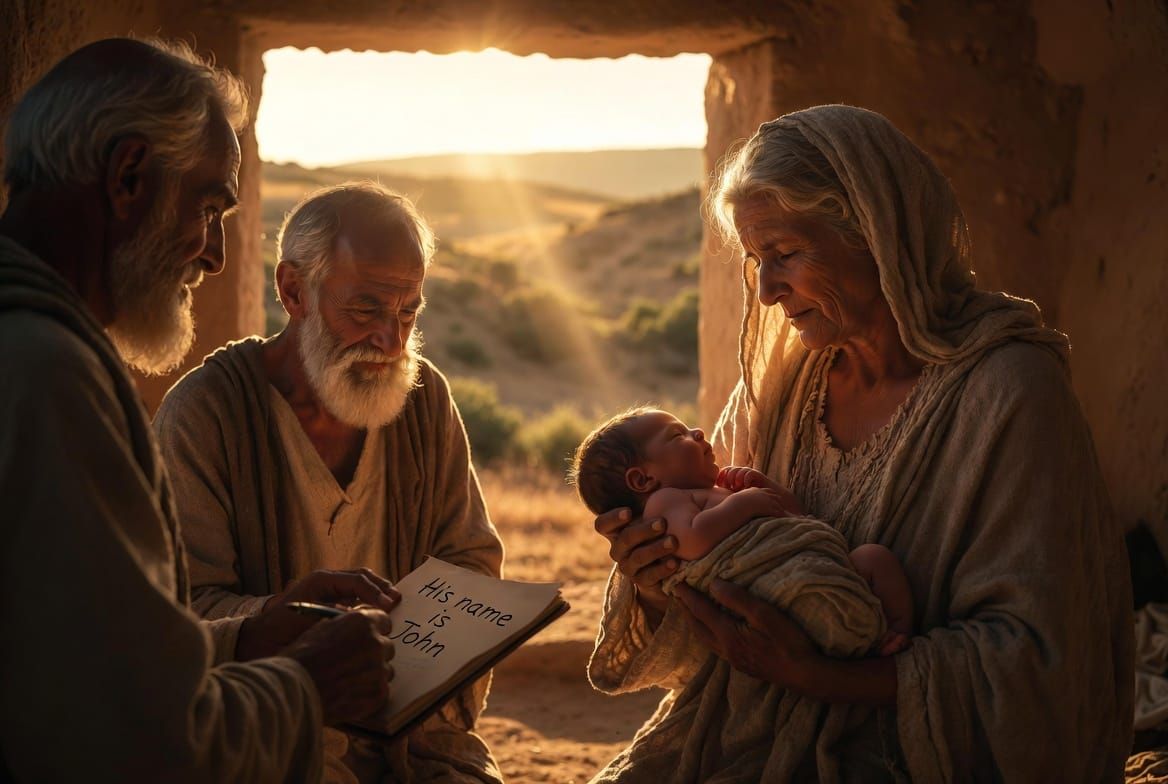
Then comes the eighth day, the day of circumcision and naming, and with it one of the most human scenes in the Gospels. The relatives have already decided: the boy will be Zechariah, after his father. That is how it was done, family names carried forward, the future tied safely to the past. And Elizabeth says no. “No; he shall be called John.” (Luke 1:60, ESV) The relatives object, none of your family bears that name, and they appeal over her head to the father, making signs to him. And Zechariah asks for a writing tablet and ends nine months of silence with four words: “His name is John.” (Luke 1:63, ESV) Not “he shall be called.” His name is John. It was settled in heaven before he was conceived. The name means the Lord is gracious, and the moment Zechariah writes it, his tongue is loosed and the first thing he does is bless God. His obedience marks the moment when God opens what unbelief had closed.
And the neighbors are afraid, the good fear, the awe that falls when people realize God is at work in their own hill country, and the news runs through all Judea, and everyone who hears it asks the question that titles this sermon: “What then will this child be?” (Luke 1:66, ESV) Luke answers before the sentence ends: “For the hand of the Lord was with him.” Every child is a question waiting to be answered. This one already had the answer resting on him.
Then Zechariah, filled with the Holy Spirit, sings. We know this song. The Benedictus has belonged to the Church’s morning prayer for centuries, and in our Prayer Book it remains one of the principal Gospel canticles of Morning Prayer. Zechariah’s first recorded words after nine months of silence became words the Church has prayed from generation to generation: “Blessed be the Lord God of Israel, for he has visited and redeemed his people.” (Luke 1:68, ESV) Notice the tense. Has visited. Has redeemed. The Messiah is not yet born, Mary is perhaps three months along, and Zechariah sings as if the whole work were finished. That is what being filled with the Spirit does to a man’s grammar. Faith speaks of God’s promises in the past tense, because when God has said it, it is as good as done.
And then the old priest turns to the eight-day-old boy in the room. Verses 76–77: “And you, child, will be called the prophet of the Most High; for you will go before the Lord to prepare his ways, to give knowledge of salvation to his people in the forgiveness of their sins.” (Luke 1:76–77, ESV) There had been no prophet in Israel for four hundred years. Malachi had fallen silent, and the silence had held from generation to generation, and Malachi’s last recorded words had promised that before the great day of the Lord, Elijah would come. Now a priest of the Old Testament holds the child who will break that silence. John will be the hinge between the testaments: the last of the old prophets and the herald of the new creation, the voice Isaiah promised; and the appointed Old Testament reading gives us that very promise: “A voice cries: ‘In the wilderness prepare the way of the Lord; make straight in the desert a highway for our God.’” (Isaiah 40:3, ESV)
Look at how Isaiah 40 opens: “Comfort, comfort my people, says your God. Speak tenderly to Jerusalem, and cry to her that her warfare is ended, that her iniquity is pardoned.” (Isaiah 40:1–2, ESV) The voice in the wilderness is not first a voice of condemnation. It is a voice of comfort, the announcement that the exile is ending and the Lord himself is coming. Yes, John will preach repentance with fire, and call the crowds a brood of vipers, and name Herod’s sin to his face. But the purpose of all that straightening of roads is given in Zechariah’s song, in what may be the most beautiful lines in the whole Benedictus: “because of the tender mercy of our God, whereby the sunrise shall visit us from on high to give light to those who sit in darkness and in the shadow of death, to guide our feet into the way of peace.” (Luke 1:78–79, ESV) The tender mercy of our God. The sunrise from on high. John’s whole fiery ministry exists to get people ready for a dawn. Repentance is the road; mercy is the destination.
The appointed Psalm, Psalm 85:7–13, holds the same two notes in one frame. The appointed portion begins with the plea: “Show us your steadfast love, O Lord, and grant us your salvation” (Psalm 85:7, ESV); and it ends with the vision of what arrives when God answers: “Steadfast love and faithfulness meet; righteousness and peace kiss each other.” (Psalm 85:10, ESV) That meeting, righteousness and peace embracing rather than opposing, is exactly what John was born to announce. The Lord whose way he prepares is the one in whom the demands of righteousness and the gift of peace are reconciled at last, at a cross John would not live to see.
The appointed reading from Acts shows us how the apostles preached John. Paul, in the synagogue at Antioch in Pisidia, rehearses the history of Israel and brings it to its point: “Before his coming, John had proclaimed a baptism of repentance to all the people of Israel. And as John was finishing his course, he said, ‘What do you suppose that I am? I am not he. No, but behold, after me one is coming, the sandals of whose feet I am not worthy to untie.’” (Acts 13:24–25, ESV) That is John’s greatness in his own words: I am not he. The crowds were ready to crown him. The priests sent a delegation to ask if he was the Christ. And John never once took what belonged to Jesus. He pointed. That is the whole posture of his life, the finger extended toward the Lamb of God who takes away the sin of the world. Christian artists have often shown him that way, with one long finger pointing away from himself. He must increase. I must decrease.
So what then did this child become? He became the man Jesus called the greatest born of women: “Truly, I say to you, among those born of women there has arisen no one greater than John the Baptist.” (Matthew 11:11, ESV) And then Jesus added the sentence that includes every one of us: “Yet the one who is least in the kingdom of heaven is greater than he.” John stood at the door of the kingdom and pointed through it. We live inside what he could only announce. The least believer who knows Christ crucified and risen stands in a fuller light than the greatest of the prophets. That is not a diminishment of John. It is the measure of what John was pointing at.
And here is where the feast lands on us. Three days ago we heard Jesus say: have no fear of them. Today we meet the man who embodied that command, and we see where such courage comes from, because John’s fearlessness was not temperament. It was vocation. He knew what he was for. From before his birth he was set apart to prepare the way, and a man who knows what he is for can stand in front of a king and tell the truth, and can sit in a prison cell, and can lose his head, because his life was never about preserving his life. It was about the one coming after him. Verse 80 tells us the child grew and became strong in spirit and was in the wilderness until the day of his public appearance, decades of hiddenness for a few brief months of ministry, and he counted it enough, because the work was never the point. The Lord he prepared for was the point.
The Collect for this feast turns John’s life into four petitions, and they are worth hearing slowly: that we may truly repent, boldly rebuke vice, patiently suffer for the sake of truth, and proclaim the coming of Jesus Christ our Lord. Notice the order. Repentance comes first, the preacher of repentance was himself repentant, and no one can prepare the way for anyone else who has not first cleared his own road. Boldness comes second, and it is boldness about vice, not about opinions. John did not die for a partisan quarrel; he died for naming sin as sin before a ruler who had the power to imprison and kill him for it. Patience comes third, and it may be the hardest of the four: John sat in Herod’s prison long enough to wrestle with doubt, sending his disciples to ask Jesus, are you the one who is to come, or shall we look for another? Patient suffering is not suffering without questions. It is staying faithful while the questions go unanswered. And proclamation comes last, the whole point of the other three. We do not repent, rebuke, and suffer for their own sake. We do it so that the proclamation rings true when we make it.
Every one of us was once the subject of that nursery question, what then will this child be, and for those of us with many years behind us, most of the answer has now been written. But not all of it. John’s vocation was unique, but its Christward posture belongs to the whole Church: prepare the way of the Lord. Point. Decrease, that he may increase. There are people all around us sitting in darkness and the shadow of death, the grief that does not lift, the illness that does not relent, the loneliness that settles in and stays, some of them our own neighbors, some at our own tables, and the voice they need is not a polished one. It is a faithful one.
And if you have never turned to the Christ John announces, then hear the Baptist today. Repent, and behold the Lamb of God who takes away the sin of the world. The tender mercy Zechariah sang about is mercy for sinners, including you. Christ has come. He has borne sin upon the Cross, risen from the dead, and opened the way of forgiveness and life. Do not merely admire the finger pointing toward him. Look where John points, turn to Jesus Christ, and trust him.
Zechariah was old when his song finally came. Elizabeth was old when her son finally came. God has never had the slightest difficulty doing his greatest work through people the world had quietly counted out. The sunrise from on high has visited us. The tender mercy of our God is not a rumor; we have received it. What remains is to do what John did with every breath he was given: turn, extend the finger, and say, behold, the Lamb of God.
In the Name of the Father, and of the Son, and of the Holy Spirit. Amen.