When I Am Lifted Up: Holy Cross Day (John 12:31-36a)
John 12:31–36a brings us to the Cross, where Jesus bears our sin, casts down the ruler of this world, and calls us to believe in the Light. Christ has done the saving work. Come to him, trust his mercy, and follow by grace. #ChristIsKing #Christianity #HolyCrossDay
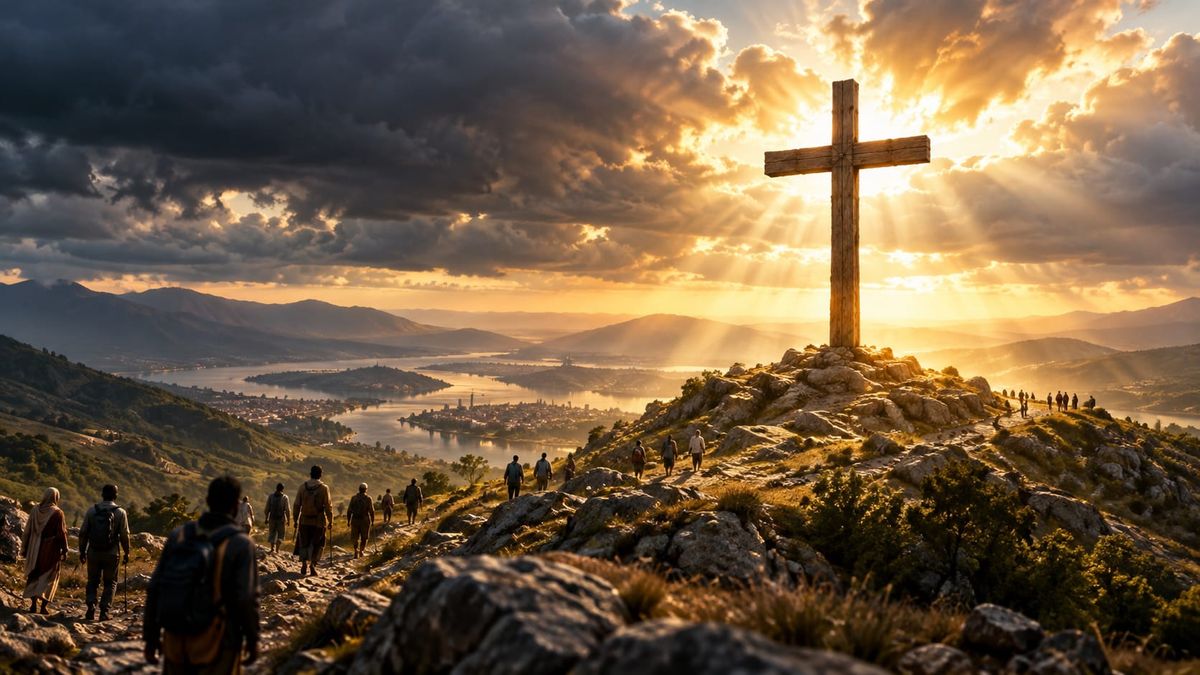
September 14, 2026, Holy Cross Day, Red-Letter Holy Day, Season after Pentecost
John 12:31–36a, Psalm 98, Philippians 2:5–11, Isaiah 45:21–25
Grace, mercy, and peace be with you on this Feast of the Holy Cross.
There are few things more familiar to Christians than the Cross. We see it above altars, wear it around our necks, make its sign upon ourselves, and place it over graves because we bury our dead in the hope of the Resurrection. Something that once announced Roman power, public shame, suffering, and death has become the most recognizable symbol of the Christian faith. Familiarity, however, has its dangers. We can become so accustomed to the Cross that we forget how astonishing it is that Christians glory in it at all.
Holy Cross Day is not simply another opportunity to mourn what happened at Calvary. We have already walked through Good Friday and celebrated Easter. When the Church sets the Cross before us again in September, she does so from the far side of the empty tomb. We look upon the same Cross, but now we know openly what Jesus knew before he ever went there: the place that looked like his defeat would become the place of his victory.
Jesus tells us this himself in John 12. He has entered Jerusalem, the hour of his Passion has drawn near, and some Greeks have come asking to see him. The nations are beginning to come toward Israel’s Messiah, and Jesus recognizes in their coming a sign that his hour has arrived. He speaks about what is about to happen, not as though events are spinning beyond his control, but as the saving work God will accomplish through the Cross.
Verse 31 begins with words that turn the whole scene upside down: “Now is the judgment of this world; now will the ruler of this world be cast out.” (John 12:31, ESV) Within days, Jesus will stand before human judges, be condemned by Pilate, mocked by soldiers, rejected by the crowd, and nailed to a Roman cross. Everything visible will suggest that the world has rendered its judgment upon Jesus. Yet before any of it happens, Jesus tells us that the opposite is true. At the Cross, the world is being judged.
The Cross reveals the fallen world for what it is when confronted by its rightful Lord. Human pride, envy, fear, cowardice, political calculation, religious hypocrisy, violence, and unbelief all converge upon Jesus. Pilate would rather preserve his position than do what he knows is right. The leaders would rather destroy the Messiah than surrender control. The disciples scatter. Fallen humanity takes the one through whom all things were made and nails him to a tree.
We are not allowed to watch that scene as though it were only about them. Saint Paul says that Jesus “was delivered up for our trespasses.” (Romans 4:25, ESV) Our sin belongs there. Our pride, rebellion, refusal to trust God, desire to make ourselves lords of our own lives, and every way we have turned aside from him are exposed at the Cross. Sin is not a minor defect repaired by a little more effort. Our deepest problem cannot be solved by education, politics, money, technology, or becoming slightly improved versions of ourselves. We need redemption, and redemption costs more than we can pay.
This is one of the deepest reversals in the Gospel. The world imagines power as the ability to force others downward while lifting ourselves upward. Jesus reveals divine power through self-giving love. The world grasps; Jesus gives. The world preserves itself; Jesus lays down his life. The world displays power by destroying its enemies; Christ conquers through giving himself for sinners. The Cross therefore judges not only obvious wickedness but also our instinct to define strength apart from the character of God revealed in Christ.
But Jesus does not stop with judgment. Still in verse 31, he says, “Now will the ruler of this world be cast out.” (John 12:31, ESV) Everything about the Crucifixion will appear to say the opposite. Judas betrays him. The disciples abandon him. Rome kills him. If there were ever a moment that looked like darkness had won, Calvary was it. Yet Jesus says that is precisely where the ruler of this world is cast out. The apparent victory of Satan becomes his defeat. The instrument intended to destroy Christ becomes the instrument through which Christ conquers. The Lamb who is slain is the victorious King.
Our reading from Philippians shows how far the Son’s willing descent goes. Christ Jesus, “though he was in the form of God, did not count equality with God a thing to be grasped,” but took the form of a servant and humbled himself “by becoming obedient to the point of death, even death on a cross.” (Philippians 2:6, 8, ESV) The eternal Son does not cease to be God. He takes the form of a servant and carries his obedience all the way to the shame of Calvary. Then Paul gives us the great reversal: “Therefore God has highly exalted him and bestowed on him the name that is above every name.” (Philippians 2:9, ESV)
That language takes us directly back to Isaiah 45. The LORD declares that there is no other God and no other Savior and cries in verse 22, “Turn to me and be saved, all the ends of the earth! For I am God, and there is no other.” (Isaiah 45:22, ESV) Then he says, “To me every knee shall bow, every tongue shall swear allegiance.” (Isaiah 45:23, ESV) Paul places Jesus at the center of that confession. The man humbled unto death on a Cross is the Lord before whom every knee will bow.
The Cross therefore does not reveal a weak Jesus who is later compensated by a powerful God. The one hanging there is the incarnate Son. His lordship is being revealed in a way the world does not understand. The throne looks like a Cross, the crown looks like thorns, and the victory looks like death, but the King is reigning even there.
Nor does every knee bowing mean that every person will finally be saved. For those who turn to Christ in repentance and faith, “Jesus Christ is Lord” is already the joyful confession of a redeemed people. But the day is coming when his lordship will be undeniable even to those who rejected him. Acknowledgment at judgment is not the same thing as saving faith. That is why Isaiah first cries, “Turn to me and be saved.” The call is to bow before the King now, in faith, rather than merely acknowledge his lordship when we finally stand before him.
Then verse 32 gives this feast its center. Jesus says, “And I, when I am lifted up from the earth, will draw all people to myself.” (John 12:32, ESV) John immediately tells us that Jesus is speaking of the kind of death he is going to die. The lifting up is the Crucifixion. Yet the shameful lifting up also becomes his exaltation. The Cross meant to degrade him becomes the place where his glory is revealed. Calvary is not an unfortunate detour before Jesus can finally be glorified. The glory of the Son shines through the obedience by which he gives himself for us.
Jesus says, “I will draw all people to myself.” The Greeks who have come asking to see him are already a sign of the breadth of that promise. Isaiah summoned “all the ends of the earth” to the one God and Savior, and now the nations are beginning to come toward Israel’s Messiah. The Cross is not the possession of one people, nation, race, or social class. Jew and Gentile, respectable and despised, powerful and powerless, those long near religion and those far from it are summoned to the same Savior. We all come to the same Cross because we all need the same Savior.
Notice also where Jesus says he will draw us. He does not say merely toward a set of ideas, a religious movement, or even the Cross as an object. He says, “to myself.” The center of Christianity is Jesus Christ himself. The Gospel calls us not merely to understand what happened at Calvary, but to come to the one who died there.
Verses 35 and 36 bring that call directly home. Jesus says, “The light is among you for a little while longer. Walk while you have the light, lest darkness overtake you.” (John 12:35, ESV) Then he says, “While you have the light, believe in the light, that you may become sons of light.” (John 12:36, ESV) Believe in the Light. That is where contemplation of the Cross must finally lead. Jesus does not permit us simply to admire the Cross, explain it, defend its doctrine, or decorate our churches with it. He calls us to trust the Crucified One.
Familiarity with Christianity can become dangerous here. We can know the story of the Cross for decades and still keep Christ himself at a distance. We may know that Jesus died for sinners and know the language of atonement and Resurrection, yet never entrust ourselves to him. There is a difference between knowing that Jesus is the Savior and trusting ourselves to the Savior.
So the Gospel presses the question upon us. Have we rested our hope upon the one who was lifted up for us? Are we bringing our sin to him rather than endlessly trying to justify ourselves? Have we entrusted our lives, our deaths, our futures, and our judgment to Christ? Isaiah says, “Turn to me and be saved.” Jesus says, “Believe in the light.” Scripture does not merely give us information about salvation. It calls us to the Savior.
The Cross tells us why we must come empty-handed. We cannot undo what we have done, produce enough future goodness to erase past sin, conquer death, defeat the devil, or reconcile ourselves to a holy God by trying harder. If we could save ourselves, there would have been no need for the Son of God to be lifted up. But what we could not do, God has done. Before we reached toward Christ, Christ gave himself for sinners. Before we obeyed, he became obedient unto death. Before we loved him, he loved us. The Gospel begins not with what we offer God, but with what God has done for us in Jesus Christ.
Perhaps some of us have known the story of the Cross for years without ever entrusting ourselves to the Christ who died there. Jesus’ word is wonderfully simple: “Believe in the light.” We do not make ourselves worthy and then come to Christ. We come because we are not worthy and because Christ is sufficient for sinners. We bring the broken life to the Savior who was lifted up for us.
Only after the Gospel has placed us there can we rightly hear the application in the Collect for this feast. It asks that “we, who glory in the mystery of our redemption, may have grace to take up our cross and follow him.” The order could hardly be more important. We glory first in redemption. Christ’s Cross comes before ours. His obedience saves us; ours does not. Then the redeemed ask for grace to follow the Crucified Lord.
Taking up the cross is therefore not a way of earning what Christ has accomplished. It is what life begins to look like when Jesus, rather than the self, becomes Lord. The Cross changes how the Church understands victory and defeat. We are easily tempted to measure faithfulness by the world’s standards. Are we admired? Are we influential? Are we growing? Do people approve of what we teach? Those questions are not always irrelevant, but they cannot become our master. Jesus looked defeated on Good Friday, yet no moment in history has overturned the world more completely.
There will be times when faithfulness costs approval. The Church will be tempted to soften truths because the faith once delivered does not always fit comfortably within the assumptions of the culture around us. We are not called to be needlessly offensive, harsh, or quarrelsome, but neither are we free to change what Christ has given us to make discipleship less costly. The Church that glories in the Cross cannot make acceptance by the world her highest good.
The Cross also reaches into the quieter places of ordinary life. It confronts the pride that keeps us from saying, “I was wrong,” the resentment we would rather nurse than forgive, the appetites we excuse rather than bring under Christ’s lordship, the comfort we protect from costly obedience, and the ambitions that make recognition more important than service. Sometimes faithfulness costs something real. Yet none of these things earns the love of God. We carry the cross because we have already been loved at the Cross.
Nor does cross-bearing mean suffering is good in itself. Christianity does not teach us to seek pain, tolerate abuse, or manufacture hardship so that we can feel more spiritual. We do not glory in suffering. We glory in Christ, who took the suffering imposed upon him and turned even death into the place of salvation and victory. Our obedience is not payment for grace. It is the fruit of grace.
That distinction matters pastorally. A Christian may endure suffering faithfully without pretending that the suffering itself is holy. There are burdens we are called to bear because obedience to Christ is costly, and there are injuries from which wisdom, truth, and love may require us to step away. The Cross does not baptize cruelty. It teaches us that faithfulness may be costly while reminding us that Christ’s saving suffering is unique. His Cross redeems us; ours never does.
That keeps discipleship from turning into another form of self-salvation. The grace that calls us to costly obedience is the same grace that has already secured our standing before God in Christ. The order remains Gospel first, discipleship second: gift before response, redemption before obedience, Christ’s saving Cross before every cross we are asked to carry.
That is why Psalm 98 is such a fitting response. After judgment, sin, Satan, obedience unto death, and the Cross, we might expect only lament. Instead the psalmist says, “Oh sing to the LORD a new song, for he has done marvelous things!” (Psalm 98:1, ESV) The emphasis falls where it should: he has done marvelous things. The Cross is first something God has done for us before it becomes something God calls us to carry. We celebrate the salvation God has accomplished through the crucified and risen Christ.
That truth gives the Church courage when obedience becomes costly. We do not need to panic when faithfulness fails to win immediate approval, imitate the world’s methods to secure the world’s definition of success, or surrender truth because truth has become unpopular. That does not give us permission to romanticize failure, stubbornness, or poor judgment. It means faithfulness to Christ remains the measure beneath all the others. The ruler of this world has been judged. Christ is Lord. We do not have to win by becoming unlike the one we follow.
So when Jesus says, “When I am lifted up from the earth, I will draw all people to myself,” we hear both promise and invitation. Christ has done the saving work. He bears our sin, defeats the enemy, and draws sinners to himself. Our response begins where Jesus tells us it begins: “Believe in the light.” And having believed, we follow. Even our following depends upon the grace of the one who first loved us.
Holy Cross Day brings us back to the center of the Christian life. The Cross tells the truth about our sin, but an even greater truth about the mercy of God. It exposes the rebellion of the world and announces the defeat of its ruler. It shows us Christ humbled unto death and reveals the King before whom every knee will bow. It tells us that we cannot save ourselves and points us to the one who has done what we could never do.
So we look again at the Cross today, not merely at the wood, nails, or suffering, but at the one lifted up there. We hear him call, “Believe in the light.” The Cross does not proclaim that suffering wins. It proclaims that Jesus Christ has conquered through the very place where the world thought it had defeated him. The Crucified One is risen, the King is exalted, the nations are being drawn, and the one lifted high upon the Cross is still calling sinners to himself.
So let us turn to him and be saved. Let us believe in the Light. And by his grace, let us follow where the crucified and risen Lord leads.
In the Name of the Father, and of the Son, and of the Holy Spirit. Amen.