Where Your Treasure Is: Tuesday of Rogationtide (Matthew 6:19-24)
Rogation Day II. "Where your treasure is, there your heart will be also." The treasure does not follow the heart. The heart follows the treasure. What we accumulate, protect, and return to; that is where our heart actually is, regardless of what we say it is.
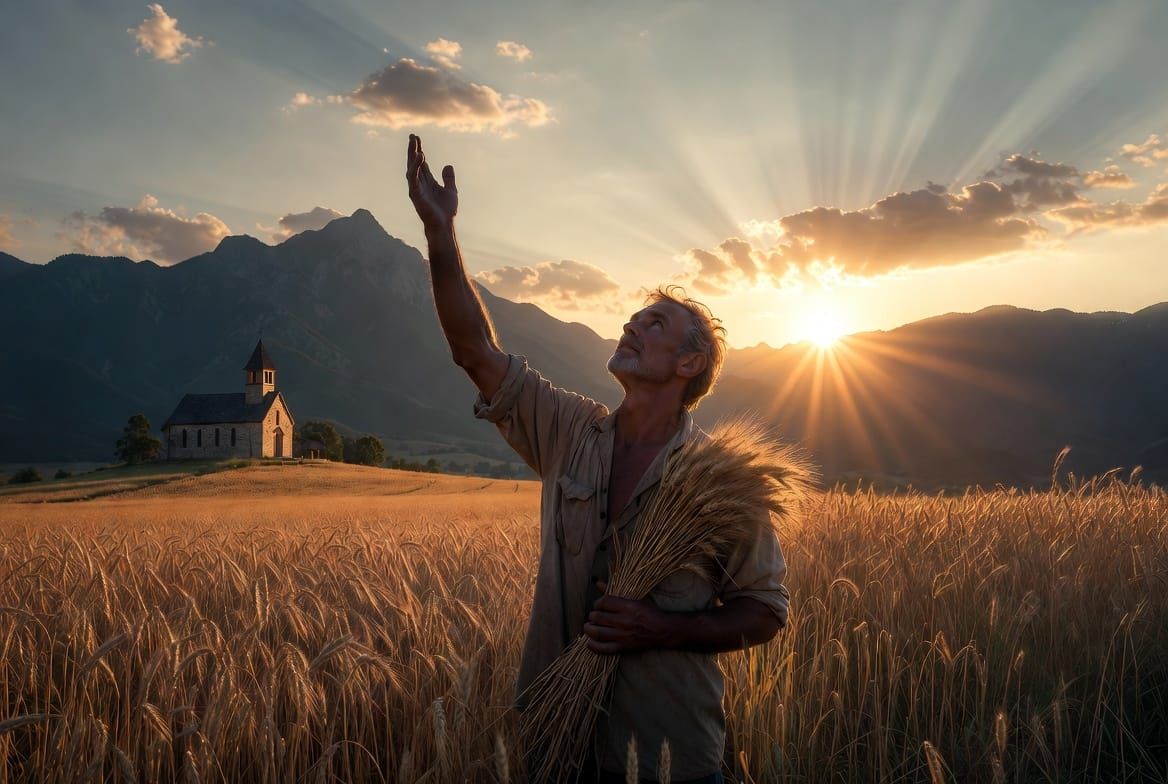
May 12, 2026, Rogation Day II, Tuesday of Rogationtide, Season of Easter
Matthew 6:19–24, Psalm 107:1–9, Ecclesiasticus 38:27–32, 1 Corinthians 3:10–14
Grace, mercy, and peace be with you on this second day of Rogationtide.
The readings for the second Rogation Day are appointed in the BCP 2019 on page 732: Ecclesiasticus 38:27–32, Psalm 107:1–9, 1 Corinthians 3:10–14, and Matthew 6:19–24. Yesterday we prayed about creaturely dependence, the farmer who scatters seed and sleeps, and the seed grows: he knows not how. The growth is in God’s hands. Today the Lord presses us a step further. Given that all we receive comes from his hand, what are we doing with it? The second Rogation Day moves from receiving God’s gifts to our stewardship of them.
Over these three days of Rogationtide the Lord speaks to creaturely dependence, faithful stewardship, and trust in the Father’s provision. Monday named the dependence. Today names the responsibility that dependence carries with it.
The first reading appointed for today is Ecclesiasticus 38:27–32, a passage honoring craftsmen and laborers whose skilled work sustains the life of a community. It speaks of the smith at his forge, the potter at his wheel, and others whose hands are occupied with their craft. Because Ecclesiasticus is among the books our Articles say the Church reads “for example of life and instruction of manners,” though not to establish doctrine, we receive its wisdom here as moral instruction. On a Rogation Day devoted not only to agriculture but also to industry, the point is especially fitting. Human labor is honorable. Skill is a gift. Work matters. The question Jesus will press upon us is not whether material work and material goods are good, but whether we receive them as gifts under God or allow them to become our master.
Jesus begins in verse 19: “Do not lay up for yourselves treasures on earth, where moth and rust destroy and where thieves break in and steal.” (Matthew 6:19, ESV) Hear that in the context of the Rogation Days. The harvest, the labor, the goods of the earth, these are among the most tangible forms of earthly treasure there are. The fields and gardens and orchards, the income from honest work, the houses we live in, the food on our tables, the provision God’s sustaining mercy gives day after day, all of them are good gifts.
Jesus is not condemning the goodness of material things. The same Father to whom he teaches us to pray for daily bread is the Father from whom those things come. The warning is about laying them up for ourselves, making temporary gifts into the place where we seek our security.
Jesus draws a contrast between two kinds of treasure and two places to store them. Earthly treasure can be destroyed by moth and rust and stolen by thieves. It is real, and it can be good, but it is fragile, temporary, and incapable of bearing the weight of our ultimate trust. Heavenly treasure cannot be corrupted or taken. The immediate context helps us understand what Jesus means. Just before this, in Matthew 6, he has spoken about giving to the needy, prayer, and fasting, all done before the Father who sees in secret rather than for the praise of others. These are not ways of purchasing heaven. They are the works of those whose lives are already directed toward the Father and his Kingdom. Treasure in heaven is life invested in what belongs to God and therefore cannot finally be lost.
Then comes verse 21, the pivot of the passage: “For where your treasure is, there your heart will be also.” (Matthew 6:21, ESV) We might expect Jesus to say, “Where your heart is, there your treasure will be.” That would fit our common assumption that the heart leads and our possessions simply follow. But Jesus says it the other way around. Where your treasure is, there your heart will be also.
What we invest in forms us. What we accumulate, protect, return to, fear losing, and spend ourselves upon gradually lays claim to the heart. We can say that God is first while our habits quietly testify that something else has become more important. The Rogation Days are a fitting time to ask this honestly. When I look at the produce of the earth and the fruit of my labor, what do I see? A gift from a gracious hand to be received and stewarded, or a possession by which I intend to secure myself?
Jesus then changes images in verses 22 and 23: “The eye is the lamp of the body. So, if your eye is healthy, your whole body will be full of light.” (Matthew 6:22, ESV) The Greek word translated healthy is haplous (hah-PLOOS). It can carry the sense of single, sound, sincere, or undivided. And in this context, surrounded by teaching about treasure and followed immediately by the warning about serving money, the language also resonates with the biblical contrast between a generous eye and a covetous one.
The point is not merely that we should stare harder at God and refuse to notice anything else. The question is whether our vision is whole or divided. Do we see the things of this world as gifts from the Father, received with thanksgiving and available for his purposes? Or do we look upon them with the possessive eye, the calculating eye, the eye that asks first, “How much of this can I keep for myself?” A healthy eye sees the gift and remembers the giver. It can enjoy the gift without worshiping it. It can receive without clutching and give without believing that generosity has somehow made us poorer.
But Jesus says that if the eye is bad, the whole body will be full of darkness. A distorted way of seeing possessions eventually distorts the person who possesses them. What begins as something we own can become something that owns us.
And that brings Jesus to verse 24: “No one can serve two masters.” (Matthew 6:24, ESV) The word for serve is douleuein(doo-LEW-ayn), to serve as a slave, to belong to a master. Jesus does not say that God and money are simply two competing interests that need to be kept in proper balance. He says they are rival masters: “You cannot serve God and money.” (Matthew 6:24, ESV)
Money itself is not evil. The danger is that wealth promises what only God can actually give: security, freedom, significance, even a kind of imagined control over the future. Once we begin asking wealth to save us from our creaturely dependence, it has ceased to be a tool and has become a master. That is particularly searching during Rogationtide. These are days when we ask God for provision. We ask for fruitful earth, for honest labor, for prosperity in its proper sense, for enough. And while we ask, Jesus asks us a question in return: if I give you what you are asking for, will you receive it as a gift, or will you begin trusting the gift instead of the giver?
Paul approaches stewardship from another direction in 1 Corinthians 3. His immediate concern is the building up of the Church. Paul has planted, Apollos has watered, but God has given the growth. Now he changes the image. Christ is the foundation, and Christian ministers and workers are building upon it.
Paul writes, “Let each one take care how he builds upon it.” (1 Corinthians 3:10, ESV) And then he says something that governs everything that follows: “For no one can lay a foundation other than that which is laid, which is Jesus Christ.”(1 Corinthians 3:11, ESV) That has to come first. The Christian life is not a building project in which we construct our way toward God. The foundation has already been laid. Jesus Christ is the foundation. His death for our sins, his resurrection from the grave, and his grace toward sinners are not the reward at the end of our labor. They are the ground beneath our feet before our labor begins.
That is especially worth remembering in this Season of Easter. The foundation is not an idea or a moral program. The foundation is the crucified and risen Jesus Christ. Our stewardship does not begin with what we will do for God, but with what God has already done for us in his Son.
Then Paul speaks about what is built upon that foundation: gold, silver, precious stones, wood, hay, straw. The Day will disclose it because it will be revealed by fire, and the fire will test “what sort of work each one has done.” (1 Corinthians 3:13, ESV) Paul is not teaching that our works earn our salvation. Christ himself is the foundation, already laid for us. In the very next verse after our appointed reading, Paul says that a person’s work may be burned up and he may suffer loss, “though he himself will be saved.” (1 Corinthians 3:15, ESV) The question here is not whether Christ’s finished work is sufficient. It is whether the life we build upon that foundation is worthy of the one who saved us.
In its original setting Paul is warning those who build up the Church to take care how they build. But the principle reaches naturally into Rogationtide. We are stewards of gifts received from God, and the use we make of those gifts matters. Not everything we spend our lives building will endure.
That is a sobering word in a culture obsessed with accumulation. We can spend decades constructing something impressive that will not survive the judgment of God. We can also do work that appears small, hidden, and ordinary but is precious because it was done upon the foundation of Christ and for the glory of God. The question is not merely, “How much did I build?” The question is, “What did I build, upon what foundation, and for whom?” Rogationtide asks the question before the fire does. What are we building with what God has given us? What are we doing with our time, our possessions, our abilities, our land, our work, our influence, our opportunities? When all that is temporary has fallen away, what will remain?
Psalm 107 gives us the other side of this. It begins: “Oh give thanks to the LORD, for he is good, for his steadfast love endures forever!” (Psalm 107:1, ESV) The Hebrew word is hesed (KHEH-sed), God’s steadfast, covenant love. The psalm then tells of people wandering in desert wastes, finding no city in which to dwell, hungry and thirsty, their souls fainting within them. And when they cry to the Lord in their trouble, he delivers them. Verse 9 says, “For he satisfies the longing soul, and the hungry soul he fills with good things.” (Psalm 107:9, ESV)
That is the deeper answer to the problem of treasure. The soul was never made to be satisfied by the treasure. God gives good things, and we are right to thank him for them. But the good things are signs of the goodness of the giver. If we ask the gifts to do what only God can do, even abundance will leave us hungry. The human heart can possess more and more while becoming less and less satisfied.
The psalm does not teach us that faithful people will never experience hunger, scarcity, or loss. Scripture plainly knows otherwise. It teaches something deeper: the final satisfaction of the longing soul is found in the God whose steadfast love endures forever. Our security is not in the quantity of the gift but in the character of the giver. The prayers of Rogation teach the same posture: God gives and preserves the harvest, God prospers honest labor, and we receive his gifts with thanksgiving rather than treating them as though they originated with us.
There is a connection here to the Lord’s Prayer that is worth making explicit. Earlier in this same chapter, Jesus teaches us to pray: “Give us this day our daily bread.” (Matthew 6:11, ESV) That is a Rogation prayer. Notice what Jesus does not teach us to pray. He does not teach, “Give me enough bread today that I will never need to ask you again.” He teaches us to ask for daily bread, enough for today, received from the Father today.
And that petition sits inside a prayer centered upon God’s name, God’s Kingdom, God’s will, forgiveness, and deliverance from evil. Daily bread is not unimportant. Jesus commands us to ask for it. But the bread takes its proper place inside a life ordered toward the Kingdom. That is why today’s Gospel leads naturally into tomorrow’s. Immediately after Jesus says, “You cannot serve God and money,” he says, “Therefore I tell you, do not be anxious about your life.” (Matthew 6:25, ESV) The alternative to serving money is not irresponsibility. It is trust in the Father.
The Rogation Days began Monday with creaturely dependence, the farmer who knows not how the seed grows. They move today to creaturely stewardship, the question of what we do with what we receive. And tomorrow they will conclude with creaturely trust, the command not to be anxious and the Father who knows what we need. The three days form a remarkably complete picture of what it means to live as a creature before God: we receive from his hand, we are responsible for what we do with what we receive, and we are invited to rest in the knowledge that the hand that gives has not forgotten us.
So on this second Rogation Day we bring our stewardship before God and ask him to show us where our treasure is, because our hearts will follow it; to show us how we see the things he has given; to show us what we are building and whether it will endure; and to show us where a good gift may quietly have become a master. Yet when he shows us, the answer is not simply to become better managers of our possessions. The answer begins where Paul begins: “No one can lay a foundation other than that which is laid, which is Jesus Christ.” (1 Corinthians 3:11, ESV) We need Christ before we need better stewardship. We need forgiveness for the ways we have loved gifts more than the giver, grace for the ways we have sought security in things that moth and rust destroy, and the Savior who gave himself for us before we can learn rightly to give ourselves and our possessions to him.
Because Christ has given himself for us, we are free to hold what we receive with an open hand. The healthy eye sees the harvest and sees through it to the giver. The undivided heart loves the giver more than the gifts. And the person whose treasure is in heaven can receive earthly treasure gratefully, use it faithfully, give it generously, and release it when God calls for it without imagining that his life has disappeared with it.
We receive from God’s hand, and so we ask him to teach us to hold what he gives rightly. The treasure is good, but the giver is better. Give us the grace to know the difference. Tomorrow, on the final Rogation Day, Jesus will teach us the freedom that comes from trusting the Father who already knows what we need.
In the Name of the Father, and of the Son, and of the Holy Spirit. Amen.