He Knows Not How: Monday of Rogationtide (Mark 4:26-32)
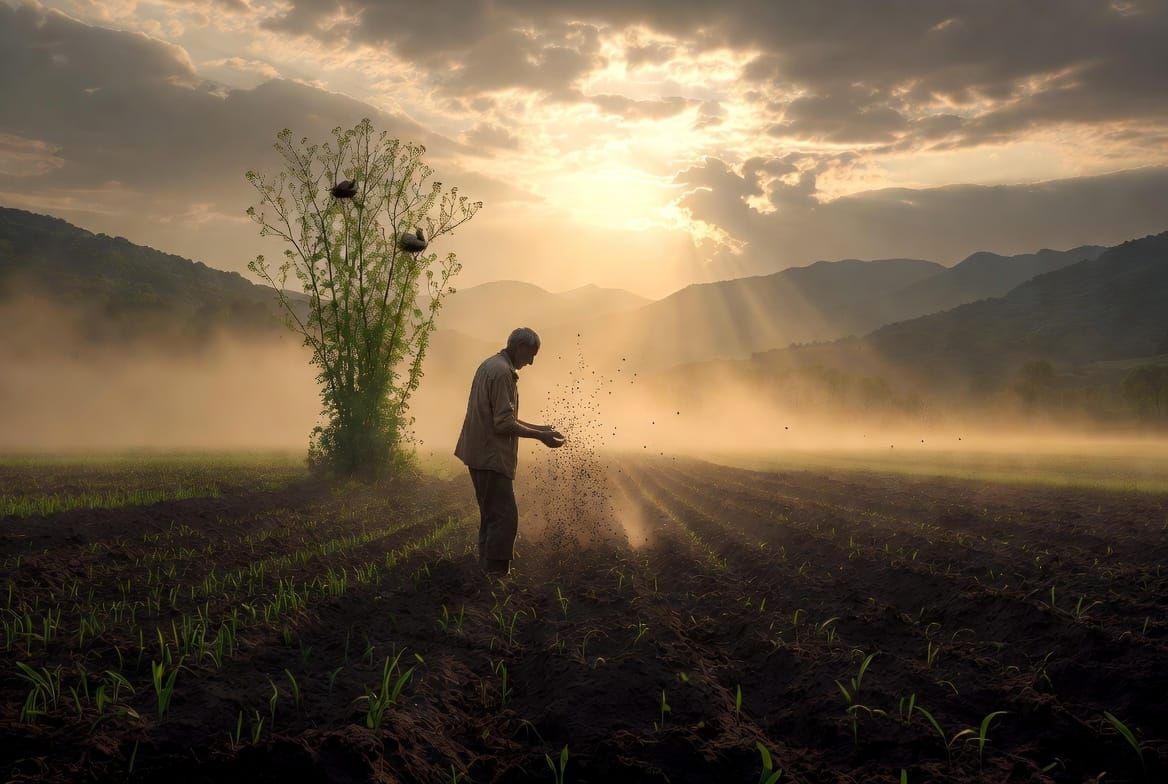
"The seed sprouts and grows; he knows not how." Mark 4:27. The farmer does not make the seed grow. He cannot watch it happen and intervene. He scatters, sleeps, and in the morning there is a blade where yesterday there was bare ground. Rogation Day I: the growth is in God's hands, not ours.
May 11, 2026, Rogation Day I, Monday of Rogationtide, Season of Easter
Mark 4:26–32, Psalm 147, Deuteronomy 11:10-15, Romans 8:18–25
Grace, mercy, and peace be with you on this first day of Rogationtide.
The readings for the first Rogation Day are appointed in the BCP 2019 on page 732: Deuteronomy 11:10–15, Psalm 147, Romans 8:18–25, and Mark 4:26–32. The Rogation Days are the Monday, Tuesday, and Wednesday before Ascension Day, historic days of prayer for God’s blessing on agriculture, on industry, and on all who labor. The word rogation comes from the Latin rogare, to ask, to beseech. These three days are the Church’s annual posture of asking, standing before the God who made the earth and makes it fruitful, with open hands.
Here in the mountains of Northeast Georgia we do not need to be told that the earth does not produce on demand. We know something of what it means to watch the sky for rain, to wait on a late frost, to hope the spring comes gently enough that the garden is not ruined before it starts. But even those of us who have never planted a seed or tended a field live downstream of the same dependence. Every meal we eat traces back, through however many links in the chain, to seed in the ground and rain from heaven. And every industry ultimately works with gifts it did not create: human bodies and minds, raw materials, time, energy, skill, and a world already given to us. The Rogation Days are the calendar’s annual insistence that we remember this.
These Rogation Days invite us to bring our dependence before the God who alone gives growth. Over these three days we will hear Jesus speak to creaturely dependence, faithful stewardship, and trust in the Father’s provision. Today is where the arc begins.
There is a phrase in the first parable that stops us if we pay attention to it. Jesus says the farmer scatters seed on the ground. He sleeps and rises night and day. And “the seed sprouts and grows; he knows not how.” (Mark 4:27, ESV) He knows not how. That phrase is worth sitting with.
The farmer in this parable is not ignorant. He knows how to prepare the soil. He knows when to plant and when to harvest. He knows the difference between good seed and bad. He does real work, necessary work, skilled work. But he cannot make a seed alive. He can plant it. He can tend the ground around it. He can recognize growth when it appears. But the life by which a dry seed breaks open underground, sends down a root, raises a shoot toward the sun, and eventually bears grain does not originate in him. He receives that life as a gift already built into God’s creation.
This is not a parable about human incompetence. It is a parable about creaturely limitation, which is a different thing entirely. God made us to tend and cultivate, to scatter and harvest, to work and build and steward. That is our proper work, and it is good work. But he did not make us to be the source of life.
Jesus says in verse 28, “The earth produces by itself.” (Mark 4:28, ESV) The Greek word is automatē, aw-toh-MAH-tay, meaning “of itself.” It is the word from which our English word automatic eventually comes. Jesus is not saying that creation is autonomous from God. He is describing what the farmer experiences. Once the seed is planted, growth takes place without the farmer making it happen. God has given his creation a genuine fruitfulness, and that created fruitfulness continues under his sustaining providence. The farmer works within it. He does not originate it.
Then Jesus describes the patient order of growth: “first the blade, then the ear, then the full grain in the ear.” (Mark 4:28, ESV) The farmer cannot skip the blade and demand the full grain tomorrow. He receives not only the growth but its timing. And when the grain is ripe, Jesus says, the farmer puts in the sickle because the harvest has come.
There is humility in that. We work, but we do not command the result. We plant, but we cannot order the seed to germinate. We pray, but we cannot command the clouds. We labor faithfully, and then we sleep. That may be one of the most difficult acts of faith in the parable. The farmer sleeps because, at some point, he has done what belongs to him and must entrust what does not belong to him to God.
Our reading from Deuteronomy makes the same point in another way. Moses tells Israel that the land they are entering is unlike Egypt, where they had known irrigation and the labor of carrying water to the soil. The Promised Land is “a land of hills and valleys, which drinks water by the rain from heaven, a land that the LORD your God cares for.”(Deuteronomy 11:11–12, ESV) Israel will still plow. Israel will still sow. Israel will still tend and harvest. But before any of that labor can bear fruit, God must give what Israel cannot manufacture. The rain comes from heaven. Human work is real, but it takes place inside divine provision.
Psalm 147 names the one who gives what the farmer cannot give. Verse 8 says that God “covers the heavens with clouds; he prepares rain for the earth; he makes grass grow on the hills.” (Psalm 147:8, ESV) Verse 14 says that he “fills you with the finest of the wheat.” (Psalm 147:14, ESV)
The psalmist is not embarrassed to say these things plainly. He does not imagine that describing rain scientifically makes God’s providence unnecessary. Clouds may form through physical processes that we can study, and grass may grow through biological processes that we can describe, but none of those explanations answers the deeper question of why there is a creation capable of doing any of it. The Christian confession is not that God ordinarily works instead of created processes. It is that the processes themselves exist, continue, and bear fruit because God created and sustains them.
God covers the heavens with clouds. God prepares rain for the earth. God makes the grass grow. The farmer who knows not how is working within a creation whose sustaining power belongs to God, and the psalmist wants us to know whose name belongs on the grain in the storehouse.
The second parable presses the same truth from a different angle. Jesus says that the Kingdom of God is like a mustard seed. It begins as something extraordinarily small, one of the proverbial examples of smallness in the world of Jesus’ hearers. Yet when it is sown, it grows and becomes larger than the other garden plants, putting out branches large enough for the birds of the air to make nests in its shade.
The contrast between the seed and what it becomes is the point. The smallness is real. The greatness is also real. And nothing about looking at that tiny seed would lead you to imagine the sprawling plant that will emerge from it.
Jesus is making a point about the Kingdom of God in both parables. The Kingdom grows by a power that does not belong to us, at a pace we do not control, toward an end we could never have produced for ourselves. We preach. We teach. We pray. We serve. We plant seeds of the Gospel. Those things matter. God has commanded them. But we cannot make a human heart alive any more than the farmer can command life into the seed. God gives the growth.
That should be both humbling and liberating for the Church. We are responsible for faithfulness. We are not sovereign over fruitfulness. We do not build the Kingdom of God by force of personality, strategy, ingenuity, or sheer effort. We scatter the seed entrusted to us. We tend what God has placed in our care. And then we trust that the life belongs to him.
Paul in Romans 8 adds a dimension that the parables only hint at. The creation that the farmer works is not simply a productive mechanism waiting to be harvested. It is a creation in bondage. It is groaning. Paul writes that creation was “subjected to futility, not willingly, but because of him who subjected it, in hope.” (Romans 8:20, ESV)
The thorns and thistles of Genesis 3 are not merely an agricultural inconvenience. They belong to a creation that has been caught up in the consequences of human sin. The world is still God’s good creation, but it is not yet what it will be. Fields produce crops, but they also produce weeds. Rain nourishes, but floods destroy. Bodies heal, but they also age. Animals flourish, but they also die. Creation gives us glimpses everywhere of God’s original goodness while simultaneously groaning under corruption.
And Paul says that this groaning creation is waiting for something. It waits “with eager longing for the revealing of the sons of God.” (Romans 8:19, ESV) It waits in hope that “the creation itself will be set free from its bondage to corruption and obtain the freedom of the glory of the children of God.” (Romans 8:21, ESV)
That means Rogation prayer is not merely asking God to make the present system work a little better. We certainly ask for rain. We ask for good harvests and fruitful labor. We ask because hungry people need food now. But Christians ask while knowing that creation itself is waiting for something greater than another growing season. It is waiting for redemption.
And Paul says we are waiting with it. “We ourselves, who have the firstfruits of the Spirit, groan inwardly as we wait eagerly for adoption as sons, the redemption of our bodies.” (Romans 8:23, ESV) Earlier in this same chapter Paul has already said that we have received the Spirit of adoption. We belong to God now in Christ. But we still wait for that adoption to be revealed in its fullness in the redemption of our bodies. The hope of creation and the hope of the Christian finally belong together. God is not abandoning what he made. He is redeeming it.
That matters especially in Eastertide. Jesus Christ entered this groaning creation, took flesh from it, suffered within it, died within it, and on Easter morning rose bodily from the grave. The resurrection is God’s declaration that corruption and death will not have the final word over his creation or over those who belong to Christ. Our Christian hope is not escape from being creatures. It is the redemption of creatures.
And yet, while creation waits, it still grows. That is the grace of it. The creation groans and still produces. The rain still falls. The seed still sprouts. Wheat still fills the fields. God’s sustaining mercy holds the earth’s fruitfulness in place even in the midst of its corruption, so that his creatures can be fed while they wait for the restoration of all things.
That is why the Collect for these Rogation Days teaches us to acknowledge that we are “constantly receiving good things from your hand.” It asks God to give and preserve for our use the harvests of land and sea and to prosper those who labor to gather them. That is not sentimental religious language. It is a confession of reality. The farmer works. The miller works. The truck driver works. The grocer works. The cook works. But before any of them can do anything, there must be a world, soil, rain, seed, life, bodies, intelligence, strength, and time. We work with what we have first received.
We are in the Season of Easter, and Ascension Day is three days away. The risen Christ who walked out of the tomb on Easter morning is the same Lord through whom all things were made and in whom all things hold together. The resurrection does not remove us from creaturely dependence. It tells us the name of the one on whom we depend.
There is something fitting about the placement of the Rogation Days immediately before Ascension. In three days we will celebrate the risen Christ ascending to the Father’s right hand. He does not ascend because he is leaving creation behind. He ascends as Lord. The man who walked the roads of Galilee, who slept in boats, ate bread, touched lepers, told stories about seeds, died upon a cross, and rose bodily from the grave is enthroned over all things.
So during these days before Ascension, the Church looks at the world Christ rules and asks for his blessing upon it. Lord, give us seasonable weather. Lord, preserve the harvests of land and sea. Lord, prosper honest labor. Lord, give daily bread. Lord, teach us to receive these things with thanksgiving. We ask because the Lord who reigns over creation is the same Lord who entered creation to save us.
These days carry a particular texture for those of us who live in the mountains. In Northeast Georgia, the rhythms of the created order are not abstract. The planting season in the southern Appalachians has its own character: late frosts that can undo a week’s work, sudden rains in summer, and the dependence on weather that no forecast fully masters. The farmer in Jesus’ parable is not a figure of ancient romanticism. He is our neighbor. And the truth Jesus tells about him, that he sleeps and rises, the seed grows, and he knows not how, is as true in Towns County as it was in Galilee.
But the lesson reaches beyond the farmer. There are things each one of us is called to do faithfully, and there are results none of us can command. A parent can teach and pray, but cannot manufacture faith in a child’s heart. A priest can preach the Word, but cannot make anyone believe it. We can labor honestly, plan carefully, love faithfully, plant generously, and still there comes a point when what happens next is beyond us. That is not failure. That is creatureliness.
On this first Rogation Day we come before God with this simple and honest acknowledgment: we do not know how. We scatter and sleep, and the seed grows, and we do not know how. We receive our daily bread from a hand we cannot see, through a creation we did not make and cannot finally control. We live in a world that groans for redemption, and we groan with it, waiting in hope for what God has promised.
So our calling is not to do nothing. The farmer scatters the seed. When harvest comes, he puts in the sickle. Our calling is to do faithfully what God has put into our hands and refuse to pretend that what belongs to God belongs to us. Plant what you have been given to plant. Tend what you have been given to tend. Do the work God has placed before you. Pray over it. And when you have done what faithfulness requires, entrust the growth to him.
The seed sprouts and grows, and we know not how. But we know who gives the growth.
In the Name of the Father, and of the Son, and of the Holy Spirit. Amen.