All Saints’ Day: An Anglican Perspective
All Saints does not celebrate only the great names of Christian history. It gathers our attention toward the whole company of the redeemed, known and unknown, whose lives have been made holy by the grace of God.
Principal Feast, November 1
The Anglican calendar is ordered by a hierarchy of holy days, each carrying a different weight of observance. All Saints’ Day, observed on November 1, is one of the seven Principal Feasts, the highest-ranking days of the liturgical year. The BCP 2019 appoints its Collect, the Preface of All Saints’, and several options for the readings of the day. As a Principal Feast, All Saints’ Day takes precedence over every other day or observance. The Prayer Book also permits the feast to be observed on the Sunday following November 1 in addition to its observance on the fixed date.
All Saints’ Day arrives only a few days after the Feast of Simon and Jude, the last apostolic feast before November. The proximity creates a fitting movement from the particular to the universal: from two named witnesses about whom Scripture tells us comparatively little to the innumerable company no calendar could ever contain. All Saints does not celebrate only the great names of Christian history. It gathers our attention toward the whole company of the redeemed, known and unknown, whose lives have been made holy by the grace of God.
In the New Testament, saints means the holy ones of God and can refer to Christians still living as well as to those who have died in Christ. All Saints’ Day arises from that larger communion of saints while directing the Church especially toward the faithful who have completed their earthly course and now await the resurrection in the presence and keeping of God. The feast embraces both the saints named in the calendar and the innumerable faithful whose names history did not preserve. It therefore looks backward in thanksgiving, around us in fellowship, and forward toward the perfected communion of the redeemed when Christ raises his people in glory.
The Appointed Readings
The BCP 2019 provides several options for All Saints’ Day: Ecclesiasticus 44:1–14 or Revelation 7:9–17 as the first lesson; Psalm 149; Revelation 7:9–17 or Ephesians 1:(11–14)15–23 as the New Testament reading; and Matthew 5:1–12 or Luke 6:20–26(27–36) as the Gospel.
The BCP permits Ecclesiasticus 44:1–14 as the first lesson, beginning with the summons, “Let us now praise famous men.” In Anglican use, Ecclesiasticus belongs among the books the Church reads for example of life and instruction of manners according to Article VI, but not for establishing doctrine. Its presence on All Saints’ Day fittingly honors the memory of the faithful, while Revelation 7 directs the Church beyond the famous toward the innumerable company whose names are known fully to God.
Psalm 149 calls the assembly of the faithful to sing a new song to the LORD and rejoice in their Maker and King. The Psalm reminds us that the saints are not isolated spiritual heroes but a worshiping people. Their holiness is lived within the praise of God, and All Saints’ Day places the Church on earth within that same great act of worship.
Ephesians 1 turns our attention toward election, inheritance, resurrection, and Christ’s headship over the Church. Paul speaks of the “riches of his glorious inheritance in the saints” and of the immeasurable greatness of God’s power displayed in raising Christ from the dead and seating him above every rule and authority. The saints belong to Christ because God has acted in Christ.
The Great Multitude
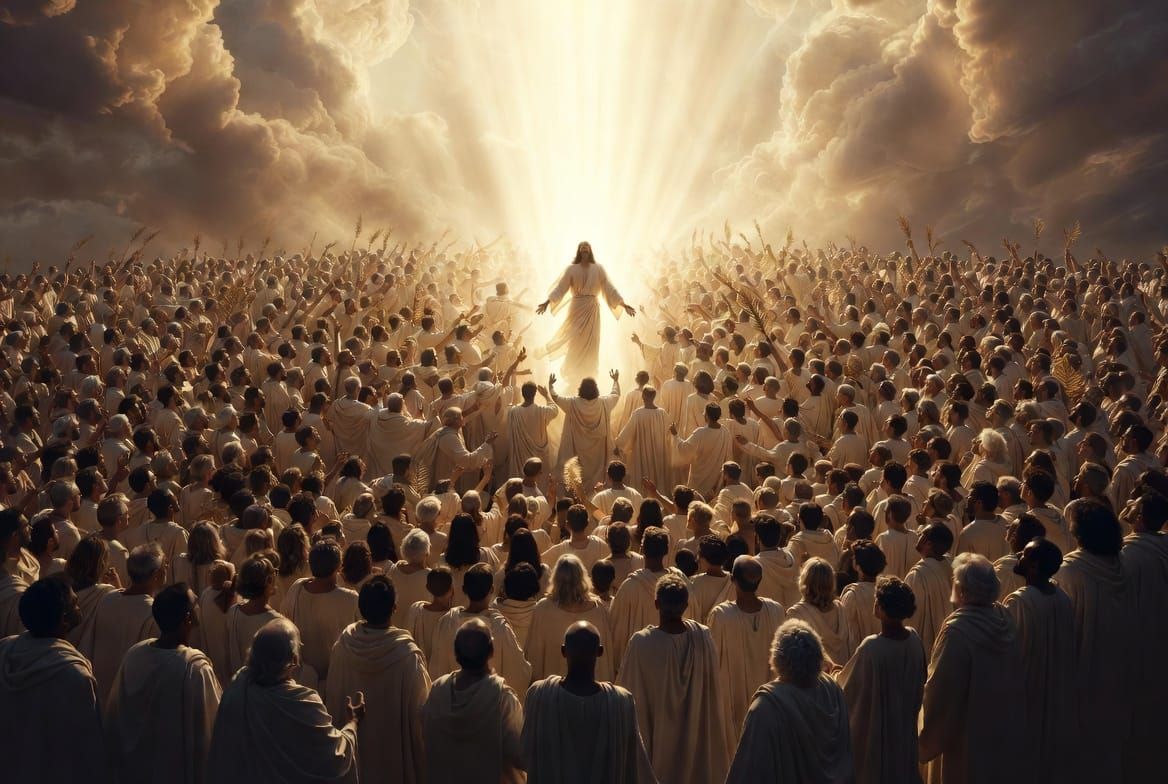
Revelation 7 gives the feast its most vivid biblical image: “a great multitude that no one could number, from every nation, from all tribes and peoples and languages,” standing before the throne and before the Lamb. (Revelation 7:9, ESV) They are clothed in white robes and cry out, “Salvation belongs to our God who sits on the throne, and to the Lamb!” (Revelation 7:10, ESV)
The vision is eschatological, but it also reveals the reality toward which the suffering Church on earth is being drawn: one innumerable people from every nation gathered around the throne and the Lamb. All Saints’ Day gives the Church a vision of her destiny, not as a collection of spiritual celebrities, but as a redeemed people gathered by grace.
The white robes are especially important. The elder explains that these are the ones who “have washed their robes and made them white in the blood of the Lamb.” (Revelation 7:14, ESV) The paradox is deliberate. The saints stand clean before God because the Lamb has given himself for them. Every saint in that great multitude stands there by grace, redeemed through the blood of Christ rather than by an accumulation of personal merit.
The feast therefore honors the saints without allowing attention to drift away from Christ. Whatever is admirable in them is finally the fruit of his saving work. Their holiness is real, but they do not stand before God because they made themselves worthy. They stand because the Lamb has redeemed them.
The vision ends with extraordinary tenderness. The Lamb becomes their Shepherd, guiding them to springs of living water, and “God will wipe away every tear from their eyes.” (Revelation 7:17, ESV) All Saints’ Day is therefore not only a feast of holiness but a feast of consolation. The redeemed are not merely preserved from judgment; they are brought into the joy, worship, and peace of God’s presence.
The Beatitudes and the Shape of Holy Life
Matthew 5:1–12 is one of the appointed Gospel options for the feast. Jesus pronounces blessed the poor in spirit, those who mourn, the meek, those who hunger and thirst for righteousness, the merciful, the pure in heart, the peacemakers, and those persecuted for righteousness’ sake.
The Beatitudes do not tell us how sinners earn their way into the great multitude. They describe the blessed life of the Kingdom and the character grace produces in those who belong to the King. Revelation 7 shows the redeemed gathered before the throne, while the Beatitudes describe the shape of life formed by Christ among those who are his.
This matters because Christian holiness is never self-manufactured. The saints are not simply unusually disciplined people who succeeded where everyone else failed. They are sinners upon whom God has acted, people forgiven and reconciled through Christ and progressively reshaped by mercy, repentance, faith, obedience, and the sanctifying work of the Holy Spirit.
At the same time, grace does not leave the Christian unchanged. The Beatitudes remain a real pattern toward which the Church is called to grow. Christians should hunger for righteousness, practice mercy, seek purity of heart, make peace, and endure faithfully when obedience brings opposition. These qualities do not purchase salvation, but they are fitting fruits of life in the Kingdom.
Luke’s appointed alternative makes the same grace particularly concrete. Jesus pronounces blessing upon the poor, hungry, grieving, and rejected while warning those whose present abundance has become their consolation. The Kingdom overturns ordinary measurements of success and blessedness. What appears enviable before the world may prove spiritually empty, while those who suffer in faith may already belong to the blessed company of the King.
The Collect and the Communion of Saints
The Collect for All Saints’ Day prays, “Almighty God, you have knit together your elect in one communion and fellowship in the mystical Body of your Son: Give us grace so to follow your blessed saints in all virtuous and godly living, that we may come to those ineffable joys that you have prepared for those who truly love you; through Jesus Christ our Lord...”
The prayer begins with God’s action. He has “knit together” his elect in one communion and fellowship. The communion of saints is not a human association produced by shared taste, culture, sentiment, or religious enthusiasm. It is the work of God within the mystical Body of Christ.
The word elect directs attention again to divine initiative. The communion of saints begins in God’s choosing mercy, not in the saints selecting themselves for holiness. Even the imitation of the saints is placed under grace. The Collect does not say, “Follow their example and earn their destination.” It asks God to give us grace to follow them in virtuous and godly living.
This is the right Anglican balance. The saints are genuinely examples. Their faithfulness matters, their courage deserves imitation, and their lives show what grace can produce in human beings. Yet their holiness remains subordinate to the prior mercy of God and the unique saving work of Christ.
The prayer also speaks of “ineffable joys.” Ineffable means beyond adequate expression, a reality so great that language cannot fully contain it. The end of the Christian life is not simply the cessation of suffering but communion with God in a joy our present language cannot exhaust.
The Great Cloud of Witnesses
The Preface of All Saints’ gives thanks that in the multitude of the saints God has surrounded the Church with “so great a cloud of witnesses.” It rejoices in their fellowship and looks toward the Church running with patience the race set before us and, together with them, receiving the unfading crown of glory.
The language corresponds naturally with Hebrews 12 and its “great cloud of witnesses.” We do not need to imagine the saints as spectators watching every detail of earthly life. Hebrews directs our attention principally to the testimony borne by their lives of faith. Having heard that witness, the Church runs with endurance while looking to Jesus, the founder and perfecter of our faith.
That understanding keeps the emphasis where the Prayer Book places it. The saints surround us as witnesses whose lives testify to the faithfulness of God, but the Collect has already reminded us that God is the one who knits his elect together and gives us grace to follow their faithful examples. Their virtue is real, but its source is grace, and the race itself is run with our eyes fixed on Jesus.
All Saints’ Day therefore invites imitation without idolatry. We remember the courage of martyrs, the faithfulness of pastors, the perseverance of ordinary Christians, the devotion of missionaries, the patience of caregivers, the fidelity of parents, and the witness of countless believers whose names were never widely known. Their lives encourage us because the God who sustained them remains faithful to his Church now.
Saints Known and Unknown
The Christian calendar names particular saints because particular lives teach the Church particular things. Peter and Paul remind us of apostolic witness, Mary Magdalene of resurrection testimony, James of Jerusalem of faithful leadership, Luke of Gospel proclamation and faithful companionship, and Simon and Jude of apostolic faithfulness that did not depend upon fame.
Yet no calendar could ever name all the faithful. Revelation 7 deliberately gives us a multitude that cannot be numbered. All Saints’ Day therefore corrects the natural human tendency to equate historical visibility with spiritual importance.
Many of the saints most fully known to God left no writings, founded no institutions, and received no public recognition. They were faithful spouses, parents, children, teachers, laborers, widows, servants, clergy, farmers, merchants, neighbors, and countless other Christians whose holiness appeared mainly in ordinary acts of repentance, prayer, love, endurance, and obedience.
The feast reminds us that the Kingdom of God has always been carried forward through innumerable lives that history barely noticed. Their names may be absent from books, but they are not absent from the knowledge of God.
All Saints and the Faithful Departed
All Saints’ Day and the Commemoration of the Faithful Departed on November 2 are closely related but distinct observances in the BCP 2019. All Saints is one of the seven Principal Feasts. November 2 appears in the calendar as an optional ecumenical commemoration of the Faithful Departed. The two therefore should not be treated as interchangeable or as equal in liturgical rank.
All Saints looks toward the whole communion of those made holy in Christ and especially toward the perfected company of the redeemed gathered before God and the Lamb. The Commemoration of the Faithful Departed provides a more particular occasion for remembering those who have died in the Lord in the hope of the resurrection.
Many Anglican congregations also remember departed members by name on or around All Saints’ Day, especially when the feast is observed on Sunday. That can be pastorally powerful because the great multitude of Revelation is not an abstraction. Christians know the communion of saints through particular people whom we have loved, worshiped beside, learned from, cared for, and buried in the sure and certain hope of the resurrection.
The distinction between the observances remains useful. All Saints emphasizes the holiness, communion, and final glory of those redeemed by Christ. The Commemoration of the Faithful Departed gives particular space for remembrance, grief, thanksgiving, and resurrection hope concerning those who have died in the Lord. Christian hope does not erase grief, and Christian grief does not erase hope.
Baptism and All Saints
The connection between All Saints’ Day and Holy Baptism is not merely a later devotional association. The BCP 2019 explicitly names All Saints’ Day, or the Sunday after All Saints’ Day, among the most appropriate occasions for Baptism, together with the Easter Vigil, the Baptism of Our Lord, and Pentecost.
The theological connection is profound. Baptism is the sacramental incorporation of the baptized into Christ and his Body, the Church. The baptismal rite confesses one Body, one Spirit, one hope, one Lord, one Faith, one Baptism, and one God and Father of all.
The BCP’s own exhortation makes the grace-first character even clearer. It teaches that by nature we cannot give ourselves what God gives in Baptism, and therefore the Church asks the Father that the candidates, being baptized with water, may be filled with the Holy Spirit, born again, and received into the Church as living members of Christ’s Body.
All Saints therefore gives Baptism an especially fitting setting. The candidate is not being welcomed into a private spirituality but into the covenant people of God, the visible Church on earth that belongs to the one communion of Christ’s saints.
Baptism is not a ceremonial declaration that someone is already holy by natural virtue. Christian identity begins in grace and then unfolds in faith, repentance, obedience, perseverance, and growth in holiness. The saints whose lives we admire did not arrive at holiness by escaping the ordinary means of Christian discipleship. They lived from the grace of God through Word, Sacrament, prayer, repentance, fellowship, suffering, obedience, and the patient sanctifying work of the Holy Spirit.
The History of the Feast
The feast developed from early Christian commemorations of martyrs and eventually widened to include all the saints. As the number of martyrs grew beyond what could easily be commemorated individually, Christians in various regions developed common observances honoring many martyrs together. These early observances did not all occur on the same date, which means the history of All Saints cannot be reduced to one pope, one dedication, or one moment.
In Rome, Pope Boniface IV dedicated the Pantheon as the church of Saint Mary and the Martyrs in AD 609 or 610, and its anniversary was observed on May 13. That event became an important part of the Western history of a common feast of the saints, although the relationship between the May observance and the later November feast is more complicated than a simple direct transfer.
The November 1 observance emerged later. Pope Gregory III, in the eighth century, dedicated an oratory in Saint Peter’s Basilica in honor of all the apostles, martyrs, confessors, and righteous departed. By the early medieval period November 1 was being observed as a feast of all the saints in parts of the West, including the English and Frankish worlds. Under Gregory IV in the ninth century, the November observance was extended much more widely through the Western Church and became established as the feast we now recognize as All Saints’ Day.
The feast remained securely rooted in the Anglican Prayer Book tradition after the Reformation and continues in the BCP 2019 as one of the seven Principal Feasts. Anglican reform did not require the Church to forget the saints. It required their remembrance to remain ordered beneath Holy Scripture and the unique saving work and mediation of Jesus Christ.
Honoring the Saints as Anglicans
Classical Anglicanism can speak warmly and positively about the saints without making them rival mediators. The Prayer Book itself provides the pattern. We thank God for his grace displayed in them, rejoice in our fellowship with them in Christ, learn from their faithful examples, and pray for grace to follow those examples.
At the same time, Jesus Christ remains the Church’s only Redeemer and the one through whom Christians have access to the Father. Classical Anglican doctrine rejects the invocation of saints as though departed Christians were necessary intermediaries through whom believers must approach God.
All Saints’ Day therefore does not ask us to look away from Christ toward the saints. It teaches us to see the saints rightly by looking at what Christ has done in them. The feast honors them most faithfully when their lives become occasions for thanksgiving to God and encouragement toward greater fidelity to Jesus.
This is precisely the structure of Revelation 7. The saints do not stand around the throne proclaiming their own achievements. Their worship is directed to God and to the Lamb, because salvation belongs to him.
The Liturgical Character
White is customarily used for All Saints’ Day in Anglican worship. It fittingly expresses the resurrection hope, joy, and festal character of one of the Church year’s highest celebrations while also recalling the white-robed multitude of Revelation 7.
The color reinforces the theological center of the day. The saints stand before God in white because they have washed their robes in the blood of the Lamb. Their holiness is gift before it becomes example, and their glory directs attention toward Christ.
What All Saints Is For
All Saints’ Day answers an implicit question running through the whole Christian year: what is all of this for? Why the Incarnation, the ministry of Jesus, the Passion, Resurrection, Ascension, Pentecost, the long work of discipleship, and the repeated call to repentance and holiness?
Revelation 7 gives the answer in biblical imagery. The movement of salvation is toward the great multitude gathered before the throne and the Lamb, toward the people of God made whole, toward worship without end, toward hunger satisfied, tears wiped away, and life in the unveiled presence of God.
The feast therefore gathers the Christian year into one great eschatological vision. Christmas, Easter, Pentecost, and the long green season of formation are not disconnected religious observances. They belong to one saving purpose in which God is gathering for himself a people from every nation, tribe, people, and language.
The saints who have completed their earthly course testify that this work of grace is not theoretical. God has acted in real people, forgiven real sins, sustained them through real suffering, produced real holiness, and kept them in Christ through death. Their lives bear witness in history to the faithfulness of God while their final hope, like ours, rests in the resurrection of the body and the life of the world to come.
The feast also keeps the Church from reducing salvation to private rescue. Revelation does not show isolated individuals enjoying separate spiritual destinies. It shows a people gathered and worshiping together. God saves persons into communion with Christ and therefore into communion with his Body.
Observing All Saints’ Day
All Saints’ Day is observed on November 1 as one of the seven Principal Feasts of the Church year. It takes precedence over every other day or observance, and the BCP also permits it to be observed on the Sunday following November 1 in addition to the fixed date. The appointed readings are Ecclesiasticus 44:1–14 or Revelation 7:9–17; Psalm 149; Revelation 7:9–17 or Ephesians 1:(11–14)15–23; and Matthew 5:1–12 or Luke 6:20–26(27–36). The Preface of All Saints’ is appointed, and white is customarily used in Anglican worship.
A fruitful observance begins with Revelation 7 and the question of how the white-robed multitude came to stand before the throne. The answer is not extraordinary human achievement but the blood of the Lamb. Then read the Beatitudes and see the life grace produces in those who belong to Christ.
Pray the Collect and notice its order. God has knit his elect together. God gives grace. By that grace Christians follow the faithful examples of the saints toward the joys God has prepared.
If Baptism is celebrated, receive it within the larger vision of the feast. The newly baptized is being received into the Body of Christ, the same communion whose final glory Revelation allows the Church to glimpse.
Remember faithful Christians through whom God has blessed you, both those whose names are known throughout the Church and those known chiefly within a family, parish, or community. Give thanks for what Christ did in them, imitate what was faithful in their lives, and allow their witness to turn your attention toward the Lord who made them holy.
Conclusion
All Saints’ Day is the Principal Feast that answers every other feast’s implicit question: what is all of this for? The Incarnation, the ministry of Jesus, the Passion, the Resurrection, the Ascension, Pentecost, and the long green season of Christian formation are all moving toward the great multitude in white robes before the throne and the Lamb.
That multitude is not assembled by human achievement. The saints stand there because the Lamb was slain, because his blood redeemed them, because God called them, kept them, sanctified them, and will bring his saving work in them to completion. Their holiness is real, but it is the fruit of grace before it becomes an example for imitation.
The Church therefore honors the saints best by looking where they look. Revelation does not show the redeemed admiring themselves or one another. They stand before the throne confessing that salvation belongs to God and to the Lamb.
November 1 allows the Church to look toward the end for which the whole Christian year has been preparing us: the redeemed gathered before God, every hunger satisfied, every tear wiped away, and the Lamb himself shepherding his people to living water. The joy is ineffable because the reality exceeds our language, yet the promise is sure because it rests upon the blood of the Lamb rather than upon the achievement of the saints.