As I Had Mercy On You (Matthew 18:21-35)
The servant wants two kingdoms at once: mercy for himself and strict accounting for everyone else. Jesus says the life of the Kingdom cannot be divided that way. Christian forgiveness begins by remembering the King.
September 13, 2026, Year A, Proper 19, Sixteenth Sunday after Pentecost, Season after Pentecost
Matthew 18:21–35, Psalm 103, Romans 14:5–12
Grace, mercy, and peace from God our Father and the Lord Jesus Christ be with you on this Sixteenth Sunday after Pentecost.
Last Sunday Jesus taught us what to do when a brother or sister sins against us: go to that person, tell the truth, seek repentance, and, if necessary, widen the circle slowly. The goal was restoration. As Jesus said, “If he listens to you, you have gained your brother.” (Matthew 18:15, ESV) This morning Peter asks the natural next question: how often must we forgive the brother we are trying to gain?
Our passage is Matthew 18:21–35. We are still in Matthew’s fourth great teaching discourse, often called the Community Discourse because Jesus is teaching his disciples what life together in the Church he is building is supposed to look like. In verse 21 Peter comes to him and asks, “Lord, how often will my brother sin against me, and I forgive him? As many as seven times?” (Matthew 18:21, ESV)
Peter’s suggestion probably sounded generous. Seven repeated acts of forgiveness would seem remarkably patient. But Peter is still counting. Jesus answers in verse 22, “I do not say to you seven times, but seventy-seven times.” (Matthew 18:22, ESV) Some translations render that expression “seventy times seven.” Either way, Jesus is not giving Peter a larger forgiveness ledger. He is giving him a number intended to make counting useless.
With verse 23, Jesus explains why: “Therefore the kingdom of heaven may be compared to a king who wished to settle accounts with his servants.” (Matthew 18:23, ESV) The answer to Peter’s question is not finally a number. It is a story about a king, a servant, and a debt that could never be repaid.
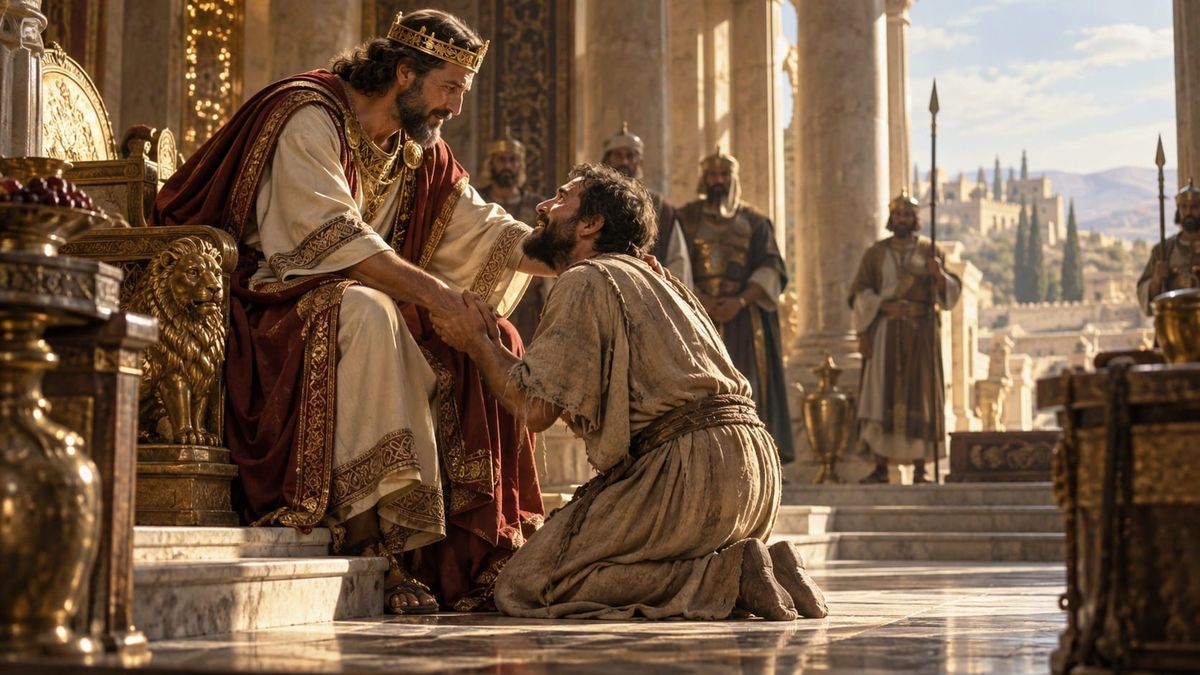
In verse 24, one servant is brought before the king owing ten thousand talents. A single talent represented years of an ordinary laborer’s wages. Jesus is describing a debt far beyond the servant’s ability to repay. Verse 25 confirms it: the servant cannot pay. By verse 26 he has fallen before the king pleading, “Have patience with me, and I will pay you everything.” (Matthew 18:26, ESV) Even if the king gave him the rest of his life, the debt was beyond his ability to settle. He is asking for time to accomplish what time cannot accomplish.
Then comes the surprise in verse 27: “And out of pity for him, the master of that servant released him and forgave him the debt.” (Matthew 18:27, ESV) The servant asks for more time. The king gives him something far greater: he cancels the debt.
That is where Jesus begins his teaching about forgiveness. He does not begin with what the servant owes to other people. He begins with what the servant has received from the king. Christianity begins in the same place. Before we are people commanded to forgive, we are sinners who have received mercy.
Psalm 103 gives us the language for what the servant has experienced. David says, “The LORD is merciful and gracious, slow to anger and abounding in steadfast love.” (Psalm 103:8, ESV) He continues, “He does not deal with us according to our sins, nor repay us according to our iniquities,” and then, “As far as the east is from the west, so far does he remove our transgressions from us.” (Psalm 103:10, 12, ESV) For those who are in Christ, our sins are not ignored. They are forgiven because Christ has dealt with them.
Our reading from Romans adds another truth we need. Paul says, “For we will all stand before the judgment seat of God,” and, “each of us will give an account of himself to God.” (Romans 14:10, 12, ESV) No one escapes the judgment of God. Yet for those who are in Christ, judgment is not a second trial to discover whether the Cross was sufficient after all. Paul also says, “There is therefore now no condemnation for those who are in Christ Jesus.” (Romans 8:1, ESV)
Judgment includes believers and unbelievers, but judgment does not mean the same thing for each. The unbeliever stands before God apart from Christ and under condemnation. The believer also gives an account, but not to discover whether Christ’s saving work was enough. Those who belong to Christ are judged as those already redeemed by him.
Paul gives us a helpful picture in 1 Corinthians 3. He describes work built upon Christ being tested. Some endures and receives reward; some is burned up and suffers loss, “though he himself will be saved.” (1 Corinthians 3:15, ESV) Salvation and evaluation are not the same thing. The believer is saved by grace, yet the life Christ has redeemed still matters before Christ.
That distinction matters as we return to Jesus’ parable. We are not justified, saved and declared righteous before God, because we have accumulated enough acts of mercy to deserve mercy. We are justified by grace through faith because of Christ. The servant does not earn cancellation of his debt. The king has pity on him and releases him.
That mercy is not merely something to admire. It is something to receive. Christ calls sinners to repent and believe the Gospel, to stop trying to settle our account with God by being decent enough, religious enough, or sorry enough. The debt is beyond our ability to pay. The good news is that Christ has done for us what we could never do for ourselves. He bore our sin at the Cross, rose bodily from the grave, and gives forgiveness and eternal life to everyone who trusts in him.
And that grace is meant to change the way we live. In verse 28 the story turns sharply: “But when that same servant went out, he found one of his fellow servants who owed him a hundred denarii.” (Matthew 18:28, ESV) The contrast is enormous, but notice that the second debt is real. A hundred denarii represented months of ordinary wages. Jesus is showing us what happens when someone who has received astonishing mercy begins dealing with others as though mercy had never been shown to him.
That matters pastorally because some of the wounds we carry are not small. The betrayal may have been real. The lie may actually have been told, the money taken, the promise broken, and trust deeply damaged. Jesus does not ask us to pretend otherwise. He asks us to see even real wounds in the light of the immeasurable mercy we ourselves have received.
The rest of verse 28 shows how completely the first servant has forgotten that mercy. He seizes his fellow servant and says, “Pay what you owe.” (Matthew 18:28, ESV) Then in verse 29 the second servant falls down and makes an almost identical plea: “Have patience with me, and I will pay you.” (Matthew 18:29, ESV) The first servant has heard those words before. They are his own plea coming back to him.
But verse 30 tells us, “He refused and went and put him in prison until he should pay the debt.” (Matthew 18:30, ESV) The tragedy is not simply that the servant has forgotten a rule about forgiveness. He has forgotten his own story. He remembers exactly what his fellow servant owes him while forgetting what the king has just forgiven him.
We can do something similar. We may remember the words, the tone, the moment, and the wound while losing sight of how completely we depend upon mercy. Jesus is not asking us to forget what happened. He is asking us not to let the debt rule our hearts.
When the other servants report what has happened, verses 31 through 33 bring the first debt back into view. The king summons the servant and says, “You wicked servant! I forgave you all that debt because you pleaded with me.” (Matthew 18:32, ESV) Then comes the question at the center of the parable: “And should not you have had mercy on your fellow servant, as I had mercy on you?” (Matthew 18:33, ESV)
That last phrase gives us the title of this sermon: As I Had Mercy on You. The king takes the servant back to the mercy he himself has already received. God does not say, “Become merciful enough, and then I will show mercy to you.” He forgives the impossible debt, and then his mercy is meant to shape the way we hold the debts of others.
The servant wants two kingdoms at once: mercy for himself and strict accounting for everyone else. Jesus says the life of the Kingdom cannot be divided that way. Christian forgiveness begins by remembering the King.
But we need to hear that without undoing what Jesus taught us last Sunday. Forgiveness does not mean calling evil good. The same Jesus who tells Peter to forgive has just said, “If your brother sins against you, go and tell him his fault.” (Matthew 18:15, ESV) Matthew 18 itself prevents us from defining forgiveness as pretending nothing happened.
Forgiveness is not identical with immediately restoring trust, removing consequences, or placing ourselves where the same harm can continue. We may forgive someone who has been abusive and still need distance and protection. A family may forgive someone caught in addiction without financing or shielding it. A spouse may forgive adultery while recognizing that reconciliation and restored trust require repentance, truthfulness, changed behavior, and time.
Nor do we always know what lies behind another person’s actions. Wounds, fears, habits, addictions, and patterns of sin may help explain what happened, awaken compassion, and help us pray. But understanding is not excusing. Brokenness may explain sin; it does not make sin good.
Here it helps to distinguish things that belong together but are not the same. Forgiveness releases vengeance. Reconciliation restores fellowship. Trust is rebuilt through demonstrated faithfulness. Forgiveness can begin even when reconciliation and restored trust are not yet possible.
Romans helps us here as well. Final judgment belongs to God. He sees what happened and judges rightly. We may still seek justice, establish boundaries, or allow appropriate consequences, but we do not have to make vengeance our vocation. We can release the debt into the hands of the Judge who sees more clearly than we ever could.
Forgiveness is also not always a single emotional event. Old anger may return, along with the desire to reopen the ledger. When it does, we remember again what the King has forgiven us.
Our Collect this morning recognizes that we cannot simply command ourselves into that kind of heart. It begins, “O God, because without you we are not able to please you,” and asks that his Holy Spirit may “in all things direct and rule our hearts.” That is exactly the prayer this Gospel requires. The God who commands forgiveness is the God whose Spirit must form the heart that forgives.
At the end of the parable, verses 34 and 35 give us Jesus’ severe warning. The king, angered by the servant’s refusal to show mercy, delivers him to punishment, and Jesus concludes, “So also my heavenly Father will do to every one of you, if you do not forgive your brother from your heart.” (Matthew 18:35, ESV) We should not explain those words away. Jesus intends them as a real warning.
But neither is Jesus teaching that a person who has truly been justified loses salvation because of one failure to forgive. Our salvation rests on Christ’s finished work, not on the perfection of our obedience. Jesus’ warning is not that one unforgiving moment cancels the Cross or that a true believer moves in and out of justification as forgiveness rises and falls. A settled, hardened refusal to forgive can reveal something spiritually serious: the mercy we profess to have received may never truly have been received by faith or taken root in us. The servant’s problem is not that he failed to earn the king’s mercy. His problem is that astonishing mercy passed over him without producing mercy in him.
That is why forgiveness matters as fruit, not as the price of salvation. The fruit does not purchase the root, but a living root bears fruit. We are not forgiven because we first became forgiving people. We forgive because grace has begun to reorder us. That does not mean we forgive perfectly or without struggle. A wounded Christian may wrestle with resentment for a long time. The warning is about making peace with vengeance, cherishing it, and refusing to surrender it. A heart ruled by the Holy Spirit cannot finally settle there. Jesus says forgiveness must reach “from your heart” because he is after more than outward restraint. We can refrain from retaliation while continuing to feed resentment every day.
This matters especially for tender consciences. If forgiveness is hard and we are grieving that it is hard, asking God for grace, and resisting the desire for vengeance, that struggle is not evidence that Christ has cast us off. The warning is aimed at the heart that makes peace with unforgiveness and refuses the mercy it professes. Our assurance rests in Christ and his promises, not in measuring how quickly our emotions change. The presence of conflict is not the same thing as the absence of grace. But the Christ who justifies also sanctifies. His grace does not leave us untouched.
So when resentment rises, remember the King before reopening the ledger. That does not mean denying what happened. It means refusing to remember another person’s sin while forgetting our own dependence upon mercy. When an old offense begins replaying in our minds, begin with Psalm 103: “As far as the east is from the west, so far does he remove our transgressions from us.” (Psalm 103:12, ESV)
Second, forgive without confusing forgiveness with enabling. There may be destructive behavior we should no longer finance, excuse, conceal, or absorb. There may be trust that should not be restored until repentance has produced visible change. Forgiveness does not require us to volunteer for another wound.
Third, place the debt into God’s hands. Perhaps someone’s name has already come to mind. We may not be ready for a conversation, and a conversation may not even be appropriate. But we can pray honestly: “Lord, you know what happened. You know what it cost. Judge rightly, protect what needs protecting, bring repentance where repentance is needed, and keep us from vengeance.” Forgiveness begins when we stop insisting that we ourselves must finally collect what is owed.
Tomorrow is Holy Cross Day, and the Church gives us one final way to understand why any of this is possible. Today Jesus tells us about an impossible debt canceled by a merciful King. Tomorrow the Church looks toward Calvary and remembers what forgiveness cost. The Collect for Holy Cross Day says that Jesus Christ was “lifted high upon the Cross that he might draw the whole world to himself,” and asks that those who “glory in the mystery of our redemption” may have “grace to take up our cross and follow him.”
God does not forgive because sin does not matter. The Cross tells us exactly the opposite. God did not pretend the debt never existed. He dealt with it in the giving of his Son for sinners who could not pay. Christ has mercy before he commands mercy. He forgives before he teaches forgiven people how to forgive. His Cross redeems us; our forgiveness does not. But those who have received mercy at the foot of the Cross cannot indefinitely live as though grace is something meant to flow toward us and stop with us. It must also flow out of us.
Last Sunday Jesus told us to seek the brother rather than abandon him. This Sunday he tells us what kind of people must do that seeking: people who know that we ourselves live by mercy. The Church Christ is building is therefore neither a community that calls sin good nor a community of relentless debt collectors. We tell the truth because sin matters. We establish boundaries when faithfulness requires them. We seek repentance because the brother or sister matters. And we forgive because we remember the King.
The debt was real, but in Christ God’s mercy was greater still. So when our hands tighten around the ledger of what another person owes, Jesus brings us again before the King and asks the question at the center of this Gospel: “Should not you have had mercy on your fellow servant, as I had mercy on you?” (Matthew 18:33, ESV) May the Holy Spirit direct and rule our hearts until the mercy we have received becomes mercy we are willing to give.
In the Name of the Father, and of the Son, and of the Holy Spirit. Amen