You Have Gained Your Brother (Matthew 18:15-20)
Jesus does not merely command reconciliation. He accomplishes reconciliation at a cost none of us could bear. He does not save us by pretending our sin is insignificant. The cross tells us how serious sin is. But neither does he leave us condemned in it.
September 6, 2026, Year A, Proper 18, Fifteenth Sunday after Pentecost, Season after Pentecost
Matthew 18:15-20, Ezekiel 33:1-11, Psalm 119:33-48
Grace, mercy, and peace from God our Father and the Lord Jesus Christ be with you on this Fifteenth Sunday after Pentecost.
Last Sunday we began Movement IV in our journey through Matthew’s Gospel: the Cost of the Kingdom. Peter had confessed Jesus as the Christ, but when Jesus told the disciples that he must go to Jerusalem, suffer, be killed, and be raised, Peter tried to turn him from the road. Jesus answered him, “Get behind me, Satan! You are a hindrance to me” (Matthew 16:23, ESV). Then he told every disciple to deny himself, take up his cross, and follow. Peter’s proper place was behind Jesus. So is ours.
This morning the cost of following Jesus moves into the life of the Church. It is one thing to say we will take up our cross and follow Christ. It is another thing to live faithfully with other sinners, to forgive and be forgiven, to tell the truth when silence would be easier, and sometimes to have conversations we would rather avoid.
Two Sundays ago, at Caesarea Philippi, Jesus said, “I will build my church” (Matthew 16:18, ESV). He gave Peter the keys of the Kingdom and spoke about binding and loosing. We said then that the keys represent the authority Christ gives his Church to proclaim and apply the Gospel, teach the apostolic faith, exercise pastoral discipline, and order her common life according to his Word. We also noted that the same language would return in Matthew 18. This morning we have arrived there.
The lectionary has moved us over Matthew 17 and into Matthew 18, the fourth of Matthew’s five great teaching discourses, often called the Community Discourse because Jesus is teaching his disciples how life together in his Kingdom is to be ordered. He begins the chapter with humility, warns against causing his little ones to stumble, and immediately before our passage tells of the shepherd who leaves the ninety-nine to seek the one wandering sheep. Immediately afterward Peter will ask, “Lord, how often will my brother sin against me, and I forgive him?” (Matthew 18:21, ESV)
That placement matters. Jesus’ teaching about confronting sin is surrounded by restoration. Before it stands the shepherd seeking the wandering sheep. After it stands the command to forgive the brother again and again. Church discipline, rightly understood, belongs inside that movement. Its purpose is not punishment for punishment’s sake. It is recovery.
Jesus begins, “If your brother sins against you, go and tell him his fault, between you and him alone” (Matthew 18:15, ESV). Notice first the word “brother.” Jesus is speaking about life within the Christian community. This is not an enemy to defeat but someone whose restoration matters because he belongs to the household Christ is building. This ordinary pattern does not require someone facing abuse, threats, or danger to confront the offender alone. In such cases we should seek the protection and help of church leaders and, where appropriate, civil authorities.
Notice also that Jesus says, “If your brother sins against you” (Matthew 18:15, ESV). He does not say, “If your brother annoys you,” “if your brother has a difficult personality,” or “if your brother prefers something different than you do.” Not every hurt feeling means someone has sinned against us. Sometimes we misunderstand. Sometimes someone speaks clumsily. Sometimes our pride is wounded. Some things need confrontation, some need clarification, and some simply need forbearance.
Christians have long used the word adiaphora (ah-dee-AH-for-ah) for “things indifferent,” matters on which faithful Christians may differ without departing from the historic, apostolic faith once delivered to the saints. Incense, musical style, vestments, and optional devotional customs belong in that category. The Trinity does not. The bodily resurrection does not. The authority of Holy Scripture does not. The Gospel that sinners are justified by grace alone, through faith alone, because of Christ alone does not. Neither do the call to repentance and the moral teaching God has given us. We should not turn preferences into dogma, but neither may we turn the apostolic faith into preference.
When there is genuine sin, however, Jesus gives us a clear first step: go to the person. Our instinct is often to do almost anything else. We rehearse the offense, tell a spouse or friend, ask someone else whether we are right, and before long several people know about a problem the person involved has never been given an opportunity to address.
There is a word for that. It is gossip.
Proverbs says, “Whoever covers an offense seeks love, but he who repeats a matter separates close friends” (Proverbs 17:9, ESV). Gossip enlarges the circle before reconciliation has even been attempted. It creates sides, hardens judgments, and damages trust. Jesus gives us the opposite pattern: “go and tell him his fault, between you and him alone” (Matthew 18:15, ESV). He keeps the circle as small as possible because the purpose is not exposure. The purpose is reconciliation.
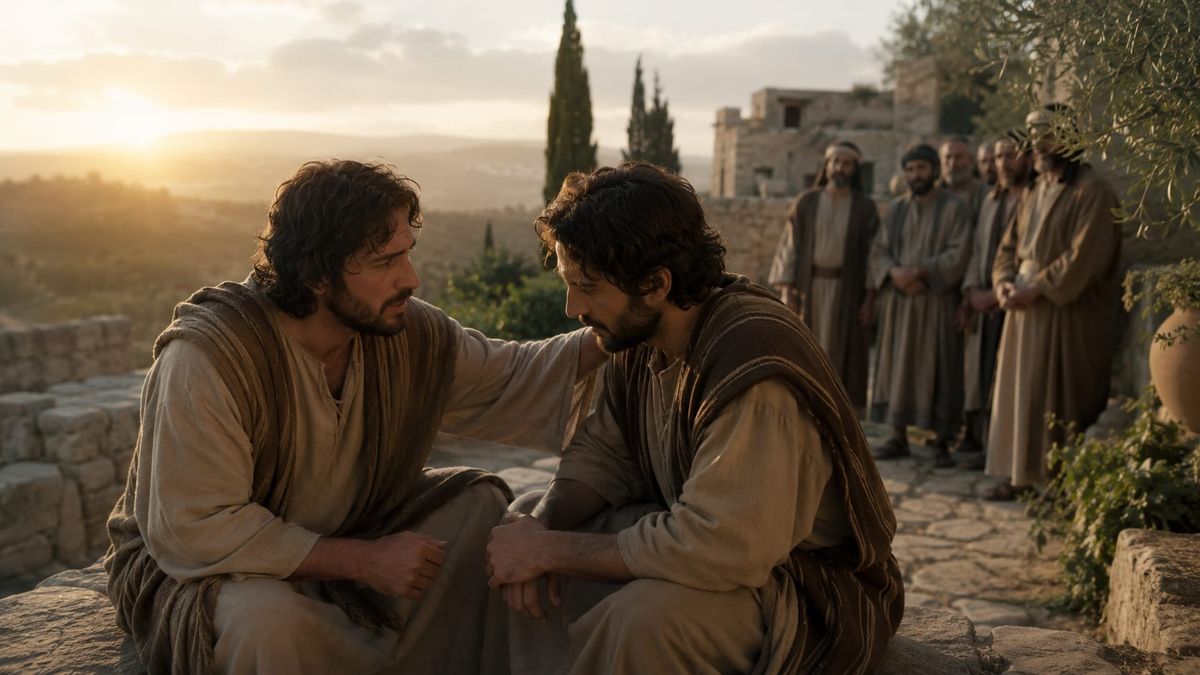
Jesus tells us exactly what success looks like: “If he listens to you, you have gained your brother” (Matthew 18:15, ESV). The Greek verb is kerdainō (ker-DYE-no), to gain or win. Jesus does not say, “You have won the argument,” or “You have proved that you were right.” He says, “you have gained your brother” (Matthew 18:15, ESV). Something precious was in danger of being lost and has now been recovered. That is why the wandering sheep stands immediately before this passage. The brother who sins is someone Christ desires to gain.
Earlier in Matthew Jesus said, “If you are offering your gift at the altar and there remember that your brother has something against you, leave your gift there before the altar and go. First be reconciled to your brother” (Matthew 5:23–24, ESV). Whether we are the offender or the offended, Christ does not permit us to cultivate distance indefinitely and call it peace.
There is something especially appropriate about remembering that as Anglicans coming to the Lord’s Table. We exchange the Peace before Holy Communion as a sign that those who receive the one bread and one cup are reconciled to one another. The Peace is probably not the moment to begin a difficult conversation across the aisle, but we should not indefinitely substitute the words “Peace be with you” for actually seeking peace.
Our Old Testament reading takes the obligation to speak even further. In Ezekiel 33 God appoints Ezekiel as a watchman for Israel. If the watchman sees danger and sounds the trumpet, he has fulfilled his responsibility. If he sees danger and remains silent, his silence itself becomes a moral failure.
God says, “So you, son of man, I have made a watchman for the house of Israel. Whenever you hear a word from my mouth, you shall give them warning from me” (Ezekiel 33:7, ESV). Ezekiel is not commissioned to announce his own opinions. He hears a word from God and faithfully speaks what God has given him.
Ezekiel tells us why silence is not always faithful; Jesus tells us how truth is to be spoken within the household of faith, with restoration as its goal.
The Church stands in a similar position. We have been entrusted with a message we did not invent. There will be times when that message is welcomed and times when it is offensive. We live in a culture in which much of the historic Christian faith is repeatedly placed back on the negotiating table, sometimes by the world and sometimes even by Christians. Must we still believe this? Must the Church still teach that? Could we reconsider what Scripture says about marriage, sexuality, repentance, judgment, salvation, or the uniqueness of Christ?
The Church does not possess authority to renegotiate the historic, apostolic faith once delivered to the saints. We receive it, confess it, teach it, and hand it on.
When Scripture teaches that sexual intimacy belongs within marriage, the Church cannot declare holy what God has called sin because the surrounding culture finds the teaching offensive. When Jesus calls all people to repentance, we cannot replace repentance with affirmation because repentance is unpopular. When the Gospel declares that sinners are justified by grace through faith because of Christ rather than their own righteousness, we do not improve the Gospel by adjusting it. When the Church confesses Jesus Christ as Lord, crucified and risen, we cannot turn that confession into one spiritual possibility among many.
The watchman does not decide whether the warning will be popular. His responsibility is to speak faithfully what he has received.
But Ezekiel also tells us why he speaks. God says, “As I live, declares the Lord GOD, I have no pleasure in the death of the wicked, but that the wicked turn from his way and live” (Ezekiel 33:11, ESV). The warning is given because God desires repentance and life.
That is the same purpose Jesus gives us: “you have gained your brother” (Matthew 18:15, ESV). The Church does not speak hard truths because we enjoy being contrary or because causing offense proves our courage. We speak because silence can abandon the very people Christ calls us to gain. There is a kind of silence that masquerades as peace but is really the abandonment of a brother.
Verse 16 tells us what happens when the private conversation fails: “But if he does not listen, take one or two others along with you, that every charge may be established by the evidence of two or three witnesses” (Matthew 18:16, ESV). Jesus draws on the Old Testament requirement that serious charges be established by witnesses, but again the circle widens slowly.
Those witnesses should not be people recruited because they are already “on our side.” Mature witnesses help both parties discern what is true. Perhaps the offender needs correction. Perhaps the offended person misunderstood. Perhaps both have something to confess. They are there not to manufacture victory but to help bring truth into the light.
Psalm 119 gives us the proper posture. The psalmist prays, “Teach me, O LORD, the way of your statutes” (Psalm 119:33, ESV). “Give me understanding” (Psalm 119:34, ESV). “Incline my heart to your testimonies” (Psalm 119:36, ESV). The watchman is himself under the Word he speaks. Before we tell another Christian his fault, we should be able to pray, “Teach me. Give me understanding. Incline my heart.” The Christian who says, “Brother, this is sin,” must also be willing to hear those words spoken back to him.
If the witnesses cannot bring reconciliation, Jesus says, “If he refuses to listen to them, tell it to the church” (Matthew 18:17, ESV). The matter now becomes part of the ordered life and leadership of the Church. And if he refuses even to listen to the Church, Jesus says, “let him be to you as a Gentile and a tax collector” (Matthew 18:17, ESV).
That is a real boundary. Persistent, unrepentant sin cannot simply be treated as though nothing has happened. Yet Matthew himself was a tax collector when Jesus called him. Jesus seeks Gentiles and tax collectors, eats with sinners, and calls them to follow. Even the final act of discipline is therefore not hatred or revenge. There is still prayer, Gospel, repentance, and a road home. The Church simply refuses to say, “Everything is well,” when it is not.
Then in verse 18 we hear the language from Caesarea Philippi again: “Whatever you bind on earth shall be bound in heaven, and whatever you loose on earth shall be loosed in heaven” (Matthew 18:18, ESV). Here the authority of the keys appears in the concrete life of the Church. It is real authority, but received authority. No priest, bishop, synod, denomination, or congregation may invent a new Gospel. Where Christ has left liberty, the Church should be reluctant to bind consciences. Where Christ has spoken, the Church should be reluctant to loose what he has bound.
Then Jesus says, “If two of you agree on earth about anything they ask, it will be done for them by my Father in heaven” (Matthew 18:19, ESV). This verse is often removed from its context and treated almost as a formula: if two Christians agree strongly enough about a healing, a job, a financial need, or some other request, God has guaranteed the result.
But agreement between two Christians does not turn our desires into divine decrees. Jesus himself prayed, “Nevertheless, not as I will, but as you will” (Matthew 26:39, ESV). John writes, “If we ask anything according to his will he hears us” (1 John 5:14, ESV). Matthew 18 does not give us a way to force God’s hand by finding another person who wants the same thing we do.
The context controls the promise. Jesus is assuring his Church that as she prayerfully undertakes the difficult work he has commanded, seeking his will rather than imposing her own, the Father hears her. The Church has real authority, but received authority. The Church has real promises in prayer, but not authority over God.
Jesus continues, “For where two or three are gathered in my name, there am I among them” (Matthew 18:20, ESV). We often quote that verse when attendance is small, and the underlying truth is certainly right. Christ is no less present with three Christians than with three thousand. But in context the “two or three” are connected with the witnesses and the difficult work Jesus has just described.
That makes the promise intensely practical. The conversation we have been avoiding, the one we are afraid will go badly, is not a room into which Christ sends us alone. When Christians attempt to repair what sin has damaged, when mature witnesses enter, or when the Church must discern something painful and call someone to repentance, Christ is there.
And the Christ who stands among us is the same one who told the shepherd to seek the wandering sheep, the same one who says the goal is to gain the brother, and the same one who, immediately after this passage, will teach Peter how extravagantly Christians must forgive. He is also the same Christ who, as we heard last Sunday, is walking toward Jerusalem.
Jesus does not merely command reconciliation. He accomplishes reconciliation at a cost none of us could bear. He does not save us by pretending our sin is insignificant. The cross tells us how serious sin is. But neither does he leave us condemned in it. He comes to sinners, bears the judgment our sin deserves, and reconciles us to the Father.
At the cross truth and mercy meet without either being diminished. Sin is named for what it is, and sinners are loved enough for the Son of God to die for them. That is the pattern Christ gives his Church. Love that refuses to speak truth is not the love Jesus describes here, and truth spoken without a desire to restore is not his truthfulness either. Jesus gives us something harder and better: truth ordered toward reconciliation.
That is why the collect this morning asks God to give us grace “to withstand the temptations of the world, the flesh, and the devil, and with pure hearts and minds to follow” him. We need that grace here. The world can tempt the Church to silence what is unpopular. The flesh can tempt us to speak truth in pride, anger, or self-justification. The devil is perfectly content with either false peace or destructive conflict. Christ calls us to something different: truth spoken in love for the sake of gaining the brother.
So this passage leaves us with three questions. First, is there someone we need to go to? Perhaps we believe someone has genuinely sinned against us, but instead of speaking to that person we have allowed resentment or conversation with others to replace the conversation Jesus commanded. Before we tell someone else, Jesus says go to the brother. Pray Psalm 119 first. Ask God to teach us, give us understanding, and incline our hearts. Then go, not to win, but to gain.
Second, are we willing to speak when love requires speech? The watchman may not remain silent simply because sounding the alarm will make him unpopular. The Church is not free to renegotiate the faith once delivered to the saints. But neither do we speak because we enjoy being right. We speak because God says, “Turn back, turn back from your evil ways” (Ezekiel 33:11, ESV). He desires repentance and life.
Third, when we do speak, do we remember the goal? Jesus gives it to us in verse 15: “you have gained your brother” (Matthew 18:15, ESV). If telling the truth causes us to stop caring whether the brother is restored, we have forgotten why Jesus sent us. If discipline becomes punishment we enjoy administering, we have lost the heart of the Shepherd. If defending the apostolic faith becomes merely another way to win a cultural battle, we have missed the reason the watchman sounds the warning.
Next Sunday Peter will ask how many times he must forgive this brother who keeps sinning against him. Jesus will answer in a way that makes Peter’s proposed seven times look miserly. But before Jesus teaches us how often to forgive the brother, he teaches us not to abandon him.
That is what Christ came to do for us. He did not remain at a safe distance. He came to sinners, called us to repentance, bore our judgment, and opened the way home. Now the Church he is building is called to become that kind of community: humble where Christ has given liberty, immovable where he has spoken, unwilling to gossip when we should go, unwilling to remain silent when love requires truth, eager to forgive, and always seeking the restoration of the one who has wandered.
The goal is not simply to prove that we were right. The goal is to gain our brother.
In the Name of the Father, and of the Son, and of the Holy Spirit. Amen.