Barnabas the Apostle: An Anglican Perspective
Today the Church observes the Feast of Saint Barnabas. He stood before the apostles in Jerusalem and vouched for Saul when no one else would. If he had been wrong, the cost would have been real. He was not wrong. The man he testified for wrote half the New Testament.
Feast Day: June 11
The Anglican calendar is ordered by a hierarchy of holy days, each carrying a different weight of observance. At the top sit the seven Principal Feasts: Easter, Ascension, Pentecost, Trinity Sunday, All Saints' Day, Christmas, and the Epiphany, the highest days of the liturgical year. Below them are the Red-Letter Holy Days: feasts of the Lord, the Virgin Mary, the Apostles, and other significant figures in salvation history, appointed in the BCP 2019 with their own collects, propers, and lectionary readings. They are called Red-Letter Days because, in the tradition of printing church calendars, these days appear in red ink, distinguished from the lesser commemorations, the Black-Letter Days, which appear in ordinary type. The Feast of Saint Barnabas the Apostle, observed on June 11 and listed on page 700 of the BCP 2019, is one of these Red-Letter Holy Days.
Barnabas is one of only two figures in the calendar honored with the title of apostle who were not among the original Twelve, the other being Paul. He was not chosen to replace Judas; that was Matthias, chosen by lot in Acts 1:26 to restore the Twelve to their full number before Pentecost. Unlike Paul, Barnabas received no direct commission from the risen Christ on the Damascus road. Yet the Church recognized the same apostolic character in his ministry. Luke uses the title explicitly in Acts 14:14: "When the apostles Barnabas and Paul heard of it..." The Church has never let that designation go. That it places Barnabas in the highest tier of its commemorations tells us something important: the Church has long considered him not a peripheral figure but a foundational one. This feast invites us to ask why.
The Biblical Portrait
His given name was Joseph; the apostles renamed him Barnabas, which Luke translates for us as "son of encouragement." (Acts 4:36, ESV) That name, given by the community that knew him best, is the most theologically precise thing we have. Before we learn where he went, what he preached, or how he died, we know what kind of man he was. The feast of Saint Barnabas is, in a sense, a feast of character.
He appears first in Acts 4:36–37, in one of the earliest portraits of the Jerusalem community. The church has been sharing its goods with those in need, and into this picture steps a Levite from Cyprus who sells a field and lays the proceeds at the apostles' feet. Luke places this cameo immediately before the dark story of Ananias and Sapphira, the couple who lied about the very same act. The juxtaposition is not accidental. Barnabas is the genuine article. His generosity is the baseline against which the counterfeit is measured.
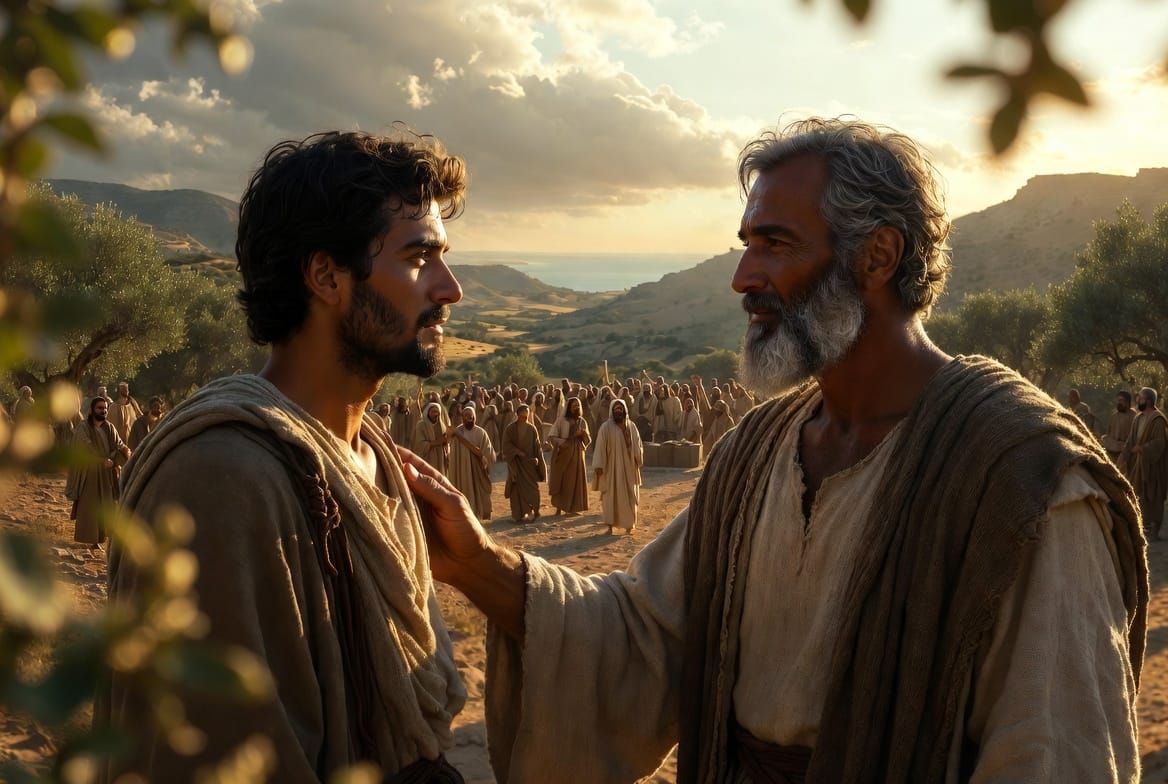
His most consequential act of encouragement comes in Acts 9. Saul of Tarsus has met the risen Christ on the Damascus road, been blinded, baptized, and transformed. He has already been preaching boldly in Damascus. And then he arrives in Jerusalem, and the disciples will not receive him. The wound is understandable: this is the man who stood over Stephen's stoning and persecuted the Church with calculated violence. Nobody wants to be deceived. And so Saul finds himself unwelcome in the Jerusalem community. Until Barnabas.
"But Barnabas took him and brought him to the apostles and declared to them how on the road he had seen the Lord, who spoke to him, and how at Damascus he had preached boldly in the name of Jesus." (Acts 9:27, ESV) That sentence is short. What it cost Barnabas to speak it was not. He stood before the apostles as a character witness for the most feared man in the Jerusalem church. He staked his own credibility on his conviction that Saul's conversion was genuine. If he had been wrong, the cost would have been real. He was not wrong. The man Barnabas testified for would go on to write half the New Testament and carry the Gospel to the ends of the Roman world.
The Antioch mission comes next. In Acts 11, the Jerusalem church hears that Gentiles in Antioch have been coming to faith and sends Barnabas to investigate. His response when he arrives is characteristic: "When he came and saw the grace of God, he was glad, and he exhorted them all to remain faithful to the Lord with steadfast purpose, for he was a man of good character, full of the Holy Spirit and of faith." (Acts 11:23–24, ESV) He saw the grace of God and he was glad. He did not arrive as an auditor checking credentials. He did not look for reasons to be suspicious. He saw what God was doing among people who did not look exactly like the Jerusalem community, and his first response was joy. This is not naïveté. It is the fruit of a man whose identity is secure enough in Christ that he does not need to control where the Spirit goes.
And then, crucially, Barnabas goes to Tarsus to find Saul and brings him to Antioch: "And when he had found him, he brought him to Antioch. For a whole year they met with the church and taught a great many people." (Acts 11:26, ESV) It is in Antioch, among this community shaped by the ministry of these two men, that the disciples are first called Christians. The name of the movement was coined in the city where Barnabas planted the work.
The first missionary journey of Acts 13 begins with Barnabas listed first: the Spirit says, separate for me Barnabas and Saul. He is the senior partner, the established figure, the one the church already trusts. And somewhere along that journey the text quietly shifts, "Paul and Barnabas" instead of "Barnabas and Saul." Paul's gifts become undeniable and his name moves to the front, and Barnabas does not appear to have minded. This too is a form of encouragement: the security of a man who does not need the recognition to keep doing the work.
The parting over John Mark in Acts 15 is often read as a failure. Barnabas wants to take John Mark on the second journey; Paul refuses, because Mark had turned back on the first. The disagreement is sharp; the Greek word Luke uses, paroxysmós (pronounced "par-ox-is-MOS"), describes a provocation strong enough to produce a permanent separation. They go their separate ways. But John Mark goes with Barnabas. Years later Paul writes to Timothy: "Get Mark and bring him with you, for he is very useful to me for ministry." (2 Timothy 4:11, ESV) The man Paul once refused to take became, in Paul's own words, useful for ministry. Barnabas saw that before anyone else. What looked like a failed partnership was, for John Mark, a second chance that gave the Church one of its four Gospels.
The Theological Significance of This Feast
The Feast of Saint Barnabas celebrates a particular kind of ministry that the Church could not have done without and still cannot do without: the ministry of the witness, the advocate, and the accompanier. Barnabas does not perform miracles on the scale of Peter. He does not write letters on the scale of Paul. What he does is see people accurately and speak up for them honestly, at personal cost, at the moment when it matters most.
There is a theological account of this ministry that runs deeper than mere encouragement. Barnabas acts as a guarantor, someone who puts their own name on the line for another person's standing in the community. This is, at a different level, what Christ does for us. He is the guarantor of the new covenant, as Hebrews 7:22 puts it: "This makes Jesus the guarantor of a better covenant." (Hebrews 7:22, ESV) He stands before the Father and speaks for us. Barnabas, in standing before the apostles and speaking for Saul, is enacting in miniature the pattern of his Lord. The son of encouragement is a figure of grace.
The feast also raises the question of what the Church loses when it produces no Barnabases: when every newcomer must prove themselves without anyone willing to stake their credibility on their behalf, when second chances are withheld because the first failure is too visible, when the man most gifted for the next stage of the mission sits in Tarsus because no one goes to find him. The Barnabas passages in Acts are not incidental color. They are a theology of how the Kingdom actually expands, through the bold proclamation of the Peters and the Pauls, yes, but also through the quiet, credibility-staking, reputation-risking encouragement of the Barnabases.
The BCP 2019 Collect and Propers
The BCP 2019 appoints the following collect for the feast on page 629: "Grant, O God, that we may follow the example of your faithful servant Barnabas, who, seeking not his own renown but the well-being of your Church, gave generously of his life and substance for the relief of the poor, and went forth courageously in mission for the spread of the Gospel; through Jesus Christ our Lord, who lives and reigns with you and the Holy Spirit, one God, for ever and ever. Amen." The collect names both the shape of Barnabas's life and its animating motive: not his own renown but the well-being of the Church. That distinction is not incidental. It is the difference between a ministry that builds the Kingdom and a ministry that builds a personal platform. The feast asks us, each year, to examine which one we are doing.
The propers for the feast are found on page 730 of the BCP 2019. The appointed readings are Isaiah 42:5–12, Psalm 112, Acts 11:19–30 and 13:1–3, and Matthew 10:7–16.
Isaiah 42 is the first Servant Song. Its opening verse declares: "I am the Lord; I have called you in righteousness; I will take you by the hand and keep you; I will give you as a covenant for the people, a light for the nations." (Isaiah 42:6, ESV) The Servant of the Lord is ultimately Christ, but the Church participates in that servant mission. Barnabas is one of its clearest New Testament embodiments: called, kept, given for others. Psalm 112 paints the portrait of the righteous person whose generosity endures: "He has distributed freely; he has given to the poor; his righteousness endures forever." (Psalm 112:9, ESV) This is the field-selling, John-Mark-retrieving, Saul-vouching man of Acts compressed into a single verse.
The Gospel appointed for the feast is Matthew 10:7–16, the commissioning of the Twelve. Jesus sends them out with authority and this instruction: "Heal the sick, raise the dead, cleanse lepers, cast out demons. You received without paying; give without pay." (Matthew 10:8, ESV) You received without paying; give without pay. This is the theology of Barnabas's entire life compressed into a single sentence. Everything he had, his field, his credibility, his standing in the Jerusalem community, his years in Antioch, his willingness to accompany John Mark when Paul would not, he gave without keeping an account. In 2026, the Feast of Saint Barnabas falls in the week between Proper 5 Sunday (June 7) and Proper 6 Sunday (June 14), whose Gospel is Matthew 9:35–10:15, the commissioning passage immediately preceding this one. The feast and the following Sunday are in deliberate conversation.
A Note on Barnabas in History and Tradition
The Feast of Saint Barnabas has been observed in the Church of England since at least the medieval period. The tradition is ancient: early Church Fathers mention Barnabas with apostolic regard, and a letter attributed to him, the Epistle of Barnabas, was known in the early Church, though its authorship is disputed by most scholars and it was not received into the canon. Tertullian, writing around 200 AD, attributed the Letter to the Hebrews to Barnabas, a view that has not found wide scholarly acceptance but testifies to the esteem in which Barnabas was held in the early Church.
Church tradition holds that Barnabas returned to Cyprus, where he was martyred, likely by stoning, around 61 AD. The Church of Cyprus has venerated him as its founding apostle and patron saint since antiquity. A tradition dating to the fifth century records that a copy of the Gospel of Matthew was found in his tomb, placed there at his burial; the Gospel, tradition says, copied in Barnabas's own hand. Whether historical or legendary, the image is fitting: the son of encouragement, buried with the Gospel of the one he spent his life commending.
Observing This Feast as Anglicans
Anglicanism does not venerate the saints in the Roman Catholic sense; we do not direct prayer to them or attribute to them a treasury of merits. The Thirty-Nine Articles are clear on this point. What the feast of Saint Barnabas gives us is not an intercessor in heaven but a mirror on earth: a man whose life, preserved in Scripture rather than merely in tradition, shows us what the Spirit produces in a person who is genuinely full of faith and the Holy Spirit. We do not pray to Barnabas. We learn from him.
The feast falls on Thursday, June 11, in the week between Proper 5 Sunday and Proper 6 Sunday. It does not displace any Sunday observance. For those building the rhythm of observing Red-Letter Days beyond Sunday, this is a natural place to begin. The propers are brief, the story is rich, and the question the feast puts to the congregation is one that repays slow consideration.
To observe the feast: pray the collect from BCP 2019, p. 629. Read Acts 9:26–31 and Acts 11:19–30, the two passages that show Barnabas most clearly at work. Read Isaiah 42:5–12 as the appointed Old Testament lesson and Psalm 112 as the appointed psalm. If time allows, read Acts 13:1–3 and the John Mark episode in Acts 15:36–40. Let the day close with a question held before God in prayer: is there someone in my life who needs me to be their Barnabas right now, someone waiting to be vouched for, someone who turned back and needs someone willing to go with them again?
Conclusion
The feast of Saint Barnabas falls in the week after the Great Commission of Trinity Sunday and before the commissioning of the Twelve at Proper 6. The season of sending has just begun. The harvest is plentiful, the laborers are few, and the Lord of the harvest is asking for more sons and daughters of encouragement.
The collect for the day closes the feast with a petition that is both its conclusion and the Church's prayer: "Grant, O God, that we may follow the example of your faithful servant Barnabas, who, seeking not his own renown but the well-being of your Church, gave generously of his life and substance for the relief of the poor, and went forth courageously in mission for the spread of the Gospel." It is a high standard. It is also an entirely ordinary one. He saw people and believed in them when others did not. He showed up. He gave what he had. And the harvest that grew from his faithfulness, Saul of Tarsus, the church at Antioch, John Mark the Evangelist, was far beyond anything he could have managed on his own. "God gave the growth." (1 Corinthians 3:6, ESV)