Blessed Is She Who Believed: The Visitation of the Virgin Mary to Elizabeth and Zechariah (Luke 1:39-56)
The Visitation reminds us that some of God’s greatest works unfold quietly. A greeting, a leap, and a song, and the Lord is already in the midst of his people. Faith receives grace, and grace turns us outward in love.
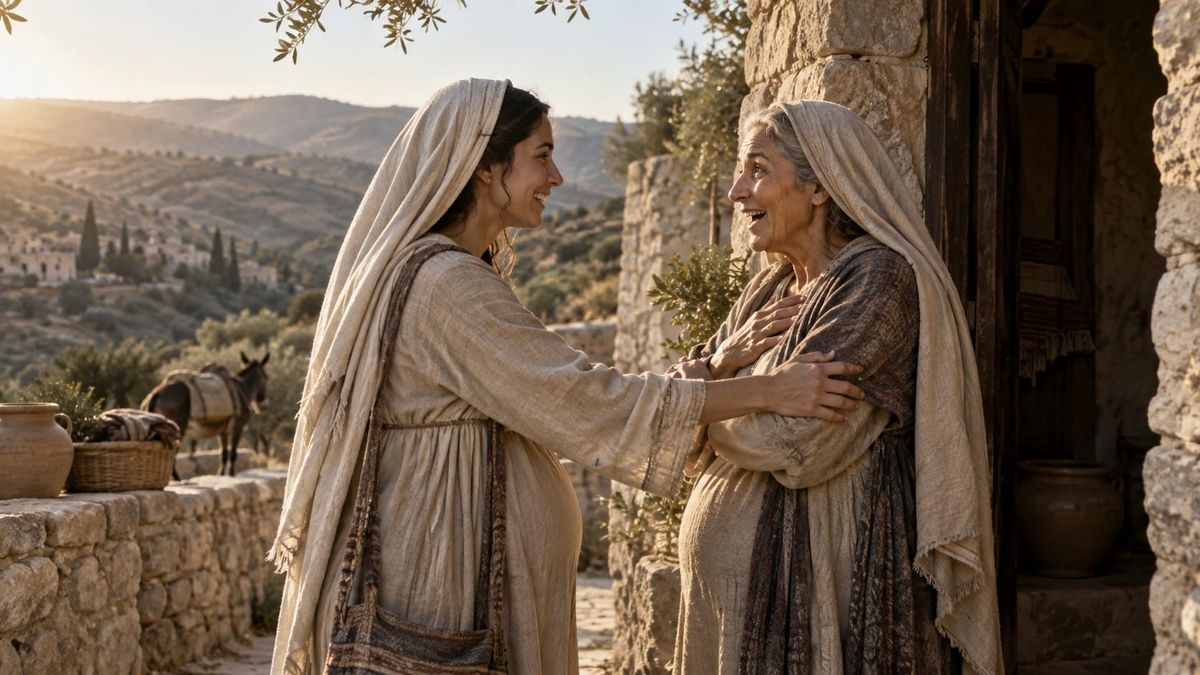
May 31, 2026, The Visitation of the Virgin Mary to Elizabeth and Zechariah, Red-Letter Holy Day, Season after Pentecost
Luke 1:39–56, Psalm 113, Colossians 3:12–17, Zephaniah 3:14–18
Grace, mercy, and peace from God our Father and the Lord Jesus Christ be with you on this Feast of the Visitation.
Today is the Visitation of the Virgin Mary to Elizabeth and Zechariah. It is one of the quieter feasts of the Christian year. There are no crowds, no mountain, no thunder, and no heavenly host filling the sky. There are two women in a house somewhere in the hill country of Judea, both carrying children whose births, humanly speaking, seemed impossible. One is old and had been barren. The other is young and still a virgin. One carries the prophet who will prepare the way of the Lord. The other carries the Lord himself.
And almost nobody knows what is happening. That may be one of the first things this feast teaches us. We are often tempted to measure the work of God by how visible it is. We notice the crowd, the platform, the dramatic conversion, the obvious answer to prayer. But some of the greatest works of God begin where almost nobody is looking: in a house in the hill country, in a greeting, in a child leaping in the womb, in a woman filled with the Holy Spirit, and then in a song.
Our primary text begins in verse 39: “In those days Mary arose and went with haste into the hill country, to a town in Judah, and she entered the house of Zechariah and greeted Elizabeth.” (Luke 1:39–40, ESV) We need to remember what has just happened. Gabriel has appeared to Mary. He has told her that she will conceive and bear a son, that his name will be Jesus, that he will be called the Son of the Most High, and that his kingdom will have no end.
Mary asks how this will be, since she is a virgin. Gabriel tells her, “The Holy Spirit will come upon you, and the power of the Most High will overshadow you.” (Luke 1:35, ESV) Then Gabriel tells her about Elizabeth. The woman who had been called barren is now six months pregnant, “For nothing will be impossible with God.” (Luke 1:37, ESV) Mary answers, “Behold, I am the servant of the Lord; let it be to me according to your word.” (Luke 1:38, ESV) And after receiving that word, Mary rises and goes.
That order matters because Mary does not travel in order to make God’s promise come true. She does not go to Elizabeth so that she can earn the grace she has received. God has already spoken. God has already promised. God has already acted. Her obedience comes after grace, and that is the pattern of the Christian life. We love because he first loved us. We forgive because we have been forgiven. We serve because Christ first took the form of a servant for us. We go because he has first come to us.
Verse 41 tells us what happens when Mary arrives: “And when Elizabeth heard the greeting of Mary, the baby leaped in her womb. And Elizabeth was filled with the Holy Spirit.” (Luke 1:41, ESV) Luke wants us to notice the sequence. Mary enters carrying Jesus. John leaps. Elizabeth is filled with the Holy Spirit. Then Elizabeth speaks.
Gabriel had already said of John that “he will be filled with the Holy Spirit, even from his mother’s womb.” (Luke 1:15, ESV) Now, before John can preach a sermon beside the Jordan, before he can cry out in the wilderness, and before he can point toward Jesus and say, “Behold, the Lamb of God.” (John 1:29, ESV) Even now, the forerunner is already responding with joy to the presence of the Christ. His witness to Jesus begins before birth.
That is a beautiful detail, but it is also a serious one. Luke does not speak as though the child in Elizabeth’s womb were merely potential life waiting to become someone later. This is John, the child whom God has named and the child to whom God has given a vocation. Luke uses the same Greek word, brephos (BREH-foss), for the child in Elizabeth’s womb and for infants after birth. There is continuity because there is one human life. But Luke’s primary concern here is even larger than that: John leaps because the Lord has come near.
Verse 42 says Elizabeth “exclaimed with a loud cry, ‘Blessed are you among women, and blessed is the fruit of your womb!’” Then in verse 43 she asks, “And why is this granted to me that the mother of my Lord should come to me?”(Luke 1:42–43, ESV) Notice what the Holy Spirit enables Elizabeth to see. Everyone else could have looked at Mary and seen a young pregnant woman arriving from Nazareth. Elizabeth sees more because God has revealed more. She calls Mary “the mother of my Lord.”
The importance of that phrase rests finally upon Jesus. Mary is the mother of the Lord because the child she carries is the Lord. This is why Christians have rightly honored Mary. Scripture honors her. Elizabeth, filled with the Holy Spirit, calls her blessed, and Mary herself will say that all generations will call her blessed. We do not honor Mary by pretending she is unimportant, but neither do we honor her by making her into something Scripture does not make her. Her blessedness comes from grace, and her significance comes from the Son she carries.
The ancient Church would later call her Theotokos (theh-oh-TOH-kos), God-bearer, or Mother of God. That title was never meant to say that Mary is the source of God or the mother of Christ’s divine nature. It was meant to protect the truth about Jesus. The one born of Mary is not merely a man whom God later adopted or joined to himself. The child is the eternal Son made flesh. Elizabeth says it far more simply: “the mother of my Lord.”
Then verse 45 gives us what may be the central sentence of the whole feast: “And blessed is she who believed that there would be a fulfillment of what was spoken to her from the Lord.” (Luke 1:45, ESV) Blessed is she who believed. Mary’s vocation as the mother of our Lord is unique. None of us will share her particular calling. But the faith Elizabeth praises is the faith to which every Christian is called. God speaks, and faith receives his Word.
That does not mean faith causes the promise. Mary did not make the Incarnation happen by believing hard enough. God sent Gabriel. God gave the promise. God the Holy Spirit overshadowed her. God the Son took flesh. Faith does not manufacture grace; faith receives grace. That distinction matters far beyond the story of Mary because Christians can easily begin to treat faith as though it were another work we perform for God. If I believe strongly enough, pray intensely enough, or obey perfectly enough, perhaps God will act.
Scripture gives us the opposite order. God acts, and faith receives. Christ dies for us while we are still sinners. Christ rises before the disciples fully understand what has happened. The Spirit is given as gift. The Gospel announces a salvation accomplished before it asks us to respond. Then faith says, with Mary, “Let it be to me according to your word.”
Our Collect understands this beautifully. It begins, “Almighty God, by whose grace Elizabeth rejoiced with the blessed Virgin Mary.” The joy comes from grace. The recognition comes from grace. Even the praise that follows is grace answering grace. That brings us directly to Mary’s song.
Beginning in verse 46, Mary says, “My soul magnifies the Lord, and my spirit rejoices in God my Savior.” (Luke 1:46–47, ESV) The Magnificat is not gentle sentiment. It is worship, but it is worship with teeth. Mary does not sing merely because she is having an emotional religious experience. She sings because God has acted.
Verse 48 says, “For he has looked on the humble estate of his servant.” Verse 49 continues, “For he who is mighty has done great things for me.” Then verse 50 declares, “And his mercy is for those who fear him from generation to generation.” The subject of Mary’s song is God. He has looked. He has done. His mercy has come. Mary does not place herself at the center of the song because the grace of God is already at the center of her life.
Then the song widens. Verses 51 through 53 say, “He has shown strength with his arm; he has scattered the proud in the thoughts of their hearts; he has brought down the mighty from their thrones and exalted those of humble estate; he has filled the hungry with good things, and the rich he has sent away empty.” (Luke 1:51–53, ESV) Mary is singing about a kingdom in which the measures of fallen humanity are overturned.
The proud do not remain secure because they are proud. The mighty do not remain on their thrones merely because they are powerful. The rich cannot purchase the favor of God, and the humble, poor, forgotten, and overlooked are not beyond his sight. This should not be flattened into a modern political platform, but neither should we make it harmless. God opposes pride. God sees the lowly. God exposes the illusion of self-sufficiency. God fills the hungry. And this great reversal begins with the child Mary is carrying. The King has come.
That is why our reading from Zephaniah fits so beautifully. The prophet tells Zion to sing and rejoice because “the King of Israel, the LORD, is in your midst.” (Zephaniah 3:15, ESV) Now hear that promise beside Luke 1. The King of Israel is in their midst, but he is present in the womb of the Virgin Mary. There is no visible throne, no crown, no army, and no court officials announcing his arrival. Mary simply walks through the door of an ordinary home, and the King is in their midst.
Elizabeth knows because the Holy Spirit opens her mouth to confess it, and John responds with the joy God has ordained for the forerunner. The world does not know yet, but the Lord has come. Psalm 113 gives us the same pattern. The LORD is exalted high above all nations, and yet he stoops down to behold the heavens and the earth. He raises the poor from the dust and lifts the needy from the ash heap. This is the God Mary sings about: high above all things, yet near to the lowly; Lord of heaven and earth, yet present in the womb of a young woman from Nazareth.
The one whom heaven cannot contain has entered his creation as one of us, and he has come to save. Mary’s song reaches its destination in verses 54 and 55: “He has helped his servant Israel, in remembrance of his mercy, as he spoke to our fathers, to Abraham and to his offspring forever.” (Luke 1:54–55, ESV) This is not God improvising a new plan. He remembers his mercy. The promise to Abraham is moving toward fulfillment. The covenant story is reaching its center. The child hidden in Mary’s womb is the one through whom all the families of the earth will be blessed.
Notice again what Mary calls God at the beginning of her song: “God my Savior.” Mary needs a Savior. Elizabeth needs a Savior. John needs a Savior. We need a Savior. And the Savior has come. That is why the Church may honor Mary without ever allowing her to become the center. She will not allow it. Her own song keeps turning our eyes away from herself and toward the Mighty One who has done great things. My soul magnifies the Lord. That is the direction of the feast.
Our Epistle from Colossians helps us see what happens when the Christ Mary carried in her body dwells among his people by faith. Paul says, “Put on then, as God’s chosen ones, holy and beloved, compassionate hearts, kindness, humility, meekness, and patience.” (Colossians 3:12, ESV) Then he says, “Let the word of Christ dwell in you richly.”(Colossians 3:16, ESV) Paul is not directly describing the Visitation, but the connection is fitting. Where Christ dwells, he changes people.
Grace does not leave us curled inward upon ourselves. Mary has received a vocation unlike any other in human history, and verse 39 tells us that she gets up and goes. We should be careful not to invent details Luke does not give us. He does not explicitly tell us every reason Mary went to Elizabeth. But he does show us faith in motion. Grace has come to Mary, and Mary moves outward.
That is a pattern worth receiving. Christian faith is never less than believing the truth God has revealed, but real faith does not remain merely an idea in the head. It goes, serves, speaks, sings, and moves toward another person. It carries the confession of Christ with it.
So what does the Visitation ask of us? First, receive the Word of God as promise. Elizabeth says, “Blessed is she who believed.” Some of us know what it is to hear the Word of God while circumstances seem to argue against it. God says he forgives repentant sinners while conscience says, “Not you.” God says he will never leave or forsake his people while grief says, “You have been abandoned.” God says Christ will raise the dead while we stand beside a grave. God says all things will finally be made new while the world appears determined to fall apart.
Faith does not pretend the circumstances are unreal. Faith says that the promise of God is more trustworthy than our ability to see its fulfillment. Mary did not yet see Bethlehem. She had not seen shepherds or Magi. She had not seen miracles. She had not seen the empty tomb. She had the Word of God, and she believed.
Second, allow grace to turn us outward. Mary rises and goes. There are people around us who need more than our good intentions. Someone needs a visit. Someone needs a phone call. Someone needs a meal. Someone needs us to stop avoiding the conversation. Someone needs to hear why we still have hope. Christian love is not silent about Christ, and Christian truth is not an excuse to withhold love.
Colossians gives us both. Let the Word of Christ dwell in you richly, and put on compassion, kindness, humility, patience, forgiveness, and love. We carry Christ into the ordinary places of life by speaking truthfully about him and by loving the people he places before us. Sometimes the work of God begins with something as ordinary as arriving at somebody else’s door.
Third, magnify the Lord rather than ourselves, our obedience, our insight, or even the strength of our faith. Mary’s song begins there and stays there. He has looked. He has done. He has shown strength. He has exalted. He has filled. He has helped. The Christian life becomes distorted whenever we reverse the grammar.
Our testimony is finally not, “Look what I have done for God.” It is, “Look what God has done for me in Jesus Christ.” He came when we could not climb to him. He bore the sin we could not remove. He died the death we deserved. He rose from the grave we could not escape. He gives us the Spirit we could never summon. And he gives us a kingdom we could never earn. That is why the Church sings.
The Visitation is wonderfully quiet. There are two women, two unborn children, an ordinary house, a greeting, a leap, and a song. And yet the history of salvation is unfolding. The Lord is in their midst. The forerunner rejoices. The Holy Spirit fills Elizabeth. Mary believes. And the Savior has come.
So with Mary, let us magnify the Lord. With Elizabeth, let us confess that the child Mary carries is the Lord. With John, let us rejoice at the presence of Christ. And with the whole Church, let us receive again the grace that came before any response we could offer. For blessed is she who believed that there would be a fulfillment of what was spoken to her from the Lord, and blessed are all who, by that same grace, receive the promise, trust the Savior, and find themselves singing, “My soul magnifies the Lord, and my spirit rejoices in God my Savior.” (Luke 1:46–47, ESV)
In the Name of the Father, and of the Son, and of the Holy Spirit. Amen.