The Visitation of the Virgin Mary to Elizabeth and Zechariah: An Anglican Perspective
Why does the church observe a feast rooted in the Advent story on May 31st, right in the middle of Trinity season? The answer reveals something surprising about how the church orders time, and something beautiful about the scene at the heart of this feast.
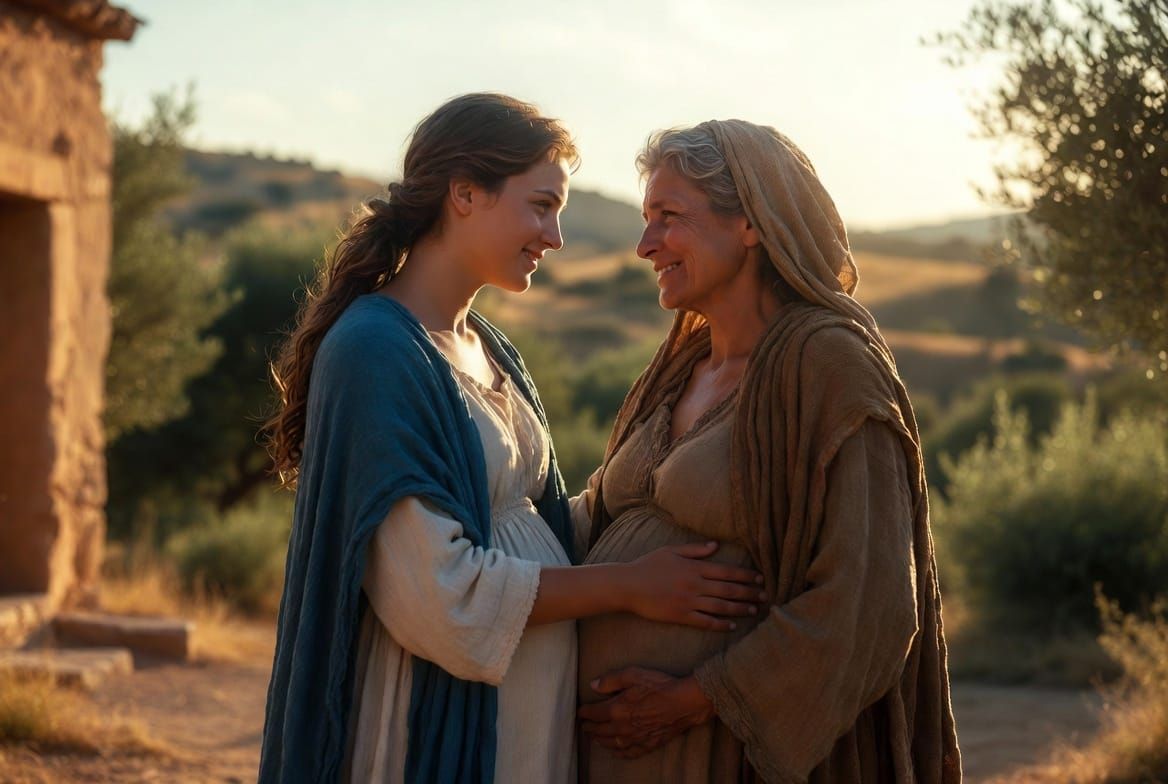
Feast Day: May 31
The Anglican calendar is ordered by a hierarchy of holy days, each carrying a different weight of observance. At the top stand the seven Principal Feasts, the highest-ranking days of the liturgical year. Below them are the Red-Letter Holy Days appointed in the BCP 2019 with their own Collects and propers. The Visitation, observed on May 31, is one of these Red-Letter Holy Days. In its Calendar of Holy Days and Commemorations, the Prayer Book gives the fuller title The Visitation of the Virgin Mary to Elizabeth and Zechariah, while the Collects and lectionary use the shorter title The Visitation. The BCP provides its Collect on page 628 and appoints its readings in the Holy Day lectionary on page 730.
The feast commemorates the meeting described in Luke 1:39–56. Mary has just received Gabriel’s announcement that she will conceive by the Holy Spirit and bear the Son of the Most High. Gabriel has also told her that her relative Elizabeth, once barren and now advanced in years, is six months pregnant. Mary therefore rises and goes “with haste” into the hill country of Judea. What follows is one of Scripture’s most intimate scenes, but it is anything but theologically small. Before Jesus is born, before John the Baptist preaches, and before the public ministry of either child begins, the presence of the incarnate Lord brings joy, the Holy Spirit gives prophetic speech, and Mary sings of the covenant mercy of God.
May 31 also places the feast fittingly between the Annunciation on March 25 and the Nativity of Saint John the Baptist on June 24. The calendar thereby allows the Church to move from Gabriel’s announcement to Mary toward the birth of the forerunner, pausing along the way at the encounter in which the mothers meet and the unborn John leaps for joy before the unborn Christ.
The Biblical Event
Luke tells us that Mary enters the house of Zechariah and greets Elizabeth. At the sound of her greeting, “the baby leaped in her womb,” and Elizabeth is “filled with the Holy Spirit.” She then cries out, “Blessed are you among women, and blessed is the fruit of your womb! And why is this granted to me that the mother of my Lord should come to me?” (Luke 1:41–43, ESV) Elizabeth later explains that when Mary’s greeting reached her ears, “the baby in my womb leaped for joy.” (Luke 1:44, ESV)
Luke carefully orders the scene. Mary arrives carrying Jesus. John leaps. Elizabeth is filled with the Holy Spirit. Elizabeth then confesses the identity of the child Mary carries. The initiative throughout belongs to God. God has conceived the Son in Mary by the Holy Spirit, God has miraculously given Elizabeth a child, and now the Spirit enables Elizabeth to recognize the Lord who has come to her.
The language is strongly Christological. Elizabeth does not merely congratulate Mary on an unusual pregnancy. Filled with the Holy Spirit, she calls her “the mother of my Lord.” The title matters because of the identity of the child. Mary’s dignity in the passage rests upon the one she bears. The eternal Son has truly taken human flesh from her, and the unborn Jesus is already the Lord.
This is one reason the Visitation belongs naturally within the Church’s confession of Mary as Theotokos (theh-oh-TOH-kos), commonly rendered “God-bearer” or “Mother of God.” The title does not mean that Mary is the source of Christ’s divine nature, that she existed before God, or that she is mother of the Godhead. It protects the unity of Christ’s Person. The one whom Mary conceived and bore is the eternal Son incarnate, truly God and truly man. Elizabeth’s biblical phrase “the mother of my Lord” points toward the same Christological truth the Church would later defend formally at the Council of Ephesus in AD 431.
John Leaps for Joy
The unborn John’s leap has naturally attracted Christian reflection because Luke himself tells us that it is a leap “for joy.”Earlier Gabriel had promised Zechariah that John would be “filled with the Holy Spirit, even from his mother’s womb.”(Luke 1:15, ESV) The Visitation therefore belongs within Luke’s account of the Spirit’s work in preparing the forerunner for his vocation.
We should nevertheless remain within what Scripture actually says. Luke tells us that John leaps for joy and that Elizabeth is filled with the Holy Spirit. Later Christian tradition sometimes speaks of John being sanctified from original sin at this particular moment, but Luke does not explicitly make that doctrinal claim. The biblical emphasis is already remarkable enough: before birth, John’s life is being ordered by God toward his vocation of bearing witness to Christ.
The scene anticipates what John will later do publicly. He will stand beside the Jordan and direct Israel’s attention away from himself toward Jesus. At the Visitation, before either child can speak, the forerunner’s joy already points beyond himself toward the Lord whose way he will prepare.
The event also gives striking biblical testimony to the continuity and significance of human life in the womb. Luke speaks of the unborn John as the child whom Gabriel has already named and whose vocation God has already declared. The Greek word brephos is used of John in Elizabeth’s womb and is also used by Luke for infants after birth. Scripture does not invite us to imagine a different kind of being before and after birth. The John who will preach beside the Jordan is already the child who leaps for joy in his mother’s womb.
Blessed Is She Who Believed
Elizabeth’s final word before the Magnificat is especially important: “Blessed is she who believed that there would be a fulfillment of what was spoken to her from the Lord.” (Luke 1:45, ESV) Mary’s blessedness is therefore not presented merely as biological motherhood. She has received God’s Word in faith.
The contrast with Zechariah earlier in the chapter is instructive. When Gabriel announces that Elizabeth will bear a son, Zechariah asks for a sign and is rebuked for not believing the angel’s words. Mary also asks a question when Gabriel announces the conception of Jesus, but hers concerns how the conception will occur because she is a virgin. Once the angel explains that the Holy Spirit will come upon her, Mary answers, “Behold, I am the servant of the Lord; let it be to me according to your word.” (Luke 1:38, ESV) Elizabeth now identifies that response as faith.
Mary’s faith must not be turned into the first cause of the Incarnation, as though salvation waits upon autonomous human initiative. God has already acted. Gabriel is sent by God, the promise originates with God, the Holy Spirit accomplishes the conception, and the child is the Son of God. Mary receives what God gives and answers the Word spoken to her.
Her obedience is therefore real precisely because grace comes first. She does not cause the promise, but she believes it. She does not generate the Savior by an act of her will, but she receives the vocation God gives her. The Visitation shows receptive faith becoming active obedience. After saying, “Let it be to me according to your word,” Mary rises and goes.
The Magnificat
Mary responds to Elizabeth with the song the Church knows by its Latin opening word, Magnificat (mag-NIF-ih-kaht): “My soul magnifies the Lord, and my spirit rejoices in God my Savior.” (Luke 1:46–47, ESV) The song has become so familiar in Anglican worship that it can be easy to miss how sweeping its claims are. The Magnificat is not gentle sentiment. It is a declaration of what God has done, what God is doing, and what the coming of his Son means for the proud arrangements of a fallen world.
Mary begins with what God has done for her personally. He has looked upon the humble estate of his servant, and “from now on all generations will call me blessed.” (Luke 1:48, ESV) She does not deny the singular grace given to her, but neither does she make herself the center. Her soul magnifies the Lord because “he who is mighty has done great things for me.” (Luke 1:49, ESV) The subject of the song is overwhelmingly God and his action.
The song then expands from Mary’s own experience to the whole pattern of God’s Kingdom. God shows strength with his arm, scatters the proud, brings down the mighty, exalts those of humble estate, fills the hungry with good things, and sends the rich away empty. These reversals should not be reduced to a modern political program, but neither should their force be spiritualized away. Mary praises the God whose Kingdom overturns the proud assumptions by which fallen humanity orders itself. Human status, power, wealth, and self-sufficiency do not determine who stands secure before him.
The Magnificat finally reaches back into Israel’s covenant history. God has “helped his servant Israel, in remembrance of his mercy, as he spoke to our fathers, to Abraham and to his offspring forever.” (Luke 1:54–55, ESV) Mary understands what is happening to her within the promises made to Israel. The child she carries does not begin a divine plan disconnected from everything that came before. He is the fulfillment of God’s covenant mercy.
The Magnificat therefore teaches the Church how Mary ought to be honored. She herself directs attention toward the Lord. The Church calls her blessed because Scripture says generations will do so, but it joins her in magnifying God rather than allowing devotion to Mary to obscure the Savior in whom her spirit rejoices.
The Lord Is in Your Midst
The BCP appoints Zephaniah 3:14–18 as the Old Testament reading for the Visitation. The prophet calls the daughter of Zion to rejoice because the LORD has taken away judgment and because “the King of Israel, the LORD, is in your midst.” (Zephaniah 3:15, ESV) The passage continues with the extraordinary promise that God himself will rejoice over his people with gladness and quiet them by his love.
Read beside Luke 1, the resonance is powerful. The Lord is indeed in the midst of his people, but his presence has arrived in a form almost no one would recognize. The King of Israel is present in the womb of the Virgin Mary. There is no royal procession, palace, visible army, or public enthronement. Mary simply arrives at a house in the hill country, and Elizabeth, filled with the Holy Spirit, recognizes that the Lord has come to her.
Zephaniah is addressing the restoration of Zion and the saving presence of God among his people, not simply predicting this single event. Yet the Visitation gives Christians a particularly beautiful way of hearing that promise in the light of the Incarnation. The God who promised to dwell in the midst of Israel has come among his people in the flesh.
Psalm 113 develops the same theme of divine exaltation and human lowliness. The LORD is exalted above the nations and yet stoops to behold the heavens and the earth, raising the poor from the dust and lifting the needy from the ashes. The God whom Mary praises in the Magnificat is the God Psalm 113 already praises: exalted beyond comparison, yet graciously attentive to the lowly.
The BCP also permits Ecce Deus, Isaiah 12:2–6, in place of Psalm 113. That canticle likewise calls God’s people to rejoice because “great among you is the Holy One of Israel.” The appointed texts repeatedly return to the same astonishing truth: God is in the midst of his people, and his presence brings salvation and joy.
The Appointed Epistle
Colossians 3:12–17 may at first appear less directly connected with the Visitation than Zephaniah or Luke. Paul calls God’s chosen people to compassionate hearts, kindness, humility, meekness, patience, forgiveness, love, peace, gratitude, and a life in which “the word of Christ” dwells richly among them. (Colossians 3:12–16, ESV)
Colossians 3 should not be treated as though Paul were directly describing the Visitation. He is addressing the mature corporate life of the Church, while Luke is narrating a unique event within the Incarnation. Yet the readings illuminate one another. Mary’s going with haste to Elizabeth can fittingly be received as an example of faith moving outward toward another person, while the meeting culminates in precisely the kind of thankful praise Paul envisions when he speaks of psalms, hymns, and spiritual songs.
There is another fitting resonance in Paul’s phrase, “Let the word of Christ dwell in you richly.” (Colossians 3:16, ESV)Mary carries within her not merely words about Christ but the Word made flesh himself. The Epistle should not be allegorized into a description of Mary’s pregnancy, but the liturgical juxtaposition invites the Church to ask what happens when Christ dwells among his people. In both readings the answer includes humility, gratitude, love, and praise.
The Visitation and the Holy Spirit
Luke’s account of the Visitation is saturated with the activity of the Holy Spirit. The Spirit has overshadowed Mary in the conception of Jesus. Gabriel has promised that John will be filled with the Holy Spirit from his mother’s womb. Now Elizabeth is filled with the Holy Spirit and recognizes the Lord who has come to her.
The Spirit’s work is therefore Christ-centered. He does not draw attention away from Jesus but enables Elizabeth to confess him. That pattern continues throughout the New Testament: the Spirit bears witness to Christ, glorifies him, gives boldness for his proclamation, and forms a people who confess Jesus as Lord.
The Visitation thus anticipates, on a small and intimate scale, a pattern that becomes public at Pentecost. The circumstances are entirely different, but the direction is the same: the Spirit acts, Christ is confessed, and praise breaks forth. Luke 1 already shows the Triune God at work in the unfolding of salvation.
The Mother of My Lord
Elizabeth’s phrase “the mother of my Lord” also gives the Church a properly ordered way to honor Mary. Scripture gives us no warrant to make her invisible. Elizabeth, filled with the Holy Spirit, calls her blessed, and Mary herself declares that all generations will call her blessed. Her motherhood is real because the humanity of Jesus is real: the eternal Son was truly conceived in her womb, received true human nature from her, and was born from her.
But the biblical honor given to Mary never makes her another redeemer or a necessary mediator beside Christ. She rejoices in “God my Savior,” receives grace, believes God’s promise, and magnifies the Lord. Even the title Theotokosultimately guards a truth about Jesus: the one born of Mary is one divine Person, the eternal Son, truly God and truly man.
Mary is therefore honored most faithfully when the Church allows her biblical witness to direct attention toward her Son.
God Acts First
The whole narrative is governed by divine initiative. Elizabeth receives the child she could not give herself. Gabriel is sent. The Holy Spirit overshadows Mary. John’s vocation comes from God’s promise. Elizabeth’s confession follows the Spirit’s filling. Mary’s Magnificat celebrates what the Mighty One has done.
Human responses matter. Mary believes and travels. Elizabeth welcomes and confesses. John leaps for joy. Mary sings. Yet every response arises within the grace of God already at work.
The Magnificat refuses to let us reverse the order. Mary does not sing about the great thing she has done for God. She sings because “he who is mighty has done great things for me.” (Luke 1:49, ESV) That is the pattern of Christian discipleship as well. God speaks, calls, gives, saves, and empowers. His people receive and answer.
Why May 31?
The biblical text does not give a date for the Visitation in our modern calendar, and the dates of the Annunciation and the Nativity of Saint John the Baptist are themselves liturgical commemorations rather than historical claims that those events can be established to those precise modern dates. It is therefore better not to calculate that Mary’s visit “almost certainly” took place on a particular modern date.
The feast itself developed much later than the biblical event. Observances of the Visitation appeared in the medieval Western Church, and in 1389 Pope Urban VI extended the feast to the wider Western Church during the Great Schism. The observance became established on July 2, a date preserved for centuries in Western calendars.
The modern May 31 date places the Visitation between the Annunciation on March 25 and the Nativity of Saint John the Baptist on June 24. The BCP 2019 uses May 31. The point is not to claim that May 31 is the demonstrable historical anniversary of Mary’s arrival at Elizabeth’s home. Liturgical calendars order time theologically as well as chronologically. The present placement gives the biblical sequence a natural shape: the Annunciation, the Visitation, and then the birth of the forerunner.
The BCP 2019 Collect and Proper Preface
The BCP appoints this Collect on page 628:
“Almighty God, by whose grace Elizabeth rejoiced with the blessed Virgin Mary and greeted her as the mother of the Lord: Look with favor on your lowly servants, that, with Mary, we may magnify your holy Name and rejoice to acclaim her Son as our Savior; who lives and reigns with you, in the unity of the Holy Spirit, one God, now and for ever. Amen.”
The Collect gives the feast its theology with admirable precision. Elizabeth rejoices by grace. Mary is called blessed, but the prayer does not terminate upon her. It asks that with Mary the Church may magnify God’s holy Name and rejoice to acclaim her Son as our Savior. Marian honor and Christ-centered worship are not rivals when ordered according to Scripture. Mary teaches the Church to magnify the Lord.
The BCP appoints the Preface of the Presentation for the Visitation. The Preface gives thanks for the mystery of the Word made flesh and for the knowledge of God’s glory revealed in the face of Jesus Christ. Its use keeps the Visitation firmly within the mystery of the Incarnation. Mary is important because the Word has become flesh, and Elizabeth rejoices because the Lord has come to her.
The Appointed Readings
The Holy Day lectionary appoints Zephaniah 3:14–18; Psalm 113 or Ecce Deus; Colossians 3:12–17; and Luke 1:39–56.
The readings form a coherent theological whole. Zephaniah proclaims the Lord in the midst of his people. Psalm 113 and Ecce Deus praise the exalted God who draws near in mercy. Colossians describes a people in whom the word of Christ dwells richly. Luke gives the event itself: Christ comes hidden in Mary’s womb, John leaps, Elizabeth speaks by the Holy Spirit, and Mary magnifies God.
The feast therefore remains Christological from beginning to end. Mary and Elizabeth are not incidental, but neither are they independent centers of devotion. Everything happens because the Lord has come.
When May 31 Falls on Sunday
Because the date of Easter changes each year, May 31 can fall at different places within the Paschal cycle. The BCP’s general rule permits Red-Letter Holy Days falling on Sunday to be observed on that Sunday or transferred to the nearest following weekday, except in Advent, Lent, and Easter. Principal Feasts take precedence over every other observance.
That means the Visitation should not simply be assumed to replace whatever Sunday happens to fall on May 31. If May 31 occurs during Eastertide, the Sunday of Easter retains its proper observance. If it coincides with a Principal Feast such as Trinity Sunday, the Principal Feast takes precedence. Outside those restrictions, the Prayer Book’s normal provision for a Red-Letter Holy Day falling on Sunday applies.
In 2026, May 31 is Trinity Sunday. Trinity Sunday therefore takes precedence, and the Visitation does not replace its propers. The Visitation may instead be transferred according to the Prayer Book’s provisions. This keeps the fixed date of the feast within the wider hierarchy of the Christian year rather than allowing one worthy observance to obscure another of higher rank.
The Magnificat in Anglican Worship
The Visitation has a special place in Anglican spirituality because the Magnificat has stood at the heart of Evening Prayer since the first Book of Common Prayer in 1549. Anglicans do not encounter Mary’s song only once each year on May 31. The Prayer Book places her words continually upon the lips of the Church.
This is a remarkably strong form of biblical Marian devotion. The Church does not merely speak about Mary. She learns to pray with her. Yet the content of that prayer continually directs worship toward God: “My soul magnifies the Lord, and my spirit rejoices in God my Savior.” (Luke 1:46–47, ESV)
The Magnificat keeps Christian praise tethered to the whole biblical story. The God Mary praises is the God of Abraham, Israel, covenant mercy, judgment upon pride, care for the lowly, and fulfillment of promise. Her spirituality is not vague religious emotion. It is saturated with the language and theology of Israel’s Scriptures.
In this sense, the Anglican habit of singing the Magnificat continually is itself formative. Evening after evening, the Church learns that grace produces humility, salvation produces praise, human pride cannot stand before God, and the fulfillment of God’s promises is found in the Son Mary carries. The Church is still arriving at Elizabeth’s door, still hearing the greeting, and still finding in Mary’s song the words with which to praise God for the salvation he has accomplished in his Son. That image was present in the earliest article and is worth retaining.
A Feast of Quiet Providence
The Visitation reminds the Church how much of God’s saving work unfolds before the world notices.
The scene contains no imperial court, public assembly, religious spectacle, or crowd. The great powers of the age know nothing about what is happening in the hill country of Judea. Yet within an ordinary household, the history of salvation is unfolding. An elderly woman bears the forerunner promised by God. A young virgin carries the incarnate Son. The Holy Spirit fills Elizabeth. John leaps for joy. Mary sings of God’s covenant mercy.
Just a greeting, a leap, and a song. And yet the history of salvation is unfolding.
The quietness should not be confused with insignificance. God does not need public recognition before his purposes become real. Long before Caesar knows the name Jesus of Nazareth, before Herod feels threatened, before scribes debate him, and before crowds follow him, the Son of God is already present and the promises of God are already being fulfilled.
That gives the feast enduring pastoral force. Christians often judge the importance of God’s work by visibility, scale, or immediate results. The Visitation teaches another measure. God may be accomplishing something of eternal significance in a home, a pregnancy, an act of obedience, a conversation, a prayer, or a visit that appears almost entirely ordinary to everyone else.
Mary’s Haste and Christian Service
Mary’s journey also provides a genuine example of faith becoming active, although we should resist filling in motives Luke does not explicitly state. Scripture says she went “with haste” to Elizabeth after receiving Gabriel’s announcement. It is reasonable to recognize loving attentiveness and fellowship in her going, but Luke’s primary interest remains theological: the mother of the Lord is brought into the presence of the mother of the forerunner, and the promises concerning both children begin to converge.
Christian witness includes presence, service, friendship, and acts of mercy, but these should never be contrasted with proclamation, teaching, reasoning, or contending for the faith once delivered. The apostolic Church is called to both love and truth.
Mary’s journey gives us a durable application. A person who has received grace does not necessarily become self-absorbed. Mary has just received a vocation without parallel in human history, yet she rises and goes. Christian faith turns outward. The Christ who dwells among his people forms them into people willing to move toward others in love while bearing truthful witness to him.
The Liturgical Character
White is customarily used for the Visitation in Anglican worship. It fittingly expresses the joy of the feast and its close relationship to the mystery of the Incarnation.
Because May 31 moves in relation to the Paschal cycle, the feast can occur during Eastertide in some years and during the Season after Pentecost in others. White may therefore either stand within the festal setting of Easter or interrupt the green normally associated with the later season.
In either setting, the color serves the central mystery of the feast rather than creating a separate season of its own: the Word has become flesh, and the mother of the Lord has come to Elizabeth’s house.
Observing This Feast
The Visitation is observed on May 31. The Collect is found on page 628 and the Holy Day readings on page 730 of the BCP 2019. The appointed lessons are Zephaniah 3:14–18, Psalm 113 or Ecce Deus, Colossians 3:12–17, and Luke 1:39–56. The appointed Proper Preface is the Preface of the Presentation.
Begin with the Gospel and read the whole scene rather than stopping before the Magnificat. Notice the sequence of divine action and human response: Mary carries Christ, John leaps, Elizabeth is filled with the Holy Spirit, Elizabeth confesses, and Mary praises God. Pay particular attention to Elizabeth’s words, “Blessed is she who believed,” and ask for grace to receive God’s Word with the same receptive faith.
Pray or sing the Magnificat and allow its words to retain their full biblical force. Praise God for his mercy, allow its judgment upon pride and self-sufficiency to search the heart, and hear in its final lines the long covenant story reaching toward fulfillment in Christ.
Read Zephaniah alongside Luke and meditate upon the promise that the Lord is in the midst of his people. Read Psalm 113 or Ecce Deus and notice how God’s exalted majesty is joined to his gracious nearness. Read Colossians and ask whether the presence of Christ among his people is producing compassion, humility, forgiveness, gratitude, worship, and love.
The feast also gives a fitting occasion to thank God for faithful mothers, for children in the womb, for Christian friendship across generations, and for the quiet acts of obedience through which God often advances purposes far greater than those involved can yet see.
Conclusion
The Visitation is a feast of recognition, grace, and joy. Mary arrives at Elizabeth’s house carrying within her the eternal Son made flesh. John leaps for joy. Elizabeth, filled with the Holy Spirit, recognizes the mother of her Lord. Mary responds by magnifying not herself but God her Savior.
Everything begins with God. He gives Elizabeth the child she could not give herself. He sends Gabriel. He accomplishes the virginal conception of his Son by the Holy Spirit. He gives Elizabeth prophetic speech. He keeps the promises made to Abraham and Israel. Mary believes, obeys, travels, and sings because grace has already come to her.
The feast therefore honors Mary most faithfully by joining her in the direction of her praise. She is blessed among women, the mother of the Lord, and the believer who received God’s promise in faith. Yet her own song teaches the Church where to look: “My soul magnifies the Lord, and my spirit rejoices in God my Savior.” (Luke 1:46–47, ESV)
The scene remains wonderfully quiet. There is a house in the hill country, two women carrying children promised by God, a greeting, a leap of joy, the filling of the Holy Spirit, and a song. The world scarcely notices. Yet the Lord is in the midst of his people, the forerunner is already rejoicing before the Christ, and the covenant promises of God are moving toward their fulfillment.
That is the grace of the Visitation. Before the world sees what God is doing, faith rejoices because the Lord has come.