Come, Holy Spirit: The Day of Pentecost 2026 (Acts 2:1-21)
The same Spirit who hovered over the waters at creation, who breathed life into dry bones, who fell like wind and fire in Jerusalem — has been given to us. Not as a memory. As a present reality. Pentecost is not history. It is where we live.
May 24, 2026, Year A, The Day of Pentecost, Principal Feast, Season of Easter
Acts 2:1–21, Psalm 104:24–35, John 14:8–17
Grace, mercy, and peace from God our Father and the Lord Jesus Christ be with you on this Day of Pentecost, Whitsunday.
The word Pentecost comes from the Greek name for the Jewish Feast of Weeks, fifty days after Passover, originally appointed as a celebration of the firstfruits of the wheat harvest. In later Jewish tradition, this feast also came to be associated with the giving of the Law at Sinai. That connection gives us a fitting biblical picture of what happens in Acts 2. The God who gave his Law to Israel now fulfills his promise to write his Law upon the hearts of his people by giving the Holy Spirit. These are the firstfruits of a harvest of salvation that is still being gathered in.
Today is also a hinge point in the liturgical calendar. Pentecost is the fiftieth and final day of the Easter season, its crown and culmination. It is also the great public manifestation and Spirit-empowerment of the apostolic Church for her mission to the nations. Next Sunday is Trinity Sunday, the First Sunday after Pentecost, and the long Season after Pentecost carries us toward Advent. Pentecost stands at the seam: the last day of Easter and the new-creation breath of everything that follows.
We began this Easter season with Mary Magdalene weeping outside an empty tomb. No hope. No expectation. Just grief, and a stone rolled away. And then, a voice. One word: her name. And everything turned.
Since that Easter morning we have followed the risen Christ as he found his people, one encounter at a time. A locked room on Easter evening, frightened disciples crushed by guilt and grief, and Jesus coming through anyway, speaking peace, breathing new-creation life. Two disciples on the Emmaus road with past-tense hope, hearts burning before they recognized who was walking beside them. One gate. One way. One vine, and the word that ran through John 15 again and again was abide: stay, remain, dwell, do not leave the vine. And on the Sunday after Ascension Day, we were not merely the audience of the longest recorded prayer of Jesus in the Gospels. We were its subject. Jesus lifted his eyes to heaven and prayed, “Holy Father, keep them in your name.” (John 17:11, ESV)
Then he ascended. The disciples returned to Jerusalem and waited. The one who prayed for them is now, as Paul tells us, at the right hand of the Father, still interceding: “Christ Jesus is the one who died, more than that, who was raised, who is at the right hand of God, who indeed is interceding for us.” (Romans 8:34, ESV) He has not gone silent. He has not forgotten the prayer of John 17.
Today that prayer is being answered visibly. It is answered as the Spirit gathers people from the nations into one body. It continues to be answered wherever the Gospel goes and people are gathered into Christ. And it will be answered in its fullness when Jesus returns and gathers his people from every tribe and tongue and nation.
Our primary text this morning is Acts 2:1–21. But before we unpack it fully, let us begin in our Gospel reading, John 14, where the Spirit was promised, because promises mean the most when we can see them being fulfilled.
We have been in the Farewell Discourse since the Fifth Sunday of Easter, John 14, 15, and 16, then the High Priestly Prayer of John 17, all of it spoken on Maundy Thursday night as Jesus prepared his disciples for what was coming. This morning the lectionary returns us to John 14, just beyond the verse where Jesus declared, “I am the way, and the truth, and the life.” (John 14:6, ESV)
That same chapter contains another promise. Jesus says, “Whoever believes in me will also do the works that I do; and greater works than these will he do, because I am going to the Father.” (John 14:12, ESV) Greater, at least in part, not because the disciples surpass Christ in divine power, but because the risen and ascended Christ will carry his work through a Spirit-filled Church into every nation. Today, with thousands hearing the Gospel in Jerusalem, we see that promise beginning to unfold in its public fulfillment.
Philip had asked Jesus to show them the Father, and Jesus answered, “Whoever has seen me has seen the Father.” (John 14:9, ESV) Then comes the promise in verses 16 and 17: “And I will ask the Father, and he will give you another Helper, to be with you forever, even the Spirit of truth.” (John 14:16–17, ESV)
Another Helper. The Greek word is Paraklētos (par-AK-lay-toss), one called alongside to help, an advocate, comforter, counselor. The Father gives the Spirit at the Son’s request, and the Spirit remains with Christ’s people forever.
When Jesus breathed on the disciples on Easter evening and said, “Receive the Holy Spirit,” (John 20:22, ESV) he commissioned them as his sent apostles and gave them the Spirit in connection with that mission. Pentecost is not the arrival of a different Spirit or a replacement for what happened on Easter evening. It is the promised public outpouring and empowering of the Church for witness to the nations.
Jesus had already told them what would happen: “you will receive power when the Holy Spirit has come upon you, and you will be my witnesses.” (Acts 1:8, ESV) What was promised now breaks into public view.
Jesus also calls him the Spirit of truth. The promise in John 14:26 is first given to the apostles: “the Holy Spirit, whom the Father will send in my name, he will teach you all things and bring to your remembrance all that I have said to you.”(John 14:26, ESV) Their Spirit-guided witness becomes foundational for the Church. And the same Spirit of truth who brought Christ’s words to their remembrance continues to bring the Church under that apostolic Word, illuminating Scripture and applying its truth to the lives of Christ’s people.
After the Ascension, the disciples gather in Jerusalem: the apostles, the women, Mary the mother of Jesus, the brothers of Jesus, about one hundred and twenty people in all. They pray and wait because Jesus told them to wait.
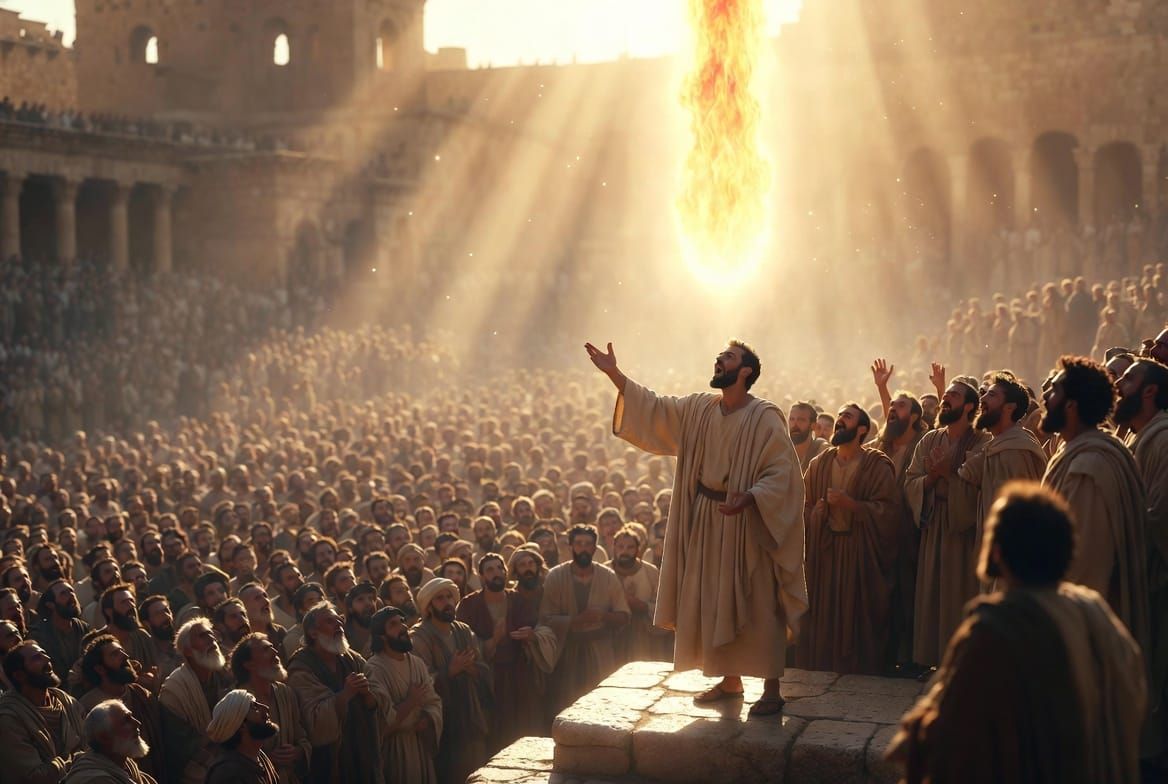
Then verse 1 says, “When the day of Pentecost arrived, they were all together in one place.” (Acts 2:1, ESV) Many interpreters have suggested that by this point they may have been somewhere near the Temple courts, which would help explain how such a large crowd gathered so quickly. Luke does not tell us the exact location. What he does tell us is unmistakable. Verse 2 says, “suddenly there came from heaven a sound like a mighty rushing wind, and it filled the entire house where they were sitting.” (Acts 2:2, ESV) Divided tongues as of fire appear. They are filled with the Holy Spirit. The empowering Jesus promised has arrived.
The sign of it is the languages. Devout Jews from every nation under heaven are there. Parthians, Medes, Elamites, visitors from Rome, Cretans, Arabians. Each hears the disciples speaking in the language of home: “we hear them telling in our own tongues the mighty works of God.” (Acts 2:11, ESV)
To understand what this means, we need to go back to Genesis. At the plain of Shinar, humanity built a tower to make a name for itself, and God scattered them and confused their language. The fracture of Babel, nation divided from nation and tongue from tongue, runs through the history of fallen humanity.
Pentecost does not reverse Babel by erasing the languages. It does something better. The languages remain, but now each one becomes a vessel for the mighty works of God. The Gospel does not demand that every nation first become one earthly culture. The Spirit carries the one Gospel into the languages of the peoples.
This is new creation. The Spirit hovered over the waters in Genesis 1:2. God breathed the breath of life into Adam. The Spirit brought life to the valley of dry bones in Ezekiel 37. Jesus breathed new-creation breath upon his disciples on Easter evening. Now that same Spirit is poured out upon the gathered people of God and sends the Gospel outward to the nations.
Psalm 104, appointed for this morning, ties the creation theme together: “When you send forth your Spirit, they are created, and you renew the face of the ground.” (Psalm 104:30, ESV) The Spirit is the giver of life. And now the Creator Spirit is at work in the firstfruits of the new creation, beginning in Jerusalem and moving toward the ends of the earth.
And then Peter stands up.
Sit with that for just a moment. On Maundy Thursday night, the same night Jesus spoke the Farewell Discourse, Peter stood outside a charcoal fire in the courtyard of the high priest. A servant girl asked whether he was one of Jesus’ disciples. He said no. Three times. The man who had drawn a sword in Gethsemane could not hold through one night in a courtyard. He denied the name three times before the rooster crowed, just as Jesus said he would.
Just over seven weeks later, the same man is on his feet before a crowd in Jerusalem proclaiming the very name he denied.
The Spirit does not wait for Peter to become impressive enough. The Spirit is given, and Peter stands. This is what fruit borne through abiding looks like. Through failure and grief, through restoration, prayer, and waiting, Christ has kept Peter connected to the vine. The branch does not produce fruit by trying harder. It bears fruit because the life of the vine is flowing through it.
Then Peter opens the Scriptures.
In verse 17 he reaches back to the prophet Joel: “And in the last days it shall be, God declares, that I will pour out my Spirit on all flesh, and your sons and your daughters shall prophesy, and your young men shall see visions, and your old men shall dream dreams.” (Acts 2:17, ESV; quoting Joel 2:28–29)
Peter is not saying, “Perhaps this reminds us of Joel.” He is saying that Joel’s promise is being fulfilled before their eyes. What the prophet saw from a distance has broken into history. The promised new-covenant outpouring of the Spirit has arrived.
Jeremiah had promised a covenant in which God would write his Law upon the heart. Ezekiel had promised, “I will put my Spirit within you.” Joel had promised the Spirit poured out on all flesh. Jesus had promised another Helper and power from on high. Pentecost gathers those promises together. God keeps his word.
And Peter’s quotation closes with the line toward which the whole sermon is moving: “And it shall come to pass that everyone who calls upon the name of the Lord shall be saved.” (Acts 2:21, ESV; quoting Joel 2:32)
That is where fifty days of Easter have been heading.
There is another Old Testament echo here that is worth seeing. At Sinai, after the golden calf, about three thousand fell under judgment for idolatry. (Exodus 32:28) At Pentecost, after Peter proclaims the crucified and risen Christ, about three thousand receive the word and are baptized.
The contrast is striking. At Sinai, judgment falls on sin. At Pentecost, through the Gospel of Christ and the gift of the Spirit, sinners are brought to life. The Law is holy and good, but it cannot give life to the sinful heart. God gives through the Spirit what the Law could never produce in us: new hearts, new life, and a people made alive in Christ.
Paul will later say that God “has made us sufficient to be ministers of a new covenant, not of the letter but of the Spirit. For the letter kills, but the Spirit gives life.” (2 Corinthians 3:6, ESV) Pentecost is not God abandoning the Old Testament. It is God fulfilling what the Law and the Prophets were pointing toward.
And then there is the name. On the Sunday after Ascension Day, Jesus prayed, “I have manifested your name to the people whom you gave me out of the world.” (John 17:6, ESV) He prayed that they would be kept in that name, that they would be one, and that through their witness the world would believe.
Now the man who denied the name three times is preaching in Jerusalem, and people from the nations are hearing the mighty works of God. The prayer of John 17 is being answered. The promise of John 14 is being fulfilled. Joel is being fulfilled. Ezekiel is being fulfilled. Jeremiah is being fulfilled. The story is moving forward because God is faithful.
And that fulfillment has not stopped.
The Gospel goes beyond Jerusalem to Judea and Samaria and toward the ends of the earth. People who were far off are brought near. The nations hear. Sinners repent. Men and women are baptized into Christ. The Church is gathered from every tribe and tongue. The prayer continues to be answered, the promise continues to bear fruit, and one day, when Christ returns, what Pentecost began to reveal will be seen in fullness.
Which brings us to where we actually live. We believe Christ has won. We believe the Spirit has been poured out. And then we look around at our families, at our own hearts, at the world outside these walls, and sometimes wonder what to make of all the wreckage.
We named this tension last week on the Sunday after Ascension Day: the already and the not yet. The victory is real, and the rubble is real at the same time. We are like people in war-torn Europe on VE Day. The war had been won, but ruined cities still had to be rebuilt and enemy forces had not vanished everywhere at once. The victory was real, and the rubble was real.
We see the wreckage of broken families. We grieve people we love. We live with the consequences of our own sin and the sins of others. We fear. We doubt. The enemy has not stopped his propaganda.
But Pentecost declares that we have not been left to rebuild alone.
The same Spirit who gave Peter his voice, who gathered thousands through the preaching of Christ, who has sustained the Church through centuries of persecution, failure, repentance, mission, and renewal, has been given to Christ’s people. Not as a memory of something that happened long ago in Jerusalem, but as the living presence of God with his Church.
So what does that mean for us?
First, the Spirit has been poured out upon the people of God. Joel speaks of sons and daughters, young and old, servants and free. The gift is not confined to a spiritual elite. The Spirit is not rationed according to age, energy, usefulness, social standing, or how impressive we think our Christian life has been. If you belong to Christ, you are not outside the Spirit’s work. God is not finished with his people.
Second, the Spirit of truth continually brings us back to God’s Word and applies its promises and commands to our lives. When fear speaks, Scripture speaks a truer word. When guilt accuses, the Gospel directs us again to Christ. When the world demands our allegiance, the Spirit brings us under the apostolic Word and reminds us whose name we bear.
He brings us back to our Baptism, where we were joined to Christ and incorporated into his Church. He brings us to this Table, where Christ feeds his people. He forms us not as isolated spiritual individuals but as the Body of Christ, gathered around Word and Sacrament and sent into the world.
Third, we are not waiting for the new creation to begin. In Christ it has already begun, and by the Spirit we are living in its firstfruits while we wait for its fullness when Jesus returns.
That changes Monday morning.
When we go to work, care for a neighbor, sit with someone who is suffering, speak a word of truth, forgive, repent, pray, serve, and bear witness to Jesus, we are not killing time until the Kingdom comes in its fullness. We are living under the reign of the risen Christ in the power of the Spirit he has given.
The new-creation breath that filled the locked room on Easter evening has been moving outward through this entire season: onto the Emmaus road, through the gate, along the way, into the vine, through the prayer of John 17, and now here, wind and fire, Gospel and mission, flowing outward toward the nations.
Keep doing the next right thing.
Easter began for us this year with Mary Magdalene, grieving in the garden, hearing the risen Jesus call her by name and being sent to tell the others, “I have seen the Lord.” Pentecost brings that Easter witness into the languages of the nations. What began with one woman announcing the risen Christ now becomes the worldwide witness of Christ’s Church.
The arc of Easter does not end with a private encounter. It opens outward into a people sent.
The Collect for the Day of Pentecost prays it as well as it can be prayed:
“Almighty God, on this day, through the outpouring of the Holy Spirit, you revealed the way of eternal life to every race and nation: Pour out this gift anew, that by the preaching of the Gospel your salvation may reach to the ends of the earth; through Jesus Christ our Lord, who lives and reigns with you, in the unity of the Holy Spirit, one God, for ever and ever. Amen.”
That is our prayer, offered not in uncertainty but in confidence. The Spirit has been poured out. The Gospel has gone forth. The King who ascended is at the right hand of the Father. And the promises God made through the prophets are being fulfilled before our eyes as Christ gathers his Church.
The Lord who called one grieving woman by name in the garden is now proclaimed by name to the nations. The man who denied that name now stands and preaches it. The Spirit whom Joel promised has been poured out. The new covenant Jeremiah and Ezekiel foresaw is being fulfilled. The prayer of John 17 is being answered. The Gospel is going to the ends of the earth.
And the work is not finished yet.
It will continue until the last sinner who will call upon the Lord has been gathered in, until the Gospel has accomplished everything God intends, until the risen and ascended Christ returns and the firstfruits give way to the harvest.
So come, Holy Spirit. Renew your Church. Keep us in the name of Jesus. Send us with the Gospel.
“And it shall come to pass that everyone who calls upon the name of the Lord shall be saved.” (Acts 2:21, ESV)
In the Name of the Father, and of the Son, and of the Holy Spirit. Amen.