The Day of Pentecost: An Anglican Perspective
Pentecost is not a spiritual experience that can be kept private. The Spirit comes with wind and fire and immediately produces proclamation. To receive the Spirit is to be sent. Every generation of the Church stands in the same need: pour out this gift anew.
Principal Feast: The fiftieth day of Easter , Whitsunday
The Anglican calendar is ordered by a hierarchy of holy days, each carrying a different weight of observance. At the very top stand the seven Principal Feasts, the highest-ranking days of the liturgical year: Easter Day, Christmas Day, Ascension Day, the Day of Pentecost, Trinity Sunday, the Epiphany, and All Saints’ Day. The BCP 2019 directs that the Principal Feasts take precedence over every other day or observance. The Day of Pentecost therefore belongs to the highest rank of the Anglican calendar.
Pentecost is the fiftieth and final day of Easter. The BCP says explicitly that “The Easter Season includes and ends with the Day of Pentecost.” (BCP 2019, p. 614) The feast celebrates the promised outpouring of the Holy Spirit upon the disciples in Jerusalem, the empowering of the apostolic Church for her mission, and the beginning of the great outward movement by which the Gospel of the crucified, risen, and ascended Christ is proclaimed to the nations.
Pentecost is therefore not an appendix added after Easter and Ascension. It is the culmination of the Paschal season. The Son who died and rose has ascended to the Father’s right hand, and from that place of exaltation he pours out the Spirit he promised. Peter interprets the event precisely this way when he declares that Jesus, “being therefore exalted at the right hand of God, and having received from the Father the promise of the Holy Spirit,” has poured out what the crowd now sees and hears. (Acts 2:33, ESV) Pentecost is one of the great fruits of Christ’s enthronement.
The Fiftieth Day
The name Pentecost comes from the Greek pentēkostē (pen-tay-kos-TAY), meaning “fiftieth.” The Christian feast has its biblical setting in the Jewish Feast of Weeks, Shavuot, one of Israel’s pilgrimage festivals. Leviticus commands Israel to count fifty days from the offering of the firstfruits and then present a new grain offering to the LORD. (Leviticus 23:15–21) In later Jewish tradition, the Feast of Weeks also became associated with the giving of the Law at Sinai.
Luke’s setting is therefore richly biblical without requiring us to assume that every later Jewish interpretation of the feast was already fixed in precisely the same form in the first century. Jerusalem is filled with worshipers for one of Israel’s great festivals, and on that day God fulfills the prophetic promise of a greater outpouring. The Spirit comes not only upon particular individuals for particular callings but is poured out upon the gathered disciples as the promised gift of the new covenant.
There is also a fitting firstfruits pattern. Israel brought the firstfruits of harvest before God, and Acts 2 ends with the first great harvest of the apostolic mission as about three thousand people receive Peter’s word and are baptized. (Acts 2:41)They are not the whole harvest but the beginning of a mission Jesus has already said will extend “to the end of the earth.”(Acts 1:8, ESV)
The Biblical Event
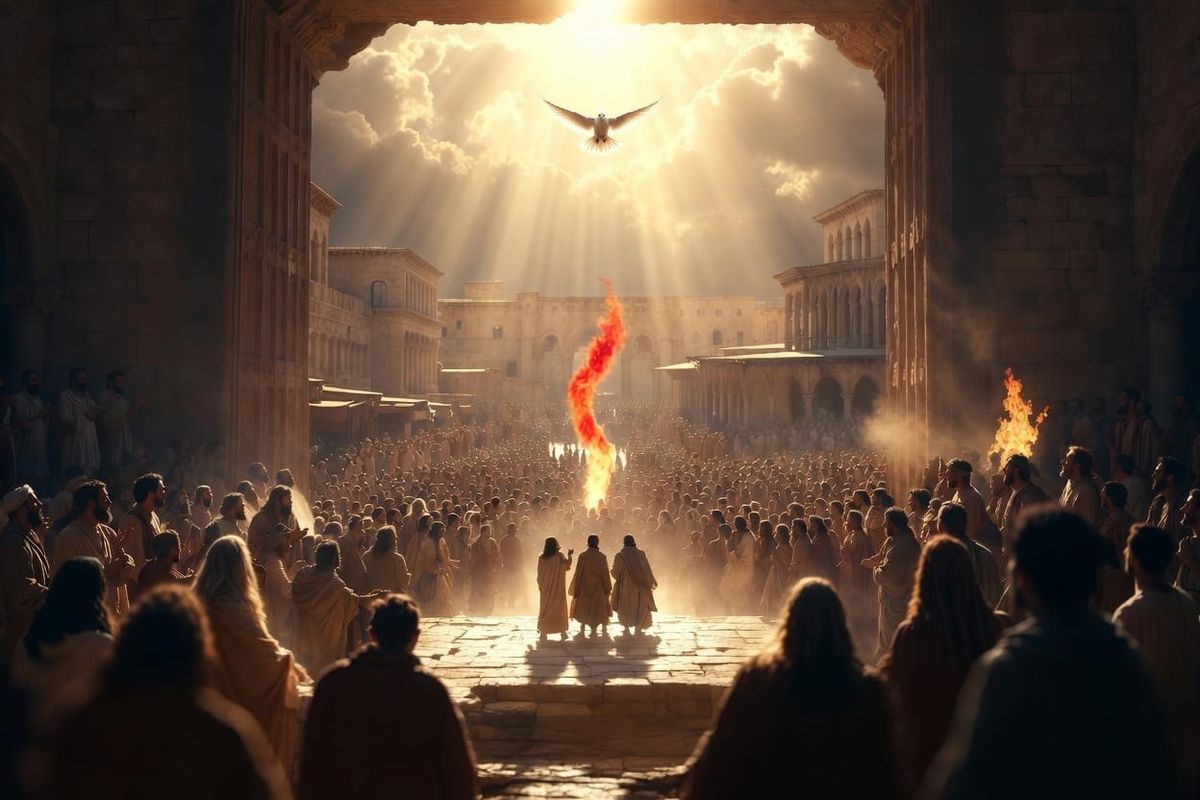
Acts records that “when the day of Pentecost arrived, they were all together in one place.” Suddenly there comes from heaven “a sound like a mighty rushing wind,” filling the house. Divided tongues “as of fire” appear and rest upon them, and “they were all filled with the Holy Spirit and began to speak in other tongues as the Spirit gave them utterance.”(Acts 2:1–4, ESV)
Luke is careful with his language. The sound is like a mighty rushing wind, and the tongues are as of fire. He describes visible and audible signs of a divine action that exceeds ordinary description. Yet both images carry deep biblical resonance.
The Hebrew ruach and the Greek pneuma can each mean spirit, wind, or breath according to context. Scripture already associates God’s Spirit with creation, life, prophecy, and renewal. The Spirit of God hovers over the waters at creation, while Ezekiel’s vision of the dry bones brings breath, life, and Spirit together as God promises to put his Spirit within his people. (Genesis 1:2; Ezekiel 37:1–14) Pentecost announces that the divine Spirit promised by the prophets is now poured out upon the new-covenant people of God.
Fire likewise belongs repeatedly to biblical manifestations of God’s presence. God appears to Moses in the burning bush. Sinai burns when the LORD descends upon it. Fire accompanies God’s presence in the wilderness. The tongues as of fire at Pentecost therefore belong within an established scriptural world of divine holiness and glory, while something remarkable is happening: the fiery sign rests upon the gathered people themselves.
The Promise of the New Covenant
Pentecost belongs within the prophetic promises of the new covenant. Jeremiah foretells a covenant in which God will put his law within his people and write it upon their hearts. Ezekiel promises that God will give his people a new heart and a new spirit and declares, “I will put my Spirit within you.” (Jeremiah 31:31–34; Ezekiel 36:26–27, ESV)
Pentecost should not be reduced to a simplistic contrast between a supposedly bad Old Testament Law and a good New Testament Spirit. The Law itself was God’s gift to Israel. The problem was not God’s Word but the sinful human heart. The new-covenant promise is that God himself will forgive sin, act upon the heart, give his Spirit, and produce in his people the obedience they could never generate from themselves.
God is again the first mover. The disciples do not climb toward heaven until they achieve a spiritual condition capable of attracting the Spirit. They wait because Christ has told them to wait. The Father gives what he promised. The exalted Son pours out the Spirit. Only then do the apostles speak with the boldness and power that characterize the mission of Acts.
Pentecost is therefore grace before response. God gives; the Church receives. God fills; the Church speaks. God acts first, and the people he empowers become witnesses.
The Languages of the Nations
The sound draws a crowd of Jews and proselytes from across the Mediterranean world and beyond. Luke names Parthians, Medes, Elamites, residents of Mesopotamia, Judea, Cappadocia, Pontus, Asia, Phrygia, Pamphylia, Egypt, Libya, Rome, Crete, and Arabia. They are astonished because each hears the disciples speaking in his own language, and they say, “We hear them telling in our own tongues the mighty works of God.” (Acts 2:11, ESV)
Christian tradition has long heard here a healing or reversal of Babel. Genesis 11 depicts humanity’s proud attempt to make a name for itself, followed by the confusion of language and scattering of peoples. Pentecost does not undo Babel by abolishing linguistic diversity and returning humanity to one earthly language. It does something better. The languages remain, but the one Gospel is proclaimed intelligibly through them.
The unity given by the Holy Spirit is therefore not cultural sameness. Pentecost does not require every nation to become one ethnicity or culture before entering the Church. The Gospel goes outward into the languages of the peoples. Human distinctions are not erased, but they are gathered under the one saving proclamation of Jesus Christ.
Revelation shows the destination of that mission when it pictures an innumerable multitude “from every nation, from all tribes and peoples and languages” standing before the throne and before the Lamb. (Revelation 7:9, ESV) Pentecost begins to display in history the gathering that will finally be revealed in glory.
Peter Interprets Pentecost
The signs themselves do not explain Pentecost. Peter stands and interprets what has happened through Holy Scripture. He begins with the prophet Joel: “And in the last days it shall be, God declares, that I will pour out my Spirit on all flesh.”Sons and daughters will prophesy, young and old will receive the promised gift, and “everyone who calls upon the name of the Lord shall be saved.” (Acts 2:17, 21, ESV)
The phrase all flesh does not mean that every person automatically receives the Holy Spirit irrespective of repentance and faith. Peter’s own sermon calls his hearers to repent and be baptized. The emphasis is upon the breadth of God’s promise. The Spirit is not the possession of only a small class of prophets, priests, kings, or specially appointed leaders. The new-covenant people, male and female, old and young, receive the promised Spirit.
Peter then moves directly to Jesus. Pentecost is not a feast in which the Holy Spirit draws attention away from Christ. Peter proclaims Jesus of Nazareth, his death according to God’s definite plan and foreknowledge, his Resurrection, his exaltation, and his lordship. The Spirit makes Christ known.
The climax is Peter’s declaration, “Let all the house of Israel therefore know for certain that God has made him both Lord and Christ, this Jesus whom you crucified.” (Acts 2:36, ESV) The first great Spirit-empowered sermon of the apostolic Church is unmistakably Christ-centered.
Pentecost and the Church
Pentecost is often called the birthday of the Church. The expression can be useful if we understand what it means, but it can also mislead if it suggests that the people of God or the community gathered by Jesus did not exist before Acts 2. Christ had already called disciples, appointed the Twelve, gathered a covenant community, instituted the Eucharist, commanded Baptism, commissioned the apostles, and spoken explicitly of his Church.
It is therefore more precise to describe Pentecost as the great public manifestation and Spirit-empowerment of the apostolic Church for her mission to the nations. The Church does not spring into existence from nothing on this day. The community Christ has gathered receives the promised Spirit and begins its public, worldwide witness with extraordinary force.
The result is immediately visible. Peter preaches, the hearers are cut to the heart, and about three thousand are baptized. They then devote themselves “to the apostles’ teaching and the fellowship, to the breaking of bread and the prayers.”(Acts 2:42, ESV) Pentecost produces not merely an ecstatic experience but a worshiping, sacramental, apostolic community.
The signs are dramatic, but Luke’s description of what follows is strikingly ordinary: teaching, fellowship, breaking of bread, prayer, generosity, and common life. The Spirit who comes with wind and fire forms a Church that perseveres in the means Christ has given.
The Gifts of the Spirit
The Pentecost lectionary gives the Church 1 Corinthians 12:4–13 as an alternative reading alongside Acts 2. Paul’s teaching provides an essential theology of spiritual gifts: “There are varieties of gifts, but the same Spirit; and there are varieties of service, but the same Lord.” (1 Corinthians 12:4–5, ESV)
The diversity of gifts serves unity rather than competition. Paul insists that “to each is given the manifestation of the Spirit for the common good.” (1 Corinthians 12:7, ESV) Gifts are not badges of superior spirituality and do not exist primarily to provide private religious experiences. They are gifts of grace entrusted for the building up of Christ’s Body.
Paul then grounds the Church’s unity in the one Spirit: “For in one Spirit we were all baptized into one body, Jews or Greeks, slaves or free, and all were made to drink of one Spirit.” (1 Corinthians 12:13, ESV) The same Spirit distributes different gifts while uniting believers in one Body.
Pentecost therefore celebrates neither uniformity nor spiritual individualism. The Holy Spirit creates a people whose members differ in gifts and callings but belong to one Lord and serve one common good.
The Spirit of Truth
The appointed Gospel is John 14:8–17. Philip asks Jesus, “Lord, show us the Father, and it is enough for us.” Jesus answers, “Whoever has seen me has seen the Father,” and then promises, “I will ask the Father, and he will give you another Helper, to be with you forever, even the Spirit of truth.” (John 14:8–9, 16–17, ESV)
The Greek word translated Helper is Paraklētos (par-AK-lay-toss), a term that can carry the sense of helper, advocate, counselor, or one called alongside. No single English word captures every shade of meaning. What matters especially in John 14 is who gives him, how long he remains, and what he does. The Father gives him at the Son’s request, and he abides with Christ’s people forever.
The passage is profoundly Trinitarian. The Son speaks of the Father and promises another Helper, the Holy Spirit. Father, Son, and Spirit are distinguished without being separated. Pentecost is therefore not merely “the feast of the Spirit” in isolation from the Father and the Son. The Father gives the Spirit through the exalted Son, and the Spirit glorifies Christ and brings his people into the truth.
This guards Christian teaching about the Spirit from dissolving into vague spirituality. The Holy Spirit is not an impersonal energy, religious excitement, or divine force available for human manipulation. He is the Lord and giver of life, the third Person of the Holy Trinity, eternally one God with the Father and the Son.
The Spirit and Holy Scripture
Jesus calls him “the Spirit of truth.” Elsewhere in the Upper Room Discourse, Jesus promises that the Spirit will teach the apostles, bring to remembrance what he has said, guide them into all truth, and glorify Christ. (John 14:26; 16:13–14)
That has profound importance for the Church’s reception of apostolic Scripture. The New Testament is not merely the surviving religious literature of gifted first-century Christians. The apostolic witnesses speak and write within the promised ministry of the Holy Spirit, who leads them into the truth concerning Christ.
At the same time, appeals to the Holy Spirit can never rightly be used to overthrow what the Spirit has given through Holy Scripture. The Spirit of truth does not contradict himself. Claims of new spiritual insight must be tested by the apostolic Word rather than used as a means of escaping it.
Pentecost therefore gives the Church neither a dead letter nor permission for endless doctrinal novelty. The living Spirit who inspired the Scriptures continues to bring Christ’s people under their truth and to glorify the Christ to whom they bear witness.
The Spirit and Creation
Psalm 104:24–35 gives Pentecost a cosmic horizon. The Psalm praises God for the creatures of earth and sea and declares, “When you send forth your Spirit, they are created, and you renew the face of the ground.” (Psalm 104:30, ESV)The Psalm is appointed in all three years of the Pentecost lectionary.
The Spirit poured out upon the Church is the Spirit of the Creator. His work cannot be reduced to the inward religious experience of individuals. The same divine Spirit who gives life to creation is at work in the new creation begun through Jesus Christ.
Yet creation and redemption should not be collapsed into the same act. Psalm 104 praises God’s continuing providential giving of life; Acts 2 announces the particular new-covenant outpouring promised by the prophets and accomplished through the exalted Christ. The same Spirit acts in both, but Pentecost is a distinct saving-historical event.
This gives Pentecost an eschatological horizon as well. Paul calls the Holy Spirit the “guarantee” of our inheritance. (Ephesians 1:13–14) His presence is the pledge that the God who began the new creation in Christ will bring his saving work to completion.
The BCP 2019 Collects
The BCP provides two Collects for the Day of Pentecost on page 614. The first begins:
“Almighty God, on this day, through the outpouring of the Holy Spirit, you revealed the way of eternal life to every race and nation.”
It then asks:
“Pour out this gift anew, that by the preaching of the Gospel your salvation may reach to the ends of the earth.” (BCP 2019, p. 614)
The order is significant. God has already acted. The Spirit was poured out, the Gospel was proclaimed among the nations, and the apostolic mission began. The Church now asks God to “Pour out this gift anew,” not because the historical Pentecost must be repeated as though the first outpouring had expired, but because every generation of the Church remains wholly dependent upon the Spirit for renewal, faithfulness, holiness, and mission.
The prayer also keeps spiritual renewal tied to the preaching of the Gospel. The Church does not ask for an outpouring merely so that Christians may feel more spiritually alive. She asks so that God’s salvation may reach to the ends of the earth.
The alternative Collect begins, “O God, who on this day taught the hearts of your faithful people by sending to them the light of your Holy Spirit.” It asks for the same Spirit to give “a right judgment in all things” and continual joy in his holy comfort. (BCP 2019, p. 614) Together the two prayers hold mission, truth, discernment, illumination, and comfort within the one work of the Spirit.
The Proper Preface of Pentecost
The Proper Preface of Pentecost gives thanks through Jesus Christ, according to whose promise the Holy Spirit came down from heaven upon the disciples to teach them, lead them into truth, and give them boldness and zeal to preach the Gospel to all nations. The Preface then describes the result as deliverance from darkness and error into the true knowledge of God and his Son. (BCP 2019, p. 154)
The Spirit teaches, leads into truth, gives boldness, and drives Gospel proclamation. Pentecost is therefore neither anti-intellectual enthusiasm nor mere intellectual enlightenment. Truth becomes proclamation. Knowledge of God becomes mission.
The BCP expressly says that the Collects, lessons, and prefaces for the Day of Pentecost and Trinity Sunday are not used on the following weekdays. The dated propers are used instead. (BCP 2019, p. 614) Pentecost concludes the Easter season on the feast itself rather than creating a Pentecost octave in the Prayer Book.
The Appointed Readings
The appointed readings for the Day of Pentecost are found on page 725 of the BCP 2019 and are the same in all three years: Genesis 11:1–9 or Acts 2:1–11; Psalm 104:24–35; Acts 2:1–11 or 1 Corinthians 12:4–13; and John 14:8–17.
The arrangement allows the Church to hear Acts 2 as the central historical account while also providing complementary readings. When Genesis 11 is used in the first position, the relationship between Babel and Pentecost becomes especially visible. First Corinthians 12 can then move the congregation from the historical outpouring to the continuing Spirit-gifted life of Christ’s Body.
Psalm 104 places the Spirit’s work within the wider work of the Creator, while John 14 returns the congregation to the Upper Room so that Christ’s promise of the Spirit can be heard in light of its fulfillment. The lectionary therefore holds together promise, event, creation, Church, mission, spiritual gifts, and Trinitarian revelation.
Pentecost and Holy Baptism
Pentecost is one of the days the BCP identifies as especially appropriate for Holy Baptism, together with the Easter Vigil, the Baptism of Our Lord, and All Saints’ Day or the Sunday following All Saints’. The Prayer Book actually calls these the most appropriate days for Baptism. (BCP 2019, p. 161)
The connection is evident in Acts 2. Peter’s hearers ask what they should do, and he answers, “Repent and be baptized every one of you in the name of Jesus Christ for the forgiveness of your sins.” He then promises, “you will receive the gift of the Holy Spirit.” (Acts 2:38, ESV) About three thousand receive his word and are baptized.
The BCP’s baptismal theology is explicitly shaped by the work of the Holy Spirit. Baptism joins the baptized to Christ in his death and Resurrection, brings new birth to righteousness, and incorporates them into Christ’s Church. Pentecost is therefore a particularly fitting day for Baptism because the feast holds together Gospel proclamation, repentance, Baptism, the gift of the Spirit, and incorporation into the apostolic community.
Again, grace precedes response. Baptism is not a candidate’s public performance of spiritual achievement. God gives what sinners cannot generate from themselves. The Church baptizes because salvation begins with divine mercy and gift.
Whitsunday
The BCP retains the traditional English name Whitsunday alongside Day of Pentecost. The word has long been associated in English Christian tradition with the Pentecost feast, and explanations of its precise linguistic origin have varied. It is therefore better not to rest the theology of the feast upon a single confident etymology.
The traditional name nevertheless belongs deeply to English and Anglican usage. It recalls generations of Christians who knew Pentecost not as a marginal observance but as one of the great annual festivals of the Church.
Its older English title can therefore be retained without romanticizing the past. Whitsunday is simply another inherited Anglican name for the feast on which the Church celebrates the promised Holy Spirit poured out through the exalted Christ.
The Ancient Feast
Pentecost belongs to the most ancient strata of Christian Paschal observance. By around AD 200, Christians clearly knew the fifty days after Easter as a sustained season of Paschal joy. Over time, the fiftieth day emerged more distinctly as the celebration of the Holy Spirit’s outpouring, while remaining the culmination of the Paschal fifty days.
The exact historical development should not be made tidier than the evidence allows. We need not claim that a fully developed independent Pentecost feast existed in precisely its later form in every Christian community from the earliest apostolic generation. What is ancient beyond dispute is the biblical event itself and the Christian observance of the Paschal fifty days whose culmination became Pentecost.
The BCP 2019 stands firmly within that inheritance. It names Pentecost a Principal Feast, provides two Collects, appoints a Proper Preface and fixed readings, identifies it as one of the most appropriate days for Baptism, and explicitly marks it as the conclusion of the Easter season.
Pentecost in Anglican Worship
The liturgical color is red, fittingly recalling the tongues “as of fire” resting upon the disciples and the Spirit’s empowering of the Church for bold witness to Christ.
The visual change can be dramatic because Pentecost concludes the white festal season of Easter. Yet the change to red does not mean the Church has already left Easter behind. The BCP says expressly that the Easter season includes and ends with Pentecost. The Season after Pentecost begins after the feast.
Because Pentecost is the final day of Easter, the Paschal Candle appropriately remains part of the Church’s principal worship on this day. The BCP directs that it should be lit at all principal services throughout the Season of Easter. Pentecost is still Easter’s fiftieth day.
That visual continuity makes an important theological point. The Holy Spirit does not replace Christ. The Spirit glorifies Christ, bears witness to Christ, and empowers the Church to proclaim Christ. Pentecost is not the moment when Easter recedes into the background. It is the moment when the risen and ascended Christ pours out his Spirit so that the Easter Gospel may go to the nations.
Pentecost and the Season After Pentecost
Pentecost ends the Easter season, but the long season that follows takes its name from the feast. The BCP explains that the First Sunday after Pentecost is Trinity Sunday and that subsequent Sundays may be designated either after Pentecost or after Trinity.
The relationship matters. The Season after Pentecost is not a period in which the Church has moved beyond the Holy Spirit. It is the long season in which Spirit-empowered Christian life takes the form of sustained discipleship through Word, Sacrament, prayer, obedience, mission, holiness, and ordinary faithfulness.
The wind and fire of Acts 2 therefore lead into a life that is often much less spectacular. The same Spirit who gives apostolic boldness also produces holiness, love, patience, unity, discernment, service, endurance, and perseverance. Pentecost cannot be confined to extraordinary gifts any more than Easter can be confined to a single Sunday morning.
Christian growth is not self-improvement undertaken after the saving events are over. It is life in the Spirit given by the risen and ascended Christ.
The Summer Ember Days
The BCP notes immediately after the Pentecost Collects that the Wednesday, Friday, and Saturday of that week are the traditional summer Ember Days. (BCP 2019, p. 614)
The Calendar identifies their particular purpose as prayer for those called to Holy Orders. They occur four times each year, including the Wednesday, Friday, and Saturday after the Day of Pentecost, and the BCP says that Ember Days may be kept with fasting. Such fasting normally includes prayer, self-examination, and acts of mercy.
Their placement immediately after Pentecost is fitting. The Spirit gives gifts to the Church, and the Church then prays especially for those whom God may be calling to the ordained ministries of Deacon, Priest, and Bishop. The connection should not be overstated as though Pentecost were only about ordained ministry, but the liturgical sequence is pastorally rich. Vocation begins in God’s call, and the Church discerns, forms, ordains, and receives those whom he gives for the building up of Christ’s Body.
Observing This Feast
The Day of Pentecost is a Principal Feast and always falls on Sunday as the fiftieth day of Easter. The two Collects are found on page 614, the Proper Preface of Pentecost on page 154, and the appointed readings on page 725 of the BCP 2019. Pentecost concludes the Great Fifty Days.
Read Acts 2 beyond verse 11 if possible. The wind, fire, and languages are extraordinary, but Peter’s sermon explains what they mean. Follow the movement from Joel’s promise to Christ’s death and Resurrection, from Christ’s exaltation to the outpouring of the Spirit, and from Peter’s preaching to repentance, Baptism, and the common life of the apostolic Church.
Read John 14:8–17 and notice the Trinitarian movement of the passage. The Son reveals the Father, asks the Father, and the Father gives another Helper, the Spirit of truth. Pentecost is not a vague celebration of spirituality. It is the saving work of the Triune God.
Read 1 Corinthians 12 and ask not merely which spiritual gift you possess but how what God has given you serves the common good. Pray Psalm 104 and give thanks that the Spirit who gives life to creation is the Spirit whom the exalted Christ pours upon his Church.
Where Baptism is celebrated, receive it as the Prayer Book teaches it: as God’s gracious work by which sinners are united to Christ and received into his Church. Where there are no Baptisms, remember your own Baptism and the Body into which God has incorporated you.
Then pray the first Collect with the missionary urgency it deserves: ask God to “Pour out this gift anew, that by the preaching of the Gospel your salvation may reach to the ends of the earth.” (BCP 2019, p. 614)
Conclusion
Pentecost brings the Great Fifty Days to their appointed culmination. Jesus Christ was crucified and has risen. The risen Lord has ascended. The exalted Christ has received from the Father the promised Spirit and poured him out upon his people. The result is proclamation: the mighty works of God are announced in the languages of the nations, Peter preaches Christ, sinners repent, thousands are baptized, and the apostolic Church moves outward in mission.
Yet the deepest truth of Pentecost is not what the disciples finally managed to accomplish. They had already demonstrated how little their own courage and understanding could achieve. They waited because Christ told them to wait, and they spoke because the Spirit gave them utterance. God acted first.
That remains the Church’s posture. She cannot manufacture spiritual life, convert the nations by technique, preserve her unity by goodwill alone, or keep herself in the truth by intelligence alone. The risen and ascended Lord must give what his people cannot produce. The Holy Spirit teaches, sanctifies, unites, equips, emboldens, and bears witness to Christ.
The first Collect therefore gives Pentecost its enduring prayer. God once revealed the way of eternal life to every race and nation through the outpouring of the Holy Spirit, and the Church now asks him to “Pour out this gift anew, that by the preaching of the Gospel your salvation may reach to the ends of the earth.” (BCP 2019, p. 614) The Church’s life and mission begin where the first Pentecost began: not with human ability reaching upward, but with the gift of God coming down.