Faith Taking Visible Form: Joseph, Husband of the Virgin Mary and Guardian of Jesus (Luke 2:41-52)
Joseph never speaks in the Gospel record, yet his faith becomes visible through obedience. He receives what God entrusts, protects what God places in his care, and remains faithful even when he cannot see the whole plan.
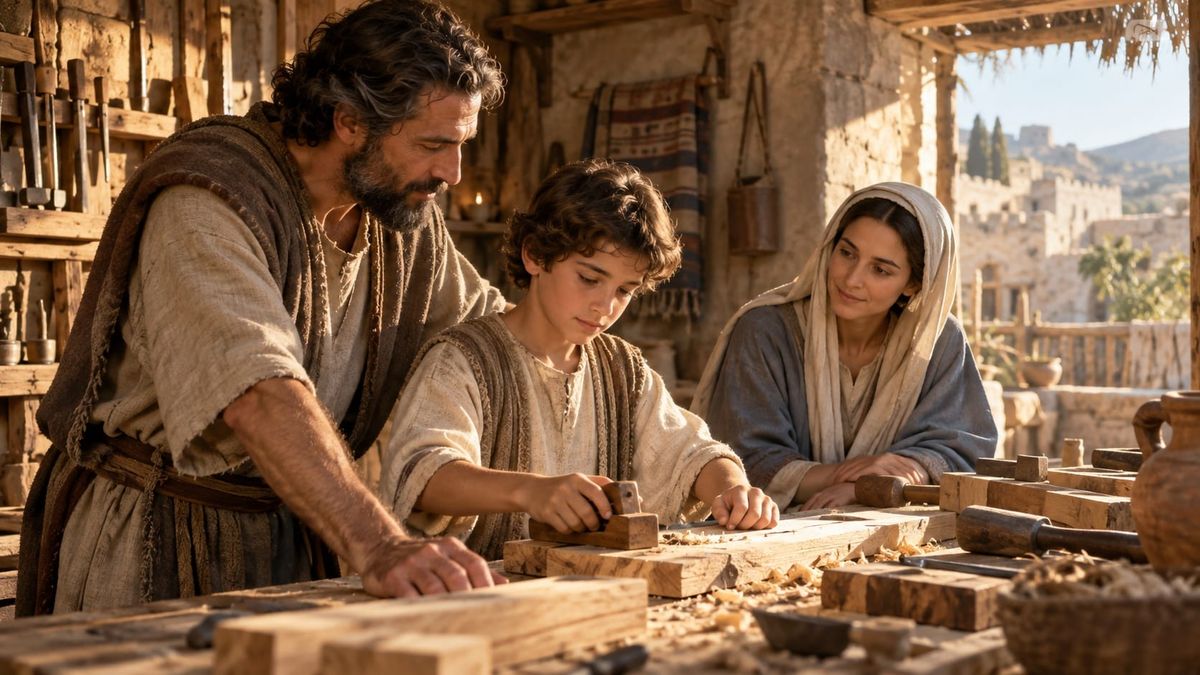
Grace, mercy, and peace from God our Father and the Lord Jesus Christ be with you on this feast of Joseph, Husband of the Virgin Mary and Guardian of Jesus.
Joseph is one of the quietest people in all of Scripture. The Gospels never record a single word that he speaks. We know him almost entirely through what he does. He receives Mary when God tells him not to fear. He names the child Jesus when the angel tells him his name. He rises in the night and takes the child and his mother to Egypt when Herod seeks his life. He returns when God tells him to return. And in our Gospel this morning, he travels with his family to Jerusalem for the Passover, searches for the missing twelve-year-old Jesus, and then returns with him to the hidden life of Nazareth.
Our Collect captures Joseph’s life in two phrases. We ask God to give us grace to imitate his “uprightness of life” and his “obedience to your commands.” Those are not dramatic qualities, at least not in the way the world usually measures greatness. Joseph does not preach before crowds, write a book of the Bible, perform a recorded miracle, or become the center of the story. He receives what God entrusts to him, obeys what God commands, and remains faithful when he cannot yet see the whole plan.
Our primary Gospel is Luke 2:41–52. Luke begins in verse 41 by telling us, “Now his parents went to Jerusalem every year at the Feast of the Passover.” (Luke 2:41, ESV) That sentence tells us something important about the household in which Jesus is being raised. Mary and Joseph are living within the covenant life of Israel. They make the journey to Jerusalem because the worship of God and the remembrance of his saving acts belong to the ordinary rhythm of their family.
Joseph’s faithfulness here is not spectacular. It is repetitive. He goes every year. That may sound like a small thing, but most faithfulness is built from precisely those kinds of repeated acts. We come to worship. We pray. We hear the Scriptures. We keep our promises. We care for the people God has entrusted to us. We do the next faithful thing and then do it again.
There is an important word for us there, especially during Lent. We often imagine spiritual growth through dramatic moments, but much of the Christian life is formed through ordinary obedience repeated over time. A life of faith is not usually built in one great act. It is built through countless acts of receiving God’s gifts, trusting his Word, repenting when we sin, and returning to the path he has given us.
Luke continues in verse 42: “And when he was twelve years old, they went up according to custom.” (Luke 2:42, ESV)Again, there is that ordinary language: according to custom. Joseph is not trying to invent a spiritual life for his family. He is faithfully inhabiting the life God has already given his people.
Then the ordinary journey becomes a crisis. Luke tells us that when the feast has ended, Jesus remains behind in Jerusalem, but his parents do not know it. They assume he is somewhere among the traveling company. After a day’s journey, they begin looking for him among relatives and acquaintances. When they cannot find him, they return to Jerusalem.
Verse 46 tells us, “After three days they found him in the temple, sitting among the teachers, listening to them and asking them questions.” (Luke 2:46, ESV) Everyone who hears him is amazed at his understanding and his answers. But Mary and Joseph are not merely amazed. Luke says they are astonished, and Mary speaks for them both: “Son, why have you treated us so? Behold, your father and I have been searching for you in great distress.” (Luke 2:48, ESV)
That sentence gives us one of the clearest biblical descriptions of Joseph’s earthly vocation. Mary says, “your father and I.” Luke is not confused about the Virgin Birth. He has already told us that Jesus was conceived by the Holy Spirit. But he can still call Joseph Jesus’ father in the ordinary human sense because Joseph truly occupies a fatherly place in the household.
Joseph is not Jesus’ biological father, but neither is he merely a bystander. God has given him a real vocation toward this child. He is husband to Mary, guardian of Jesus, provider for the household, and earthly father in the ordinary structures of family life.
That is worth noticing because Scripture gives us a much richer picture of fatherhood than biology alone. Fatherhood includes receiving responsibility, providing, protecting, teaching, guiding, and remaining faithful to those God has placed in our care. Joseph’s circumstances are unique because the child entrusted to him is the incarnate Son of God, but the shape of his vocation is recognizable.
There are fathers who receive children biologically, fathers who receive children through adoption, foster fathers, stepfathers, grandfathers who suddenly find themselves carrying parental responsibility, and other men who are called to exercise fatherly care in circumstances they did not plan. Joseph reminds us that fatherhood is not finally about possession. It is about stewardship. The child does not belong to the father as property. The father receives a life that ultimately belongs to God and is called to guard, nurture, teach, and love that life faithfully.
Then Jesus answers Mary in verse 49: “Why were you looking for me? Did you not know that I must be in my Father’s house?” (Luke 2:49, ESV)
There is the mystery at the heart of Joseph’s vocation.
Mary has just said, “your father and I.” Jesus answers by speaking of “my Father.” Joseph is truly his earthly father, yet Jesus has a Father in a unique and eternal sense that Joseph never can be. The child whom Joseph has been called to guard is the eternal Son of the Father.
Jesus is not rejecting Joseph. He is revealing the deepest truth about himself. His identity and mission come ultimately from his heavenly Father. Before Jesus belongs to the household of Nazareth, he is the eternal Son. Before Joseph receives him into a Davidic household, he is the beloved Son of the Father.
And Joseph’s greatness is seen in the fact that his own fatherly vocation exists beneath that greater Fatherhood. Joseph does not need Jesus to belong to him absolutely. He receives the child from God and serves God’s purposes for him.
That is an important truth for every Christian vocation. Nothing God entrusts to us finally belongs to us. Our children belong to God. Our marriages belong to God. Our ministries belong to God. Our money, homes, work, abilities, and even our lives belong to God. Faithfulness means receiving what he entrusts without confusing stewardship with ownership.
The appointed reading from 2 Samuel helps us understand why Joseph’s place in this household matters. God promises David, “When your days are fulfilled and you lie down with your fathers, I will raise up your offspring after you,” and then promises, “I will establish the throne of his kingdom forever.” (2 Samuel 7:12–13, ESV)
That promise begins with David’s dynasty, but it reaches toward a King whose kingdom will never end. Psalm 89 repeats the promise: “I have made a covenant with my chosen one; I have sworn to David my servant: ‘I will establish your offspring forever, and build your throne for all generations.’” (Psalm 89:3–4, ESV)
Joseph stands within that house. Matthew calls him a “son of David.” God has not forgotten the promise made centuries earlier. Kingdoms have risen and fallen. David’s throne has disappeared as an ordinary political reality. Israel has passed through exile and foreign occupation. Yet in the fullness of time, the promised Son enters a Davidic household through Joseph.
That does not mean Joseph biologically generates the Messiah. Scripture is emphatic that Jesus is conceived by the Holy Spirit and born of the Virgin Mary. But Joseph receives Jesus into his household as God commands him to do. The promise is fulfilled because God is faithful.
And that leads us to our Epistle from Romans 4. Paul is speaking about Abraham, who received a promise from God that he could not fulfill by his own power. Paul says, “In hope he believed against hope, that he should become the father of many nations.” (Romans 4:18, ESV) Abraham’s faith rests not in his ability to produce the promised future but in the faithfulness of the God who has spoken.
Joseph’s circumstances are different, but the shape of faith is remarkably similar. Joseph receives a word from God that overturns the future he had expected. Mary is pregnant, and he knows the child is not his. Before the angel speaks, Matthew tells us that Joseph, being a just man and unwilling to put her to shame, resolves to divorce her quietly.
Then God speaks.
The angel tells him, “Do not fear to take Mary as your wife.” (Matthew 1:20, ESV) Joseph takes her. The angel tells him, “You shall call his name Jesus.” (Matthew 1:21, ESV) Joseph names him. God warns him to flee into Egypt. Joseph rises in the night and flees. God tells him to return. Joseph rises and returns.
Joseph does not merely admire the Word of God. He orders his life around it.
That is what faith does. Faith is not merely agreeing that God exists or admitting that his commands are wise. Faith receives what God gives and entrusts itself to what God has said. The Collect calls Joseph’s life “obedience to your commands,” but that obedience is not a way of earning God’s favor. It is faith taking visible form.
The Collect itself keeps the order right. We do not pray, “O God, we will imitate Joseph if we try hard enough.” We pray, “Give us grace to imitate.” Grace comes first. God speaks, God gives, God calls, and God supplies what we need. Then faith responds.
That is especially important during Lent. Lent can easily be distorted into a season in which we measure our Christianity by how disciplined we have managed to become. We count the prayers, the fasts, the things we have given up, the days we have succeeded, and the days we have failed. But Christian obedience does not begin with our determination. It begins with grace.
Joseph obeys because God has spoken to him and entrusted something to him. We obey because God has first acted for us in Christ. We do not become children of God by imitating Joseph well enough. We are received by grace through faith because of Jesus Christ, and then grace begins to form in us the kind of faithfulness we see in Joseph.
Now notice what happens next in Luke’s Gospel. After Jesus speaks of his Father’s house, Luke tells us in verse 50, “And they did not understand the saying that he spoke to them.” (Luke 2:50, ESV)
That sentence may be one of the most comforting things in the entire passage.
Joseph is faithful, and he does not understand everything.
He has received dreams and angelic commands. He knows that this child was conceived by the Holy Spirit. He knows what the angel said about Jesus saving his people from their sins. He has fled Herod and returned from Egypt. Yet he still does not understand everything God is doing.
Faithfulness and complete understanding are not the same thing.
We often think we could obey more easily if God would simply explain the whole plan. If we knew why this suffering had come, how this difficulty would end, what God intended to accomplish, or where the next five years would lead, then perhaps we could trust him.
Joseph is not given that luxury.
He receives enough light for the next act of obedience.
That may be the pattern many of us need to recover. God seldom gives us the entire map. He gives us his Word. He gives us his promises. He gives us today’s responsibilities. He gives us the people immediately in front of us. And then he calls us to faithfulness.
You may not understand why a particular burden has been given to you. You may not understand why a door closed, why a relationship became difficult, why a responsibility now rests on your shoulders, or how some long season of uncertainty will end. Joseph reminds us that understanding the whole plan is not a prerequisite for obedience.
Then Luke says in verse 51, “And he went down with them and came to Nazareth and was submissive to them.” (Luke 2:51, ESV)
This is astonishing.
The eternal Son, who has just spoken of his heavenly Father, goes home with Mary and Joseph and is submissive to them.
Jesus’ divine Sonship does not abolish the ordinary structures of human family life. The one through whom all things were made goes back to Nazareth and lives beneath the authority of his earthly parents. The one who commands the angels receives the ordinary care, instruction, and discipline of a household.
This is part of the humility of the Incarnation. The Son of God did not merely appear to be human. He entered human life fully. He was carried as a child, protected from danger, taught within a household, taken to worship, and raised under the care of Mary and Joseph.
Joseph’s guardianship therefore tells us something about Christ. The God who could have protected the child without any human instrument chooses to use the ordinary obedience of Joseph. The one who governs nations appoints an ordinary man to guard the human life of his incarnate Son.
And much of that guardianship is hidden from us.
After this passage, Joseph disappears from the Gospel narrative. Scripture does not tell us when he dies or how long he lives. We are not given a record of the ordinary years in Nazareth. Yet those years must have contained work, meals, Sabbath worship, pilgrimages, family responsibilities, ordinary instruction, provision, repair, patience, correction, laughter, worry, and all the countless things that make up household life.
None of it is recorded.
And none of it was wasted.
That may be the most direct application of Joseph’s feast for many of us. Much of what God calls us to do will never be remembered by history. Most prayers are not recorded. Most acts of patience are witnessed by very few people. Most meals prepared, bills paid, rides given, beds made, children taught, sick relatives cared for, repairs completed, promises kept, and quiet acts of generosity will disappear from human memory.
The world trains us to measure importance by visibility. Scripture does not.
Joseph’s most important work was largely hidden, but hidden is not the same as insignificant.
He guarded what God entrusted to him. He obeyed what God commanded. He remained within the vocation God gave him without needing to become the center of the story.
There is a particular lesson here for fathers and husbands, although it is not limited to them. Authority in Joseph’s life takes the form of protection and service. God gives him responsibility, and Joseph does not use that responsibility to make himself important. He uses it to guard Mary and Jesus.
Christian authority always takes its deepest shape from Christ himself, who came not to be served but to serve and to give his life as a ransom for many. Whether authority is exercised in a household, a church, a workplace, or any other sphere of responsibility, it is never given merely for the benefit of the person who holds it. It is given for the good of those entrusted to our care.
And that returns us to the final verse of our Gospel. Luke says in verse 52, “And Jesus increased in wisdom and in stature and in favor with God and man.” (Luke 2:52, ESV)
Luke lets us see the hidden years only through that one sentence. Jesus grows. The incarnate Son truly lives a human life. He matures within an ordinary household under the care of Mary and Joseph.
Joseph cannot make Jesus the Son of God. He cannot give him his divine identity or mission. He cannot produce the salvation Jesus has come to accomplish. But he can faithfully do what God has assigned to him.
That is the shape of Christian vocation.
We cannot accomplish the work of God by our own power. We cannot control the future. We cannot guarantee the spiritual life of our children, force another person to believe, make a ministry fruitful, or secure every person we love against suffering. We are not the Savior.
Joseph was not the Savior either.
He was the man God called to guard the Savior.
And perhaps there is freedom in remembering that distinction. God does not ask us to be Christ for the people entrusted to us. Christ is already Christ. He asks us to receive what he gives, obey what he commands, and trust him with what only he can accomplish.
So on this feast of a man whose voice Scripture never records, the Church gives thanks for a life in which faith became visible through obedience. Joseph did not understand everything, but he trusted the God who spoke. He could not see the whole plan, but he took the next faithful step. He did not need to become the center of the story because the child entrusted to him was already the center.
Our Collect therefore gives us exactly the prayer we need: “Give us grace to imitate his uprightness of life and his obedience to your commands.” Not simply, “Make us more impressive.” Not, “Give us a larger place in the story.” Give us grace to be faithful.
Receive what God has entrusted to you. Guard it faithfully. Obey the Word he has given you. Do the work immediately before you, even when no one notices. And when you cannot see the whole plan, remember that the God who kept his promise to David, who kept his promise to Abraham, and who entrusted his incarnate Son to Joseph has not ceased to be faithful.
Joseph’s greatness lies finally in the one he was called to receive and guard. The child who went home with him to Nazareth is the eternal Son of the Father, the promised Son of David, and the Savior who would one day give himself upon the Cross for Joseph and for us.
We are not saved by Joseph’s obedience, nor by our own. We are saved by Jesus Christ. And because Christ has made us his own, we can ask for grace to live with the same quiet faithfulness: upright in life, obedient to his commands, and willing to trust God even when we cannot yet see what he is doing.
In the Name of the Father, and of the Son, and of the Holy Spirit. Amen.