Flesh and Blood Has Not Revealed This: The Confession of Saint Peter (Matthew 16:13-19)
“Flesh and Blood Has Not Revealed This.” Matthew 16:13–19. The Feast of the Confession of Peter. The Father revealed what human wisdom could never discover. The Church does not confess Christ because it figured him out. It confesses him because the Father revealed him.
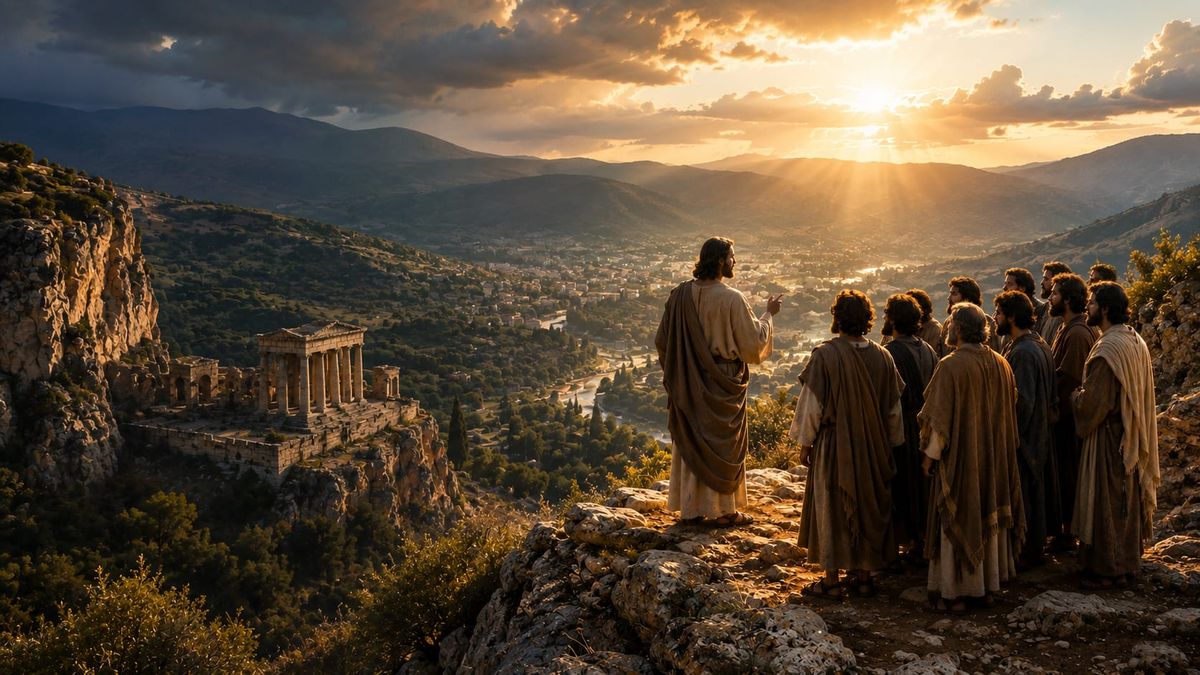
January 18, 2026, The Confession of Saint Peter, Red-Letter Holy Day, Season of Epiphany
Matthew 16:13–19, Psalm 23, Acts 4:8–13, 1 Peter 5:1–11
Grace, mercy, and peace from God our Father and the Lord Jesus Christ be with you on this feast of the Confession of Saint Peter.
The Anglican calendar is not primarily a calendar of great men. It is a calendar of the acts of God. When it sets aside January 18 each year for the Confession of Saint Peter, it honors not simply a great man but a great answer to a great question. It commemorates not a missionary journey, not a martyrdom, not a miracle. It commemorates the moment when, at Caesarea Philippi, a fisherman from Galilee answered the question Jesus put to his disciples: “You are the Christ, the Son of the living God.” (Matthew 16:16, ESV) The feast exists because those words are not merely Peter’s words. They are the Church’s words. And every January, the feast calls the Church to hear them again and to ask whether we still mean them.
The setting matters. Jesus and his disciples have traveled north to Caesarea Philippi, a largely Gentile setting at the base of Mount Hermon, a place marked by pagan worship, Roman political power, and competing claims of allegiance. Jesus does not ask the question in Jerusalem. He does not ask it in the Temple or in a synagogue. He asks it there, away from the religious center, in a place where the confession would have sounded especially sharp against the surrounding claims.
The name Caesarea Philippi itself signals something. Philip the tetrarch developed the city and named it Caesarea Philippi in honor of Caesar and himself, while the older name Panias recalled the worship of the Greek god Pan whose sanctuary stood nearby. It was a place where the question of ultimate allegiance was already in the air. Who is Lord here: Caesar, Pan, or the one from Galilee? Jesus stands in the middle of all that and puts the question to his disciples. And the question still finds us amid competing claims. Our Caesarea Philippi may be the workplace where naming Jesus as Lord seems too exclusive, the family gathering where speaking openly about faith feels impolite, or the public conversation where confessing Christ puts us outside the accepted categories. The pressure is not always to deny Jesus outright. More often, it is to make him smaller, safer, or more acceptable.
The question itself arrives in two stages. Verse 13: “Who do people say that the Son of Man is?” (Matthew 16:13, ESV)The disciples report what they have heard: John the Baptist, Elijah, Jeremiah, one of the prophets. These are not dismissive answers. They represent genuine recognition that something of enormous significance is happening in Jesus. The crowd has placed him among the greatest figures in Israel’s history. But they have also placed him within existing categories. They have made him remarkable without recognizing him fully. They have not dismissed him. They have simply placed him in a category that cannot hold him.
Then in verse 15, Jesus turns the question personal: “But who do you say that I am?” (Matthew 16:15, ESV) The shift is everything. Not who do people say. Who do you say. The disciples have been with him through the healings, through the feeding of the five thousand, through the walking on water, through the controversies with the Pharisees and the scribes. They have more evidence than the crowd. And the question presses them past evidence into confession, past report into commitment. It is one thing to observe that Jesus is remarkable. It is another thing to say who he is.
Simon Peter answers: “You are the Christ, the Son of the living God.” Not a prophet. Not Elijah. Not one of the great figures of Israel’s past. The Christ: the Anointed One, the promised King, the one toward whom Israel’s Scriptures have been pointing. The Son of the living God: a declaration that reaches into his unique relationship with the Father.
The disciples had already confessed something of this after Jesus walked upon the sea. Matthew tells us that those in the boat worshiped him and said, “Truly you are the Son of God.” (Matthew 14:33, ESV) But Caesarea Philippi is the climactic confession. Peter now names Jesus not only as Son but as the Christ. No immediate miraculous rescue has prompted the words. And Jesus himself tells Peter where the recognition came from.
That response is the theological heart of this feast. Verse 17: “Blessed are you, Simon Bar-Jonah! For flesh and blood has not revealed this to you, but my Father who is in heaven.” (Matthew 16:17, ESV) Before Jesus says anything about Peter’s role, before he says anything about the Church or the keys, he says this: Peter did not arrive at this confession by his own intelligence or insight. The Father revealed it. This is the first and most important thing to understand about the confession: it is not a human achievement. Peter is not commended for being the smartest disciple or the most perceptive. He is blessed because the Father has revealed the Son.
This does not mean that evidence, reason, and the witness of Scripture are irrelevant. They matter. The disciples had observed the healings, heard the teaching, seen what could not easily be explained. Peter had been present at the feeding of the five thousand and in the boat when Jesus walked on water. None of that is set aside. But none of it, by itself, produced the confession. Evidence can show us that something extraordinary is happening. The Father opens our eyes to recognize the one standing before us as the Christ, the Son of the living God. Reason and evidence bring us to the question. God’s revelation enables the confession.
The confession is a gift before it is anything else. The Church does not invent Christ and then confess the Christ she has designed. She receives the apostolic faith. We did not generate it, and therefore we are not free to revise it whenever the surrounding culture finds it inconvenient.
Jesus continues in verses 18 and 19: “And I tell you, you are Peter, and on this rock I will build my church.” The Church has long debated exactly how Peter and the rock relate. We do not need to solve that by pretending Peter has nothing to do with the rock. The Greek wordplay is deliberate: Petros (PEH-tros) and petra (PEH-trah). Jesus personally names Peter in connection with the rock, and Peter genuinely receives a foundational role among the apostles.
But neither can Peter be separated from the confession he has just made, and neither Peter nor his confession can be separated from Christ himself. Paul tells us that “no one can lay a foundation other than that which is laid, which is Jesus Christ.” (1 Corinthians 3:11, ESV) And Ephesians says the household of God is “built on the foundation of the apostles and prophets, Christ Jesus himself being the cornerstone.” (Ephesians 2:20, ESV) The Anglican reading need not choose between Peter and the confession as though affirming one required denying the other. Peter is intimately connected with the rock because he bears the confession the Father has revealed. He is first among the apostles, while Christ remains the ultimate foundation and cornerstone of the Church.
The keys of the Kingdom deserve a word. In the ancient world, keys signified stewardship and delegated authority. The image recalls Isaiah 22:22, where the key of the house of David signifies authority to open and shut on behalf of the king. Jesus gives the keys personally to Peter, and in Matthew 18:18 he gives the binding and loosing authority to the disciples together. This is real authority, but it is delegated authority. The Church proclaims and applies the Gospel, teaches according to the Word of Christ, declares forgiveness to the penitent, and exercises discipline in the King’s name. She bears the keys. She does not own the house. Christ remains Lord of it.
And then comes the promise: “the gates of hell shall not prevail against it.” The word translated hell is Hadēs, the realm of the dead. And gates are defensive structures. The picture is not primarily the Church hiding behind her walls while hell attacks. The gates of death themselves will not be able to hold against what Christ is building.
Why? Because death could not hold Christ.
That is the reason the promise stands. Jesus will go into the grave and come out again bodily. And the Church he builds belongs to the risen Lord. Congregations may close. Christian institutions may fail. Believers may suffer and die. The promise is greater than institutional survival. The grave itself cannot finally keep those who belong to the Shepherd who has conquered death. The gates of Hades will not prevail because the risen Christ is building his Church.
And Peter will discover that the confession does not exempt him from pressure. The man who makes the confession in the hills will make it again in a courtroom.
That courtroom scene is the appointed reading from Acts 4:8–13. Peter and John have been arrested after the healing of a lame man in the name of Jesus. The rulers ask by what authority they acted. And Peter, filled with the Holy Spirit, answers: “let it be known to all of you and to all the people of Israel that by the name of Jesus Christ of Nazareth, whom you crucified, whom God raised from the dead, by him this man is standing before you well.” (Acts 4:10, ESV) Then comes verse 12, one of the most absolute statements in the New Testament: “And there is salvation in no one else, for there is no other name under heaven given among men by which we must be saved.” (Acts 4:12, ESV)
The confession made in the hills is now made before authorities capable of punishing Peter. The stakes have risen dramatically. Peter has not adjusted the confession to fit the audience.
But notice what Acts tells us: Peter is “filled with the Holy Spirit.” The Father who revealed the Son at Caesarea Philippi has not left Peter to manufacture courage in the courtroom. The God who gives the confession also gives grace to proclaim it when proclamation becomes costly.
The appointed Psalm for this feast is Psalm 23, and its choice rewards attention: “The LORD is my shepherd; I shall not want.” (Psalm 23:1, ESV) The connection to Peter becomes especially rich when we remember John 21. The risen Christ asks Peter three times, Do you love me? And three times the commission comes: feed my lambs, tend my sheep, feed my sheep. The repetition answers Peter’s three denials. The man who confessed Christ, denied Christ, and was restored by Christ is entrusted with the care of Christ’s flock.
The public confession and the pastoral commission belong together. To confess Christ as Lord is to be drawn into his concern for the flock. But Peter never becomes the chief Shepherd. He can shepherd Christ’s sheep because Christ is first Peter’s Shepherd and the Shepherd of the whole Church.
That is exactly what 1 Peter 5:1–11 makes clear. Peter writes to the elders as a fellow elder and a witness of the sufferings of Christ. He tells them to “shepherd the flock of God that is among you,” and he points them beyond himself to the day “when the chief Shepherd appears.” (1 Peter 5:2, 4, ESV) Peter has genuine pastoral authority, but he remains an under-shepherd. Christ alone is the chief Shepherd.
Peter also writes: “Be sober-minded; be watchful. Your adversary the devil prowls around like a roaring lion, seeking someone to devour. Resist him, firm in your faith.” (1 Peter 5:8–9, ESV) The man who writes those words knows weakness firsthand. He confessed Christ boldly, failed grievously, was restored graciously, and according to the ancient tradition of the Church eventually gave his life for the name he once denied. His counsel is not abstract pastoral theology. It is the hard-won witness of a man who discovered that Christian steadfastness cannot be taken for granted.
The Confession of Saint Peter does not simply remember what Peter said. It calls the Church to say it again. Every generation receives the confession and is called to make it its own: in worship, in witness, under pressure, and in the dailiness of ordinary Christian life. Peter received it by grace, confessed it boldly, failed by his own strength, and was restored by grace again. The arc of his life is the arc the feast invites us to trace in ours.
Three things the feast asks of us.
First, we receive the confession by grace. The Church receives the apostolic faith, and we as individual believers receive Christ. Neither the Church nor any one of us invented the confession or discovered it through the superior quality of our reasoning. None of us can stand before God and claim that we found Jesus through our own wisdom. The Father revealed the Son to Peter, and faith remains a gift of grace.
This is not a peripheral point. It governs everything else. The temptation of every generation is to manage what is said about Jesus: to soften the edges, to make the confession more acceptable, to adjust it until it costs less. That impulse assumes the confession belongs to us to revise. But if the Father gave it, we do not get to improve it. The pressure to make the declaration about Jesus more palatable takes sophisticated forms: emphasizing love without lordship, or the ethics of the Kingdom without the necessity of faith in the King. These adjustments can feel like pastoral wisdom. But the Father’s gift does not improve when we edit it. What the Church needs to offer the world is not a more comfortable Christ. It is the Christ the Father has revealed.
Second, we confess Christ, together and personally. The Church confesses Christ in worship, preaching, teaching, sacrament, and public witness. We confess Christ personally in our homes, our relationships, our workplaces, and in every situation where circumstances require us to say plainly whom we believe Jesus to be. The question Jesus asks is not merely academic: “But who do you say that I am?”
Peter makes the confession at Caesarea Philippi, and later he makes it before the Sanhedrin. In the hills it comes among disciples. In the courtroom it may cost him his freedom. Yet Acts tells us that Peter answers filled with the Holy Spirit. We are responsible to confess Christ, but the grace to do so does not finally come from the quality of our resolve. The same God who gives faith gives courage.
And this is where Acts 4:12 refuses to let us soften the confession: “there is salvation in no one else.” Not one path among many. Not one helpful spiritual teacher among many. No other name. That is not arrogance if it is something we received rather than invented. The Church can confess it humbly precisely because the truth belongs to Christ, not to us.
Third, we remain faithful by grace. The Church must remain steadfast in the apostolic confession, and we as individual Christians must remain steadfast in our personal confession of Christ. But neither the Church nor any one of us remains faithful by sheer determination.
Peter himself proves this. The man who makes one of the boldest confessions in the Gospels will later deny three times that he even knows Jesus. He is not kept by his own resolve. He is restored by the grace of the one he confessed.
And that is why the Collect matters so much. It does not say, Almighty Father, watch us make ourselves steadfast. It prays: “Keep your Church steadfast upon the rock of this faith.” That is a petition, not a resolution. Not: we will try harder. But: Father, keep us.
The same grace that revealed the confession to Peter is the grace that restored him when he failed it. The same grace strengthens him before the Sanhedrin. The same grace keeps the Church, and keeps each of us, in the faith we have received.
“Blessed are you, Simon Bar-Jonah! For flesh and blood has not revealed this to you, but my Father who is in heaven.”(Matthew 16:17, ESV)
In the Name of the Father, and of the Son, and of the Holy Spirit. Amen.