He Ascended Into Heaven: Ascension Day 2026 (Luke 24:44-53)
The last thing the disciples saw of Jesus in Luke’s Gospel was his hands raised over them in blessing. He was carried up in the middle of it. The blessing did not stop when he disappeared. It is still in progress. Ascension Day is the feast of a presence, not an absence.
May 14, 2026, Year A, Ascension Day, Season of Easter
Luke 24:44–53, Psalm 110:1–5, Acts 1:1–11, Ephesians 1:15–23
Alleluia! Christ is risen!
Grace, mercy, and peace from God our Father and the Lord Jesus Christ be with you on this Ascension Day.
We began this Easter season with Mary Magdalene weeping in the dark outside an empty tomb. The stone was rolled away, the body was gone, and then came a voice speaking her name, and everything turned. Since that morning we have followed the risen Christ as he found his people: a locked room breathing new-creation life, two disciples on an Emmaus road with burning hearts, the true vine and the repeated command to abide. This coming Sunday, on the Sunday after Ascension, we will hear Jesus lift his eyes to heaven in the High Priestly Prayer and pray, “Holy Father, keep them in your name.” (John 17:11, ESV) That prayer was first spoken on Maundy Thursday night, hours before the cross. Today, on Ascension Day, we see more fully where the one who prayed it now reigns and intercedes for the people he has entrusted to the Father.
The movement of Eastertide has brought us here. Easter proclaims that the crucified Christ has risen from the dead and inaugurated the new creation. Ascension proclaims that the risen Christ is exalted to the right hand of the Father and reigns over all things. Pentecost will proclaim the outpouring of the Holy Spirit upon the Church for her mission in the world. We are standing at the hinge today. The empty tomb is behind us. Pentecost lies ahead. Between them stands this article of the Creed: he ascended into heaven.
Today is the fortieth day of Easter and one of the seven Principal Feasts of the Anglican liturgical year. Acts tells us that Jesus presented himself alive to his apostles during forty days, and on this day the risen Lord was taken from their sight. The same Jesus who was crucified, buried, and raised bodily is now glorified in that same humanity, exalted to the right hand of the Father, where he reigns and intercedes for his people even now.
The Ascension is therefore not the disappearance of Jesus. It is his exaltation. Neither does Jesus leave his humanity behind when he ascends. The human nature he assumed from the Virgin Mary, the humanity in which he suffered and died and rose again, is the humanity in which he enters heaven. We should say this carefully. Jesus does not somehow take all of us bodily into heaven with him on Ascension Day. But our humanity is there in him. The eternal Son remains truly God and truly man, and human nature has been glorified and enthroned in his person. Where the Head has gone, his people are promised one day to follow, and when he returns our mortal bodies will finally share in the glory of his resurrection.
Our Gospel reading is Luke 24:44–53, the final scene of Luke’s Gospel. Jesus begins in verse 44 by gathering the whole scriptural story around himself: “These are my words that I spoke to you while I was still with you, that everything written about me in the Law of Moses and the Prophets and the Psalms must be fulfilled.” (Luke 24:44, ESV) The Law, the Prophets, and the Psalms together bear witness to the saving purpose that reaches its fulfillment in him.
Then Luke tells us in verse 45, “he opened their minds to understand the Scriptures.” That phrase is easy to pass over, but it is extraordinary. These men have been with Jesus for years. They have heard him teach, watched him heal the sick, cast out demons, raise the dead, calm storms, and confront the powers of darkness. Yet even after all of that, they need the risen Christ to open their minds to understand what the Scriptures have been saying.
Christian understanding begins with grace. The Scriptures are not a puzzle we master by cleverness until we finally discover Christ at the center. The risen Lord gives understanding. He opens the Word and opens his people to the Word. We saw that on the Emmaus road when he interpreted Moses and the Prophets and their hearts burned within them. We see it again here as he prepares the apostles to become witnesses of the Gospel they will carry into the world. At Pentecost the same Lord will pour out the Holy Spirit, empowering these witnesses to proclaim openly what he has now taught them to understand.
Jesus tells them what that Gospel is in verses 46 and 47: “Thus it is written, that the Christ should suffer and on the third day rise from the dead, and that repentance for the forgiveness of sins should be proclaimed in his name to all nations, beginning from Jerusalem.” (Luke 24:46–47, ESV) Ascension Day therefore cannot be separated from the cross and empty tomb. The one being exalted is the one who suffered for sinners. The message the ascended Christ sends into the world is not vague spirituality or moral improvement. It is repentance and forgiveness of sins in his name.
Then he tells the disciples, “You are witnesses of these things.” (Luke 24:48, ESV) Witnesses, not inventors. They do not create the message. They testify to what God has done in Christ. But even eyewitnesses to the Resurrection are not told simply to rush out and rely upon their own courage. Jesus says, “stay in the city until you are clothed with power from on high.” (Luke 24:49, ESV) The commission comes from Christ, and the power to carry it out must also come from Christ.
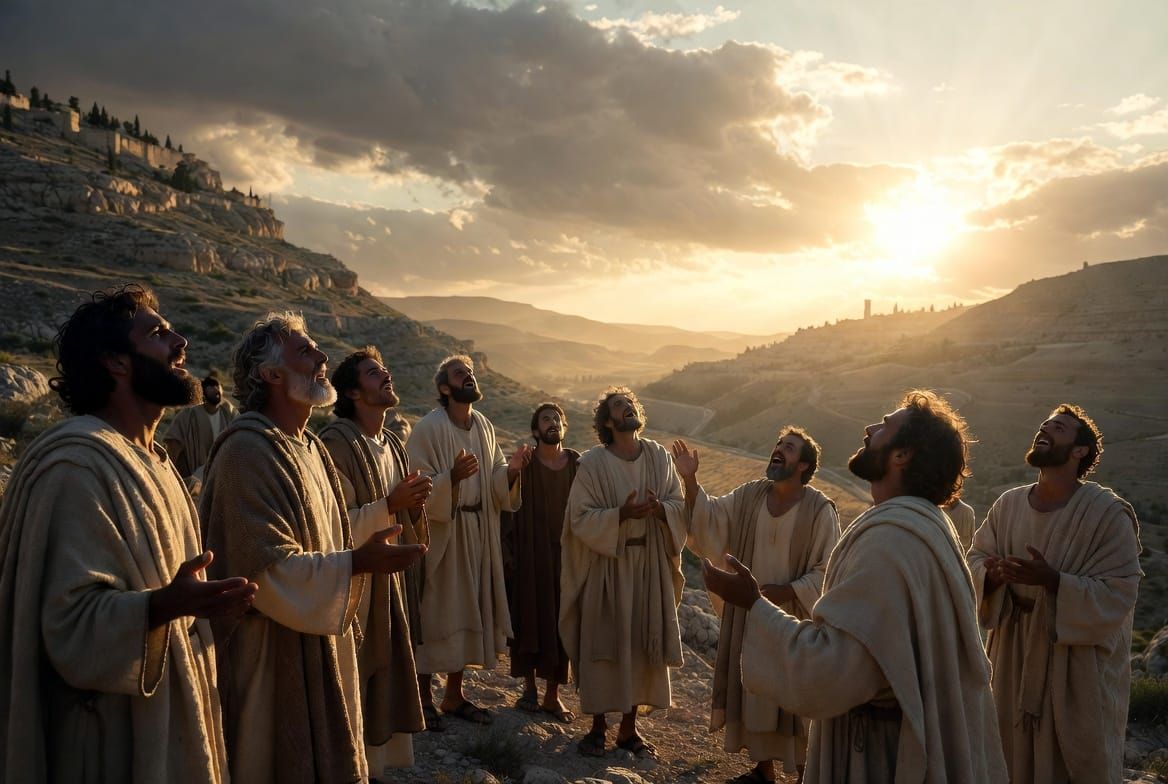
Then Luke brings us to the Ascension itself: “And he led them out as far as Bethany, and lifting up his hands he blessed them. While he blessed them, he parted from them and was carried up into heaven.” (Luke 24:50–51, ESV) He led them. He lifted his hands. He blessed them. And while blessing them, he was carried into heaven.
The final visible posture of Jesus toward his disciples in Luke’s Gospel is therefore blessing. We should not turn that image into the claim that the physical act of Ascension continues forever or that Jesus remains eternally frozen with his hands raised above Bethany. But Luke wants us to notice how he leaves them. The ascended Lord is not hostile toward his Church. He does not depart disappointed or unwilling. He leaves them under his blessing, and the Lord who blesses them as he ascends remains the Lord who reigns and intercedes for them in heaven.
That helps explain their response. Verse 52 says that they worshiped him and returned to Jerusalem “with great joy.” Not grief. Not abandonment. Great joy. They understand that what has happened is not defeat. The risen Jesus has been exalted, and they return to Jerusalem continually blessing God while they await what he promised.
Luke wrote both this Gospel and the book of Acts, and Acts opens by returning to the same event. Luke writes, “In the first book, O Theophilus, I have dealt with all that Jesus began to do and teach, until the day when he was taken up.”(Acts 1:1–2, ESV) That little word began matters. Luke’s Gospel records what Jesus began to do and teach. Acts will tell the continuing story of Christ’s work through the Holy Spirit and through the witnesses he sends.
Jesus has not handed over a religious project and retired. The mission remains his. That is why immediately before the Ascension he says, “You will receive power when the Holy Spirit has come upon you, and you will be my witnesses.”(Acts 1:8, ESV) Christ sends. Christ promises. Christ gives the Spirit. The Church responds.
Then Acts gives us another detail: “as they were looking on, he was lifted up, and a cloud took him out of their sight.”(Acts 1:9, ESV) The cloud is familiar biblical imagery for divine glory. The cloud covered Sinai. The glory-cloud accompanied Israel. The cloud filled the tabernacle and Temple. At the Transfiguration a cloud overshadowed the disciples as the Father’s voice identified Jesus as his beloved Son.
Luke therefore gives us more than a description of Jesus rising higher into the sky until weather obscures the view. The cloud marks divine glory. According to his humanity, the risen Jesus is received into heaven. According to his divine nature, the eternal Son has never ceased to fill heaven and earth. The Ascension does not turn Jesus’ humanity into omnipresence. It brings the incarnate Son in his glorified humanity into the heavenly glory and royal exaltation that belong to him.
And then two men in white robes ask the disciples, “Men of Galilee, why do you stand looking into heaven?” (Acts 1:11, ESV) Their question is not contempt for what the disciples have just witnessed. It redirects them toward what comes next. “This Jesus, who was taken up from you into heaven, will come in the same way as you saw him go into heaven.” The Jesus who ascended is the Jesus who will return. Bodily. Personally. Visibly. In glory.
That means history has a destination. The Church is not waiting for humanity gradually to evolve beyond its need for Christ. We are waiting for Christ himself. But until he comes, the posture of the Church is not passive staring into heaven. The apostles have been sent back to Jerusalem to pray, to wait for the Spirit, and then to bear witness to the ends of the earth.
Psalm 110 tells us what the Ascension means. It begins, “The LORD says to my Lord: ‘Sit at my right hand, until I make your enemies your footstool.’” (Psalm 110:1, ESV) It is one of the most frequently quoted and alluded-to Psalms in the New Testament because the early Church understood that the crucified and risen Messiah had been enthroned at the right hand of God.
The right hand is the place of royal authority. Jesus is not waiting for some future historical development before he becomes King. He reigns now. Every earthly government, every spiritual power, every cultural force, every authority that appears unassailable is beneath the throne of Jesus Christ.
But Psalm 110 gives us another image as well: “You are a priest forever after the order of Melchizedek.” (Psalm 110:4, ESV) The one who ascends is King and Priest. He reigns, and he intercedes.
Hebrews develops this throughout its argument. Christ offered himself once for all upon the Cross. That sacrifice is complete and cannot be repeated. Having accomplished redemption, he has entered heaven itself to appear before God on our behalf. Paul says the same in Romans 8: “Christ Jesus is the one who died, more than that, who was raised, who is at the right hand of God, who indeed is interceding for us.” (Romans 8:34, ESV) Death, Resurrection, enthronement, intercession.
That should matter to every Christian in this room. The ascended Lord is not merely ruling the universe at an unimaginably great distance. Our great High Priest appears before the Father on our behalf. When our prayers are weak, our hope does not rest on the eloquence of our prayers. When our consciences accuse us, our hope does not rest on our ability to persuade God to receive us. Our hope is Jesus Christ, crucified, risen, ascended, and interceding for his people.
And that prepares us for what we will hear on Sunday in John 17. The prayer Jesus prayed on the night before his crucifixion reveals the priestly heart of the one who now appears before the Father for us. The earthly prayer of the Upper Room and the heavenly intercession of the ascended Christ are not identical acts, but they reveal the same Savior, the Son who loves his own and brings them before the Father.
Paul’s prayer in Ephesians 1 shows us the royal side of the same reality. He prays that the Church would know “the immeasurable greatness of his power toward us who believe,” the power God worked in Christ “when he raised him from the dead and seated him at his right hand in the heavenly places, far above all rule and authority and power and dominion.” (Ephesians 1:19–21, ESV)
Far above all rule and authority and power and dominion. Every power that frightens us, every authority that claims ultimate allegiance, every force that seems for a season to control history, Christ is above all of it. Not eventually. Now. His enemies have not all yet been finally destroyed, and death itself still awaits its last defeat, but the throne is already occupied. Jesus Christ reigns.
That is why Ascension Day should make the Church both confident and humble. Confident, because the world is not finally governed by the powers we can see. Humble, because the throne is not ours. The Church does not reign in Christ’s place. She belongs to Christ and lives under his authority.
Paul continues: God “put all things under his feet and gave him as head over all things to the church, which is his body.”(Ephesians 1:22–23, ESV) The Church is the Body whose Head is the ascended Christ. We are not simply an association formed around admiration for a religious teacher who lived long ago. Our life comes from our living Head.
That does not mean that everything the institutional Church decides automatically becomes the will of Christ, nor that every action of Christians can be identified with Christ’s own action. The Body remains accountable to the Head. But it does mean that Christ has chosen to send his people into the world as his witnesses, equipped by his Spirit, entrusted with the ministry of his Word and Sacraments, and called to love and serve in his name.
So when the Church feeds the hungry, visits the prisoner, comforts the grieving, teaches the Scriptures, administers the Sacraments, and proclaims forgiveness of sins in Jesus’ name, those are not insignificant activities. They belong to the mission the ascended Christ has given his people. We do them not because we are trying to make Christ King, but because Christ is King.
The Collect for Ascension Day teaches us how to respond: “Almighty God, whose only-begotten Son our Lord Jesus Christ ascended into heaven: May our hearts and minds also there ascend, and with him continually dwell.”
That does not mean escaping the world. It means learning to live in this world under the allegiance of heaven. Paul says, “If then you have been raised with Christ, seek the things that are above, where Christ is, seated at the right hand of God.” (Colossians 3:1, ESV) We seek the things above precisely so that we can live faithfully among the things below. Our earthly vocations, families, neighbors, work, sufferings, and responsibilities do not become less important. They are put into their proper order beneath the reign of Christ.
The disciples show us what that looks like. They return to Jerusalem with great joy. They worship. They pray. They wait for the promise of the Father. They do not confuse waiting with inactivity, and they do not confuse activity with self-sufficiency. The mission has been given, but they will not undertake it in their own power.
Liturgically, we now enter those days between Ascension and Pentecost. We do not pretend that Pentecost has not happened or that the Holy Spirit has not been given to the Church. But we can inhabit the apostolic posture of prayerful dependence. We can ask again that the Spirit strengthen, sanctify, and empower the Church for the work Christ has given us.
And Ascension Day places all of that beneath one final promise: “This Jesus ... will come in the same way as you saw him go into heaven.” (Acts 1:11, ESV) The same Jesus. The crucified one. The risen one. The incarnate Son who has ascended in the humanity he shares with us. He will return.
That promise changes the horizon of Christian life. History is not drifting endlessly. Our labor is not an attempt to manufacture the Kingdom by our own strength. We bear witness, love our neighbors, teach the faith, receive the Sacraments, pray, repent, suffer, endure, and hope beneath the reign of a King who has promised to return.
And because he will return, what we do now matters. There is a city to return to. There are neighbors to love. There is a Gospel to proclaim. There are sins to repent of and sins whose forgiveness must be announced in Jesus’ name. There are frightened Christians who need to remember that the throne of the universe is already occupied.
Luke leaves us with Christ’s hands raised in blessing. Acts leaves us with the promise that the same Jesus will return. Ephesians shows us that he already reigns above every power. Psalm 110 tells us that the King is also our eternal Priest.
So Ascension Day does not ask us to choose between looking toward heaven and serving faithfully on earth. It teaches us how the two belong together. Our hearts and minds ascend to where Christ is because our King is there. Then, under his authority and in the power of his Spirit, we turn again toward the world he has sent us to serve.
He led them out toward Bethany. He lifted his hands. He blessed them. And while blessing them, he was carried into heaven.
The hands raised over his disciples were pierced hands. The King on the throne is the Savior who died for sinners. The High Priest interceding for us is the Lamb who was slain. And the Jesus who has gone before us is the Jesus who will come again.
So lift up your hearts. Christ is ascended. Christ is reigning. Christ is interceding. And Christ will return.
In the Name of the Father, and of the Son, and of the Holy Spirit. Amen.