He Had Compassion (Matthew 14:13-21)
“He Had Compassion.” Matthew 14:13–21. Jesus withdraws to grieve John’s death and the crowd follows on foot. Compassion moves before will does. Five loaves, two fish, five thousand fed. The only miracle in all four Gospels.
Proper 13, Year A, 2026, Season after Pentecost
Matthew 14:13–21, Psalm 78:14–25, Nehemiah 9:16–21
Grace, mercy, and peace from God our Father and the Lord Jesus Christ be with you on this Tenth Sunday after Pentecost.
For three Sundays we have been in the Kingdom parables of Matthew 13: the sower, the wheat and the tares, the mustard seed and the leaven, the hidden treasure, the pearl of great price, the dragnet. The King has been describing his Kingdom in story form to those with ears to hear. Today we enter Movement III, and the register shifts. The King stops describing and starts acting. Our passage is Matthew 14:13–21.
Verse 13 opens with a phrase that is easy to pass over: “Now when Jesus heard this, he withdrew from there in a boat to a desolate place by himself.” (Matthew 14:13, ESV) What had he heard? The previous passage, Matthew 14:1–12, tells us: John the Baptist has been executed. Herod has beheaded him in prison and sent the head on a platter to the daughter of Herodias. Jesus’ cousin, his forerunner, the one who said behold the Lamb of God, is dead. And the first thing Jesus does when he hears the news is go somewhere alone.
There is a sentence worth sitting with: the miracle begins not with abundance but with grief, and not with Jesus at his most capable but at his most human.
Every one of us knows what it is like to reach the end of ourselves. To come home after a loss and want nothing except to sit quietly. To feel the weight of grief settle into the body and to know that we have nothing left to offer. Jesus knows that place. He got into the boat because he needed to. He sought the desolate place because his heart required it. And yet when compassion met him on the shore, grief did not harden into indifference. He saw them. He had compassion. He healed. The miracle does not begin with triumph. It begins with grief.
But the crowd follows. When they hear he has withdrawn, they go after him on foot from the towns. These are not wealthy observers who could afford to wait. They are the sick, the suffering, the poor: Galilean families who have followed Jesus because there is nowhere else to turn. Mark’s account supplies the phrase: “they were like sheep without a shepherd.” (Mark 6:34, ESV) They have left the towns on foot and arrived at the desolate place before Jesus does.
Verse 14: “When he went ashore he saw a great crowd, and he had compassion on them and healed their sick.” (Matthew 14:14, ESV) The Greek word translated compassion is splanchnizomai (splank-NIDZ-oh-my). It means to be moved in the bowels, in the gut. It is the deepest physical language for empathy that the Greek language has. It is the word Matthew uses in chapter 9 when Jesus sees the crowds like sheep without a shepherd. It is the word Luke uses in the parable of the prodigal son when the father sees his son coming from far off. It is not mild sympathy or professional courtesy. It is something that happens in the body before it happens in the will. Jesus sees them, and something moves in him, and he heals their sick.
Matthew tells us that Jesus intentionally withdrew. His need for solitude was real. The point is not that Christians should never rest or seek renewal; Jesus regularly withdrew to lonely places to pray. The interruption came. What Matthew shows us is a man whose compassion, when it encountered need directly, overrode his plan for the afternoon. Love is willing to be interrupted. Wisdom, guided by the Spirit, knows when an interruption is one God himself has sent.
As evening comes the disciples make the reasonable suggestion: “This is a desolate place, and the day is now over; send the crowds away to go into the villages and buy food for themselves.” (Matthew 14:15, ESV) They are correct on every point. It is a desolate place, the same word the Psalms and Nehemiah use for the wilderness where Israel wandered and God fed them. The day is over. The logistics are against staying. What the disciples do not yet see is that a desolate place and five thousand hungry people is precisely the kind of situation God has been in before. Send them away, they say.
Jesus responds with an impossible command: “They need not go away; you give them something to eat.” (Matthew 14:16, ESV) Not: I will feed them. You give them something to eat. He gives the disciples an assignment that exceeds their resources and then provides what is needed. This is the pattern the Kingdom runs on.
The disciples report the inventory: five loaves and two fish. John’s account of the same event adds a detail Matthew omits: it is a boy’s lunch. Five barley loaves, the bread of the poor, and two small fish. The inadequacy of what they have is the point. Jesus does not ask for something sufficient. He asks for what they have.
The disciples go to Jesus with their arithmetic. Two hundred denarii would not be enough, Philip calculates in John’s account; they might as well send the crowd away. The math is correct. But the question is never whether five loaves are enough. The question is whether the one holding them is merely a rabbi or the Lord who fed Israel in the wilderness.
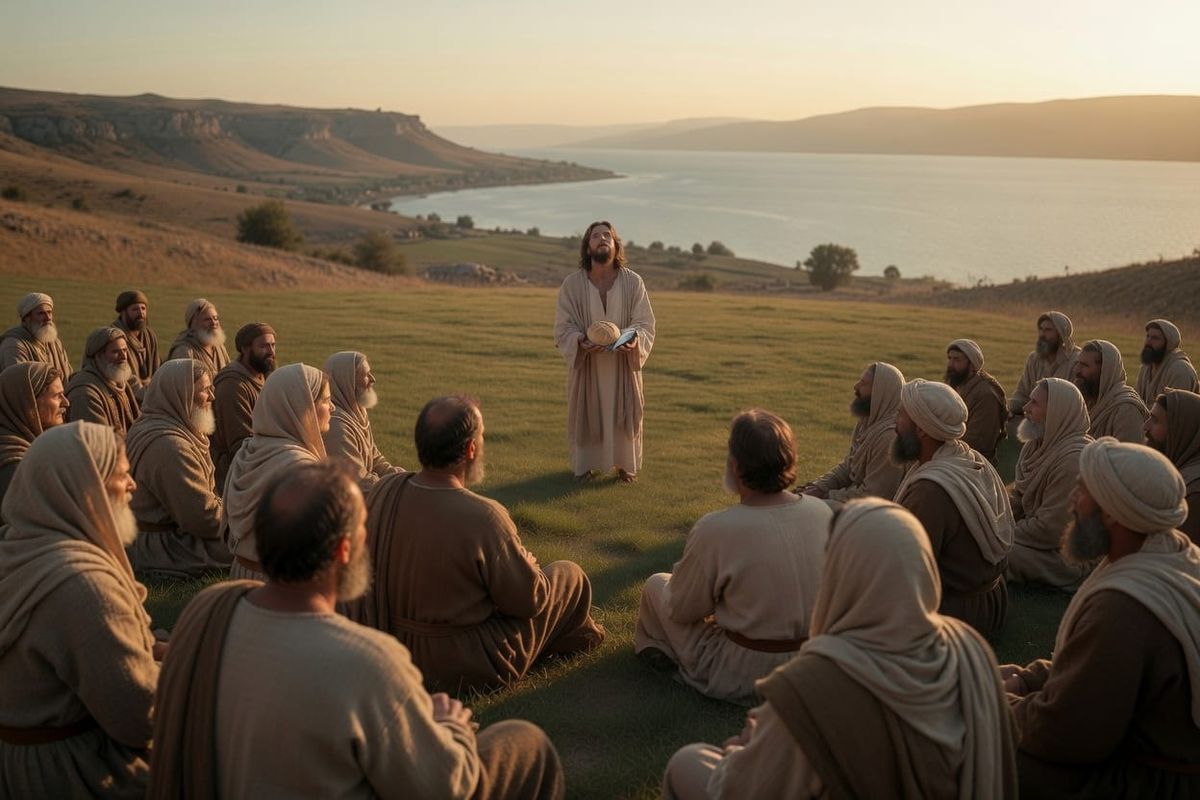
He orders the crowds to sit down on the grass. He takes the five loaves and two fish. He looks up to heaven. He says a blessing. He breaks the loaves. He gives them to the disciples.
Matthew uses four verbs here: took, blessed, broke, gave. They are the same four verbs Matthew will use in chapter 26 at the Last Supper: “Now as they were eating, Jesus took bread, and after blessing it broke it and gave it to the disciples.” (Matthew 26:26, ESV) The same words. The same hands. The same sequence. Matthew intends us to hear the echo. The feeding of the five thousand anticipates the Table, and every celebration of the Eucharist reminds us of the same compassionate Lord who fed the crowd in the wilderness. The crowd by the sea of Galilee and the congregation gathered at this Table are at the same meal in different forms, served by the same hands.
Every Sunday we gather at this Table and the same sequence unfolds. The priest takes the bread. Looks up to heaven. Blesses. Breaks. Gives. The congregation receives what they did not produce and could not earn. What is happening at this Table is the same thing that happened on that hillside: the one who had compassion on the crowd by the sea has compassion on this congregation. We bring what we have. He makes it what we need.
The wilderness echo runs deeper still. Psalm 78 and Nehemiah 9, both appointed for this Sunday, recall the same scene from an earlier moment in Israel's history: God feeding his people in the desert. Psalm 78 asks the question every believer eventually asks: “Can God spread a table in the wilderness?” (Psalm 78:19, ESV) The answer is yes. God rained down manna and sent quail. As Nehemiah remembers, “You gave your good Spirit to instruct them and did not withhold your manna from their mouth and gave them water for their thirst.” (Nehemiah 9:20, ESV)
Now, in a desolate place by the sea of Galilee, the same God is doing it again. The wilderness is not the obstacle to his provision; it is the occasion for it. Every Sunday we come to his Table as people who know something of the wilderness, bringing not our sufficiency but our need; carrying griefs, burdens, fears, sins, and needs that we cannot satisfy ourselves. And we discover again what Israel discovered in the desert and what the crowd discovered by the sea: the desolate place is exactly where the Lord delights to spread his table.
There is a distinction worth noting between Moses and Jesus in these parallel moments. Moses interceded for the manna; God provided it. Jesus does not intercede for the bread. He takes it, blesses it, and distributes it himself. Moses asked. Jesus gives. The same God who rained bread from heaven is now the one distributing it with his own hands. This is who stepped out of the boat.
John’s account of this miracle, the only miracle recorded in all four Gospels, follows it with Jesus’ own interpretation: “I am the bread of life; whoever comes to me shall not hunger, and whoever believes in me shall never thirst.” (John 6:35, ESV) The miracle points beyond itself. The bread is a sign. The one distributing it is what the crowd actually needs. The crowd by the sea of Galilee is hungry; the bread satisfies them for an afternoon. What they need for eternity is the one who blessed the bread.
And they all ate and were satisfied. Twelve baskets of fragments left over, one for each disciple, pointing to the new Israel, the Church, that Jesus was forming through them. The collect for this Sunday names what the miracle enacts: “Almighty and merciful God, it is only by your grace that your faithful people offer you true and laudable service.” (BCP 2019, p. 618) The disciples offer five loaves and two fish. It is only by grace that it becomes true and laudable service. They brought what they had. He made it more than enough.
The Church’s calendar places the Feast of the Transfiguration of Our Lord on August 6, four days from this Sunday. An article will be on the church website this week. It is worth pausing on the proximity, because the calendar is making a theological point. The same Jesus who stepped off a boat in grief and had compassion on five thousand people is the one whose face will shine like the sun on a mountain four days later. The crowd saw the compassion; Peter, James, and John on the mountain will see the glory. Both are real, and both belong to the same face. James, whose feast we observed eight days ago, was among the disciples distributing bread today. He was also one of the three on the mountain, and the first of the Twelve to drink the cup. August 6 honors what he saw before he drank it.
Three things this passage presses on us.
First: compassion often meets us before we are ready. This is not a command to ignore our exhaustion; it is a description of how love works. Jesus sought the desolate place because he needed it. His plan was healthy. The interruption came. And when it did, compassion overrode the plan. The crowd could not wait until he was done grieving, and he did not ask them to.
The parent who hears another knock on the bedroom door after finally sitting down. The wife caring for a sick husband while carrying her own grief. The teacher who walks into the classroom after a sleepless night. The church member who arrives on Sunday carrying burdens no one else can see. None of them are ready. All of them show up.
The passage does not tell us that this will always be asked of us, or that we should never protect our rest. It shows us a Lord who, when compassion met him in the desolate place, did not send it away. Christian maturity is learning, through the Spirit’s wisdom, to recognize the interruption God himself has sent.
Second: because he has compassion, he receives inadequate offerings. He does not wait for the disciples to produce something sufficient. He says “bring them here to me” after they have named their poverty. The inadequacy of the offering is not the obstacle; it is the occasion for his compassion to act. The widow who thinks her prayers are too small. The father who thinks he has nothing left to give his children. The volunteer who wonders whether showing up will matter. All of them are answering a question Jesus is not asking. He is not asking for sufficiency. He is asking for what we have, because his compassion already intends to do with it what we could not predict.
Third: because he blesses what we bring, it comes back in abundance. The disciples bring five loaves and carry away twelve baskets. The Kingdom’s economy runs contrary to every other economy we know. The hour given to prayer that somehow creates more time rather than less. The money given to a neighbor in need that does not leave us poorer in the ways that matter. The act of service offered when we had nothing left that somehow leaves us more whole than before we gave it. We bring five loaves to his hands.
What does it mean that he had compassion on them? It means what it has always meant: The King who acts does not wait until everything is finally in order. He steps off the boat into whatever is in front of him and is moved. The sheep without a shepherd have found their Shepherd. The hungry are fed. The desolate place becomes, for an evening, a table in the wilderness.
We come to this Table the same way the crowd came to that shore: with what we have and with what we need. We have five loaves. We need a miracle. And the one who looked up to heaven over barley bread by the sea of Galilee looks up to heaven here. Same hands. Same blessing. Same bread broken and given. The arithmetic changes entirely depending on who is holding the bread.
There is no record of the crowd asking who fed them. They ate and were satisfied. The disciples carrying twelve baskets knew something the crowd did not yet fully understand. They had felt the bread multiply in their hands as they distributed it. They had watched him look up to heaven and bless.
The desolate place became, for an evening, a table in the wilderness. That is where the King sets his table. That is what compassion looks like when God himself has come among his people. And so the question begins to form: Who is this? We will look at the answer to that next week.
In the Name of the Father, and of the Son, and of the Holy Spirit. Amen.