Of Great Price (Matthew 13:31–33; 44–50)
Proper 12. Five Kingdom parables. The mustard seed, the leaven, the hidden treasure, the pearl, the dragnet. The first two show how the Kingdom works: in hiddenness, from small beginnings. The middle two show what it is worth: everything. The last one shows what happens at the end.
July 26, 2026, Proper 12, Year A, Season after Pentecost
Matthew 13:31–33; 44–50, Psalm 119:121–136, 1 Kings 3:3–14
Grace, mercy, and peace from God our Father and the Lord Jesus Christ be with you on this Ninth Sunday after Pentecost.
Last week we sat with the parable of the wheat and the tares: the field of the whole world, the enemy sowing weeds while men sleep, the master’s patience for the sake of the elect still being gathered, and the promise that at the close of the age the righteous will shine like the sun in the Kingdom of their Father. Today we reach the end of Matthew 13. Five more parables complete the chapter, and they pivot from what happens in the field to what the field is worth. Our primary passage this morning is Matthew 13:31–33 and 44–50.
The five parables fall into three groupings. The first two, the mustard seed and the leaven, describe how the Kingdom works. The middle two, the hidden treasure and the pearl of great price, describe what the Kingdom is worth. The fifth, the dragnet, returns to the eschatological frame of last week, that is, the question of what happens at the end of the age: the sorting that belongs to the angels, not to us. Together they give us a complete picture of the Kingdom: its manner of growth, its supreme value, and its ultimate end.
Verse 31 opens with the mustard seed: “The kingdom of heaven is like a grain of mustard seed that a man took and sowed in his field. It is the smallest of all seeds, but when it has grown it is larger than all the garden plants and becomes a tree, so that the birds of the air come and make nests in its branches.” (Matthew 13:31–32, ESV)
The Kingdom begins in forms the world considers insignificant. The disciples standing with Jesus on the shore of the Sea of Galilee are a small and unremarkable group gathered around an itinerant teacher from Nazareth. Nothing about the scene suggests what is coming. This is the point. The Kingdom is not recognizable in its early stages as the thing it will become. It starts as a seed and ends as a tree where the nations nest.
The congregation that feels small, that serves faithfully in a place that does not look like the big buildings, is not failing to be the Kingdom. It may be in the middle of exactly what the mustard seed does. The parable does not promise a certain size; it describes a certain method. Small is how it starts. Hidden is how it grows.
Think of a parent who has prayed for a child across decades, who has watched that child walk away from the faith and has kept praying anyway, who has shown up faithfully to worship and has not given up on what was planted in the household when the child was small. That parent is not failing to see results. That parent is living inside the parable. The seed is in the soil. The planter has not abandoned it. The tree is not yet visible, but the one who said the mustard seed becomes a tree knows exactly what is hidden within it. Their prayer is not in vain.
The image of birds nesting in the branches is drawn from the Old Testament: in Daniel 4 and Ezekiel 17, the great empires of the world are pictured as trees where the nations find shelter. Jesus is reaching for that image deliberately. The Kingdom that begins as a grain of mustard seed will become the tree in whose branches all the nations of the earth find rest in Christ. The disciples could not have imagined in that moment the scope of what was being planted. Neither can we. The seed does not visibly look like the tree it will become. Only the one who planted it knows what is hidden within it.
Verse 33 gives us the leaven: “The kingdom of heaven is like leaven that a woman took and hid in three measures of flour, till it was all leavened.” (Matthew 13:33, ESV) Three measures of flour is an enormous quantity, far more than a family would ordinarily prepare. The leaven is hidden in it. It works invisibly, permeating from within, until the whole mass is changed. The Kingdom does not always announce itself. It operates in concealment, working through the ordinary material of human life, until the transformation it has been accomplishing becomes visible.
This is the second way the Kingdom works: not only from small to large, but from hidden to manifest, from invisible to undeniable. The mustard seed and the leaven together are a word of steadiness for those who serve the Kingdom in ways that cannot yet be measured. The question they answer is not “why is the Kingdom so small?” but “do you know how this works?” This is how it works. It works like a seed buried in dark soil and like yeast folded into flour. The invisibility is not the problem; it is the method. The Church has always had to resist measuring the Kingdom by what is currently visible.
Then the pivot. Verse 44 introduces two parables that are not about how the Kingdom grows but about what it is worth.
The hidden treasure: “The kingdom of heaven is like treasure hidden in a field, which a man found and covered up. Then in his joy he goes and sells all that he has and buys that field.” (Matthew 13:44, ESV) The man is not looking for treasure. He is working in a field that is not his own. He stumbles on something. He recognizes what it is. He covers it back up, goes home, sells everything he owns, and comes back to buy the field.
The text notes that he does this in his joy. This is not a reluctant transaction. He has found something that makes everything else look like inventory, and selling the inventory is not painful; it registers, from the inside, as the obvious and joyful response. The Kingdom does not demand sacrifice as though sacrifice were the point. It reveals a value so surpassing that what looks like sacrifice from the outside is simply the recognition of what things are worth.
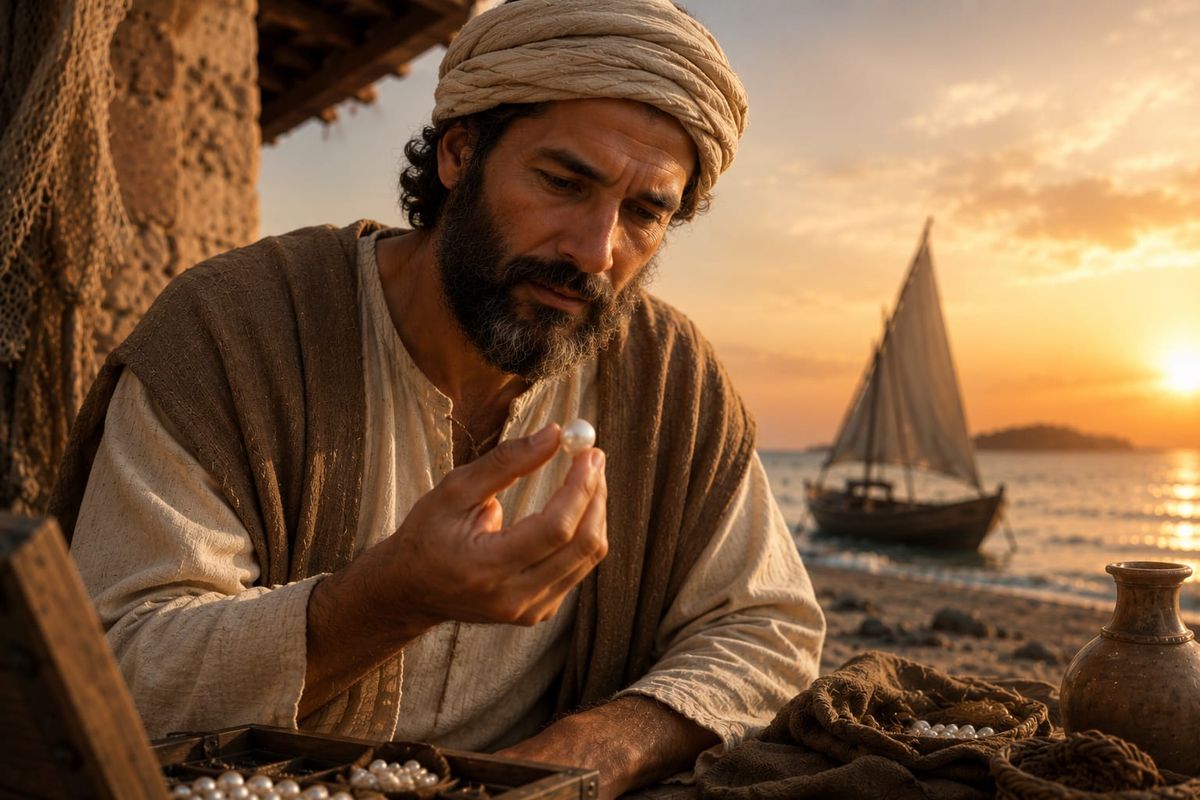
Verse 45 brings us the pearl merchant: “Again, the kingdom of heaven is like a merchant in search of fine pearls, who, on finding one pearl of great value, went and sold all that he had and bought it.” (Matthew 13:45–46, ESV) This man is the opposite of the first. He is a professional who has spent his life evaluating pearls. And then he finds one that reorders the entire scale. He does not agonize over the decision. He sells everything and buys it.
The contrast between the two parables is deliberate, but so is what they share. The farmer found the treasure by accident; he had not been looking. The merchant found the pearl at the end of a lifetime of seeking; he had been looking for exactly this. Two very different paths, and the same response: in both cases the discovery produces immediate action. There is no delay between recognition and response. The farmer does not consult advisors; the merchant does not continue shopping. What matters is not the path by which it is found but what happens the moment it is found.
When Jesus says sell all and buy, he is not giving us a universal command to liquidate our possessions. He is describing the reorientation that finding the Kingdom produces. And it is worth naming what is happening in the parable: the man does not create the treasure; he discovers it. We are not purchasing grace; we are responding to it. The grace comes first. The recognition comes second. The reorientation follows.
The transaction in these parables is about value, not literally about property. The question they press is: has what we hold in the Kingdom become the standard against which everything else in our lives is measured? Has it reordered our priorities? That is what selling everything means. Not the loss of all other goods, but the recognition that all other goods now take their value, or their lack of it, from their relationship to the one thing of supreme worth.
It is worth pausing on what the one thing of supreme worth actually is. The Kingdom is where the King is. When the man finds the treasure hidden in the field, he has found Christ, who entered the world not in power and visibility but hidden in the ordinary material of human life. When the merchant finds the pearl beyond price, he has found Christ.
Solomon knew what to ask for in our Old Testament reading. 1 Kings 3:3–14 records the night God appears to Solomon in a dream and says:"Ask what I shall give you." (1 Kings 3:5, ESV) Solomon could ask for anything. Long life. Riches. Military victory over his enemies. He asks for none of these. He asks for wisdom to govern God's people: "Give your servant therefore an understanding mind to govern your people, that I may discern between good and evil, for who is able to govern this your great people?" (1 Kings 3:9, ESV) He has found his pearl and named it. The merchant who sells everything for one pearl is Solomon's prayer in parable form: this, Lord. Not the other things. This.
God’s response is the collect’s theology made narrative: “Behold, I give you a wise and discerning mind, so that none like you has been before you and none like you shall arise after you. I give you also what you have not asked, both riches and honor, so that no other king shall compare with you, all your days.” (1 Kings 3:12–13, ESV) Solomon asked for wisdom. He received wisdom. And then he received everything he had not asked for. Focus and second things and you may find them. Focus on first things, Christ, and you may also end up with second things. Remember, "seek first the kingdom of God and his righteousness, and all these things will be added to you." (Matthew 6:33, ESV)
This is the pattern our collect names: “Almighty and everlasting God, you are always more ready to hear than we to pray, and to give more than we either desire or deserve.” (BCP 2019, p. 618) The man who sold everything for the field received the treasure. The merchant who sold everything for the pearl received the pearl. Solomon who asked for wisdom received wisdom and riches. In every case, God gives more than the transaction seemed to promise.
Psalm 119:127 places the merchant’s posture in the voice of the psalmist: “Therefore I love your commandments above gold, above fine gold.” (Psalm 119:127, ESV) The psalmist has already made the transaction. He has placed the commandments above everything the world considers most valuable. Not reluctantly, not as an act of duty: he loves them above gold. The pearl is already in his hands.
The fifth parable, in verses 47 through 50, is the dragnet: “Again, the kingdom of heaven is like a net that was thrown into the sea and gathered fish of every kind. When it was full, men drew it ashore and sat down and sorted the good into containers but threw away the bad. So it will be at the end of the age. The angels will come out and separate the evil from the righteous.” (Matthew 13:47–49, ESV) The fishermen do not sort at sea. They cast the net broadly, gathering every kind, and sort on shore when the work of casting is done. The sorting at the close of the age belongs to the angels, just as the separation of wheat from tares belongs to the reapers. Our work is not sorting; our work is casting. The Kingdom is the net. We go on casting it, trusting that the one who commands the harvest also commands the catch.
These five parables close the longest sustained section of Kingdom teaching in Matthew’s Gospel. From the parable of the sower in Proper 10 through the wheat and tares in Proper 11 and now to these five, Jesus has described the Kingdom from every angle: the soil in which the word falls, the enemy who sows alongside it, the patience the harvest requires, the hiddenness in which the Kingdom grows, and the supreme value that makes everything else negotiable. Matthew 13 ends with a beach, a sorted catch, and the word of Jesus about the close of the age. But the image the chapter leaves us carrying is the merchant: one pearl in his hand, everything else sold, in no apparent distress about the transaction. The dragnet tells us how it ends. The pearl tells us what it was worth.
What does it look like, practically, to let the Kingdom hold the place of the pearl? Three things the parables suggest.
First: name what we actually value most. As we saw in the parable, two very different paths, the accidental discovery and the lifetime of searching, arrive at the same moment of recognition. Some of us came to faith without looking for it; some came after years of searching. What matters is what happened at the moment of recognition: did we see what it was? Did we recognize that what we had found was Christ himself, the treasure hidden in the field? The first step is being honest about whether we have truly seen it. What we protect most fiercely is what we actually value most. The parable does not shame that answer; it invites us to compare it to the treasure we have found.
Second: invest in the field, not just admire it. The farmer did not stand at the edge of the field marveling at the treasure he had glimpsed. He went and bought the field. And to buy it he had to evaluate his entire estate. That evaluation is the practical work Step 2 asks of us: what in our week is occupying time that belongs to prayer? What in our budget is drawing resources that could serve the Kingdom? What habits of attention are taking up space that the treasure deserves? The parable does not require us to impoverish ourselves, but it does require us to actually move things: making room for prayer, for the word, for the gathered community, for the works of mercy the Kingdom calls us to.
Third: trust the size. The mustard seed and the leaven remind us that faithful investment in what seems small is exactly how the Kingdom grows. We do not need to see the tree to keep tending the seed. The method is hiddenness. The result is the Lord’s to produce. We plant, water, and trust the harvest to him.
This means resisting the temptation to measure the Kingdom by attendance numbers and large budgets. Those things matter, and a growing congregation is a gift. But the mustard seed parable does not say the Kingdom is like a rapidly expanding plant. It says the Kingdom is like a seed that starts small and ends large, and the process between those two points is mostly invisible. The measure the parables offer is not size but faithfulness: is the word being received? Is the leaven at work in the people who are here?
Church growth, rightly understood, is the spiritual maturity of the people. When the Kingdom goes deeper into a people, when lives are genuinely reordered around the treasure, when prayer becomes real and mercy becomes habitual and the word is received with understanding, something happens. People notice. They are drawn. The leaven does not stay contained to the portion of dough that was first touched; it works outward until all is leavened.
Depth in the Kingdom tends, over time, to produce breadth in the congregation. Not always on our schedule, and not by our management, but the Lord who said the mustard seed becomes a tree also said that men would come and nest in its branches. Growth is not ours to manufacture, but faithfulness is not inert. The two parables together say: go deep, and trust the size to him.
Underlying all three steps is the posture the collect describes. We bring our honest ledger to God, we make room in the field, we tend the seed, and we trust him with the outcome. And even our ability to recognize the treasure is itself God’s gracious work; the Spirit opens eyes to see what the world walks past. This is the collect’s promise: the assurance that what we cannot produce by our own effort, God will supply. The God who gives more than we desire or deserve is the one we are reordering toward, and that changes what the reordering means.
The three steps the parables suggest, then, are not a program for personal improvement. They are the posture of people who have found the pearl and know the dragnet is coming: honest about what we value, invested in the field, trusting the seed to the one who produces the harvest. The dragnet tells us how the story ends. The pearl tells us what the Kingdom was worth all along. Let that price govern the whole ledger, in the confidence that the one who gives more than we desire or deserve is already at work in what we have planted.
In the Name of the Father, and of the Son, and of the Holy Spirit. Amen.