He Has Risen: The Great Vigil of Easter 2026 (Matthew 28:1-10)
On Friday, Jesus said, “It is finished.” On Saturday, he was buried. At the Great Vigil, the stone is rolled away and the word finally comes: “He has risen.” The grave could not hold Christ, and because he lives, those who belong to him will live also.
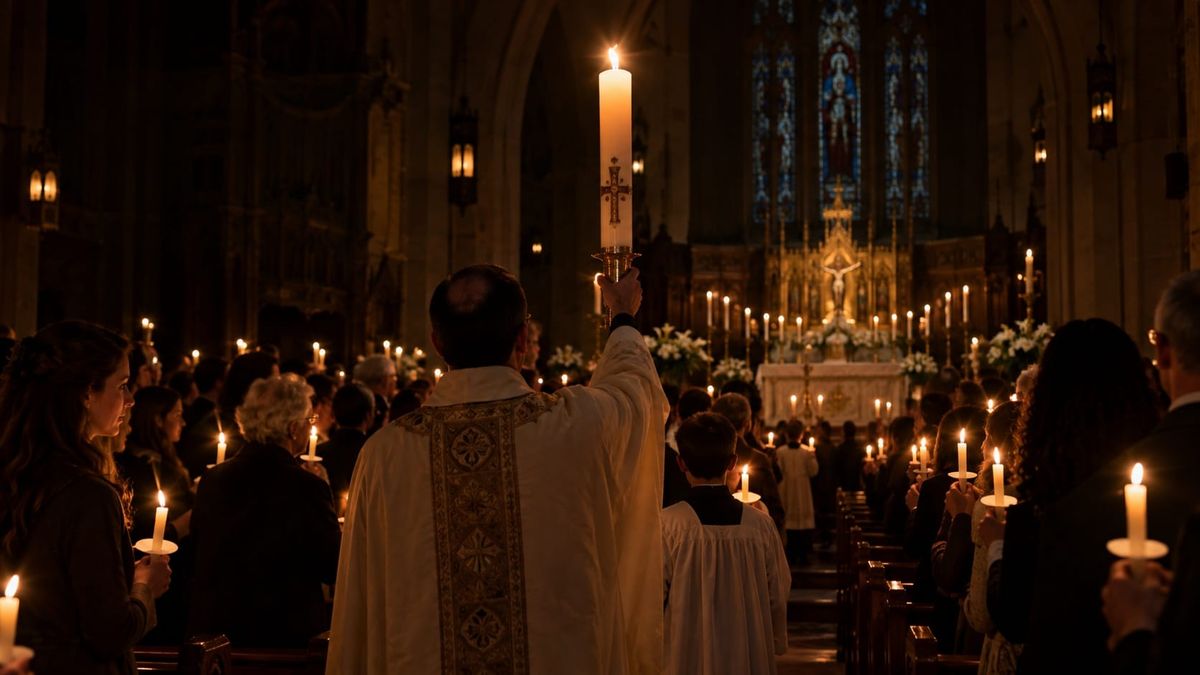
April 4, 2026, The Great Vigil of Easter, The First Liturgy of Easter Day
Matthew 28:1–10, Psalm 114, Romans 6:3–11, Exodus 14:10–15:1
Grace, mercy, and peace from God our Father and the Lord Jesus Christ be with you on this most holy night, as the Church passes from the silence of the tomb into the joy of Easter.
On Thursday night, Jesus gathered his disciples around the table and gave himself to them, his Body given and his Blood of the new covenant. On Friday, we followed him to the Cross and heard the word that gathered his saving work into one declaration: tetelestai. “It is finished.” (John 19:30, ESV) Yesterday, on Holy Saturday, we remained for a little while at the tomb with the apostle’s simple confession: “he was buried.” The stone was sealed, the guard was posted, the women waited, and the body of Jesus rested in the grave. Tonight, Matthew gives us the next sentence, and the restraint of these days finally gives way to the proclamation toward which the whole Triduum has been moving: he has risen.
Verse 1 begins, “Now after the Sabbath, toward the dawn of the first day of the week, Mary Magdalene and the other Mary went to see the tomb.” (Matthew 28:1, ESV) These are the same women Matthew showed us sitting opposite the tomb when Joseph of Arimathea placed Jesus there. They had watched the burial. They knew where his body had been laid. They had seen the stone rolled into place. Now, after the Sabbath, they return to the place of death. Matthew does not suggest that they are coming because they expect an empty tomb. They return because love draws them back to the place where the One they loved had been buried.
But when they arrive, the world they thought they understood has already been overturned. Verse 2 tells us, “And behold, there was a great earthquake, for an angel of the Lord descended from heaven and came and rolled back the stone and sat on it.” (Matthew 28:2, ESV) The earth shakes. The stone moves. The guard that had been placed there to make the tomb secure becomes helpless before the messenger of God. Yesterday, everything in Matthew’s final scene seemed to say that death had won: the body was inside, the stone was in place, the seal was fixed, and armed men stood watch. Tonight, God overturns the whole arrangement.
The stone is not rolled away because Jesus needs help getting out. Matthew does not present the angel as rescuing a trapped Savior. The stone is rolled away so that the women may see what God has already done. That matters because Easter begins with divine action, not human effort. The women do not move the stone. The disciples do not raise Jesus. The Church does not generate resurrection life by believing hard enough, worshiping fervently enough, or promising to do better. God acts. God raises the dead. Grace comes before our response because the Resurrection happened before anyone at the tomb understood what God had done.
Then, in verses 5 and 6, the angel says, “Do not be afraid, for I know that you seek Jesus who was crucified. He is not here, for he has risen, as he said.” (Matthew 28:5–6, ESV) Notice how carefully the angel speaks. He does not say merely that Jesus is alive. He identifies him as “Jesus who was crucified.” Easter does not replace Good Friday with a happier story. The risen Lord is the Crucified One. The wounds were real, the suffering was real, the death was real, and the body Joseph laid in the tomb is the body God has raised.
Then the angel adds, “Come, see the place where he lay.” (Matthew 28:6, ESV) That invitation reaches directly back into Holy Saturday. Yesterday we said with Paul, “he was buried.” Tonight the women are shown the place where he had been. The place is real. The burial is real. The tomb is real. But the body is gone. The Christian claim is not that Jesus’ teaching survived in the memories of his followers, that grief slowly became inspiration, or that death became a metaphor for hope. God raised the crucified Jesus bodily from the dead.
The Gospel therefore begins with news rather than aspiration: “He is not here, for he has risen, as he said.” Those last words matter. Jesus had told them what would happen. The Cross was not a defeat God somehow repaired after the fact, and the Resurrection was not an emergency response to a plan gone wrong. The Son had said that he would suffer, die, and rise. What God promised, God has done. Christian hope therefore rests not in our ability to imagine a better ending, but in the faithfulness of the God who keeps his word.
The long history proclaimed in the Vigil’s lessons belongs naturally to this night because Easter does not appear out of nowhere. The same God who created light out of darkness, judged evil, kept covenant, delivered his people, promised cleansing and new hearts, and spoke life over dry bones has brought his saving purpose to fulfillment in Jesus Christ. Again and again, Scripture shows us the God who acts when his people cannot save themselves, who opens a way where they cannot make one, and who keeps promises that seem impossible from the human side.
This is especially clear in the Old Testament reading the Vigil always requires, the passage through the Red Sea. Israel stands trapped. Pharaoh’s army is behind them. The sea is before them. They cannot defeat the Egyptians, command the waters, or manufacture an escape route. They have reached the end of what human beings can do, and it is precisely there that God acts. Exodus 14 tells us that the Lord opens the sea and brings his people through on dry ground while the power that enslaved them is broken behind them. Then Exodus 15 begins with a song: “I will sing to the LORD, for he has triumphed gloriously.” (Exodus 15:1, ESV) Psalm 114 remembers the same deliverance by saying, “The sea looked and fled; Jordan turned back.” Creation itself seems to move before the presence of the Lord.
The Vigil gives us that story because Easter is the greater Passover. Israel passes from slavery toward freedom through waters God opens. Christ passes through death and emerges victorious. Those united to Christ are brought out from slavery to sin into newness of life, and finally they will be brought through death itself into resurrection. The Exodus is not merely a symbol whose own history no longer matters. God truly delivered Israel from Pharaoh. But that real deliverance becomes part of the scriptural pattern through which the Church understands the greater salvation accomplished in Christ. The God who opened a way through the sea has opened the greater way through sin and death in Jesus Christ.
Romans 6 takes that pattern of deliverance and brings it directly to us. Paul asks in verse 3, “Do you not know that all of us who have been baptized into Christ Jesus were baptized into his death?” Then verse 4 says, “We were buried therefore with him by baptism into death, in order that, just as Christ was raised from the dead by the glory of the Father, we too might walk in newness of life.” (Romans 6:3–4, ESV) Notice the order. Christ acts first. Christ dies, Christ is buried, and Christ is raised. Then, united to him, we are given a new life.
Christianity does not begin with the command to improve yourself. It begins with a death and a Resurrection you did not perform. Baptism does not celebrate our ability to become better people. It declares that God has joined us to Christ. That is why the Great Vigil has always held Baptism close to the Resurrection. The connection is not decorative. Paul gives it to us directly. We are buried with Christ so that we may walk in newness of life, and that newness is not merely turning over a new leaf, beginning another religious effort, or promising to try harder after Lent. It is life that comes from union with the risen Christ.
That means Easter speaks directly to sin as well as to death. Paul continues by saying that our old self was crucified with Christ so that we would no longer be enslaved to sin. Then, in verse 11, he says, “So you also must consider yourselves dead to sin and alive to God in Christ Jesus.” (Romans 6:11, ESV) The Resurrection is not only about what happens when we die. It changes who owns us now. Sin does not get to say that we will always belong to it. The habits that shame us do not get to say that nothing can ever change. The failures of our past do not get to define the final truth about us.
If you belong to Christ, your deepest identity is not found in the sin from which he has saved you, but in the Lord who died and rose for you. That does not mean Christians become incapable of sin. Paul would have no need to exhort us if that were true. We still struggle, still repent, still fall, and still return again to grace. But sin is no longer our rightful master. Christ is Lord. Repentance is therefore not an attempt to persuade God to give us life. It is the response of people to whom life has already been given in Christ. We turn from sin because we belong to the risen Lord, not in order to make him our Lord by the strength of our turning.
This is the movement from Exodus to Easter. Israel is brought out of slavery. In Christ, we are brought out from the dominion of sin. Israel passes through waters God opens. In Baptism, we are joined to Christ’s death and Resurrection. Israel emerges to walk as a redeemed people. Christians are called to walk in newness of life. God’s grace does not leave us where it finds us, but neither does our obedience create the grace. The deliverance comes first. The new life follows.
Then Matthew carries us from the empty tomb into witness. In verse 7, the angel tells the women, “Go quickly and tell his disciples that he has risen from the dead.” (Matthew 28:7, ESV) Resurrection news immediately becomes a message to be carried. Verse 8 says that they leave the tomb “with fear and great joy.” That combination is wonderfully human. They are not calm because they have mastered the event. Something has happened that exceeds every category they possess. Fear and joy run together because the world they entered that morning is no longer the world they thought they knew.
And then, in verse 9, the risen Jesus himself meets them: “And behold, Jesus met them and said, ‘Greetings!’ And they came up and took hold of his feet and worshiped him.” (Matthew 28:9, ESV) They take hold of his feet. Matthew will not let us turn the Resurrection into an abstraction. This is Jesus. He can be met, touched, and worshiped. The body that was nailed to the Cross is alive. The body wrapped in linen and placed behind the stone is alive. The One who was dead now stands before them.
That brings us back to the question Holy Saturday left hanging in the air from Job: “If a man dies, shall he live again?”Tonight Matthew answers it by showing us Jesus alive before the women. And that answer matters because Easter is not only about Jesus’ victory in isolation. Paul says elsewhere that Christ has been raised as “the firstfruits of those who have fallen asleep.” (1 Corinthians 15:20, ESV) Firstfruits means there is more to come. His Resurrection is not a solitary exception to the rule of death. It is the beginning of the harvest, and therefore the bodily Resurrection of Jesus is God’s pledge that those who are his will also be raised bodily at the last day.
That is why Easter speaks so powerfully to those who have stood beside graves. Holy Saturday allowed us to tell the truth about what burial feels like. The prayers are said, the body is committed to the earth, and the living go home while the dead remain behind. Easter does not tell us that grief was foolish because now we know better. It tells us that grief is not the final word because death is not the final word. We bury Christians in sure and certain hope not because we are trying to soften the reality of death, but because the One to whom they belong has already been raised from it.
Some of us carry particular faces and names into this night: parents, husbands and wives, brothers and sisters, friends, and sometimes children. Their absence is still felt at holidays and dinner tables, in photographs and familiar places, in memories that arrive without warning. Easter does not ask us to pretend that absence does not hurt. Jesus himself wept at Lazarus’s tomb. But Easter tells us that a Christian grave is not a place where hope ends. The body committed to the ground awaits the day when Christ will raise his people, and what is sown perishable will be raised imperishable.
The Shepherd who leads us through the valley of the shadow of death has walked that valley himself. He entered death, and he came out alive. Our hope is therefore not simply that some invisible part of us continues after the body dies. We confess the resurrection of the body. The Gospel announces an empty tomb and a risen Lord whom the women can take hold of and worship. God does not abandon his creation to death. The body matters, creation matters, and the God who raised Jesus will not leave his people forever in the grave.
That promise does not remove the sorrow of death now. Christians still mourn. We still miss those who have died. We still stand at gravesides with tears in our eyes. But we do not stand there believing the grave has made an irreversible claim upon someone who belongs to Christ. At the last day, the Lord who raised Jesus from the dead will raise those who are his. What we now confess by faith we will then see, and the hope that seems hidden beneath earth and stone will be revealed in resurrection life.
This is why Easter means more than encouragement in difficult circumstances. Illness, loneliness, disappointment, and loss are real, and the risen Christ meets us in them. But the Gospel reaches deeper still, to the enemy none of us can finally escape by our own power. Death itself has been confronted by Jesus Christ. He has passed through it and risen, and because he lives, death cannot make the final claim upon those who belong to him. That hope allows us to face every lesser fear without pretending that any of them is small. They are simply not ultimate.
The hope of resurrection also changes how we live before we die. If death has lost its final claim, then we do not need to live as though this present age is all we have. We do not need to clutch every possession, protect every comfort, or build our identity around keeping ourselves safe. We can love generously, forgive, repent, serve, and give ourselves away because our life is hidden with Christ and our future is held by the God who raises the dead. Newness of life now and resurrection at the last day belong together because both come from the same risen Lord.
That is why Romans 6 belongs beside Matthew 28. The same Resurrection that promises life beyond the grave also gives us newness of life now. We have not yet received the resurrection body promised at the last day, but even now we belong to the risen Christ. His future has already begun to shape our present. We are dead to sin and alive to God in him, and the life we live now is meant to bear witness to the kingdom that will one day be revealed in fullness.
The renewal of baptismal vows, when it is used at the Vigil, is therefore not a promise to manufacture a new life by trying harder. It is a response to grace already given. We remember whose we are and that Christ has joined us to himself. The Collect for this night asks God, who made this holy night shine with the glory of the Lord’s Resurrection, to “stir up in your Church that Spirit of adoption which is given to us in Baptism.” The gift comes first. We receive the grace, and then we are renewed to worship and live as those who belong to him.
And now the whole movement of these days comes together. Thursday night, Christ gave himself to us. Friday, we heard tetelestai: the saving work is finished. Saturday, we confessed that he was buried. Tonight, the stone is rolled away, the place where he lay is empty, and the angel says, “He has risen.” The God who opened the sea has opened the greater way. He brings sinners out of slavery into freedom, from sin into newness of life, and at the last he will bring his people through death into resurrection.
So if you carry grief into this Easter night, carry it honestly. You do not need to manufacture joy or pretend that loss no longer hurts. If you carry the burden of sin, do not imagine that you must free yourself before Christ will receive you. If you look toward your own death with fear, do not rest your hope in your courage. Bring all of it to the risen Christ. The news does not depend upon the strength of our feelings tonight. The tomb is empty whether we arrive rejoicing or weary, confident or trembling.
Perhaps that is one of the gifts of the Vigil. After all the movement of these days, the Church is finally permitted simply to stand before what God has done. We have followed Christ from the table to the Cross, from the Cross to the tomb, and from the tomb into light. We have heard the old stories of deliverance, watched the flame spread through the darkness, and heard again the announcement that changes everything. We do not need to manufacture Easter. We receive it.
Jesus Christ, who was crucified, is risen from the dead. Sin does not have the final word. The grave does not have the final word. Death does not have the final word. Christ does. Because he lives, those who belong to him will live also. The God who opened the sea, who brings sinners out of bondage, and who raised Jesus from the grave will not abandon his people to death. The body was given, the sacrifice was finished, he was buried, and now he has risen. The whole journey of these days has brought us here.
For now, stand before the empty place with Mary Magdalene and the other Mary and hear the angel’s words once more: “He is not here, for he has risen, as he said.” We need not add anything to them. We need only receive them, trust the One who promised them, and worship the living Christ. One day the graves will give up their dead, and the hope we confess tonight will be seen in resurrection life.
Alleluia. Christ is risen. The Lord is risen indeed. Alleluia.
In the Name of the Father, and of the Son, and of the Holy Spirit. Amen.