The Paschal Candle: An Anglican Perspective
The Paschal Candle therefore belongs to the whole biblical movement from Passover to Resurrection. Its light is not generic optimism, springtime renewal, or the natural return of brightness after winter. It is specifically the light of the crucified and risen Jesus Christ.
The Light of Christ, the Resurrection, and the Church’s Easter Hope
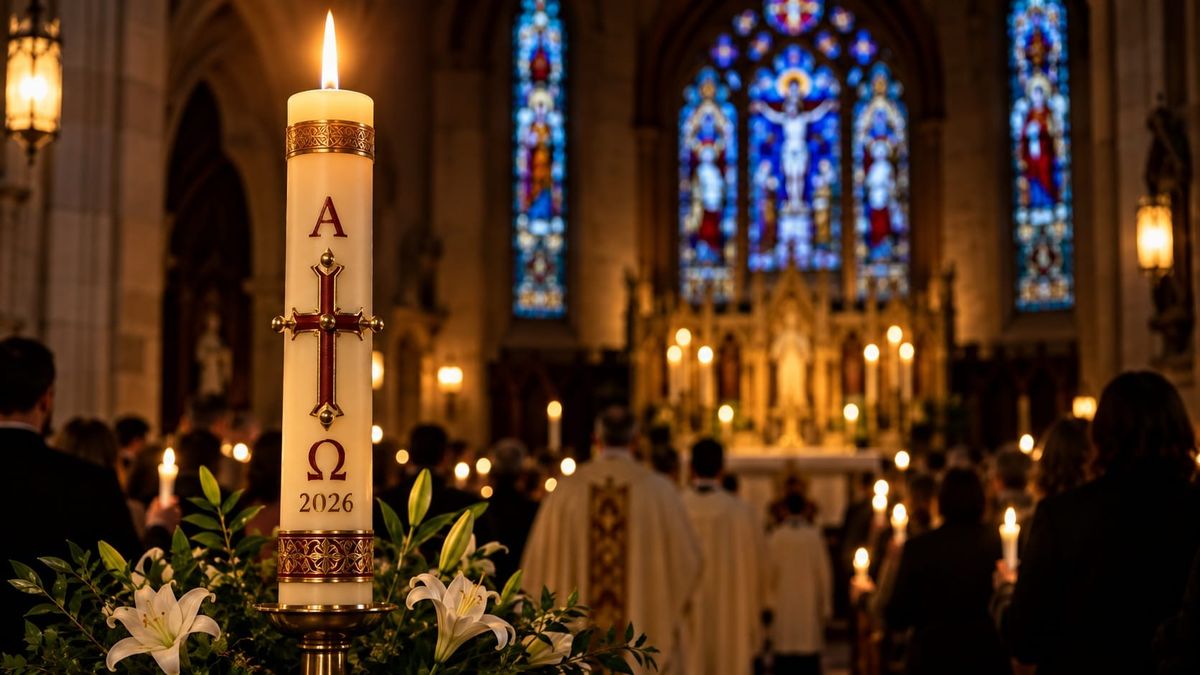
When the Church gathers for the Great Vigil of Easter, one of the first things the congregation encounters is darkness. The church may be almost completely unlit. Outside or near the entrance, a new fire is kindled. From that fire a large candle is lit, carried into the church, and lifted before the people with the proclamation, “The light of Christ.” The congregation responds, “Thanks be to God.”
That candle is the Paschal Candle. It will stand prominently throughout the Easter season, burning at the Church’s principal celebrations as a visible proclamation that Jesus Christ has risen from the dead. The same candle will traditionally appear again at Holy Baptism and at the Burial of the Dead, connecting the Christian’s entrance into the sacramental life of the Church with the resurrection hope in which the Church finally commits the body of one of her members to the grave.
The Paschal Candle is therefore much more than an Easter decoration. The Book of Common Prayer 2019 explicitly identifies it as a symbol of Christ, the Light of the world (BCP 2019, p. 581). It belongs within a liturgy in which darkness gives way to light, the history of salvation is proclaimed from Holy Scripture, Christians are united to Christ’s death and resurrection in Baptism, and the Church gathers at the Holy Table to celebrate the victory of the risen Lord.
Like other physical signs used in Christian worship, however, the candle needs to be understood rightly. It is not itself Christ. Its flame does not contain the risen Lord, and lighting it does not reenact or repeat the Resurrection. The candle serves the Gospel, making visible what the Church is already proclaiming: Jesus Christ has passed through death, risen victorious from the grave, and brought his people into the light of his resurrection life.
What “Paschal” Means
The word Paschal comes from the Christian language of Passover. Easter is the Christian Pascha (PAH-skah), the feast in which the Church celebrates Christ’s passage through death into resurrection and recognizes in him the fulfillment of the biblical Passover.
That connection stands near the heart of the Great Vigil itself. The BCP begins the Service of Light by declaring that on this most holy night “our Lord Jesus passed over from death to life.” It continues, “For this is the Passover of the Lord,” in which the Church, hearing God’s Word and celebrating his Sacraments, shares in Christ’s victory over death (BCP 2019, p. 582).
The Exsultet (eg-ZUHL-tet), the great Easter proclamation sung or said beside the Paschal Candle, makes the connection even more explicit. Christ is proclaimed as the true Paschal Lamb, and the Church remembers Israel’s deliverance from bondage, the crossing of the Red Sea, the pillar of fire, and finally Christ’s breaking of the bonds of death and hell (BCP 2019, pp. 583–585).
The Paschal Candle therefore belongs to the whole biblical movement from Passover to Resurrection. Its light is not generic optimism, springtime renewal, or the natural return of brightness after winter. It is specifically the light of the crucified and risen Jesus Christ.
The Paschal Candle and the Ancient Easter Vigil
The history of the Easter Vigil reaches deep into the early life of the Church. Christians gathered in watchfulness and prayer through the night as they prepared to celebrate the Resurrection. The ceremonies surrounding the Easter light developed over time, and we should resist the temptation to describe every later feature of the Paschal Candle as though it appeared in apostolic Christianity in exactly its present form.
What can be said safely is that the Easter Vigil is an ancient Christian observance and that, over time, the use of light became increasingly associated in the Western Church with the Paschal celebration. As the Vigil developed, the lighting of lamps and candles took on an explicitly Christian meaning: the darkness of the night gave way to light as the Church proclaimed the Resurrection of Christ.
The Church of England’s historical notes on the Easter liturgy describe this development carefully. They identify the earliest Christian observance of Easter as a vigil of watching, fasting, and prayer through the hours of darkness, and explain that the ordinary evening lighting of a candle gradually acquired specifically Paschal meaning in the Western Church.
That history is more careful than simply saying that Christians borrowed a candle ceremony directly from Jewish Passover observance. Christianity unquestionably receives Passover through the biblical story and identifies Christ as the true Paschal Lamb, but the particular development of the Easter Candle belongs to the liturgical history of the Christian Vigil.
What matters for Anglican worship today is that the Paschal Candle has not survived merely as an antiquarian custom. It has been received into the Church’s Easter worship because it continues to proclaim clearly what Easter means.
The Service of Light
The Book of Common Prayer 2019 gives the Paschal Candle its clearest setting in the opening portion of the Great Vigil of Easter. The Prayer Book says that the Vigil is the first liturgy of Easter Day and is properly celebrated sometime between sunset on Holy Saturday and sunrise on Easter morning. The liturgy normally has four parts: the Service of Light, the Service of Lessons, Holy Baptism or the Renewal of Baptismal Vows, and the Holy Eucharist (BCP 2019, p. 581).
The Service of Light begins in darkness, and according to ancient tradition, the light for the Paschal Candle is taken from a newly kindled fire rather than from an already existing source of light. If circumstances permit, the fire may be kindled outside, with the congregation gathering around it before following the candle into the church (BCP 2019, p. 595).
This is liturgical drama, but it is not theater for its own sake. Darkness is real within the biblical story. Scripture speaks of the darkness of sin, death, ignorance, judgment, and the grave. Saint John proclaims of the eternal Word, “The light shines in the darkness, and the darkness has not overcome it” (John 1:5).
The Prayer Book itself supplies the meaning of the action. As the Paschal Candle is lit, the Celebrant prays, “May the light of Christ, rising in glory, banish all darkness from our hearts and minds” (BCP 2019, p. 583).
The candle is then carried into the church, and three times the minister announces, “The light of Christ,” to which the people answer, “Thanks be to God” (BCP 2019, p. 583). If candles have been distributed to members of the congregation, they are lit from the Paschal Candle, so that one flame becomes many as light spreads through the darkness.
The action interprets itself. The Church does not generate the light. The light is received and carried. Christian salvation does not arise because humanity gradually overcomes darkness by its own effort. Christ comes into the darkness, and his people receive light from him.
The Cross, Alpha and Omega, and the Year
The BCP permits the Paschal Candle to be marked before it is lit. These markings are optional, but where they are used, the Prayer Book gives them an explicitly Christological meaning (BCP 2019, p. 595).
A cross is traced on the candle while Christ is proclaimed as “yesterday and today” and “the beginning and the end.” The Greek letters Alpha and Omega may then be marked upon it, followed by the numerals of the current year. As those numerals are traced, the Celebrant declares that all time belongs to Christ and that glory and power belong to him through every age.
This is a particularly rich part of the ceremony because it prevents the Resurrection from becoming merely an event remembered from the distant past. The Christian proclamation is not simply that Jesus rose once, long ago, in the reign of Pontius Pilate. The risen Jesus is Lord now.
The year marked on the candle belongs to him. This year, with its joys, losses, wars, elections, births, funerals, anxieties, parish life, family life, and ordinary days, stands within his lordship.
The language of Alpha and Omega comes from Revelation, where the Lord declares himself the beginning and the end (Revelation 21:6; 22:13). The candle therefore places the Church’s present life inside the reign of the eternal Christ.
History does not belong finally to emperors, governments, markets, armies, cultural movements, or human ambitions. All time belongs to Christ.
The Wounds of the Risen Lord
The Prayer Book also permits nails or incense studs to be inserted into the candle, and traditionally five are used, commonly associated with the wounds of Christ. As they are inserted, the BCP provides the prayer, “By his holy and glorious wounds may Christ our Lord guard and keep us” (BCP 2019, p. 595).
The symbolism is important. Easter does not give the Church a different Jesus from the Jesus of Good Friday. The risen Christ is the crucified Christ.
Resurrection does not erase the Cross or make Christ’s Passion an unfortunate episode left behind once Easter morning arrives. The One who conquered death is the One who was pierced for sinners. Saint John’s Gospel deliberately preserves that continuity when the risen Lord shows his disciples his hands and his side (John 20:20) and later invites Thomas to see and touch the marks of his wounds (John 20:27).
The Paschal Candle therefore brings Cross and Resurrection together. The wounds are not signs that death finally defeated Christ. They are the wounds of the victorious Lamb.
Christ’s suffering was real, his death was real, and the price of redemption was not imaginary. Yet death could not hold him.
The Exsultet and the Meaning of the Candle
The Paschal Candle cannot be understood fully apart from the Exsultet. After the procession, the candle is placed in its stand and the Exsultet is customarily sung or said nearby. The BCP describes this ancient proclamation as the climax of the Service of Light (BCP 2019, p. 581).
The Exsultet prevents the candle from becoming an isolated symbol onto which Christians project whatever meaning they prefer. The Church interprets the light through the Gospel.
The proclamation rejoices because darkness has been vanquished by the eternal King. It praises Jesus Christ as the only-begotten Son of God, remembers that he has paid the debt of Adam’s sin, names him as the true Paschal Lamb, remembers Israel’s deliverance from Egypt, recalls the pillar of fire, and proclaims the night in which Christ broke the bonds of death and hell and rose victorious from the grave (BCP 2019, pp. 583–585).
The Paschal Candle therefore stands inside the whole history of redemption. Creation, Fall, Exodus, Passover, Cross, Resurrection, Baptism, Eucharist, and final glory are not separate religious ideas loosely gathered around Easter. They belong to the one saving work of God fulfilled in Jesus Christ.
The candle’s flame is beautiful, but the Church does not simply contemplate beauty. She interprets the flame through Scripture and proclamation. That is a characteristically Anglican instinct worth preserving: symbols are most trustworthy when they remain servants of the Word of God.
The Paschal Candle Through the Great Fifty Days
The Paschal Candle does not disappear after the Great Vigil. The BCP directs that it “should be lit for all principal services throughout the season of Easter” (BCP 2019, p. 595), placing the candle within the full Great Fifty Days rather than treating Easter as a celebration exhausted by Easter morning.
Easter is a season because the Resurrection cannot be adequately celebrated in a few hours. For fifty days, from Easter through Pentecost, the Church dwells in the victory of the risen Christ. The Alleluia returns. The Scriptures repeatedly proclaim the risen Lord. The Church hears again how Christ appeared to his disciples, opened the Scriptures, commissioned his witnesses, ascended into glory, and poured out the Holy Spirit.
The candle stands in the midst of that season as a continuing visual confession: Christ is risen. It would therefore be misleading to describe the Paschal Candle merely as the candle used “at Easter.” Its fullest liturgical home is Eastertide.
What About Ascension Day?
A related ceremonial question arises at Ascension Day because an older Western custom developed in which the Paschal Candle was extinguished after the Gospel, symbolizing Christ’s departure from the disciples’ sight. Some Anglican parishes have inherited or adopted that practice.
The symbolism is understandable, but Ascension Day does not end the Easter season. It falls within the Great Fifty Days, which continue through Pentecost. The Book of Common Prayer 2019 therefore directs that the Paschal Candle “should be lit for all principal services throughout the season of Easter” (BCP 2019, p. 595).
So the distinction is simple: extinguishing the candle on Ascension Day is a historic Western ceremonial custom, while continuing to light it through Eastertide follows the explicit rubric of the BCP 2019.
The Paschal Candle and Holy Baptism
The Paschal Candle also reaches beyond Eastertide, and the BCP says that it is traditionally used at Baptism throughout the year (BCP 2019, p. 595). That connection is not accidental.
The Prayer Book’s introduction to the Great Vigil says that Holy Baptism is the Sacrament through which candidates are “united to the death and resurrection of Jesus Christ” and points directly to Romans 6:3–4 (BCP 2019, p. 581). Saint Paul gives the theological heart of that connection when he writes, “We were buried therefore with him by baptism into death, in order that, just as Christ was raised from the dead by the glory of the Father, we too might walk in newness of life” (Romans 6:4).
Baptism is therefore not simply a ceremony of welcome, a public declaration of personal commitment, or a religious naming ceremony. In Baptism, the Christian is united to Christ’s death and resurrection and incorporated into the life of his Church.
The Paschal Candle stands nearby because the life proclaimed in Baptism is resurrection life. The same Lord whose Resurrection is proclaimed by the Easter Candle is the Lord into whose death and resurrection Christians are baptized. Some Anglican customs include giving the newly baptized a lighted candle, often kindled from the Paschal Candle. Even where that particular ceremonial action is not used, the theological connection remains clear.
The Paschal Candle and the Burial of the Dead
Perhaps one of the most pastorally powerful uses of the Paschal Candle comes at the other end of Christian earthly life. The BCP says that the candle is traditionally used at the Burial of the Dead throughout the year (BCP 2019, p. 595).
That creates a profound liturgical relationship between Baptism and burial. At Baptism, the Church proclaims that we are united to Christ’s death and resurrection. At Christian burial, the Church gathers around the body of one who was baptized into that death and resurrection and confesses the hope that the risen Christ will raise the dead.
The candle does not deny grief. Christian burial is not a demand that mourners pretend death is painless. Jesus himself wept at the tomb of Lazarus.
Nor does the candle teach that Christian hope ends with the soul’s departure from the body. The Creed carries us further: “the resurrection of the dead, and the life of the world to come.”
The Paschal Candle at a funeral therefore points toward Easter. The body is committed to the grave for a time, but death does not possess the final word. The Christ who rose bodily from the grave will raise his people.
The same light that entered the darkened church on Easter night now burns beside the Christian dead. This is not sentimentality, but resurrection theology made visible.
Beeswax, Size, and Other Customs
Many Paschal Candles are made from beeswax, and Christian tradition has sometimes attached devotional symbolism to that material. Paschal Candles also vary considerably in size and decoration.
Those customs may be meaningful, but they should not be confused with what the BCP requires. The Book of Common Prayer 2019 does not prescribe beeswax, a particular height or diameter, or an elaborate decorative scheme.
Some candles are richly ornamented. Others are marked simply with the cross, Alpha and Omega, and the year. The important question is not how elaborate the candle is, but whether the sign serves the proclamation entrusted to it.
The Prayer Book gives the theological center: Christ is the Light of the world, and the candle bears witness to him.
What the Paschal Candle Does Not Mean
Because Christian worship uses physical things, it is sometimes important to say not only what a symbol means but also what it does not mean. The Paschal Candle is not a sacrament instituted by Christ, and it does not possess the same theological status as the water of Holy Baptism or the bread and wine of Holy Communion.
The candle is not Christ, and the flame is not Christ’s presence contained in a material object. Lighting it does not cause the Resurrection to occur again. Jesus died and rose once for all.
Nor does the Church need to invent hidden meanings for every feature of the candle. The Prayer Book already gives a rich interpretive framework: Christ the Light of the world; the Cross; Alpha and Omega; his glorious wounds; his lordship over time; the Passover; Baptism; and Resurrection.
Anglican ceremonial is healthiest when the sign remains clear and Christ remains central.
Created Things in Christian Worship
Some Christians can be uneasy with candles, processions, ashes, palms, water, oil, vestments, or other physical signs because they fear that material things may distract from spiritual truth. That concern can be healthy when it guards against superstition, but Christianity itself does not treat the material world as spiritually irrelevant, because the Son of God became flesh.
Jesus used water, bread, wine, touch, breath, spoken words, and ordinary created things within his ministry. The Church baptizes with water because Christ commanded it. She celebrates Holy Communion with bread and wine because Christ instituted it.
Other ceremonial objects do not have that sacramental status, but they may still serve faithful Christian worship. The Paschal Candle is a particularly clear example: a flame is something human beings can see, darkness is something we experience, a procession moves bodily through physical space, and one light kindles another.
The Church uses those created realities to assist the proclamation of something far greater than the objects themselves. The candle matters because Christ matters.
A Sign Received by the Anglican Church
Anglican parishes vary in ceremonial practice, and in some churches the Great Vigil is celebrated with considerable ceremonial richness: an outdoor fire, a large decorated Paschal Candle, a darkened church, a solemn procession, incense, chanting of the Exsultet, Baptism, bells, and a festal Eucharist. Other parishes celebrate more simply.
The Paschal Candle itself may be elaborate or plain. It may stand beside the font during Baptisms and near the coffin during funerals. Its precise location in the church may vary according to architecture and local custom.
This diversity need not obscure the essential point. The BCP gives the candle a defined liturgical home and a clear theological purpose. At the Great Vigil it symbolizes Christ, the Light of the world. It is lit from the new fire. It accompanies the Church through the Easter season. It is traditionally used at Baptism and burial. Its markings, where used, proclaim the eternal lordship and saving wounds of Jesus Christ (BCP 2019, pp. 581, 595).
Ceremonial details may vary. The Gospel being proclaimed should not.
Living in the Light of the Resurrection
The Paschal Candle eventually goes dark, because no candle burns forever. Its flame burns through Eastertide and may appear again beside the font or at Christian burial, but the extinguishing of the flame does not weaken the symbol. It clarifies it.
The Church does not believe in the flame; she believes in Jesus Christ. Christ does not cease to reign when Eastertide ends or when the candle is extinguished. The One proclaimed by the sign is living, ascended, reigning, interceding, and coming again.
The light therefore sends us outward. Saint Paul tells Christians to “walk as children of light” (Ephesians 5:8). Jesus tells his disciples, “You are the light of the world” (Matthew 5:14), not because the Church possesses some independent brightness of her own, but because she belongs to him.
The Easter Vigil makes that dependence visible because the people’s candles receive their flame from the Paschal Candle. The light is received before it is carried, and so it is with Christian witness. The Church does not illuminate the world by advertising her own goodness. She bears witness to Jesus Christ, receives life from him, and carries his Gospel into the darkness.
Conclusion
The Paschal Candle is one of the Anglican Church’s clearest visual proclamations of Easter. It begins in darkness. A new fire is kindled. The candle is lit. Christ is proclaimed as yesterday and today, the beginning and the end, Alpha and Omega. His Cross is traced upon it. His wounds are remembered. The year itself is placed beneath his lordship. The candle is raised and carried into the darkened church, where the proclamation and response are heard: “The light of Christ.” “Thanks be to God.”
From there the Church hears again the story of salvation, remembers the Passover, hears the prophets, renews baptismal promises or receives new Christians through the waters of Baptism, and comes at last to the Eucharistic feast of the risen Lord.
The candle remains through the Great Fifty Days because Easter is larger than a single morning. It returns at Baptism because Christians are united to Christ’s death and resurrection. It burns at Christian burial because the baptized die in the hope of the resurrection of the dead and the life of the world to come.
Yet the candle remains a sign, pointing beyond itself to the crucified and risen Lord. In a darkened church, one flame appears, and from that flame others receive their light. The darkness recedes, not because the congregation has conquered it, but because light has come.
The deepest truth proclaimed by the Paschal Candle is therefore the truth proclaimed by Easter itself: we do not light our way out of death. Christ comes to us. The crucified One has risen. Death has been defeated. The darkness cannot overcome him.
And so, whenever the Paschal Candle burns before the Church, its message remains the same: “The light of Christ.” “Thanks be to God.”