He Sent His Son (Matthew 21:33–44)
Jesus says this is “the Lord’s doing,” and it is “marvelous in our eyes.” That word marvelous matters. The proper response to the risen Son is not merely that we have understood the argument correctly. It is wonder. The one rejected by men has been chosen by God.
October 4, 2026, Year A, Proper 22, Nineteenth Sunday after Pentecost, Season after Pentecost
Matthew 21:33–44, Psalm 80:7–19, Isaiah 5:1–7
Grace, mercy, and peace from God our Father and the Lord Jesus Christ be with you on this Nineteenth Sunday after Pentecost.
In last week’s sermon, Jesus told the chief priests and elders about two sons. One said no to his father but later repented and went; the other said yes but did not go. Jesus told those leaders that tax collectors and prostitutes were entering the Kingdom before them because they believed John’s call to repentance while the leaders did not. Last week the question was whether they would do the Father’s will. This week the question is what they will do with the Father’s Son.
We are still in the section of Matthew’s Gospel we have called the Cost of the Kingdom. Now, in Jerusalem, the cost comes into sharper focus. The Father sends his Son into the vineyard, and the tenants kill him.
Our passage is Matthew 21:33–44. Jesus has entered Jerusalem and cleansed the temple. The chief priests and elders have challenged him: “By what authority are you doing these things?” (Matthew 21:23, ESV) He answered first with the parable we heard last Sunday. Then, in verse 33, he says, “Hear another parable.” (Matthew 21:33, ESV)
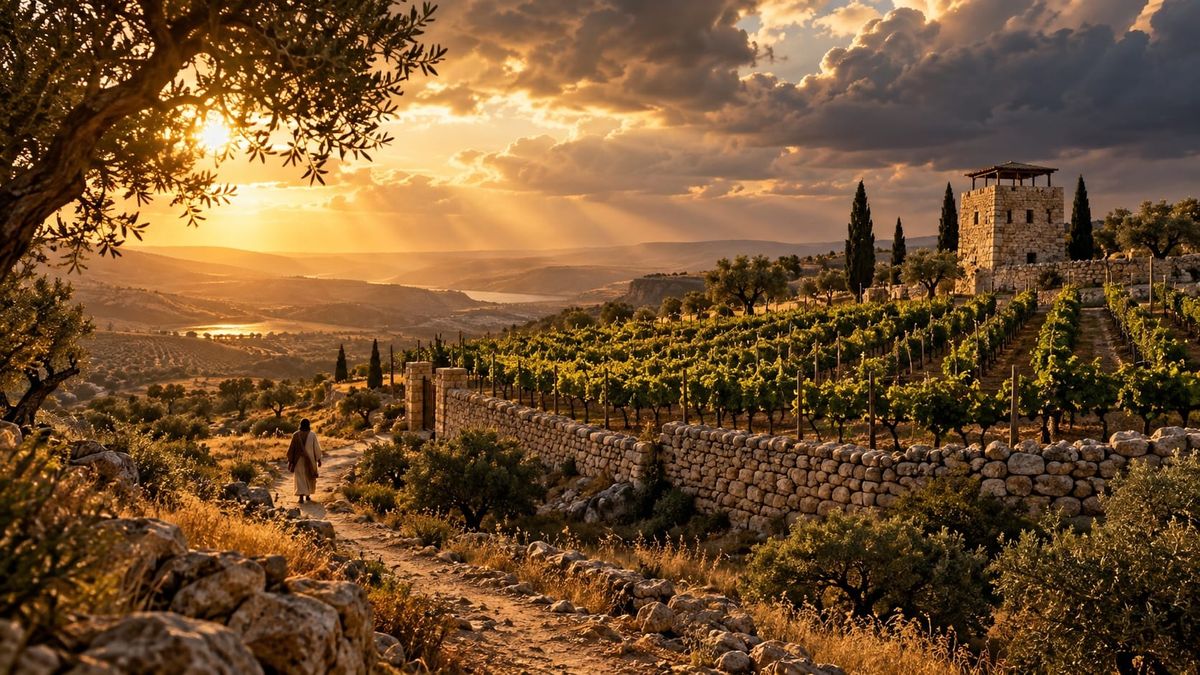
Jesus begins, “There was a master of a house who planted a vineyard.” (Matthew 21:33, ESV) He put a fence around it, dug a winepress, built a tower, leased it to tenants, and went away. His hearers would recognize the imagery because we heard its source this morning in Isaiah 5.
Isaiah describes a beloved who planted a vineyard on a fertile hill. He dug it, cleared it of stones, planted it with choice vines, built a watchtower, and cut out a wine vat. Then Isaiah tells us exactly what the vineyard means: “For the vineyard of the LORD of hosts is the house of Israel.” (Isaiah 5:7, ESV) Psalm 80 gives us the same picture. Israel is the vine God brought out of Egypt, planted, and caused to take deep root.
Jesus is taking up Israel’s Scriptures and Israel’s history. God is the owner, and Israel is his vineyard. The tenants are the religious leaders and others within Israel who reject God’s messengers and finally reject Jesus. The fence, winepress, tower, and journey deliberately echo Isaiah, but we do not need to force a separate meaning onto every detail.
The first thing Jesus wants us to see is ownership. The tenants did not plant the vineyard; they received it. They were entrusted with something that belonged to another, and their rebellion begins when they start acting as though possession had become ownership.
In verse 34, when the harvest approaches, the owner sends servants “to get his fruit.” (Matthew 21:34, ESV) But verse 35 says the tenants seize the servants, beat one, kill another, and stone another. The servants are the prophets God repeatedly sent to Israel.
Again and again the Lord sent his Word to his people. The prophets confronted kings, exposed injustice and idolatry, and called Israel to repentance. Some were mocked, beaten, and killed. Jesus is telling the long history of resistance to God in the form of a parable.
Then verse 36 says, “Again he sent other servants, more than the first.” (Matthew 21:36, ESV) They reject his servants, and he sends again. They abuse his messengers, and he sends again. This is a parable of judgment, but judgment comes after astonishing patience.
God’s warnings are not the opposite of his mercy. They are expressions of it. Every prophet sent was another call to return, another summons to repent. The owner does not abandon the vineyard after the first rebellion. He sends again.
Then Jesus reaches the center of the parable. Verse 37 says, “Finally he sent his son to them, saying, ‘They will respect my son.’” (Matthew 21:37, ESV) The servants are the prophets. The Son is Jesus. And the Son is not merely one more messenger. He is the heir.
Hebrews later describes exactly this movement: “Long ago, at many times and in many ways, God spoke to our fathers by the prophets, but in these last days he has spoken to us by his Son.” (Hebrews 1:1–2, ESV) The servants carried the word of the owner, but finally he sent his Son. The question before these leaders is no longer simply what they will do with another prophet. The Father’s Son is standing before them.
In verse 38 the tenants see the son and say, “This is the heir. Come, let us kill him and have his inheritance.” (Matthew 21:38, ESV) Verse 39 says, “And they took him and threw him out of the vineyard and killed him.” (Matthew 21:39, ESV) Jesus is telling them what they are about to do to him.
The son is cast out and killed, and Jesus will soon be taken outside the city and crucified. Earlier he told his disciples that he must go to Jerusalem, suffer, be killed, and on the third day be raised. Peter tried to turn him from that road, and Jesus refused. Now he has reached Jerusalem, and the cross is no longer distant.
Still he comes. That is the grace beneath this terrible parable. God sent the prophets, and they were rejected. He sent again. Finally, he sent his Son. Human rebellion reaches its darkest point in the killing of the Son, but divine mercy is already at work in the Son who comes knowing what sinners will do to him.
Then, in verse 40, Jesus asks, “When therefore the owner of the vineyard comes, what will he do to those tenants?” (Matthew 21:40, ESV) They answer that he will judge those wicked tenants and lease the vineyard to others who will give him its fruit. Without realizing it, they pronounce judgment upon themselves.
Jesus then takes them to Psalm 118. In verse 42 he quotes is saying, “The stone that the builders rejected has become the cornerstone; this was the Lord’s doing, and it is marvelous in our eyes.” (Matthew 21:42, ESV) Only a short time earlier, at Jesus’ entry into Jerusalem, the crowds had cried another line from that same Psalm: “Blessed is he who comes in the name of the Lord!” (Matthew 21:9; Psalm 118:26, ESV)
Matthew has placed Psalm 118 around Jesus. The one welcomed as coming in the name of the Lord is now the stone the builders reject. The image changes from vineyard to building, but the central figure does not change. The Son whom the tenants reject is the stone the builders reject.
The builders think Jesus is unfit for what God is building, but God says otherwise. They reject him, but God chooses him. They condemn him, but God vindicates him. They kill him, but God raises him. The rejected stone becomes the cornerstone.
Jesus says this is “the Lord’s doing,” and it is “marvelous in our eyes.” That word marvelous matters. The proper response to the risen Son is not merely that we have understood the argument correctly. It is wonder. The one rejected by men has been chosen by God. The one cast out and killed has become the cornerstone of everything God is building. What looks like defeat becomes the means by which God accomplishes salvation.
Then Jesus makes the judgment explicit in verse 43: “Therefore I tell you, the kingdom of God will be taken away from you and given to a people producing its fruits.” (Matthew 21:43, ESV) There is a real transfer of Kingdom stewardship. Those who reject the Son do not retain that stewardship simply because they hold religious office or belong to a privileged covenantal ancestry and history.
The verses immediately after our reading tell us that “when the chief priests and the Pharisees heard his parables, they perceived that he was speaking about them.” (Matthew 21:45, ESV) Jesus is directly confronting leaders preparing to reject the Son standing before them. But the judgment reaches beyond those particular men. The old-covenant order centered in national Israel, temple, priesthood, and land is coming to its fulfillment in Christ, and that stewardship does not continue alongside him as though nothing has changed.
Some today, especially within American evangelical circles shaped by premillennial dispensationalism, would call this “replacement theology.” But that label does not accurately describe the historic Christian reading. This is better described as fulfillment theology. God has not discarded Israel and substituted an unrelated Gentile people. His covenant promises to Israel reach their fulfillment in Jesus the Messiah, and the Old Covenant does not continue alongside the New Covenant as another saving way to God.
The New Testament itself speaks in this pattern of continuity and fulfillment. In Galatians 4, Paul contrasts “the present Jerusalem” with “the Jerusalem above.” The present Jerusalem represents the old covenant order tied to Sinai, while the Jerusalem above represents the people of promise fulfilled in Christ. That is why Paul says, “the Jerusalem above is free, and she is our mother.” (Galatians 4:26, ESV) Peter makes the same point from another angle when he takes Israel’s covenant titles and applies them to the Church: “a chosen race, a royal priesthood, a holy nation, a people for his own possession.” (1 Peter 2:9, ESV) Israel’s covenant story is not thrown away. It reaches its fulfillment in Christ and in the people gathered around him.
This is why Christians have spoken of the Church as the New Israel or fulfilled Israel. This does not mean Gentiles simply replaced Jews. Paul says, “not all who are descended from Israel belong to Israel.” (Romans 9:6, ESV) Covenant ancestry is a real privilege, but it cannot substitute for receiving the Son. Jews who receive Jesus as Messiah and Gentiles who come to Christ are gathered into the same New Covenant people; the Church.
There is not one saving covenant for Jews apart from Jesus and another for Gentiles through Jesus. Jewish people who remain in Judaism apart from Christ remain outside the New Covenant, just as Gentiles apart from Christ do. There is one Savior, one Gospel, and one New Covenant people gathered around the Son. That is why the risen Jewish Messiah sends his Jewish apostles to “make disciples of all nations.” (Matthew 28:19, ESV) God’s covenant purpose reaches its fulfillment in Israel’s Messiah and extends through him to the nations.
Paul also holds out hope for Jewish people who do not continue in unbelief: “God has the power to graft them in again.” (Romans 11:23, ESV) We may therefore rightly pray for a great turning of Jewish people to Jesus their Messiah, not to another covenant apart from Christ, but into his one New Covenant people. Our response to Jewish unbelief should be grief, prayer, Gospel witness, and hope in the mercy of God.
The judgment Jesus announces would become historically visible in the fall of Jerusalem and the destruction of the temple in AD 70.
And that brings us back to verse 43. This New Covenant people is not merely identified by what it is called, but by the fruit it bears. Jesus says the Kingdom will be given to “a people producing its fruits.”
Isaiah tells us what God had looked for in the vineyard from the beginning. The Lord “looked for justice, but behold, bloodshed; for righteousness, but behold, an outcry.” (Isaiah 5:7, ESV) God had planted a people whose life was meant to reflect his own character. Justice and righteousness were the fruit God sought from the vineyard he had planted.
So when Jesus speaks of a people “producing its fruits,” he is not changing the expectation. The New Covenant people are still called to justice and righteousness, now as the fruit of lives joined to Christ. Repentance and mercy, holiness and love of neighbor, faithful obedience and witness to the world all belong to the life of a people gathered around the Son.
Now the vineyard owner comes looking for fruit. The fruit Jesus seeks cannot be separated from repentance and faith in the Son.
That is why our Collect fits the Gospel so well. We asked God to “keep… your household the Church in continual godliness” so that we may “devoutly serve you in good works, to the glory of your Name.” Notice the order. God keeps his household by grace, and his household bears fruit. We do not bear fruit in order to become Christ’s people. We bear fruit because by grace we have been gathered to Christ.
Grace comes first, and fruit follows. Fruit does not purchase our place in the vineyard. It is the life that grows from belonging to the Son.
That means the Church cannot hear this parable merely as a story about somebody else’s failure. The tenants’ sin was not only violence. It was also the presumption that what had been entrusted to them was theirs to control. A congregation can spend so much energy preserving “our church” that we forget whose Church it is. A priest can speak of “my ministry” until he forgets whose ministry it is.
The tenants wanted the vineyard without the owner’s claim. They wanted the inheritance without the heir. We can want many good things that come with Christianity while resisting Christ himself. We can want stability, tradition, moral clarity, friendship, beautiful worship, even the comfort of familiar prayers, while resisting the Lord when his Word confronts us, corrects us, or calls us to change. The gifts are good, but none of them can take the place of the Son.
So the question comes close to us. What have we received from God that we have slowly begun to treat as though it belonged to us apart from him? Perhaps it is our plans, our resources, or simply the life we imagine we are entitled to have. Everything we have has first been received, and when Christ lays claim to what we would rather keep under our own authority, the temptation of the tenants becomes very near.
That takes us back to last Sunday. The first son said no but afterward repented and went. The religious leaders had the right offices, the right words, and the right heritage, but they would not receive John’s call to repentance. Now the warning deepens. If they would not receive the servants, what will they do with the Son?
That question belongs to us as well. We can admire Christian civilization, love Anglican worship, know the Prayer Book, receive Communion, defend Christian morality, and still resist Jesus whenever he lays claim to a part of life we have decided is ours. Religious activity does not make us owners of the vineyard. Christ remains Lord.
Verse 44 therefore gives us a severe warning: “The one who falls on this stone will be broken to pieces; and when it falls on anyone, it will crush him.” (Matthew 21:44, ESV) Jesus is not one religious possibility among many. He is the Son whom the Father sent, the rejected stone whom God made the cornerstone. There is no way into the Kingdom around him or apart from him.
But the warning is not the final word. Psalm 80 gives us the prayer of people who know they need mercy: “Restore us, O LORD God of hosts; show the light of your countenance, and we shall be saved.” (Palm 80:3, ESV) That is not the prayer of tenants claiming ownership. It is the prayer of people who know the vineyard belongs to God and salvation belongs to God.
So we pray that prayer as the Church. Restore us when we forget whose vineyard this is. Keep us when we begin to act like owners rather than servants. Make us fruitful by your grace, and keep us built upon the cornerstone you have laid.
Then let us hear once more what Jesus has shown us. They rejected the servants, and still he sent. They rejected the prophets, and still he called. Finally, he sent his Son. They cast him out and killed him, but God raised him and made the rejected stone the cornerstone. This is the Lord’s doing, and it is marvelous in our eyes.
It is marvelous because the Son whom sinners rejected is the Son through whom sinners are saved. It is marvelous because the Messiah promised to Israel has become the Savior proclaimed to the nations. It is marvelous because God has gathered one New Covenant people around the crucified and risen Christ, not by ancestry or human merit, but by grace through faith in the Son.
That Son still stands before us. The vineyard belongs to his Father, and the Kingdom is his. There is one Savior, one Gospel, and one New Covenant people gathered around him. The question is what it has always been: what will we do with the Son whom the Father has sent?
In the Name of the Father, and of the Son, and of the Holy Spirit. Amen.