The Blessing of the Animals: An Anglican Perspective
The Blessing of the Animals is an occasion for Christians to give thanks to God for the creatures he has made, to pray for animals entrusted to human care, and to remember our responsibility as stewards within God’s creation.
Optional Commemoration: October 4
The Anglican calendar is ordered by a hierarchy of holy days, each carrying a different weight of observance. At the top stand the Principal Feasts, followed by the Holy Days traditionally called Red-Letter Days. The Book of Common Prayer 2019 also provides Optional Commemorations, which allow the Church to remember faithful Christians from across its history without giving every commemoration the same liturgical rank as a Holy Day.
October 4 is the Optional Commemoration of Francis of Assisi, whom the Prayer Book remembers as “Friar and Deacon, Reformer of the Church, 1226.” His life is remembered especially for evangelical poverty, preaching, service, and a call to renewal within the Church. His name has also become closely associated with Christian care for animals and the created world. (BCP 2019, p. 707)
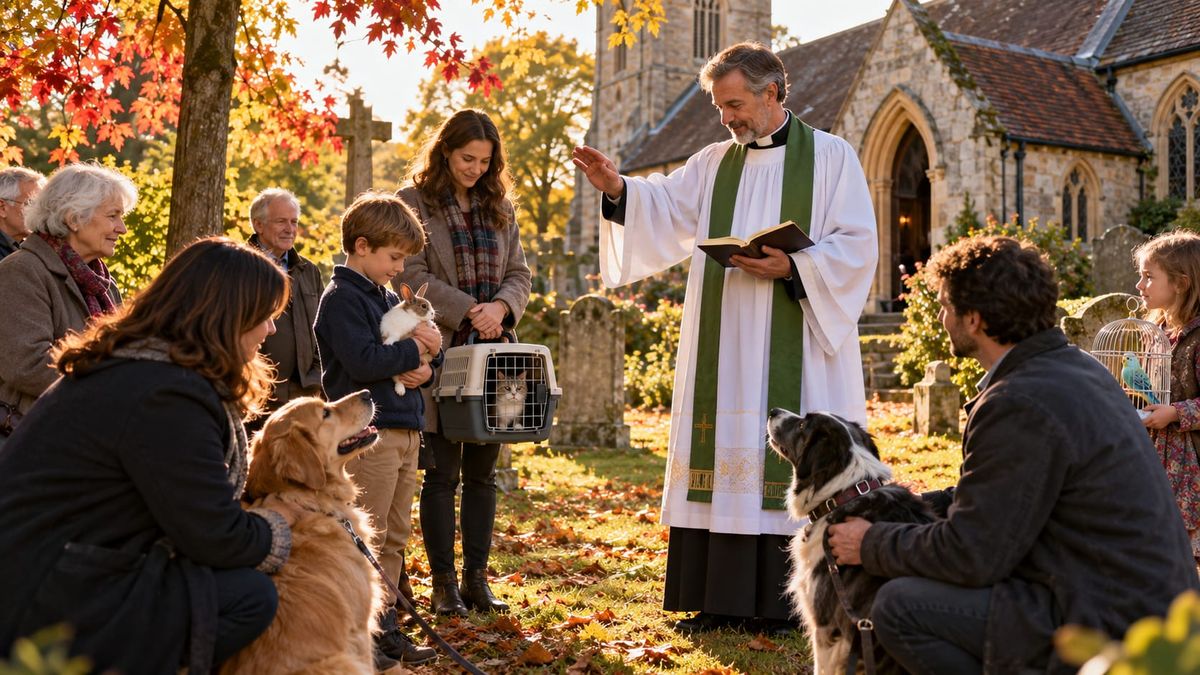
In the cool air of early autumn, Anglican churchyards sometimes become unusually lively places. Dogs arrive on leashes, cats peer cautiously from carriers, children bring rabbits or guinea pigs, and occasionally a bird, horse, or other creature joins the gathering. What might at first appear to be little more than a cheerful parish custom has a deeper purpose. The Blessing of the Animals is an occasion for Christians to give thanks to God for the creatures he has made, to pray for animals entrusted to human care, and to remember our responsibility as stewards within God’s creation.
The connection with Saint Francis is natural, but the theological foundation for blessing animals does not rest upon Francis. It rests upon Holy Scripture and upon the Christian confession that the world and everything in it belong to the God who made them.
The Goodness of Creation
The opening chapter of Genesis presents the animal world as part of God’s deliberate and ordered work. The waters teem with living creatures, birds fill the heavens, and the earth brings forth livestock, creeping things, and beasts according to their kinds. Again and again Scripture gives the divine judgment: God saw that it was good. That declaration comes before humanity is created, which means animals are not good merely because they are useful to human beings. They possess the goodness proper to creatures because God willed them, made them, and called his work good.
Scripture nevertheless distinguishes humanity from the animals. Men and women alone are made in the image of God and receive a unique vocation within creation. Humanity is given dominion over the other creatures, but biblical dominion is not absolute ownership. It is authority exercised beneath the authority of the Creator. Human beings are therefore not the owners of creation in the ultimate sense. God is.
That distinction protects us from two opposite errors. We need not pretend that human beings and animals occupy the same place within creation, but neither may we treat animals as morally insignificant objects available for unrestricted use. Proverbs states the practical consequence simply: “Whoever is righteous has regard for the life of his beast” (Proverbs 12:10, ESV). The righteous person cares for an animal because both the person and the animal live beneath the lordship of God.
The God Who Sustains Every Creature
Psalm 104 gives one of Scripture’s richest pictures of divine care for the living world. The psalmist looks across land and sea and sees a creation filled with life: “O LORD, how manifold are your works! In wisdom have you made them all; the earth is full of your creatures” (Psalm 104:24, ESV). Great and small creatures alike depend upon God. They look to him for their food. He opens his hand, and they are filled. He withdraws their breath, and they return to the dust. He sends forth his Spirit, and life is renewed.
The Psalm does not present nature as an independent system running alongside God. Creation is continually dependent upon him. That dependence is one reason Christian thanksgiving for animals differs fundamentally from the worship of nature. We do not look at a creature and stop with the creature. We look through the creature toward the wisdom, generosity, and providence of its Maker.
The Book of Common Prayer 2019 reflects the same posture in its occasional prayers and thanksgivings. Its prayer “For the Beauty of the Earth” gives thanks for “the wonder of your creatures, large and small” and asks that we grow in grateful enjoyment of God’s abundant creation. (BCP 2019, p. 682) Christian appreciation of creation is therefore fundamentally eucharistic in the ordinary sense of that word: it gives thanks. We receive what God has made and return praise to the Giver.
Animals in the Biblical Story
The place of animals in Scripture does not end with the creation account. After the Flood, God establishes his covenant with Noah, his descendants, and repeatedly with “every living creature” that came out of the ark. Birds, livestock, and the beasts of the earth are explicitly included beneath the sign of the rainbow in Genesis 9.
This does not mean that animals enter the covenant in precisely the same way human beings do. Scripture continues to distinguish humanity as the image-bearing creature given moral responsibility before God. But Genesis 9 makes something else unmistakably clear: the Creator has not forgotten the rest of his creation. His providential concern extends beyond humanity.
The prophets later use the animal world to describe the peace that accompanies God’s promised restoration. Isaiah gives the famous vision in which wolf and lamb, leopard and young goat, calf and lion dwell without destruction: “They shall not hurt or destroy in all my holy mountain; for the earth shall be full of the knowledge of the LORD as the waters cover the sea” (Isaiah 11:9, ESV). This is not merely a charming picture of tame animals. It is an eschatological vision of the Messiah’s reign, when disorder gives way to peace and creation itself participates in the restoration associated with the knowledge of the Lord.
Saint Paul gives that hope a New Testament form in Romans 8. Creation has been subjected to futility and groans as it waits for liberation from its bondage to corruption. Human redemption and the renewal of creation are not identical, but they belong to the same final purpose of God. The Christian hope is therefore not escape from creation, but resurrection and new creation.
The Francis Remembered by the Prayer Book
Popular culture often remembers Francis of Assisi as a gentle medieval figure surrounded by birds and animals. The Prayer Book remembers something larger when it calls him “Friar and Deacon, Reformer of the Church.” That description places Francis’s love for creation inside the broader reality of his Christian vocation.
Francis was born in Assisi into the family of a successful merchant. His early years included social ambition, military adventure, imprisonment, and then a gradual conversion that led him away from wealth and toward poverty, prayer, service, and the imitation of Christ. Thomas of Celano’s early biography, written only a few years after Francis’s death, describes that conversion as a movement away from his former life and his father’s wealth toward an increasingly literal obedience to the Gospel.
One of the best-known episodes from that period concerns the ruined church of San Damiano outside Assisi. In Celano’s later Second Life of Saint Francis, Francis is remembered entering the neglected church to pray and hearing Christ call him to repair his house. Francis first responded literally by helping rebuild the chapel and later other ruined churches near Assisi, but the significance of the story became much larger than masonry. His vocation increasingly took the form of renewal through radical obedience to the Gospel.
When Francis heard the Gospel account of Christ sending the disciples to preach without wealth or provisions, he recognized in those words the pattern of life he had been seeking. A small group gathered around him, and by 1209 a fraternity had formed around a rule of life drawn substantially from the words of the Gospel.
Francis was not principally a medieval naturalist. He was a Christian preacher and deacon who called people to repentance, embraced poverty because he desired to imitate Christ, served those whom respectable society often avoided, and sought renewal within the Church by calling Christians back to the demands of the Gospel. That is the Francis the Prayer Book remembers as a reformer. His association with animals is genuine, but it belongs within that much larger life of discipleship.
Saint Francis and the Family of Creation
Francis possessed an unusual ability to perceive the world through the category of creatureliness. His Canticle of the Creatures praises God through the sun, moon, wind, water, fire, earth, and even bodily death. The movement of the poem is upward toward the Creator rather than inward toward nature itself. Francis’s language is not pantheism. It is praise. The creatures matter because they are the work of God and because they join, in their own creaturely way, in directing glory toward him.
The language of brother and sister can sound strange to modern ears, but Francis was not claiming that human beings, wolves, rivers, and stars possess identical natures or vocations. He was acknowledging something more basic: none of us is the Creator, and all created things receive their existence from another.
That sense of shared creatureliness lies behind many of the stories associated with Francis. The story of Francis preaching to the birds appears in Thomas of Celano’s early biography. Celano describes Francis encountering a large gathering of birds near Bevagna, speaking to them of the Creator’s generosity, blessing them, and afterward exhorting animals and birds to praise God. The episode therefore belongs to the earliest Franciscan biographical tradition rather than merely to a much later legend.
The famous wolf of Gubbio is different. That story belongs to the later Franciscan devotional tradition, especially The Little Flowers of Saint Francis, rather than to Celano’s earliest biography. The historical evidence is therefore not equally strong for every story attached to Francis, but even the later stories endure because they express something recognizably Franciscan: the bird belongs to God, the wolf belongs to God, and we belong to God. Every creature stands beneath divine authority rather than human possession.
What Is a Blessing?
The phrase “Blessing of the Animals” can create confusion if we do not first understand what is being done. In this context, a blessing is fundamentally prayer. It is not a sacrament, nor does it place an animal within the covenantal life of the Church in the manner in which Baptism incorporates a human being into Christ’s visible body.
Animals are not baptized, confirmed, ordained, or admitted to Holy Communion because they do not possess the same moral agency or spiritual vocation given to human beings. The Church instead gives thanks to God for the creature and asks for his providential care over it. At the same time, the blessing turns the attention of the human caretaker back toward God. To bring an animal for blessing is implicitly to confess that even this part of our life does not ultimately belong to us. The creature has been entrusted to our care.
The prayer therefore blesses without confusing. It gives thanks without sentimentalizing and recognizes a genuine creaturely good without erasing the order God has established within creation. The blessing does not make the animal belong to God. It acknowledges that the animal already does.
Blessing Ordinary Life
This practice makes more sense when we remember how naturally Anglican Christianity brings ordinary material life into prayer. Christians bless homes, give thanks before meals, pray over fields and harvests, consecrate churches for worship, and bless objects set apart for holy use. Rogation prayers carry Christian intercession into fields, farms, labor, weather, and the fruitfulness of the earth.
This does not mean that every created object becomes sacred in the same way. It means that no part of ordinary life lies outside the providence of God. A Blessing of Animals belongs naturally within that world. It takes something familiar, perhaps a dog sleeping beside the chair, a horse that works beside us, cattle that sustain a farm, or a cat that has accompanied someone through years of life, and places that relationship consciously before God.
That instinct is deeply at home within Anglican devotional life. The Church does not need to turn ordinary creation into a sacrament in order to pray over it. It simply receives creation with thanksgiving.
Is the Blessing of Animals in the Book of Common Prayer?
The Book of Common Prayer 2019 does not contain a rite titled “The Blessing of Animals,” and that distinction matters. Anglican worship is not defined simply by whatever customs happen to become popular in individual parishes. The Prayer Book gives form to the Church’s common worship and preserves a received pattern of Word, Sacrament, prayer, repentance, thanksgiving, and praise.
The Prayer Book also recognizes that not every legitimate pastoral occasion can be contained within a single volume. In “Concerning the Divine Service,” it provides for authorized occasional services beyond those printed within the Prayer Book itself and allows special devotions drawn from Holy Scripture and other services consistent with Scripture, subject to appropriate ecclesial oversight. (BCP 2019, p. 7)
That gives us the proper category. The Blessing of Animals is an occasional devotion rather than one of the Prayer Book’s normative liturgies or rites. The distinction protects both things. The Prayer Book remains the normative pattern of Anglican worship, while an occasional devotion may serve the Christian life without pretending to possess the same liturgical standing. The Prayer Book orders the Church’s life, and occasional devotions serve that life.
What Happens at a Blessing of Animals?
The shape of the service is normally simple. Holy Scripture is read, prayers of thanksgiving are offered, and the congregation may pray for those who care for animals, for those whose work depends upon them, and for wisdom in humanity’s stewardship of creation. Individual animals may then be brought forward, often by name, and a prayer of blessing is offered.
The service is frequently held outdoors for obvious practical reasons. This is one of those rare church gatherings in which barking, chirping, scratching, restless animals, distracted children, and an occasional attempted escape should not be treated as liturgical catastrophe. Even so, the service should remain worship rather than spectacle. The point is not to display our pets. The point is to give thanks to Almighty God.
That distinction is especially important because the Blessing of Animals can easily become sentimental. Christian affection for animals can be entirely good. Many people know the companionship of a dog that waits by the door, a cat that settles beside them during illness, a horse that has been cared for over many years, or another animal whose presence becomes woven into the rhythms of a household. Such affection need not be mocked or minimized.
Yet the Christian doctrine of creation is far larger than affection for pets. Scripture speaks of livestock, birds, fish, wild animals, creeping things, creatures of the sea, and animals that human beings may never see. The service is most faithful when it widens our vision from “my pet” to “God’s creatures.”
Stewardship Rather Than Ownership
The practical doctrine at the heart of the observance is stewardship. Genesis gives humanity dominion, and Scripture does not condemn the human use of animals. Animals provide food, labor, clothing, companionship, and other goods within the created order. But use is not the same thing as absolute ownership. Human authority is delegated.
The deeper question is therefore not simply whether human beings may make use of animals, but how creatures belonging to God should be treated by those who themselves belong to God. That question reaches far beyond household pets. It applies to farming and livestock husbandry, hunting, veterinary medicine, breeding, working animals, land management, and human decisions affecting habitats and animal populations.
Christian stewardship rejects cruelty because authority is accountable to God. It also rejects the opposite error of treating animals as though their preservation or well-being were the highest moral good. Christian theology maintains an ordered creation. Human beings possess a unique dignity because they bear the image of God, while animals possess genuine creaturely goodness because God made them. We need not diminish either truth to preserve the other.
The Incarnation and the Created World
There is also a distinctly Christian reason the material world matters. The Word became flesh. The eternal Son did not save us by despising creation. He entered it.
Jesus was conceived, born, nourished, carried, touched, wounded, crucified, buried, and raised bodily. He walked upon soil, sailed upon water, ate bread and fish, rode into Jerusalem upon a donkey, and taught repeatedly from the created world around him. Birds, sheep, fish, seeds, vines, lilies, fields, storms, bread, wine, water, and trees became part of the ordinary vocabulary through which the incarnate Lord taught us about his Father.
The Incarnation therefore confirms what Genesis had already declared. Creation is good. It is fallen, disordered, groaning, and awaiting renewal, but it is not evil. Christianity has no need to despise matter in order to honor spirit. The Christian hope is bodily resurrection, and the final biblical vision is not redeemed humanity permanently escaping the material world but heaven and earth made new beneath the reign of God.
That gives Christian stewardship of creation a profoundly Christological foundation. We care about created things because the God who made the world has acted within the world to redeem it.
Creation Is Not God
For precisely the same reason, Christian reverence for creation must never become worship of creation. The Creator-creature distinction is fundamental. Psalm 19 declares that the heavens tell the glory of God, and Saint Paul writes that God’s eternal power and divine nature are perceived in the things that have been made. Creation reveals, witnesses, and points beyond itself, but creation is not God.
This is where Christian care for the natural world differs from every spirituality that treats divinity as something contained within nature itself. A tree may display the wisdom of God, but it is not God. An animal may awaken wonder and affection, but it is not divine. The earth may be beautiful, fruitful, and worthy of careful stewardship, but it is still creation.
A faithful Blessing of Animals preserves that order. It directs thanksgiving through the creature to the Creator. The world matters because it belongs to God, not because the world is God.
When an Animal Dies
There is also a pastoral dimension that deserves attention. For someone who has cared for the same creature through many years, the death of an animal can be painful. The Church does not need to treat such grief as foolish merely because human and animal life are not equivalent. Gratitude naturally produces grief when a good gift is lost.
Christian pastors should therefore be able to acknowledge sorrow over the death of an animal without making promises Scripture does not clearly make. The Bible gives us a magnificent hope for the renewal of creation. Isaiah envisions peace within the animal world, Romans 8 speaks of creation itself being delivered from corruption, and Revelation ends with the renewal of heaven and earth. Those texts give Christians ample reason to confess that God’s final purposes are larger than the rescue of isolated human souls.
They do not, however, give us warrant to speak with certainty about the individual destiny of every particular animal we have loved. Here Christian hope should be confident without becoming speculative. We know the character of the Creator, we know that no part of his creation lies beyond his wisdom, and we know that the final renewal accomplished in Christ will be better, not poorer, than the creation whose goodness we have already tasted. That is enough ground for Christian hope.
A Small Rite with a Large Theology
A priest placing a hand upon a dog and offering a brief prayer may appear far removed from the great doctrines of Christianity, but behind that simple act stand creation and providence, the image of God and human stewardship, the Fall and the groaning of creation, the Incarnation and bodily resurrection, and the promised renewal of all things in Jesus Christ.
The rite teaches us to look at an ordinary creature and remember first that it belongs to God, and so do we. That may be the deepest connection between Saint Francis and the Blessing of Animals. Francis did not discover that animals were unusually sacred. He rediscovered how completely everything belongs to God.
His poverty made the same confession. His preaching, his service to the poor, and his delight in sun, water, birds, animals, and earth all pointed toward the same truth. The world is not ours to possess absolutely. It is God’s world, received by grace.
Conclusion
The Blessing of the Animals has a fitting place within Anglican devotional life when it remains properly ordered. Saint Francis provides the traditional occasion, but Jesus Christ provides the theological center. We give thanks for animals because God created them, pray for them because his providence sustains them, and care for them because the Creator has entrusted his world to human stewardship.
Christian faith therefore refuses both cruelty and idolatry. Creatures are neither worthless nor divine. They are good because God made them, dependent because he sustains them, and entrusted to human care within an ordered creation in which men and women uniquely bear the image of God.
The Blessing of the Animals is more than a pleasant autumn gathering. At its best, it teaches us again how Christians receive the world: not as owners with absolute rights and not as worshipers before nature, but as grateful creatures living among other creatures beneath the care of one Creator. The creature belongs to God, and so do we.