The Great Vigil of Easter: An Anglican Perspective
The Great Vigil of Easter is the first liturgy of Easter Day. From darkness into light, from Scripture to Baptism, and from the empty tomb to the Eucharistic feast, the Church proclaims the Passover of the Lord: Jesus Christ has passed through death into life.
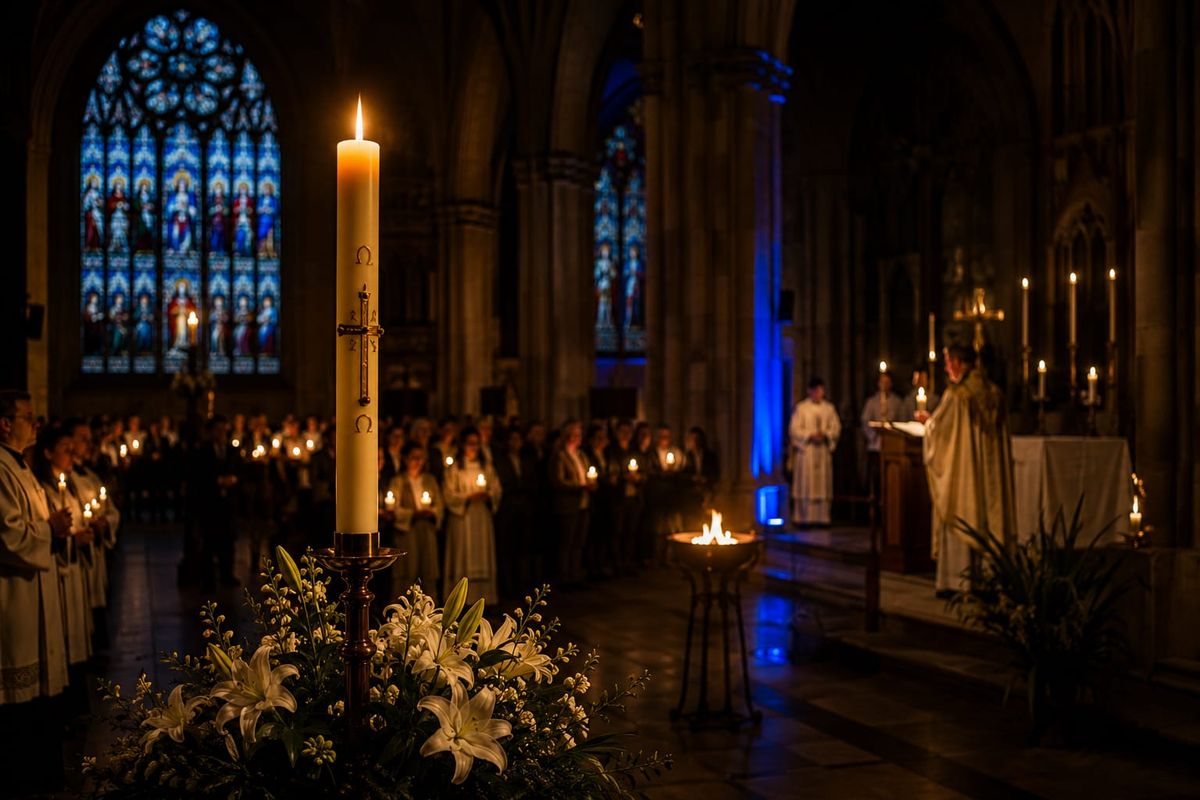
The First Liturgy of Easter Day
The Anglican calendar is ordered by a hierarchy of holy days, each carrying a different weight of observance. The Great Vigil of Easter is not itself a separate Principal Feast or Red-Letter Holy Day. Rather, the BCP 2019 identifies it as “the first liturgy of Easter Day.” Celebrated at a convenient time between sunset on Holy Saturday and sunrise on Easter morning, it is the liturgical threshold through which the Church passes from the restraint of Lent and Holy Week into the joy of the Resurrection. (BCP 2019, p. 581)
The Great Vigil gathers the whole story of redemption into one extraordinary act of worship. Darkness gives way to light. The Scriptures recount God’s mighty acts and promises from creation through deliverance, covenant, judgment, restoration, and resurrection hope. Baptism joins Christians sacramentally to the death and Resurrection of Christ. The Easter Gospel announces the empty tomb, the Alleluia returns, and the Holy Eucharist becomes what the Prayer Book calls “the proper culmination of the Easter Liturgy.” (BCP 2019, p. 581)
For this reason, the Vigil is more than an elaborate way of beginning Easter. Its movement teaches the Gospel. The God who created light out of darkness, delivered Israel through the sea, judged evil, kept covenant, promised cleansing and new hearts, raised dry bones, and preserved his people through judgment has brought his saving purpose to fulfillment in Jesus Christ. The Lord who was crucified, dead, and buried has risen, and those united to him are called to walk in newness of life.
The Threshold of Easter
Holy Saturday belongs to the tomb. The Great Vigil belongs to Easter. The distinction is explicit in the BCP, which directs that the Vigil be celebrated between sunset on Holy Saturday and sunrise on Easter morning and identifies it as the first liturgy of Easter Day. The point is not that every liturgical day must be understood simply as beginning at sunset. Rather, the Prayer Book itself marks this service as the crossing of the threshold. The restrained waiting of Holy Saturday has reached its end, and the Paschal feast has begun.
The Vigil also completes the movement that began on Maundy Thursday. The BCP describes Maundy Thursday, Good Friday, Holy Saturday, and the Great Vigil as forming a single liturgy, even though the individual rites retain their own forms and the congregation departs between them. The meaning is cumulative rather than one literally uninterrupted gathering. The Church has moved from the Upper Room to the Cross, from the Cross to the tomb, and from the tomb into the proclamation of the Resurrection.
This is why the Vigil should not be understood simply as an Easter service held at an unusual hour. It is the destination toward which the Triduum has been moving. The silence of Maundy Thursday, the Cross of Good Friday, and the waiting of Holy Saturday now give way to light, Word, water, and Eucharistic feast.
The Four Movements of the Vigil
The BCP 2019 says that the Great Vigil normally consists of four parts: the Service of Light, the Service of Lessons, Holy Baptism or the Renewal of Baptismal Vows, and the Holy Eucharist. (BCP 2019, p. 581) These are not four unrelated ceremonies gathered together for effect. Each reveals another dimension of the same saving work.
The Service of Light proclaims Christ as the light who has overcome darkness. The Service of Lessons places his Resurrection within the whole history of God’s mighty acts and promises. Holy Baptism declares that Christ’s victory is not merely something Christians admire from a distance but a salvation into which they are incorporated. Where there are no candidates for Baptism or Confirmation, the baptized congregation renews its vows. The Eucharist then becomes the proper culmination of the Easter liturgy, nourishing the Church by the grace of the risen Christ.
The movement is therefore from divine action to proclamation and participation. God has acted. Scripture tells the history of his saving purpose. Baptism joins sinners to Christ’s death and Resurrection. The Eucharist feeds the people whom Christ has made his own.
The Service of Light
The Vigil appropriately begins in darkness. The BCP directs that fire be kindled and that the Paschal Candle be lit from it. The Prayer Book itself identifies the candle as symbolizing Christ, the light of the world. The Celebrant then prays that the light of Christ, rising in glory, may “banish all darkness from our hearts and minds.”
The Deacon, or the Celebrant when there is no Deacon, carries the Paschal Candle into the church, pausing three times to proclaim, “The light of Christ,” to which the people respond, “Thanks be to God.” Congregational candles, where provided, are lit from the Paschal Candle. The imagery is simple but profound. The light does not originate with us. Christ is risen, and his light is received and carried by his people.
The BCP’s Additional Directions make the visual movement even more deliberate. Apart from the Paschal Candle and candles held by the congregation, it is desirable that the building remain as dark as possible until the Easter Acclamation. The darkness is therefore allowed to remain for a time even after the first flame appears. Resurrection light has entered the darkness, but the full festal illumination waits for the proclamation that Christ is risen.
According to ancient tradition, the Prayer Book directs that the light for the Paschal Candle be taken from newly kindled fire rather than from an already existing source. Where the fire is kindled outside, the congregation may gather around it and follow the Paschal Candle in procession. The practice does not make the fire itself sacred. It serves the proclamation of Christ, whose Resurrection inaugurates the new creation.
The Exsultet
The climax of the Service of Light is the Exsultet (eg-ZUHL-tet), the ancient Easter proclamation customarily sung or said beside the Paschal Candle. The BCP identifies this ancient song of praise as the climax of this part of the Vigil. It summons heaven, earth, and the Church to rejoice because the eternal King has vanquished darkness.
The Exsultet repeatedly declares, “This is the night.” It remembers Israel’s deliverance from bondage and passage through the Red Sea, and then proclaims the greater Paschal victory accomplished in Christ. It declares that believers are delivered from the gloom of sin and restored to grace and holiness of life, and that Christ has broken the bonds of death and risen victorious from the grave.
The liturgy does not confuse the historical night of the Exodus with the historical night of Christ’s Resurrection. Rather, it confesses that the God who delivered Israel has brought his saving purpose to fulfillment in Jesus Christ. The Exodus is both a real act of divine deliverance in Israel’s history and part of the scriptural pattern through which the Church understands the greater Passover of Christ.
The Exsultet therefore does not celebrate an abstract triumph of brightness over darkness. Its joy is explicitly Christian. Christ is the true Paschal Lamb. His blood delivers. Sin is forgiven. Death and hell are conquered. The entire proclamation rises toward Jesus Christ, the Morning Star who knows no setting.
The Service of Lessons
After the Service of Light comes an extended proclamation of Scripture. The BCP calls the Church to hear the record of God’s saving deeds in history and to remember how God saved his people in ages past and, in the fullness of time, sent his Son to be our Redeemer. The Prayer Book then asks that God bring to completion in each of us the saving work he has begun.
The Vigil therefore refuses to treat Easter as an isolated miracle detached from everything that came before it. The Resurrection is the climax of the biblical story. Creation, Fall, judgment, covenant, sacrifice, Exodus, promise, restoration, cleansing, new creation, deliverance, and resurrection hope all find their center and fulfillment in the crucified and risen Christ.
The BCP appoints a rich series of possible Old Testament lessons: Genesis 1:1–2:3, the creation; Genesis 3, the Fall; Genesis 7:1–5, 11–18; 8:6–20; 9:8–13, the Flood and covenant with Noah; Genesis 22:1–18, Abraham and Isaac; Exodus 14:10–15:1, Israel’s deliverance at the Red Sea; Isaiah 4:2–6; Isaiah 55:1–11; Ezekiel 36:24–28; Ezekiel 37:1–14; Daniel 3:1–28; Jonah 1:1–2:10; and Zephaniah 3:12–20.
At least three of the appointed lessons are read, and the Exodus account of Israel’s deliverance at the Red Sea is always included. After each reading, an appointed Psalm or Canticle, or another suitable Psalm, Canticle, or hymn, may be used, followed by silence and the appointed or another suitable Collect.
That requirement tells us something important about the theology of the Vigil. The Exodus is not merely one interesting biblical parallel among many. It provides the great biblical pattern of Paschal deliverance: slavery gives way to freedom, death threatens, God opens a way through the waters, the oppressor is defeated, and God’s people emerge on the other side to sing his praise.
Through the Waters
The Red Sea reading is especially important because the BCP explicitly connects Israel’s passage through the sea with Holy Baptism. The Collect following the Exodus lesson remembers that God delivered his chosen people from slavery under Pharaoh as a sign of the salvation offered to the nations through the water of Baptism.
This does not mean that the Exodus was merely a symbol whose historical meaning can be discarded. God truly delivered Israel. But the same God who acted in that covenant history has brought his saving purpose to fulfillment in Christ, and the Church receives the Exodus as part of the scriptural pattern through which Baptism is understood.
Paul makes the connection between Baptism and Easter explicit in Romans 6, appointed later in the Vigil. Christians who have been baptized into Christ Jesus have been baptized into his death and buried with him through Baptism into death so that, “just as Christ was raised from the dead by the glory of the Father, we too might walk in newness of life.” (Romans 6:3–4, ESV)
The Vigil therefore places water beside the empty tomb because Baptism belongs to the Paschal mystery. Christ has passed from death to life, and those baptized into him are joined to his death and Resurrection.
Baptism and the Resurrection
The Great Vigil has long been a particularly fitting occasion for Holy Baptism, and the BCP makes the theological reason explicit: Holy Baptism is the Sacrament through which candidates are united to the death and Resurrection of Jesus Christ. When the Bishop is present, Confirmation may also be administered. If there are no candidates for Baptism or Confirmation, the congregation joins in a Renewal of Baptismal Vows.
The BCP permits Baptism and Confirmation to occur either following the Service of Lessons or after the Gospel and sermon. Its Additional Directions provide the precise ordering according to whether there are candidates for Baptism, Confirmation, Reception, or Reaffirmation. This flexibility does not alter the theological relationship. Baptism and Easter belong together because Baptism joins sinners to the crucified and risen Christ.
The renewal of baptismal vows is not a re-baptism and does not imply that Baptism must somehow be repeated or made effective again. The Sacrament rests upon God’s promise and action, not upon our ability continually to recreate it. The renewal allows the baptized to remember what God has given and to reaffirm the life of repentance, faith, obedience, and discipleship to which Baptism calls them.
This is why the Vigil joins Resurrection and Baptism so closely. Easter is not merely the announcement that Jesus survived death. The risen Christ is the firstfruits and beginning of the new creation, and those united to him receive a new identity and life. Paul does not stop with the statement that we were buried with Christ. Those joined to him are called to walk in newness of life.
Grace therefore comes before obligation. Christians do not create resurrection life by promising to behave better. God joins sinners to Christ, gives what they cannot give themselves, and then calls them to live as those who have received new life in him.
The Easter Acclamation
At the appointed point in the Vigil, the long restraint of Lent finally breaks. The Celebrant proclaims, “Alleluia! Christ is risen!” and the people answer, “The Lord is risen indeed! Alleluia!” The BCP then permits a joyful fanfare and bells, the church is lighted, and the candles at the Altar may be lit from the Paschal Candle.
The Additional Directions likewise say that after the Easter Acclamation the joy of the Resurrection is appropriately demonstrated with bells and music. The change is deliberate. Darkness, restraint, and waiting give way to the public proclamation that Jesus Christ has risen. White is fittingly used for the Easter celebration that begins here, expressing festal joy, light, and the glory of the Resurrection. This is customary Anglican liturgical practice rather than a universal color rubric supplied by the BCP itself.
The return of Alleluia carries particular force where it has been omitted throughout Lent. Its absence has created a liturgical hunger. When it returns at the Vigil, the word itself becomes part of the transition from fast to feast.
Yet the acclamation is more than the release of accumulated emotion. It is a confession of fact. Jesus Christ, who was crucified and buried, has been raised bodily from the dead. The Church rejoices because something has happened in history and because that event has changed the condition of the world.
The darkness can now give way fully to light because death has lost its dominion. The joy is not a denial of Good Friday. The one proclaimed as risen is the Crucified One. Easter does not erase his wounds. It declares that the wounded and crucified Jesus is the victorious Lord whom death could not hold.
The Easter Gospel
Following the Easter Acclamation and the festal praise, the Easter Collect is prayed. The service then continues with Romans 6:3–11. Psalm 114 or another suitable Psalm, hymn, or anthem may follow, and the BCP notes that the use of Alleluia is particularly appropriate. The Gospel is Matthew 28:1–10.
Matthew brings Mary Magdalene and the other Mary to the tomb, where the angel announces, “He is not here, for he has risen, as he said.” (Matthew 28:6, ESV) The women are shown the place where Jesus had lain and are then sent to tell the disciples. As they go, Jesus himself meets them. They take hold of his feet and worship him.
The physical details matter. The tomb is empty. There is a place where the body had lain. The risen Christ can be encountered, touched, and worshiped. The Resurrection is not merely the survival of Jesus’ teaching in the memory of his followers, nor is it a religious metaphor for hope after disappointment. God raised the crucified Jesus bodily from the dead.
The Christian proclamation therefore begins with news rather than aspiration: he has risen. Everything the Church does at the Vigil responds to that reality.
The Holy Eucharist
The BCP calls the Holy Eucharist “the proper culmination of the Easter Liturgy.” As the Church keeps this holy feast, the Prayer Book says that she shares in the joy of the Savior’s triumph and is strengthened by his grace to walk in newness of life.
The Proper Preface of Easter is used at the Eucharist. It proclaims Christ as the true Paschal Lamb offered for us, who has taken away the sin of the world, and declares that by his death he has destroyed death and by his rising to life again has won everlasting life.
The sacrifice of Christ is not repeated. Calvary is finished. Jesus has been raised from the dead. In Holy Communion the faithful truly receive the Body and Blood of Christ and the benefits of his once-for-all sacrifice and victorious Resurrection. The risen Lord nourishes the people whom he has redeemed.
This is why the Eucharist properly culminates the Vigil. The Church has not gathered merely to hear that Christ lives. The risen Lord feeds his people and strengthens them by grace to walk in the newness of life proclaimed throughout the liturgy.
Not a Reenactment
The dramatic character of the Great Vigil could tempt us to think that the Church somehow recreates the Resurrection through ritual. It does not. The darkness does not return Christ to the tomb. The new fire does not cause him to rise. The Easter Acclamation does not make the Resurrection true. Christ rose once in history, and the Vigil orders the Church’s worship around that accomplished reality.
Darkness, fire, Scripture, water, proclamation, and Eucharist allow the whole person to receive again the Gospel God has already accomplished in Christ. The liturgy possesses its power precisely because the saving event does not depend upon it. Christian worship remembers in the biblical and sacramental sense. God’s mighty acts are proclaimed before his people, their saving significance is received in faith, and the Sacraments Christ instituted communicate the grace he has promised. The Church does not manufacture Easter. Easter creates the Church’s joy.
The Beginning of the Fifty Days
The Great Vigil begins Easter Day, but Easter Day itself begins a much longer feast. The Season of Easter extends for fifty days and carries the Church from the Resurrection through the Ascension to the Day of Pentecost. The Vigil is therefore not merely the end of Lent. It is the beginning of a sustained season of Resurrection joy.
The restored Alleluia, white vestments and hangings according to customary Anglican practice, the Paschal Candle, the Proper Preface of Easter, and the repeated proclamation of Christ’s Resurrection all shape the Church’s worship. Lent trained the Church through restraint and penitence. Easter now trains her through sustained rejoicing. The Paschal Candle continues to bear witness throughout this season. The BCP directs that it should be lit at all principal services throughout the Season of Easter and notes that it is traditionally used at Baptism and the Burial of the Dead throughout the year. At Baptism, the Church proclaims participation in the new life of the risen Christ. At burial, she proclaims Resurrection hope in the face of death. The same light fittingly belongs at both.
The transition matters. Christians can sometimes be better at observing Lent than Easter, treating penitence as substantial while allowing joy to become shallow or brief. The Great Vigil refuses that imbalance. The same Church that spent forty days preparing for Easter now begins fifty days learning to live in the reality of the risen Christ.
Observing the Great Vigil
Where the Great Vigil is offered, the best way to understand it is to participate in the whole movement rather than treating it as a collection of interesting ceremonies. Enter the darkness and allow the Service of Light to do its work. Hear the Exsultet as a proclamation of Christ’s victory. Listen to the Old Testament lessons not as a lengthy delay before the Gospel but as the history of God’s saving work into which the Resurrection comes.
Pay particular attention to the Red Sea. At least three of the appointed Old Testament lessons are read, but the Exodus account of the Red Sea is always included. The God who opened the sea is the God who has accomplished the greater deliverance from sin and death through Jesus Christ.
When Baptism is celebrated, receive it as the visible proclamation that Christ’s death and Resurrection create a people. When baptismal vows are renewed, remember the grace already given and the life into which the baptized have been called. The vows do not create the grace. They answer the grace God has already given.
Then receive the Easter Acclamation as the answer toward which Holy Week has been moving. The Lord who gave himself on Maundy Thursday, whose sacrifice was finished on Good Friday, and whose body rested in the tomb on Holy Saturday is risen indeed. Receive the Eucharist as the proper culmination of that victory and enter the fifty days of Easter not as though Lent had merely stopped, but as one whose life has been placed under the lordship of the risen Christ.
Conclusion
The Great Vigil gathers the story of salvation into a movement from darkness to light, promise to fulfillment, death to life, and fasting to feast. Creation, Exodus, covenant, cleansing, resurrection hope, Baptism, Gospel, and Eucharist are gathered around the one saving reality that gives them their Paschal center: Jesus Christ, crucified and buried, has risen bodily from the dead.
None of the Vigil’s actions creates the victory being celebrated. Christ has already accomplished the saving work. The Church keeps Vigil because that work is complete and because Christians need continually to be returned to the reality that now defines them. The darkness gives way because Christ is risen. Baptism gives new life because we are joined to Christ. The Eucharist nourishes the Church because the risen Lord has promised to feed his people with his grace.
The Collect gives the Vigil its proper prayer by asking God, who made this most holy night shine with the glory of the Lord’s Resurrection, to “stir up in your Church that Spirit of adoption which is given to us in Baptism,” so that, renewed in body and mind, we may worship him in sincerity and truth. (BCP 2019, p. 592) Easter is not only the announcement that Christ lives. Because Christ lives, those joined to him are given new life and sent out to live it.