Hope in the Wilderness: Passion Sunday 2026 (John 11:1-44)
Fifth Sunday in Lent (Passion Sunday): A sealed tomb, dry bones, and the long ache of unanswered prayer. But the God who delayed for Lazarus, who spoke life into a graveyard, is still here. He weeps at the grave. He still acts. And the stone will not stay in place.
March 22, 2026, Year A, The Fifth Sunday in Lent, Passion Sunday
John 11:1-44, Psalm 130, Ezekiel 37:1-14
Grace, mercy, and peace from God our Father and the Lord Jesus Christ be with you on this Fifth Sunday in Lent, Passion Sunday.
At the beginning of Lent, on Ash Wednesday, we entered the season with the honesty that we are but dust, no pretending, no performance, just the plain truth of what we are without God. Last Sunday we stood before a man born blind, whose darkness was not punishment but the place where the works of God would be displayed, and the whole Lenten season gathered itself into one question: “Do you believe in the Son of Man?” (John 9:35, ESV) Today, that question finds its ultimate proving ground in front of a sealed tomb, four days in.
Today we also stand at what the older Western tradition calls Passiontide. Here in our parish, the crosses are veiled, not gone but covered, as our attention narrows toward the Passion. Holy Week begins next Sunday, and the Church, in her wisdom, asks us not to rush ahead of it.
Think back to Advent, the wreath and its candles lit one by one in the darkness of December. The first candle is commonly called the Hope candle. It burns not because the promise has already been fulfilled, but precisely because it has not, not yet. One small flame cannot eliminate the darkness. What it does is declare, quietly and stubbornly, that the darkness will not win. Passion Sunday carries something of that same character.
We stand in a kind of December today. Covered crosses. Dry bones in a valley. A sealed tomb in Bethany. But the Church does not draw our attention to these things merely so that we will grieve. She points through them toward something greater that has not yet fully appeared. As I have said throughout Lent, the wilderness is not the final destination. The valley of dry bones is not where Ezekiel’s vision ends. The darkness outside Lazarus’s tomb is not the last word in John’s Gospel. Hope burning in the midst of darkness, that is Passion Sunday.
Our Gospel reading is John 11:1–44. Our other readings, Ezekiel 37:1–14 and Psalm 130, speak from that same dark place, the same wilderness. All three refuse to remain there.
The story opens with urgency. Lazarus is gravely ill, and his sisters send word immediately. Their message is telling, not a demand or even an explicit request, but a statement of fact full of trust: “Lord, he whom you love is ill.” (John 11:3, ESV)They do not tell Jesus what to do. They simply tell him what is happening, trusting that his love matters.
Jesus hears the news, and then John gives us one of the most quietly difficult lines in the New Testament: “So, when he heard that Lazarus was ill, he stayed two days longer in the place where he was.” (John 11:6, ESV) He stays. He does not rush. He knows what is happening, and he does not immediately move.
Many of us know something of what that delay feels like. We have laid the situation before God as plainly as we knew how, prayed, kept the faith, and waited. The answer did not come on the timeline we hoped for or in the form we expected. Mary and Martha loved Jesus, and Jesus loved them, and still their brother died while they waited.
That is why we need to hear what John says just before the delay. Jesus says, “This illness does not lead to death. It is for the glory of God, so that the Son of God may be glorified through it,” and John immediately adds, “Now Jesus loved Martha and her sister and Lazarus.” (John 11:4–5, ESV) Lazarus does die, so Jesus cannot mean that death will never occur. He means that death will not have the final word. The delay is not indifference. It unfolds within the love and purpose of Christ, even though neither the disciples nor the sisters can yet see what he is doing.
Jesus later tells the disciples that he is glad he was not there, “so that you may believe.” (John 11:15, ESV) He will use even the darkness of Lazarus’s death to reveal a greater glory and deepen their faith. If he had arrived and healed a sick man, that would have been a great work. But now Lazarus is dead, four days in the tomb, and what Jesus is about to do will reveal something more: not merely his authority over sickness, but his authority over death itself.
Stand here in the delay for a moment. It is where many of us spend a great deal of our lives, and it is not a comfortable place. There is a particular ache to unanswered prayer when we have prayed, trusted, and reached out in faith, and the silence continues. What do we do with a God who hears and yet sometimes makes us wait? Psalm 130 knows this territory well.
The psalmist opens with a cry that has no preamble: “Out of the depths I cry to you, O LORD!” (Psalm 130:1, ESV) The depths are the dangerous waters, the place where a person feels overwhelmed. And the weight pressing him down is not only circumstance but his own sin: “If you, O LORD, should mark iniquities, O Lord, who could stand?” (Psalm 130:3, ESV) He has looked honestly at himself before God and knows the verdict. None of us would fare better. Yet he does not stop there. From the depths he reaches for something he does not deserve and cannot earn but knows to be true: “But with you there is forgiveness.” (Psalm 130:4, ESV)
Then he waits. He compares himself to watchmen straining toward the first faint line of dawn: “My soul waits for the Lord more than watchmen for the morning, more than watchmen for the morning.” (Psalm 130:6, ESV) The repetition is deliberate. He longs for morning because he knows morning will come even while the darkness is still total. This is Lenten waiting at its most honest, not passive resignation but active hope.
The psalm ends in confidence: “For with the LORD there is steadfast love, and with him is plentiful redemption.” (Psalm 130:7, ESV) From the depths to plentiful redemption. The God who hears the cry from the bottom is the God whose mercy does not run dry.
Ezekiel takes us somewhere even more stark. The hand of the Lord carries the prophet, in the Spirit, into a valley full of bones. Not fresh graves. Not recent death. Bones long since stripped of the life they once held. And God asks the most remarkable question: “Son of man, can these bones live?” (Ezekiel 37:3, ESV)
Ezekiel’s answer is the only honest one available: “O Lord GOD, you know.” (Ezekiel 37:3, ESV) From any human standpoint the question is absurd. Dry bones do not live again. But Ezekiel will not tell God that resurrection is impossible.
What Ezekiel is looking at is Israel, scattered and exiled, the Temple destroyed, the nation finished by every outward measure. God says: prophesy to these bones. Ezekiel does. Bone finds bone. Tendons appear. Flesh follows. Skin covers them. But there is still no breath.
Then God tells him to prophesy to the breath, the ruach, a Hebrew word that can mean breath, wind, or spirit. Ezekiel obeys, breath enters them, and they stand, “an exceedingly great army.” (Ezekiel 37:10, ESV) God then interprets the vision himself: “I will put my Spirit within you, and you shall live.” (Ezekiel 37:14, ESV)
The point is not that Ezekiel possesses some technique for creating life. Ezekiel speaks because God commands him, and God alone gives life. The same God who breathed life into Adam now promises to put his Spirit within his people. Life comes from God.
This is the same divine life we have been tracing through John’s Gospel. Nicodemus needed birth from above. The woman at the well needed living water. The man born blind needed sight that only Christ could give. Lazarus now lies in a tomb where no human help can reach him. In every case, the decisive action belongs to God. Divine life cannot be manufactured, earned, or improved into. It must be received.
The dry bones are not only an ancient image. They can also become a mirror. There are valley seasons in human lives when hope seems to have decomposed entirely. Marriages go dry and silent. Faith becomes mechanical. Grief outlasts the patience of the people around us. Regret grows old and brittle. A situation we prayed would change does not change. God’s question still confronts us: “Can these bones live?” The faithful answer is still Ezekiel’s: “O Lord GOD, you know.”
We cannot leave John 11 without going the full distance. Jesus arrives near Bethany, and before he reaches the tomb he meets Martha on the road. Martha, grieving and bewildered, becomes the place where the Lenten question receives its fullest answer. Jesus says, “I am the resurrection and the life. Whoever believes in me, though he die, yet shall he live.”Then he asks, “Do you believe this?” (John 11:25–26, ESV)
Martha answers, “Yes, Lord; I believe that you are the Christ, the Son of God, who is coming into the world.” (John 11:27, ESV) The man born blind confessed and worshiped. Martha stands on a road with her brother dead and makes her confession. Different circumstances, the same fundamental answer: Yes, Lord, I believe.
That confession does not mean Martha understands everything. When they arrive at the tomb and Jesus says to remove the stone, she protests: “Lord, by this time there will be an odor, for he has been dead four days.” (John 11:39, ESV) Faith and faltering understanding sit side by side, which is where many of us live. Jesus does not abandon her for that. He says, “Did I not tell you that if you believed you would see the glory of God?” (John 11:40, ESV) Her confession remains true even while she struggles to understand what Jesus is about to do.
And before he speaks the word of life, Jesus weeps. “Jesus wept.” (John 11:35, ESV) The shortest verse in the Bible is one of the most important. God incarnate stands at the grave of someone he loves and grieves. The wilderness is real. The sorrow is real. Death is an enemy. Christianity does not ask us to perform cheerfulness in the face of genuine suffering. Lament is not the opposite of faith. Sometimes it is one of faith’s most truthful expressions.
Jesus weeps, and Jesus acts. Those things are not in tension. They belong together.
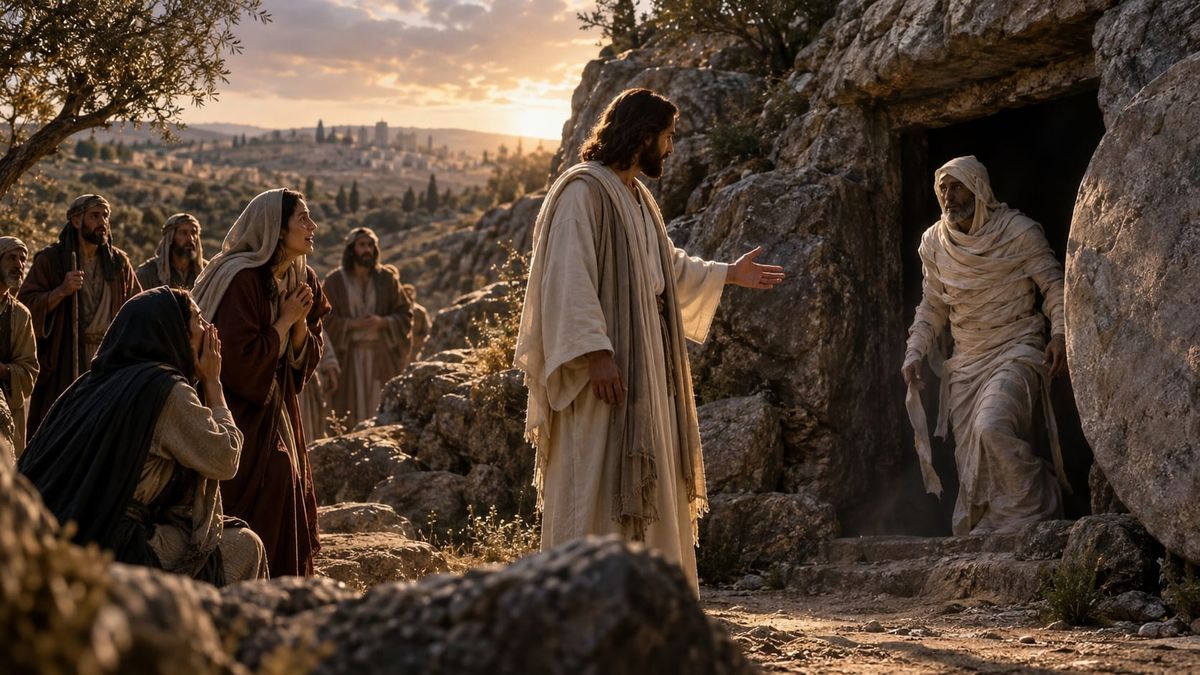
Then they take away the stone. Jesus prays so that those standing there may believe, and he cries with a loud voice, “Lazarus, come out.” (John 11:43, ESV) The dead man comes out, still bound in his burial cloths, alive. And Jesus says, “Unbind him, and let him go.” (John 11:44, ESV)
The raising of Lazarus is the climactic sign before John’s Passion narrative. Lazarus will die again. This is restoration to mortal life, not yet the Resurrection life Jesus himself will enter. But the sign reveals who Jesus is. The one who calls Lazarus out of the tomb is the Lord who will himself rise bodily from the dead.
And the sign moves Jesus directly toward the Cross. In the verses immediately after our reading, the council gathers, Caiaphas speaks of one man dying for the people, and from that day they make plans to put Jesus to death. Jesus gives life to Lazarus, and his enemies answer by plotting the death of the giver of life.
That is Passion Sunday. Resurrection is already shining through the approaching Cross.
Our Collect gives us another way to say the same thing. We pray, “Almighty God, you alone can bring into order the unruly wills and affections of sinners.” Then we ask him to “Grant your people grace to love what you command and desire what you promise.” (BCP 2019, p. 606) Even hope itself is not something we manufacture by force of personality. We ask God for grace because he alone can reorder the heart and fix it where true joys are found.
So what does all of this mean for us as we enter this final stretch of Lent? I want to give us four movements.
First, name the valley honestly. Ezekiel stood in the middle of death and saw it clearly. The psalmist cried from the depths without cleaning it up first. Martha told Jesus exactly what she felt: “Lord, if you had been here, my brother would not have died.” (John 11:21, ESV) There is a temptation among Christians to perform hopefulness, to say the correct thing before we have actually brought the grief itself before God. But biblical faith tells the truth.
The first movement toward hope is often to say plainly before God, and sometimes before a trusted Christian, “This is where I actually am.” God meets us in the valley rather than in our attempts to pretend we are somewhere else.
Second, stay in the conversation. Martha goes to Jesus while grieving and tells him what hurts. She does not withdraw into silence or stop bringing her complaint to him. She remains in the conversation. Practically, that means continuing to pray when prayer feels dry, remaining among God’s people in seasons when worship feels difficult, and allowing another Christian to know when we cannot see the way forward. That kind of honesty can itself be an act of faith.
Third, keep speaking God’s truth and promises where hope seems dead. Ezekiel spoke because God commanded him, and God alone gave life. We do not manufacture resurrection through positive speech. We cannot command God to revive every situation according to our preferred outcome. But neither do we have to surrender our minds to despair.
A parent can keep praying for a child who has walked away from the faith. A husband or wife can keep speaking truth, repentance, blessing, and hope into a wounded marriage. A Christian can answer the inner voice that says, “This will never change,” not with forced optimism but with the character and promises of God. The bones looked hopeless too, but their life came from the Lord.
Fourth, help unbind one another. Jesus raises Lazarus, but he gives those standing nearby the work of removing the grave clothes. The Church should not keep wrapping people whom Christ has restored in the grave clothes of old shame and old reputation.
There are people who have repented, been forgiven, and begun to walk in newness of life, yet others still insist on treating them as though their worst season is their permanent identity. There are people who need encouragement, patience, accountability, friendship, and room to live as the person grace is making them. Christ gives life. But he often gives his people the privilege of helping one another walk in the freedom he has given.
We are one week from Palm Sunday. In a few days our churches will fill with Hosannas, and then the liturgy will turn toward betrayal, trial, crucifixion, and the silence of the tomb. The veils remain for now, and the Cross draws nearer.
Do not look away from it as we enter this final stretch of Lent. Walk toward it even when you do not yet understand everything. The question sharpening throughout this season, “Do you believe in the Son of Man?” finds its answer not after every difficulty has been explained, but here beside a tomb: “Yes, Lord; I believe.”
Come to this Table. Come with whatever weight you carry, whatever depth you have been crying from, whatever valley seems dry beyond recovery. The one who wept at Lazarus’s tomb is here. The one who calls the dead to life is here. He gives himself to us in the sacrament of his Body and Blood, feeding his people with the life he alone can give.
The wilderness is not the end. The valley is not the end. The tomb is not the end. The silence is not the end. The Lord who meets us in the darkness is the Lord who brings life out of death.
And Passion Sunday tells us where that hope is going. The one who called Lazarus out will soon enter the tomb himself. He will bear our sin, pass through death, and rise again. The grave will not have the final word over him, and because we belong to him, it will not have the final word over us.
In the Name of the Father, and of the Son, and of the Holy Spirit. Amen.