I Am Jesus Whom You Are Persecuting (Acts 26:9–21): The Conversion of Saint Paul
“I Am Jesus Whom You Are Persecuting.” Saul contributed resistance; Christ supplied everything else. Grace stopped the persecutor, forgave him, and sent him as a witness. No sinner is beyond Christ’s reach simply because he appears beyond ours.
January 25, 2026, The Conversion of Saint Paul, Red-Letter Holy Day, Season of Epiphany
Acts 26:9–21, Psalm 67, Galatians 1:11–24, Matthew 10:16–25
Grace, mercy, and peace from God our Father and the Lord Jesus Christ be with you on this feast of the Conversion of Saint Paul.
One week ago, on the Feast of the Confession of Saint Peter, the Church heard Jesus ask his disciples, “But who do you say that I am?” (Matthew 16:15, ESV) Peter answered, “You are the Christ, the Son of the living God.” (Matthew 16:16, ESV) Jesus told him, “Flesh and blood has not revealed this to you, but my Father who is in heaven.” (Matthew 16:17, ESV) Peter had followed Jesus, heard his teaching, witnessed his miracles, and still the confession finally came by revelation.
Today, exactly one week later, the Church gives us another apostolic encounter with the identity of Jesus, but the circumstances could hardly be more different. Peter is standing among the disciples at Caesarea Philippi. Saul of Tarsus is traveling toward Damascus to arrest Christians. Peter has been following Jesus. Saul has been trying to destroy his Church. Peter receives revelation from the Father and confesses the Son. Saul is surrounded by a light brighter than the midday sun and hears a voice asking, “Saul, Saul, why are you persecuting me?” (Acts 26:14, ESV)
Then Saul asks the question upon which the rest of his life will turn: “Who are you, Lord?” The answer comes: “I am Jesus whom you are persecuting.” (Acts 26:15, ESV)
Our primary reading is Acts 26:9–21. This is one of three accounts of Paul’s conversion in the book of Acts, but this one comes many years after the event. Paul is no longer the young Pharisee on the road to Damascus. He is a prisoner standing before King Agrippa, explaining why his entire life changed and why he now preaches the very faith he once tried to destroy.
Paul begins with an admission that is easy to pass over because we already know how the story ends: “I myself was convinced that I ought to do many things in opposing the name of Jesus of Nazareth.” (Acts 26:9, ESV) Paul was not confused about his mission. He was convinced. He believed Jesus was a false Messiah. He believed the Christians proclaiming his resurrection were dangerous. He believed opposing them was part of his faithfulness to God.
That makes Paul’s story more unsettling than if he had simply been a reckless or irreligious man. Paul was sincere, educated, zealous, and deeply formed by the Scriptures. He had thought carefully about what he was doing, and he was profoundly wrong. Paul tells Agrippa that he imprisoned Christians, approved when they were put to death, punished them in the synagogues, tried to make them blaspheme, and pursued them into foreign cities. He describes himself as being in “raging fury against them.” (Acts 26:11, ESV)
And then Christ interrupted him.
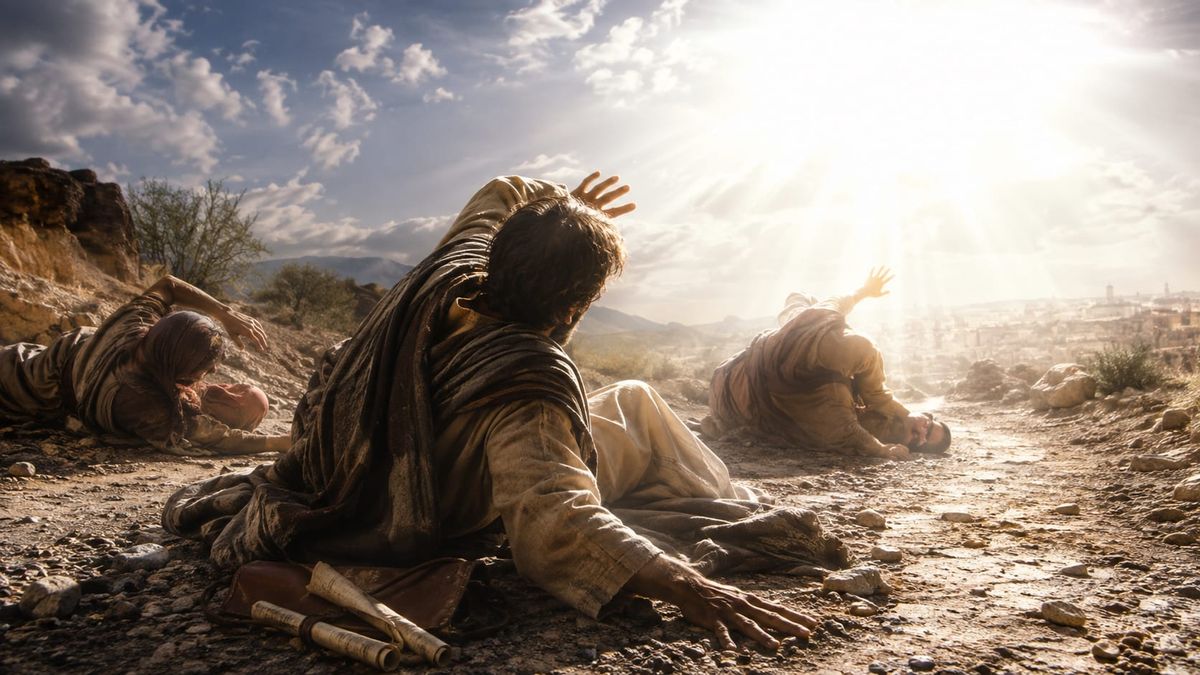
Paul says, “At midday, O king, I saw on the way a light from heaven, brighter than the sun.” (Acts 26:13, ESV) He and his companions fell to the ground, and then Paul heard the voice: “Saul, Saul, why are you persecuting me?” (Acts 26:14, ESV) There is something important in the way Jesus asks the question. Paul had been persecuting Christians. He had arrested men and women, imprisoned them, and pursued them from city to city. Yet Jesus does not ask, “Why are you persecuting my people?” He asks, “Why are you persecuting me?” (Acts 26:14, ESV)
The risen Christ identifies himself with his Church. Paul will later give us some of the New Testament’s richest teaching about the Church as the Body of Christ, and perhaps we should not be surprised. This is where he first encounters that truth in the most personal way possible. He attacks Christians, and Christ tells him that the attack is against himself.
That should deepen the way we understand what the Church is. The Church is not merely a religious organization founded in memory of Jesus, and Christians are not simply people who happen to agree with his teaching. Christ has united himself to his people. We belong to him so completely that he speaks of the suffering of his Church as suffering directed against himself. That should comfort us when the Church suffers, but it should also sober us in the way we treat one another. The Christian sitting beside us is not merely another person who happens to attend the same parish. He or she belongs to Christ. The Church is often disappointing because it is filled with sinners, ourselves included, but Christ has nevertheless bound himself to his people.
But the center of this passage is not finally Paul’s relationship to the Church. It is the grace of the Christ who stops him. Notice how little Paul contributes to his conversion. He contributes opposition. Christ contributes everything else. Paul is not traveling toward Damascus because he has begun questioning whether Christianity might be true. He is not spiritually restless or looking for a new religious experience. He is going to Damascus to arrest Christians. The direction of his life is away from Christ when Christ meets him on the road.
That is why the language Paul later uses in Galatians is so important. In our appointed Epistle he reminds the Galatians that he “persecuted the church of God violently and tried to destroy it.” (Galatians 1:13, ESV) Then he describes the turning point: God “set me apart before I was born, and called me by his grace.” (Galatians 1:15, ESV) Paul does not explain his conversion by saying that he eventually became wiser, more spiritually sensitive, or more open-minded. He says God called him by grace.
The grace that reached Paul was not the reward of spiritual searching. It was the interruption of spiritual hostility. That is one reason the Conversion of Saint Paul is such an important feast for the Church. It gives us a picture of grace in unusually vivid form. Grace is not God supplying the final piece after we have done most of the work. Grace is God acting for sinners who cannot save themselves. In Paul’s case, Christ acts for a sinner who is actively resisting him.
Paul will spend the rest of his life preaching that Gospel. He will tell the Corinthians, “By the grace of God I am what I am.” (1 Corinthians 15:10, ESV) Those words are not an abstract theological formula detached from his life. Paul knows what grace means because he remembers a road outside Damascus where he was not looking for Christ, and Christ found him.
That gives us enormous hope for the people in our own lives whom we may be tempted to write off. Most of us know someone whose distance from Christ seems permanent. Perhaps it is a son or daughter, a grandchild, a brother or sister, a friend who once believed and has wandered away, or someone who has never shown the slightest interest in the Gospel. Sometimes the resistance is quiet indifference. Sometimes it is open hostility. After years of prayer with no visible change, we can begin to decide that we already know how the story will end.
The Christians in Damascus might reasonably have thought the same thing about Saul. Acts tells us that Saul was going there so that if he found anyone belonging to the Way, “men or women, he might bring them bound to Jerusalem.” (Acts 9:2, ESV) Imagine hearing that news as a Christian in Damascus. The natural prayer might have been that God would stop him from arriving. God did, but not in the way they would have expected. The persecutor entered Damascus blind, led by the hand, waiting for a Christian named Ananias to come to him.
We cannot convert anyone. Ananias could not convert Saul. The apostles in Jerusalem could not convert Saul. Only Christ could do that. But Saul’s conversion should make us very reluctant to decide that another person is beyond hope simply because we cannot imagine how Christ might reach him. Scripture does not promise that everyone for whom we pray will be converted, but human resistance does not set the limit of divine power. So we keep praying, we keep bearing witness, and we refuse to allow years of disappointment to become a theology of despair. No sinner stands beyond the reach of Christ merely because he appears beyond our reach.
But Jesus does more on the Damascus road than stop Paul. He commissions him. Christ says, “Rise and stand upon your feet, for I have appeared to you for this purpose, to appoint you as a servant and witness.” (Acts 26:16, ESV) Then he sends Paul to the Gentiles “to open their eyes, so that they may turn from darkness to light and from the power of Satan to God.” (Acts 26:18, ESV)
The reversal could hardly be more complete. The man traveling to Damascus to silence Christians is sent to open the eyes of Gentiles. The man who handed Christians over to prison is commissioned to proclaim forgiveness and deliverance. The man who tried to destroy the faith becomes one of its greatest preachers. Conversion and calling belong together. Christ does not merely save Paul from his past. He gives Paul a future.
We sometimes think of conversion almost entirely in terms of what we are saved from: guilt, judgment, death, separation from God. All of that is true and essential. But salvation also places us under a new lordship. Paul leaves Jerusalem carrying the authority of the chief priests. After meeting Christ, his life belongs to another Lord. That same change is present in every Christian conversion, even when the circumstances are far less dramatic. Most of us have not seen a light brighter than the sun or heard the audible voice of Christ from heaven. But if we belong to Christ, the fundamental question of ownership has still changed. We are no longer our own. Our lives have been placed at his disposal.
That is where conversion becomes much more than a story about the moment we first believed. If Christ is Lord, then he has something to say about our marriages, our money, our habits, our ambitions, our grudges, our retirement, our politics, our sexuality, our friendships, our fears, and our use of the years he gives us. Grace does not simply forgive the life we were already living and leave its direction untouched. Grace places that life under the lordship of Jesus.
Paul does not get to receive forgiveness and then continue toward Damascus with his original plans. Neither do we. The details of Paul’s calling are unique. None of us is being appointed Apostle to the Gentiles. But every Christian is called into the mission of Christ. There are people near us to love, truth to speak, sins to repent of, forgiveness to extend, work to do faithfully, and opportunities to bear witness to the Lord who has saved us.
Jesus also does not hide what apostolic witness will cost. That is why the appointed Gospel for this feast is Matthew 10:16–25. Jesus tells his apostles, “Behold, I am sending you out as sheep in the midst of wolves.” (Matthew 10:16, ESV)He warns them of arrest, flogging, hatred, and persecution. Then he says, “You will be dragged before governors and kings for my sake, to bear witness before them and the Gentiles.” (Matthew 10:18, ESV)
And where is Paul when he tells the story in Acts 26? He is standing before King Agrippa. Jesus said his witnesses would be brought before kings, and Acts gives us Paul before a king bearing witness to Christ. The road to Damascus did not lead Paul into an easier life. It led him into a faithful one.
Paul would know imprisonment, beatings, rejection, shipwreck, danger, and opposition. According to the ancient tradition of the Church, his ministry would finally end in martyrdom at Rome. None of that meant the commission had failed. Jesus had already warned, “A disciple is not above his teacher, nor a servant above his master.” (Matthew 10:24, ESV) Paul’s life takes the shape of the Lord who called him.
We sometimes carry a very different expectation into discipleship. We assume that if we are being faithful, things ought to work out in recognizable ways. The marriage should improve. The child should return. The ministry should bear visible fruit. The difficult conversation should go well. The faithful decision should produce the outcome we prayed for. Sometimes it does. Sometimes it does not. Paul standing before Agrippa reminds us that difficulty is not necessarily evidence that we have wandered outside the will of God. Sometimes faithfulness places us exactly where Christ said his servants would stand.
That does not mean Christians should seek suffering or mistake every hardship for persecution. It means we should not measure the faithfulness of Christ by the ease of the road. The same Lord who met Paul on the road remained Lord when Paul was standing in chains before a king.
Psalm 67 gives us the wider purpose behind all of this. The Psalm begins, “May God be gracious to us and bless us and make his face to shine upon us, that your way may be known on earth, your saving power among all nations.” (Psalm 67:1–2, ESV) Notice the movement. Grace comes to us, and then grace moves outward. God is gracious to his people so that his saving power may be known among the nations.
That is Paul’s life. The light shines upon him on the Damascus road, and then the light of the Gospel goes out through him toward the nations. The Collect we prayed this morning says the same thing. We addressed the God who “by the preaching of your apostle Paul” caused “the light of the Gospel to shine throughout the world.” The Collect does not finally celebrate Paul’s achievement. It celebrates what God accomplished through Paul.
That is exactly how Paul understood his own life. In Galatians he says that the churches of Judea heard, “He who used to persecute us is now preaching the faith he once tried to destroy.” Their response was that “they glorified God because of me.” (Galatians 1:23–24, ESV) They did not glorify Paul. They glorified God. The Conversion of Saint Paul is not finally the feast of an extraordinary man. It is the feast of an extraordinary Savior.
So what does this feast ask of us?
First, Paul’s conversion asks whether we are still willing to let Christ correct us. Paul says, “I myself was convinced.”(Acts 26:9, ESV) He was sincere, devout, learned, and wrong. Religious sincerity does not guarantee faithfulness, and zeal does not make an error true. Paul knew the Scriptures and still needed Christ to stop him. We should therefore remain under the Word of God, willing to have our assumptions corrected. That is humility. There may be beliefs we have carried for years, habits we have defended, grudges we have justified, priorities we have never examined, or ways of treating another person that seem completely reasonable to us. Christ is Lord even over the things about which we are convinced.
Second, Paul’s conversion asks whether there is anyone for whom we have quietly stopped hoping. Perhaps we still say the words of prayer, but inwardly we have settled the matter. We have decided this person is too hardened, too angry, too indifferent, or too far gone. Saul was on his way to imprison Christians when Jesus called his name. We keep praying, not because we can force the result, and not because Scripture promises us the outcome we want, but because Christ remains capable of doing what we cannot do.
Third, the Conversion of Paul asks what the grace we have received is doing through us. The Collect does not ask merely that we admire Paul’s conversion. It asks that, having his wonderful conversion in remembrance, we show ourselves thankful by following his holy teaching. Grace received becomes obedience, not as repayment for salvation but as the fruit of a life now belonging to Christ. Perhaps for us that means finally speaking of Christ to someone we have been afraid to offend. Perhaps it means taking responsibility for a ministry we have assumed someone else will do. Perhaps it means forgiving someone because the Christ who forgave us has taken away our right to nurture the grievance indefinitely. Perhaps it means recognizing that even in later years our lives have not become spiritually disposable. If Christ still gives us breath, then there is still faithfulness to offer him.
Paul had no idea, when he left Jerusalem, what the road ahead would become. He knew where he thought he was going, and then Christ stood in the road. The man who believed Jesus was dead encountered the living Lord. The man who thought he was serving God discovered that he was fighting him. The persecutor became the servant. The enemy became the witness. The man traveling to silence Christians was sent to open the eyes of nations.
And none of it began with Paul. It began with Christ.
The grace that found him was not the reward for finding God. It was God finding him. The calling that followed was not Paul’s attempt to repay the debt. It was the new life grace had created. The suffering that came afterward was not proof that Christ had abandoned him. It was part of the road on which the risen Lord had sent him. And the Gospel that eventually spread across the Gentile world was not evidence of how remarkable Paul was. The churches heard what had happened and glorified God.
That is how the Church should remember Saint Paul, not by standing at a distance admiring an exceptional apostle, but by looking through him toward the Christ who stopped him, showed mercy to him, called him, sent him, sustained him, and caused the light of the Gospel to shine through him. The same Christ is risen. The same grace is still grace. And no sinner is beyond the reach of the Lord who met Saul on the road to Damascus.
In the Name of the Father, and of the Son, and of the Holy Spirit. Amen.