The Conversion of Saint Paul: An Anglican Perspective
The Conversion of Saint Paul, January 25. The risen Christ asked: why are you persecuting me? To persecute the Church is to persecute Christ himself. The man who came to Damascus to close eyes was sent to open them. The reversal is total.
Feast Day: January 25
The Anglican calendar is ordered by a hierarchy of holy days, each carrying a different weight of observance. At the top stand the seven Principal Feasts, the highest days of the liturgical year. Below them are the Red-Letter Holy Days appointed in the BCP 2019 with their own Collects and propers. The Conversion of Saint Paul, observed on January 25, is one of these Red-Letter Holy Days. The BCP appoints its Collect on page 626, the Preface of Apostles, and its readings in the Holy Day lectionary.
The feast is unusual because it commemorates neither Paul’s birth nor his martyrdom, but the decisive moment when the risen Christ confronted his persecutor and made him a witness. Paul was not seeking Christ or traveling toward Damascus in search of religious answers. He was hunting Christians, carrying authority to arrest those who confessed the Name of Jesus, and moving deliberately against the very Church whose apostle he would soon become.
Into that mission of violence the risen Lord intervened. Paul was stopped, confronted, called, and commissioned by the very Christ whose Church he was attempting to destroy, and the feast therefore belongs naturally within Epiphany. Christ is manifested once again, but this time to an enemy, and the manifestation becomes conversion and mission.
The Conversion of Paul is consequently one of Scripture’s most dramatic demonstrations that the grace of God is not constrained by human hostility. Christ can lay hold of a man in the very act of opposing him, overturn the direction of his life, and send him out as a servant of the Gospel he once tried to destroy. January 25 ensures that the Church does not forget how sovereign, surprising, and missionary that grace can be.
The Road to Damascus
Paul’s conversion is narrated three times in Acts, in chapters 9, 22, and 26, and Paul refers to Christ’s appearance and his calling in his own letters. The appointed reading for the feast is Acts 26:9–21, Paul’s testimony before King Agrippa, where Paul tells the story without minimizing the hostility that had marked his life before Christ confronted him.
Paul begins, “I myself was convinced that I ought to do many things in opposing the name of Jesus of Nazareth.” He imprisoned Christians and says that “when they were put to death I cast my vote against them.” (Acts 26:9–10, ESV) His persecution was not an accidental excess of youthful zeal or a momentary lapse in judgment. He believed he was right, acted deliberately upon that conviction, and pursued the followers of Jesus with the force of religious certainty behind him.
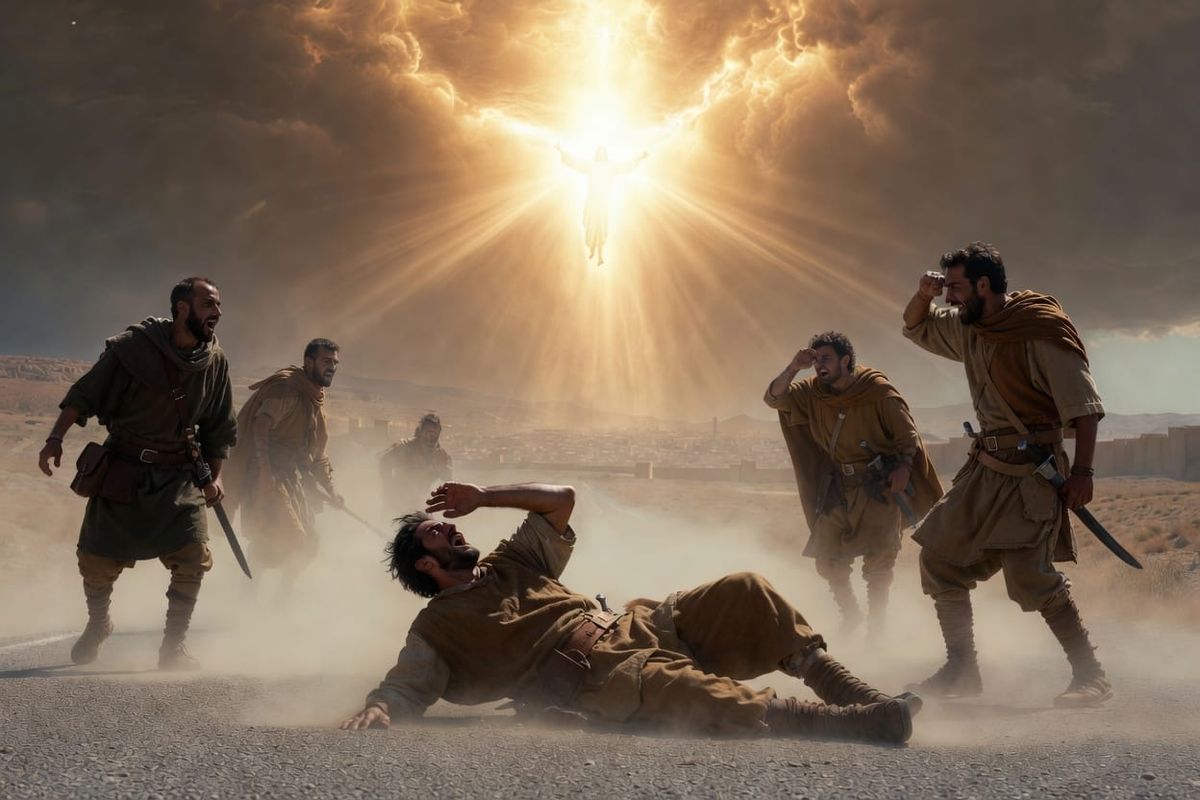
Then came the Damascus road. Paul recalls, “At midday, O king, I saw on the way a light from heaven, brighter than the sun, that shone around me and those who journeyed with me.” After they fell to the ground, he heard a voice: “Saul, Saul, why are you persecuting me?” Paul asked who was speaking, and the answer came: “I am Jesus whom you are persecuting.” (Acts 26:13–15, ESV)
The light is not merely a private religious impression. Paul and his companions are overwhelmed by what occurs, and Paul later calls the encounter “the heavenly vision.” (Acts 26:19, ESV) His claim is that the risen Jesus truly appeared to him and that everything that followed in his ministry rested upon that encounter.
The question Jesus asks is equally important: “Why are you persecuting me?” Paul has been arresting men and women, yet Christ identifies himself so closely with his people that persecution of the Church is persecution of Christ himself. The risen Lord is not detached from his body, observing the suffering of his people from a distance, but claims them as his own.
Then comes the commission. Christ tells Paul, “Rise and stand upon your feet, for I have appeared to you for this purpose, to appoint you as a servant and witness,” and sends him to the Gentiles “to open their eyes, so that they may turn from darkness to light and from the power of Satan to God.” (Acts 26:16, 18, ESV) The reversal is astonishing. The man who came to Damascus to close eyes is sent to open them; the persecutor becomes a witness; and the one who handed Christians over to prison is commissioned to proclaim deliverance from the power of Satan. Conversion and commission belong together from the beginning.
“Why Are You Persecuting Me?”
Christ’s identification with his persecuted people deserves attention of its own. Jesus does not ask, “Why are you persecuting my followers?” He asks, “Why are you persecuting me?” The wording anticipates what Paul will later teach concerning the Church as the body of Christ. Christians are not merely admirers loosely associated with an absent teacher; by the Holy Spirit they are united to the risen Lord and to one another.
This does not mean that Christ suffers again in his glorified body whenever Christians suffer, nor does it mean that every earthly institution calling itself a church is automatically beyond criticism. It means that Christ claims his people as his own, and violence directed against them is taken personally by their Lord.
For Paul, this must have transformed his understanding of both Christ and the Church at once. The Jesus he believed dead was alive, and the Christians he thought dangerous were so united to this risen Messiah that Jesus named their persecution as his own. Before Paul writes a single letter about the Church as Christ’s body, the risen Head teaches him on the Damascus road that he cannot be separated from the people who belong to him.
Paul’s Own Account
The appointed Epistle is Galatians 1:11–24, where Paul insists that the Gospel he preached did not originate in human invention: “For I did not receive it from any man, nor was I taught it, but I received it through a revelation of Jesus Christ.” (Galatians 1:12, ESV) Paul then reaches even farther back than Damascus. God, he says, “had set me apart before I was born, and who called me by his grace,” and was pleased “to reveal his Son to me, in order that I might preach him among the Gentiles.” (Galatians 1:15–16, ESV)
That language places divine initiative at the center of the feast. Paul’s calling did not begin when Paul made himself receptive enough for God to use him. God had set him apart before his birth and, at the appointed time, called him by grace and revealed the Son. The movement begins in God’s purpose and grace before it appears in Paul’s obedience.
Paul did not immediately travel to Jerusalem after his conversion. He went into Arabia and later returned to Damascus. Scripture does not tell us exactly what occupied that period, so speculation about a solitary retreat or extended theological preparation should remain speculation. Paul’s point in Galatians is not to give a devotional itinerary but to make clear that his Gospel did not originate because he first went to Jerusalem and received it from those who were apostles before him.
Only after three years did he visit Cephas, or Peter, staying fifteen days and also seeing James, the Lord’s brother. Paul fiercely maintains the divine source of his commission while elsewhere demonstrating that the Gospel he preached was the same apostolic Gospel confessed by Peter and the others. His authority comes from Christ, yet that authority does not place him outside the one apostolic Church.
The Judean churches knew him largely by reputation: “He who used to persecute us is now preaching the faith he once tried to destroy.” Their response is telling: “And they glorified God because of me.” (Galatians 1:23–24, ESV) The proper interpretation of Paul’s conversion is therefore not ultimately admiration of Paul but glory to God, whose grace had transformed the persecutor into a preacher.
God Is the First Mover in Salvation
Paul’s conversion gives unusually vivid form to a truth taught throughout Scripture: salvation begins with God’s grace rather than with the sinner’s first movement toward God. Saul is not spiritually neutral on the road to Damascus, weighing religious alternatives and gradually becoming more receptive to Jesus. He is actively opposing Christ. Yet Christ intervenes, and the Lord whom Saul rejects is the Lord who reveals himself, confronts his rebellion, calls him, and gives him an entirely new direction.
Jesus states the principle plainly: “No one can come to me unless the Father who sent me draws him.” (John 6:44, ESV)Paul’s conversion displays that divine initiative with almost startling clarity. Christ does not wait for Saul to become the kind of man who might plausibly respond well to grace. He confronts an enemy and makes him his own.
This is also the grammar of Article X of the Thirty-Nine Articles. Fallen man cannot “turn and prepare himself, by his own natural strength and good works, to faith, and calling upon God.” The Article therefore speaks of “the grace of God by Christ preventing us,” using preventing in its older sense of grace that comes before us, awakening and enabling the good will by which we respond. Paul on the Damascus road is a dramatic biblical picture of that prior grace.
This is not an abstract point about the mechanics of salvation. It is profoundly pastoral. If salvation finally depended upon finding a sufficiently receptive sinner, Paul would not be the obvious candidate. The Church’s greatest persecutor becomes one of her greatest missionaries because Christ is sovereign in grace, and that sovereignty gives the Church reason to pray and bear witness even when human resistance appears formidable.
That does not mean every hostile unbeliever will receive a Damascus-road conversion, nor does it permit Christians to presume upon God’s hidden purposes. It does mean that the Church has no warrant for deciding that a particular sinner is simply beyond the reach of grace. The hardest heart is not harder than God’s grace, and Christians therefore pray, preach, reason, love, and bear witness without despairing, because salvation does not rest upon the sinner’s ability to make the first move toward Christ.
Grace Produces Obedience
The sovereignty of grace does not leave Paul passive. The Christ who calls him also sends him, and Paul tells Agrippa, “I was not disobedient to the heavenly vision,” but proclaimed that people “should repent and turn to God, performing deeds in keeping with their repentance.” (Acts 26:19–20, ESV)
The order is important. Grace does not become a reward for obedience, but neither does grace make obedience unnecessary. Christ lays hold of Paul, and the man who is laid hold of becomes a preacher, missionary, pastor, theologian, sufferer, and servant. The obedience is real, but it grows from the grace that first claimed him.
Paul later describes the pattern perfectly: “By the grace of God I am what I am, and his grace toward me was not in vain.” He immediately adds that he labored abundantly, then corrects even that statement by saying, “though it was not I, but the grace of God that is with me.” (1 Corinthians 15:10, ESV) Paul truly labors, yet his labor never becomes an independent achievement standing beside divine grace. Grace precedes effort, enables effort, accompanies effort, and receives the glory for its fruit.
The Conversion of Paul therefore gives no support either to works-righteousness or to spiritual passivity. Christ acts first, and the one whom Christ calls genuinely follows; grace gives rise to obedience rather than competing with it.
The Appointed Readings
The BCP 2019 appoints Acts 26:9–21, Psalm 67, Galatians 1:11–24, and Matthew 10:16–25. Together they interpret Paul’s conversion as grace, revelation, mission, and costly apostolic witness.
Psalm 67 prays, “May God be gracious to us and bless us and make his face to shine upon us, that your way may be known on earth, your saving power among all nations.” (Psalm 67:1–2, ESV) Paul’s ministry becomes one great answer to that prayer. The light that overtakes him on the road sends him toward the nations, and his journeys across Asia Minor, Macedonia, Greece, and eventually toward Rome are not the adventures of an unusually ambitious religious entrepreneur but the obedience of a man who understands himself as sent by Christ so that the Gospel might be proclaimed where Christ had not been named.
The appointed Gospel, Matthew 10:16–25, is strikingly sobering for a feast of apostolic conversion. Jesus tells the apostles, “Behold, I am sending you out as sheep in the midst of wolves.” (Matthew 10:16, ESV) He warns of arrests, floggings, betrayal, hatred, and persecution, and one verse fits Acts 26 with extraordinary precision: “You will be dragged before governors and kings for my sake, to bear witness before them and the Gentiles.” (Matthew 10:18, ESV) On the feast itself, the Church hears Paul standing before King Agrippa doing exactly that.
Paul’s suffering therefore does not prove that his apostolic calling failed. It conforms him to the pattern announced by the Lord who sent his servants as sheep among wolves, for “a disciple is not above his teacher, nor a servant above his master.” (Matthew 10:24, ESV) The mission born on the Damascus road will carry Paul not away from suffering but into the costly path of the crucified Lord whom he now serves.
From Darkness to Light
Christ describes Paul’s mission in unmistakably kingdom terms. He is sent so that people may turn “from darkness to light and from the power of Satan to God.” (Acts 26:18, ESV) That language should be taken seriously without turning the feast into a speculative chronology of spiritual warfare. Satan’s power is real, and fallen humanity truly inhabits darkness apart from Christ, yet the risen Lord who commissions Paul is already the victorious King.
Paul is not sent to negotiate between two equal kingdoms. Christ has risen from the dead, the decisive victory has been accomplished, and the Gospel announces the reign of the crucified and risen Lord. The Church continues to encounter opposition, deception, persecution, and spiritual evil, and the New Testament never treats Satan as harmless; nevertheless, his opposition is limited and doomed.
The mission Christ gives Paul rests upon the accomplished victory of the Cross and Resurrection and looks toward the day when every enemy, including death itself, will finally be destroyed. The Conversion of Paul therefore belongs naturally within Epiphany’s movement from darkness into light: the man engulfed in a heavenly brightness is sent to proclaim the true Light among the nations.
Paul’s Apostolic Standing
Paul was not one of the original Twelve. He did not accompany Jesus throughout his earthly ministry and was not chosen to replace Judas as Matthias was. His apostleship is nevertheless genuine, and Paul repeatedly grounds it in the appearance and commission of the risen Christ. He asks, “Am I not an apostle? Have I not seen Jesus our Lord?” (1 Corinthians 9:1, ESV)
In 1 Corinthians 15 he places Christ’s appearance to him in the sequence of Resurrection appearances to Cephas, the Twelve, James, and the other apostles: “Last of all, as to one untimely born, he appeared also to me.” (1 Corinthians 15:8, ESV) Paul does not thereby become one of the Twelve or make Matthias’ calling a mistake. The Twelve possess a particular symbolic and historical role connected with Israel and Jesus’ earthly ministry, while Paul’s apostolate is extraordinary, arising from the risen Christ’s direct appearance and commission.
Nor does Paul present himself as self-authorizing. His ministry is recognized within the wider apostolic Church, even while he insists that its source and Gospel came from Christ rather than from human appointment. His authority is real precisely because it is received.
Paul immediately places his apostleship beneath grace. He calls himself “the least of the apostles, unworthy to be called an apostle, because I persecuted the church of God,” before saying, “But by the grace of God I am what I am.” (1 Corinthians 15:9–10, ESV) That may be the best commentary Paul ever gives on the Damascus road, because it holds together both the reality of his apostolic calling and his awareness that everything rests upon undeserved mercy.
Peter and Paul
The Conversion of Saint Paul falls exactly one week after the Confession of Saint Peter, and together the two feasts form a fitting pair within Epiphany. At Caesarea Philippi, Peter receives revelation from the Father and confesses, “You are the Christ, the Son of the living God.” (Matthew 16:16, ESV) On the Damascus road, Paul receives revelation from the risen Christ who tells him, “I am Jesus whom you are persecuting.” (Acts 26:15, ESV) In both feasts, divine initiative comes first: Peter is enabled to confess because the Father reveals the Son, while Paul is converted and commissioned because the risen Christ reveals himself.
The two men will later exercise different but complementary apostolic ministries. Peter possesses a real primacy among the Twelve, while Paul is called extraordinarily by the risen Christ as apostle to the Gentiles. Paul’s calling does not derive from Peter, yet neither man preaches a rival Gospel, and both remain servants under the authority of the same Lord.
Their ministries can even involve correction. Paul recounts opposing Peter at Antioch when Peter’s conduct was not in step with the truth of the Gospel. (Galatians 2:11–14) Apostolic authority therefore remains accountable to the Gospel entrusted by Christ. The Anglican calendar eventually commemorates Peter and Paul together on June 29; January keeps their distinctive moments separate, while June remembers them together as apostolic witnesses.
The Gospel Paul Taught
The BCP Collect asks Christians to show gratitude for Paul’s conversion by “following his holy teaching.” That makes the substance of Paul’s teaching unavoidable. At its center stands Jesus Christ crucified and risen, and Paul insists that sinners are justified by grace through faith rather than by works that could place God in their debt.
He proclaims reconciliation with God through Christ, union with Christ in his death and Resurrection, life in the Holy Spirit, adoption, the gathering of Jews who believe in Christ and believing Gentiles into one Body and one New Covenant people, bodily resurrection, and the coming renewal of creation. Paul’s Gospel is not merely a message about how isolated individuals become religious; it announces the saving work of Christ and the new creation that flows from his death and Resurrection.
The Anglican formularies receive this Pauline emphasis with particular clarity in Article XI: “We are accounted righteous before God, only for the merit of our Lord and Saviour Jesus Christ by Faith, and not for our own works or deservings.”It continues, “Wherefore, that we are justified by Faith only is a most wholesome Doctrine, and very full of comfort.” The Anglican doctrine is neither that human merit prepares the way for justification nor that good works are irrelevant. Article XII immediately describes good works as the fruits of faith that follow justification. Grace comes first, and the life transformed by grace follows.
That comfort belongs naturally to this feast because Paul himself knew that salvation could not be explained as God rewarding a worthy man. His own biography contradicted the idea. He persecuted the Church, and Christ saved him; his later doctrine of grace was not invented from his personal experience, but his experience gave him an unforgettable personal knowledge of the grace the Gospel proclaims.
Saul and Paul
A familiar Christian shorthand sometimes says that Saul became Paul when he converted, as though Christ gave him a new name on the Damascus road. Acts does not say this. Luke continues calling him Saul after his conversion, and only later, during the missionary journey in Acts 13, does Luke say, “Saul, who was also called Paul.” (Acts 13:9, ESV)
Saul was his Hebrew name, while Paul was the Roman name by which he was especially known within his Gentile mission. The transition in Luke’s usage corresponds naturally with the expanding missionary context, but it is not presented as a divinely imposed conversion-name change comparable to Abram becoming Abraham or Simon being named Peter. The actual transformation is much greater than a change of name: the persecutor becomes the preacher because Christ has laid hold of him.
The BCP 2019 Collect and Preface
The Collect on page 626 prays: “O God, by the preaching of your apostle Paul you have caused the light of the Gospel to shine throughout the world: Grant, we pray, that having his wonderful conversion in remembrance, we may show ourselves thankful to you by following his holy teaching.”
The Collect begins with God’s action. God causes the Gospel to shine through Paul’s preaching, which means that Paul is an instrument of the light rather than its source. The prayer then moves from remembrance to discipleship: the Church does not honor Paul adequately by being fascinated with the Damascus road, but by receiving the apostolic Gospel he preached and living according to the teaching Christ entrusted to him.
That order again preserves grace. God acts through Paul, and the Church responds in thankful obedience. The apostle’s ministry matters precisely because God has chosen to work through it.
The appointed Preface of Apostles gives thanks through “the great shepherd of your flock, Jesus Christ our Lord,” who after his Resurrection sent the apostles to preach the Gospel and teach all nations. The Preface is especially fitting because Paul’s commission comes precisely from the risen Christ. Damascus does not reveal a different Jesus or authorize a rival Gospel; the same risen Lord who appeared to the other apostolic witnesses appears also to Paul and sends him.
Conversion and Christian Experience
Paul’s conversion is extraordinary and should not become the template by which every Christian judges whether his or her own conversion was real. Most Christians will not encounter a visible heavenly light, fall to the ground on a road, or hear the risen Christ address them audibly, and Scripture itself records many different ways by which God brings sinners to faith.
The essential reality is not the drama of the experience but the grace of God in Christ. Christians need not be able to identify an exact moment when conversion occurred in order to trust Christ genuinely, and those baptized and raised within the Church may never remember a time when they did not know the Gospel.
Paul’s story therefore should not make quiet conversions seem inferior. Its particular purpose is to magnify grace and reveal the freedom of Christ to call even an active enemy. What all Christian conversion shares with Paul is the deeper order: God’s grace comes first. The sinner is brought from darkness to light, from unbelief to faith, from the dominion of sin into the life of Christ, and that grace produces repentance and a new direction. The circumstances of conversion vary widely, but the Savior does not; every genuine conversion rests finally upon the grace of the same Christ who calls sinners out of darkness and into his light.
The liturgical color is white, fitting both Epiphany’s theme of manifestation and this feast’s movement from darkness into light. Although Paul would eventually suffer martyrdom, January 25 commemorates his conversion and apostolic calling rather than his death; the central image is the grace by which the risen Christ laid hold of him and redirected his life toward the service of the Gospel.
Observing This Feast
The Conversion of Saint Paul is observed on January 25 during the Season of Epiphany. The Collect is on page 626, and the appointed lessons are Acts 26:9–21, Psalm 67, Galatians 1:11–24, and Matthew 10:16–25.
Read Acts 26 slowly and notice how little Paul excuses himself. He names his persecution before he speaks about the light, and then the initiative throughout the encounter becomes unmistakable: Christ appears, Christ questions, Christ appoints, and Christ sends. Read Galatians 1 and listen for Paul’s grammar of grace: set apart, called by grace, Son revealed, sent to preach. Then notice the response of the Judean churches, who glorified God because of what had happened to the man who once persecuted them.
Pray Psalm 67 as a missionary psalm and read Matthew 10 beside Acts 26. Jesus warns that his witnesses will stand before governors and kings, and Paul stands before Agrippa doing exactly that. Apostolic mission therefore follows the pattern of the crucified Lord rather than the expectations of worldly success.
The feast is also an appropriate occasion to pray for people who appear far from Christ. Christians should not presume to know whom God will call or how he will work, but neither should they decide in advance that hostility, indifference, or unbelief is stronger than grace. Paul’s conversion teaches the Church to pray boldly because God can convert anyone.
Finally, hear the Collect’s application. The appropriate thanksgiving for Paul’s wonderful conversion is not merely amazement at what happened on the Damascus road, but the reception and following of the holy apostolic teaching through which God caused the light of the Gospel to shine throughout the world.
Conclusion
The Conversion of Saint Paul is a feast of God’s sovereign grace in the calling of a sinner and the sending of an apostle. Paul was not moving toward Christ but against him, and he was not approaching Damascus as a spiritual seeker but as a persecutor carrying authority against the Church. The risen Christ interrupted that journey, confronted his hostility, revealed himself, showed mercy to his enemy, and appointed him to carry the Gospel among the nations.
The grace that found Paul did not merely rescue him from something; it sent him toward something. The man who came to close eyes was commissioned to open them, so that people might turn “from darkness to light and from the power of Satan to God.” (Acts 26:18, ESV) Everything that followed—his preaching, suffering, missionary journeys, theology of justification and grace, labor among the Gentiles, and eventual willingness to die for Christ—rests beneath his own confession: “By the grace of God I am what I am.” (1 Corinthians 15:10, ESV)
The Collect therefore gives the feast its proper response. God caused “the light of the Gospel to shine throughout the world” through Paul, and the Church asks to show her gratitude by following his holy teaching. Paul’s conversion reminds Christians never to confuse divine grace with a reward for spiritual receptivity and never to conclude that a sinner stands outside God’s power to save. Salvation began for Paul not with his reaching for Christ but with Christ laying hold of him, and the Church still lives and bears witness in confidence that the risen Lord remains sovereign in grace.