Immanuel: Love Draws Near (Isaiah 7:10-17)
There is also grace here. Ahaz refuses the sign, and God gives the sign anyway. The fulfillment does not depend upon the worthiness of the king. The promise does not survive because David’s descendants maintain perfect faith. The promise survives because God is faithful.
December 21, 2025, Year A, The Fourth Sunday in Advent
Matthew 1:18–25, Psalm 24, Isaiah 7:10–17
Grace, mercy, and peace from God our Father and the Lord Jesus Christ be with you on this Fourth Sunday in Advent.
On this fourth Sunday of Advent, as the love candle illuminates our wreath, we stand on the threshold of Christmas, contemplating the love of God that draws near to us in human flesh. In a world often marked by fear, uncertainty, and self-reliance, the Scriptures today invite us to behold the sign God gives, not because we demand it or deserve it, but because of his mercy and faithfulness. Our primary focus is Isaiah 7:10–17, where the Lord speaks into a crisis of fear and unbelief, while Psalm 24 celebrates the coming of the King of glory and Matthew reveals the fulfillment of Isaiah’s promise in Jesus Christ.
The setting of Isaiah 7 is a genuine national crisis. Judah is threatened by Rezin, king of Syria, and Pekah, king of Israel. Their plan is to invade Judah, remove Ahaz from David’s throne, and replace him with a king of their choosing. Earlier in the chapter, Isaiah tells us that when Ahaz hears of the threat, “the heart of Ahaz and the heart of his people shook as the trees of the forest shake before the wind” (Isaiah 7:2, ESV). Fear has taken hold of the king and of the nation.
But Ahaz’s great problem is not that he feels fear. His problem is what he does with that fear. Rather than trusting the promise of God, Ahaz looks toward Assyria for security. Scripture repeatedly warns Israel against binding itself to pagan powers in ways that replace covenant faithfulness with political dependence. The Lord had warned his people against making covenants with the pagan nations around them because those alliances could become a snare and draw their hearts away from him. Ahaz now looks for salvation from the great pagan empire to the north instead of from the God who placed the house of David upon the throne.
Into that fear the Lord sends Isaiah. God does not begin by abandoning Ahaz. He gives him a promise. Earlier in the chapter the Lord says concerning the kings threatening Judah, “It shall not stand, and it shall not come to pass” (Isaiah 7:7, ESV). Then comes the warning: “If you are not firm in faith, you will not be firm at all” (Isaiah 7:9, ESV). The question beneath the entire passage is therefore a question of trust. Will Ahaz rest the future of Judah upon the promise of God, or will he try to secure it by his own fearful arrangements?
Then, in verse 11, the Lord does something extraordinary. He tells Ahaz, “Ask a sign of the LORD your God; let it be deep as Sheol or high as heaven” (Isaiah 7:11, ESV). God himself offers to strengthen the king’s faltering faith with a sign. Ahaz responds, “I will not ask, and I will not put the LORD to the test” (Isaiah 7:12, ESV).
At first that sounds pious. Scripture does indeed tell us not to put the Lord to the test. But Ahaz is not humbly refusing to test God. God himself has commanded him to ask for the sign. His refusal is therefore not obedience but unbelief dressed in religious language. Ahaz has already decided where he will place his trust, and he does not want a sign from God disrupting the course he has chosen.
Isaiah answers in verses 13 and 14: “Hear then, O house of David! Is it too little for you to weary men, that you weary my God also? Therefore the Lord himself will give you a sign. Behold, the virgin shall conceive and bear a son, and shall call his name Immanuel” (Isaiah 7:13–14, ESV).
Notice that Isaiah’s address expands beyond Ahaz alone. He says, “O house of David.” That matters because the crisis threatens more than one frightened king. Rezin and Pekah intend to overthrow the Davidic dynasty itself. But centuries before Ahaz, God had made his covenant with David and promised that his house and kingdom would be established according to God’s purpose. Ahaz may be faithless, but God will not become faithless.
Every royal son born into David’s house carried that promise forward. Each generation lived beneath God’s word concerning David’s throne and the coming king. Ahaz’s unbelief cannot cancel what God has sworn. His failure cannot break the promise. The Lord therefore addresses the house of David and declares that he himself will give the sign.
The sign is astonishing: “Behold, the virgin shall conceive and bear a son, and shall call his name Immanuel.” The name means God with us. Christians do not need to be embarrassed about the plain confession the Church has always drawn from this passage. The Virgin Mary, who had not known a man, conceives by the Holy Spirit, and the child born of her is Jesus Christ.
There has long been discussion about how Isaiah’s prophecy relates to the immediate crisis facing Ahaz. Verses 15 and 16 clearly contain a near horizon: “He shall eat curds and honey when he knows how to refuse the evil and choose the good. For before the boy knows how to refuse the evil and choose the good, the land whose two kings you dread will be deserted” (Isaiah 7:15–16, ESV). Within only a few years, the two kings Ahaz fears will no longer pose the threat they presently pose.
That near horizon does not require us to weaken Matthew’s interpretation or the Virgin Birth. Prophecy can speak into an immediate historical crisis while reaching beyond that crisis to the greater work of God. Isaiah himself continues beyond chapter 7 into the great promises of chapters 9 and 11, where the child associated with David’s house becomes the king whose reign has no end and the shoot from Jesse whose rule extends to the nations. The horizon keeps expanding until the promise cannot be contained by the political crisis of Ahaz’s generation.
The time marker in verses 15 and 16 can function in that way. If you asked me how long it takes to drive to Blairsville and I answered, “About as long as one of my sermons,” you would understand that I am using something familiar as a measure of time. You would not assume that the sermon and the trip are the same event. In the same way, Isaiah can use the early years of a child as a clock for the collapse of the immediate threat while the sign itself reaches to the greater fulfillment God intends.
We should therefore resist the temptation to force Isaiah into a choice Scripture itself does not require us to make. The prophecy speaks meaningfully into Ahaz’s real crisis, and Matthew, writing under the inspiration of the Holy Spirit, identifies its decisive fulfillment in the virginal conception of Jesus. Matthew writes, “All this took place to fulfill what the Lord had spoken by the prophet: ‘Behold, the virgin shall conceive and bear a son, and they shall call his name Immanuel’” (Matthew 1:22–23, ESV).
That settles the matter most important for Christian preaching. Mary truly is the Virgin Mother of our Lord. Jesus is conceived by the Holy Spirit, not by a human father. The sign promised through Isaiah reaches its fullness when the eternal Son takes our nature upon himself in the womb of Mary. Immanuel is not merely a slogan of encouragement. In Jesus Christ, God has truly come among us.
Verse 17 also reminds us that the sign does not mean Ahaz’s choices are harmless. Isaiah warns, “The LORD will bring upon you and upon your people and upon your father’s house such days as have not come since the day that Ephraim departed from Judah, the king of Assyria” (Isaiah 7:17, ESV). The very empire Ahaz looks to for security will become an instrument of judgment. The power he thinks will save him will become part of Judah’s misery.
There is a warning here for us. Fear tempts us to grasp for security wherever it seems available, even when doing so requires us to compromise trust and obedience. The problem is not prudence. Scripture never teaches that planning, counsel, government, or ordinary means are inherently faithless. The problem comes when the gifts of God become substitutes for God, when we place ultimate confidence in the thing we can control rather than in the Lord who has spoken.
There is also grace here. Ahaz refuses the sign, and God gives the sign anyway. The fulfillment does not depend upon the worthiness of the king. The promise does not survive because David’s descendants maintain perfect faith. The promise survives because God is faithful.
That is why the house of David matters so much. Ahaz can fail, and he does. Kings after him can fail, and they do. Judah can fall, the throne can appear empty, and the people can go into exile, yet God does not abandon his word. At the proper time the promised Son comes, born of the Virgin, “descended from David according to the flesh” (Romans 1:3, ESV), Jesus Christ our Lord.
Psalm 24 widens the picture. “The earth is the LORD’s and all that is in it, the compass of the world and those who dwell therein” (Psalm 24:1, BCP 2019). The God speaking to frightened Judah is not one tribal deity competing with Syria and Assyria. The entire earth belongs to him.
Then the Psalm asks, “Who shall ascend the hill of the LORD? Or who shall stand in his holy place?” The answer is the one who has clean hands and a pure heart. (Psalm 24:3–4, BCP 2019). That should humble us, because none of us comes before God on the strength of our own righteousness. We need the King who is coming to us.
And then the gates are commanded to open: “Lift up your heads, O you gates, and be lifted up, you everlasting doors; and the King of glory shall come in.” The Psalm asks, “Who is the King of glory?” and answers, “It is the LORD, strong and mighty, even the LORD, mighty in battle” (Psalm 24:7–8, BCP 2019).
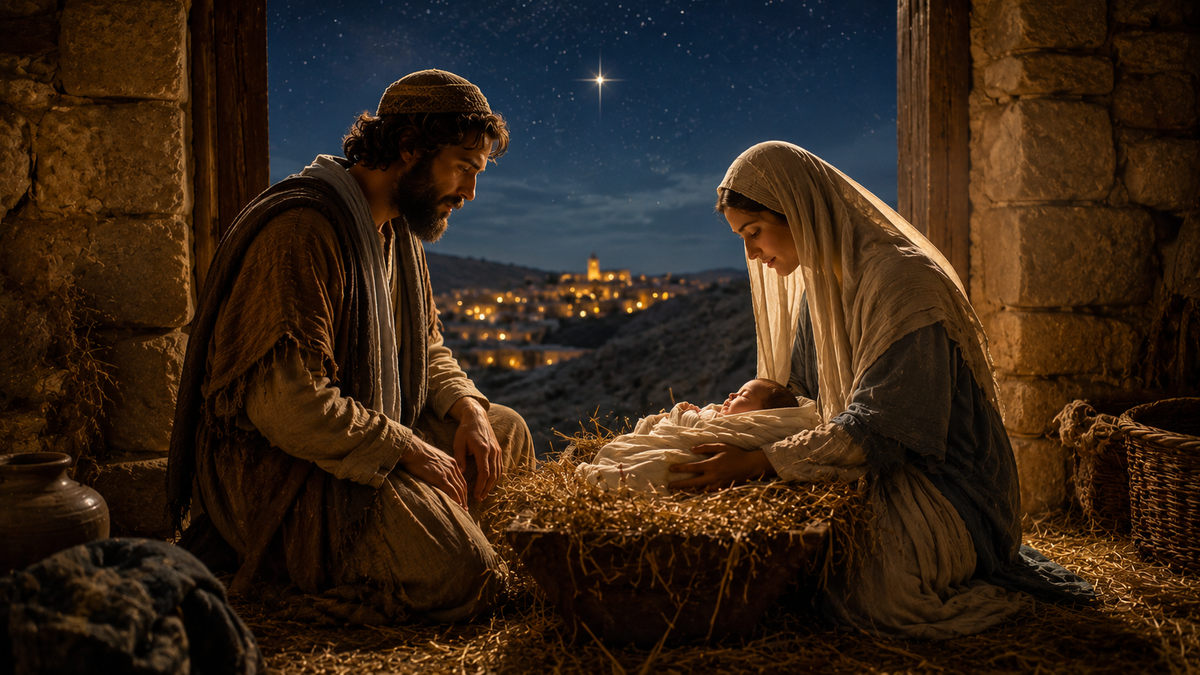
On this Fourth Sunday of Advent, Matthew tells us how the King of glory enters. He does not first enter amid the armies of earthly empire. He enters our humanity. The eternal Son comes in the womb of the Virgin. The Lord strong and mighty comes as an unborn child. The King of glory comes so near that he can truly be called Immanuel, God with us.
Matthew places us beside Joseph, another son of David confronted by fear. Joseph discovers that Mary is pregnant, and everything he thought he understood about their future appears to collapse. Because he is a just man and unwilling to put her to shame, he intends to divorce her quietly.
Then the angel says, “Joseph, son of David, do not fear to take Mary as your wife, for that which is conceived in her is from the Holy Spirit” (Matthew 1:20, ESV). Notice the address: son of David. The promise to David’s house has arrived at Joseph’s door.
The angel continues, “She will bear a son, and you shall call his name Jesus, for he will save his people from their sins” (Matthew 1:21, ESV). Jesus, Yeshua (yeh-SHOO-ah), means “the Lord saves.” Matthew then gives us the other name, Immanuel, “God with us.” The two names tell the Gospel together. God is with us in order to save us.
Here the contrast between Ahaz and Joseph becomes powerful. Both are sons of David confronted by circumstances that inspire fear. Ahaz receives the Word of God and refuses to trust it. Joseph receives the Word of God and obeys. But even here grace comes first. Joseph does not create the promise by his obedience. God speaks first. God acts first. God gives the Son first. Joseph’s obedience is the faithful response to grace already given.
That same pattern appears throughout Scripture. Think of David facing Goliath. Israel’s army looks at the giant and sees only human impossibility. David says, “You come to me with a sword and with a spear and with a javelin, but I come to you in the name of the LORD of hosts” (1 Samuel 17:45, ESV). David does not reject every ordinary means of action. He rejects the idea that Israel’s hope rests upon matching the Philistine weapon for weapon. His confidence rests in the Lord.
Or think of Daniel when obedience to God becomes dangerous. Daniel does not manufacture a miracle or control the outcome. He simply refuses to abandon the God he worships in order to purchase safety through compromise. After his deliverance he says, “My God sent his angel and shut the lions’ mouths” (Daniel 6:22, ESV). The point again is not that faithful people always escape danger. The point is that God remains God when faithfulness becomes costly.
That is the Advent question Isaiah places before us. When fear comes, where do we look for salvation? Do we grasp at our own “Assyrias,” whatever promises security apart from trust in God, or do we receive his Word and walk in the obedience faith produces?
Immanuel means that we are not left alone to accomplish this. God has come to us in Christ. He speaks to us in his Word. By his Spirit he gathers us into his Church. In Holy Baptism he joins us to Christ, and in Holy Communion he feeds his people with the sacrament of Christ’s Body and Blood. We do not ascend the holy hill by constructing righteousness of our own. We come through the righteousness and mercy of the King who has come down to us.
That is why the Collect for today is so perfectly suited to Isaiah 7. We pray, “Stir up your power, O Lord, and with great might come among us.” Then we confess that “we are sorely hindered by our sins from running the race that is set before us,” and ask that God’s “bountiful grace and mercy speedily help and deliver us” (BCP 2019, p. 599).
That is Ahaz’s problem, and it is ours. Sin hinders us. Fear distorts our judgment. We reach for what we can control. We trust what we can see. And the answer is not that we become strong enough to rescue ourselves. The prayer of Advent is, Come among us. Help us. Deliver us.
From the crisis of Ahaz to the gates of Psalm 24, and from Joseph’s fear to the womb of the Virgin Mary, the great story of Scripture converges upon this astonishing truth: God has not abandoned his fearful and faltering people to their own devices. In his sovereign mercy he has given the sign we could never produce for ourselves. The Virgin has conceived and borne a Son. His name is Jesus because he saves his people from their sins. He is Immanuel because in him God has come to dwell with us.
This is the King of glory. He comes not because our obedience has opened the way for him, but because his grace and mercy have opened the way for us. His presence calls forth faith. His promise creates hope. His mercy makes obedience possible.
As we stand on the edge of Christmas, let us therefore turn from every “Assyria” of our own making. Let us repent of every false refuge we have treated as though it could save us. Let us lift up our heads and welcome the King.
Immanuel has come in the humility of the Incarnation. He is with his Church now by his Word and Spirit, feeding and sustaining his people by grace. And he will come again in glory. Therefore, do not fear. Trust the promise. Receive the sign. Welcome the King, for God is with us, and in Jesus Christ he has come to save.
In the Name of the Father, and of the Son, and of the Holy Spirit. Amen.