The Light Has Dawned: Christmas Eve 2025 (Isaiah 9:1-7)
The people who walked in darkness have seen a great light. The Child promised by Isaiah has come. The grace of God has appeared. The Savior has been born. This Child is our Savior. This infant is our sovereign Lord. Glory to God in the highest, and on earth peace among those with whom he is pleased.
December 24, 2025, Christmas Eve, Principal Christmas Eucharist, Season of Christmas
Luke 2:1–14, Psalm 96, Titus 2:11–14, Isaiah 9:1–7
Grace, mercy, and peace from God our Father and the Lord Jesus Christ be with you on this Christmas Eve.
On this Christmas Eve, we gather in great joy after completing our Advent journey together. For four weeks we have waited watchfully, lighting the candles of hope, peace, joy, and love. We have reminded ourselves again and again that God's ancient promises are trustworthy and true, that the long-expected Messiah would indeed come, and that his coming would change everything, our hearts, our homes, our world, and our eternal destiny.
Now the season of waiting has given way to celebration. The longing of Advent has blossomed into the fulfillment of Christmas. The Child foretold by the prophets has been born. The Light promised centuries ago has dawned in the darkness. The eternal Word has become flesh and has dwelt among us, full of grace and truth.
Our readings this evening, from Isaiah 9, Psalm 96, Titus 2, and Luke 2, work together to proclaim the central truth of Christmas: the eternal God has stepped into human history in the person of Jesus Christ. He has come not as a distant ruler or an abstract idea, but as a real human baby, to bring salvation to sinners, true peace to the troubled, and everlasting glory to his creation.
I want to focus particularly on Isaiah 9:1–7 and Luke 2:1–14, while allowing Psalm 96 and Titus 2 to illuminate and deepen what we see. Isaiah gives us the prophetic promise of a coming child-king who will bring light and endless peace. Luke gives us the historical account of that promise's humble fulfillment in Bethlehem. Together these passages unveil the astonishing mystery of the Incarnation: the infinite and eternal Son has taken our finite human nature and become truly man, born in poverty and weakness, yet destined to rule the universe in perfect justice and righteousness forever.
Let us begin with Isaiah. In verses 1 and 2, he speaks God's word to a people living in deep distress and oppression. The northern regions of Israel, Zebulun and Naphtali, had been the first to suffer under the invading Assyrian empire. Their lands were overrun, their people humiliated and scattered. Darkness, gloom, and the shadow of death hung heavily over them. Yet in the midst of this despair, Isaiah proclaims a dramatic reversal and a glorious hope: “But there will be no gloom for her who was in anguish. In the former time he brought into contempt the land of Zebulun and the land of Naphtali, but in the latter time he has made glorious the way of the sea, the land beyond the Jordan, Galilee of the nations. The people who walked in darkness have seen a great light; those who dwelt in a land of deep darkness, on them has light shone” (Isaiah 9:1–2, ESV).
This is no vague wish for better days. God promises that the very places that had known the deepest humiliation will become the stage for his greatest glory. Galilee of the Gentiles, marginal, looked down upon, frequently invaded, will be the first to see the dawning of salvation's light. And as the Gospels later show, Jesus begins his ministry in exactly that region, settling in Capernaum and preaching the kingdom. What Isaiah saw in promise comes into view in the ministry of Christ.
The light is not simply the end of a bad season. It is the coming of God's salvation. The people have walked in darkness, and God causes the light to shine upon them. They do not climb out of the darkness by their own wisdom or strength. The light comes to them.
In verses 3 and 4, Isaiah describes the joy this light will bring: “You have multiplied the nation; you have increased its joy; they rejoice before you as with joy at the harvest, as they are glad when they divide the spoil. For the yoke of his burden, and the staff for his shoulder, the rod of his oppressor, you have broken as on the day of Midian” (Isaiah 9:3–4, ESV).
The celebration will be like the relief of a bountiful harvest or the exultation of soldiers after victory. But Isaiah reaches back to the day of Midian, when God delivered Israel through Gideon in a way that made unmistakably clear that the victory belonged to the Lord. Once again, God's people will discover that their salvation depends finally upon what God does for them.
Then we reach the heart of the passage. In verses 6 and 7 Isaiah tells us how this great reversal comes: “For to us a child is born, to us a son is given; and the government shall be upon his shoulder, and his name shall be called Wonderful Counselor, Mighty God, Everlasting Father, Prince of Peace. Of the increase of his government and of peace there will be no end, on the throne of David and over his kingdom, to establish it and to uphold it with justice and with righteousness from this time forth and forevermore. The zeal of the LORD of hosts will do this” (Isaiah 9:6–7, ESV).
Here is the heart of the prophecy: salvation comes through a child. He is truly born among us, sharing our humanity, and yet Isaiah gives him names that reach beyond any merely ordinary king. He is Wonderful Counselor, whose wisdom does not fail. He is Mighty God, the divine warrior whose power conquers every enemy. He is Everlasting Father, the king whose fatherly care for his people does not end. He is Prince of Peace, the one who brings shalom (shah-LOME), the wholeness and reconciliation for which the world aches.
In verse 7, Isaiah makes clear that his reign is not temporary: “Of the increase of his government and of peace there will be no end” (Isaiah 9:7, ESV). He sits upon David's throne and establishes his kingdom with justice and righteousness forever.
Then Isaiah gives us one of the most comforting sentences in verse 7: “The zeal of the LORD of hosts will do this” (Isaiah 9:7, ESV). None of this finally depends upon human strength, political success, or our ability to bring God's promises to completion. God himself is committed to fulfilling what he has spoken.
Seven hundred years later, the promised Child is born: Jesus Christ, the incarnate Son of God.
Luke tells us how it happened: “In those days a decree went out from Caesar Augustus that all the world should be registered… And Joseph also went up from Galilee, from the town of Nazareth, to Judea, to the city of David, which is called Bethlehem, because he was of the house and lineage of David, to be registered with Mary, his betrothed, who was with child. And while they were there, the time came for her to give birth. And she gave birth to her firstborn son and wrapped him in swaddling cloths and laid him in a manger, because there was no place for them in the inn” (Luke 2:1–7, ESV).
The most powerful man on earth, Caesar Augustus, issues a decree that reaches across the empire. Unknowingly, he sets in motion the events that bring Mary and Joseph to Bethlehem, the city of David, just where the prophet Micah had said the ruler of Israel would come forth. Caesar believes he is moving the world, but above Caesar stands the providence of God.
And the true King arrives in utter humility. No palace. No royal welcome. Only a stable and a feeding trough for a cradle. The Mighty God comes among us in the vulnerability of true human infancy. The Prince of Peace enters a world of Roman occupation, human sin, and coming danger. The Son does not cease to be God when he becomes man. He takes our humanity to himself and enters fully into the weakness of human life, yet without sin.
This is why the Christmas Eve Collect fits the night so beautifully. We pray, “O God, you have caused this holy night to shine with the brightness of the true Light” (BCP 2019, p. 599). The Light Isaiah promised is no abstraction. The true Light has come into the world in Jesus Christ. And the Collect asks that we who know the mystery of that Light here may one day enjoy him perfectly in heaven.
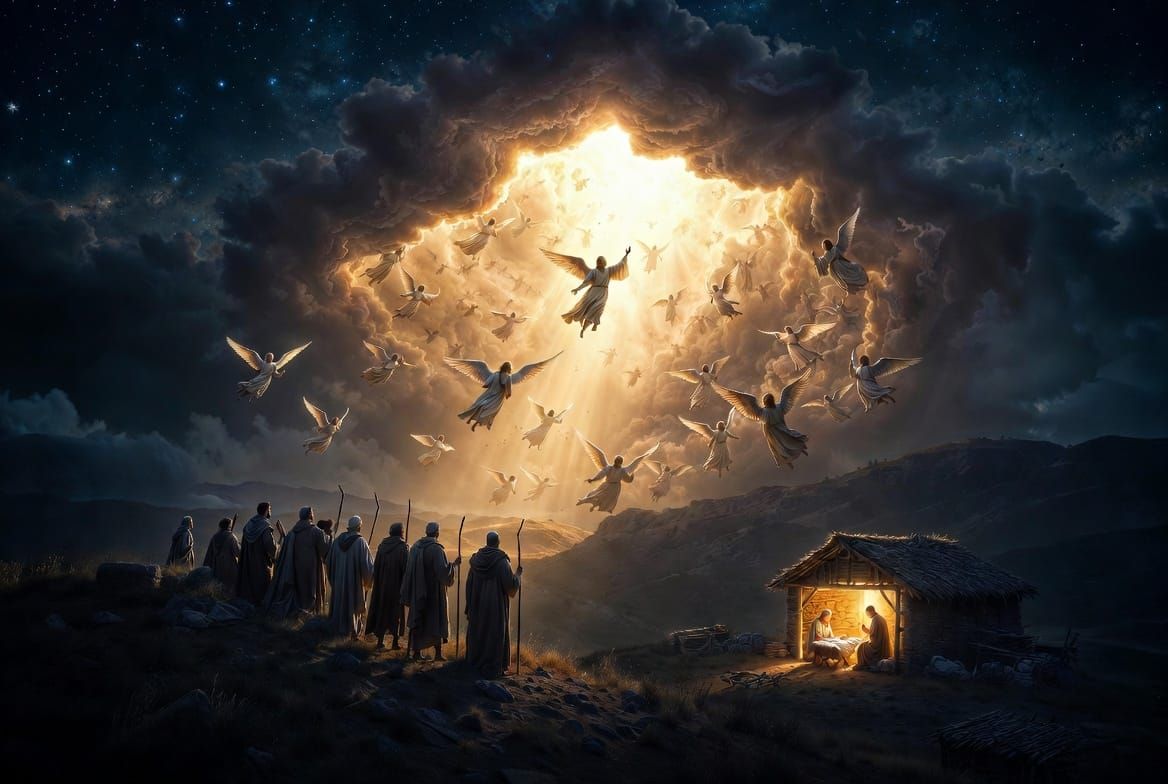
Then, in verse 8, Luke takes us outside Bethlehem: “And in the same region there were shepherds out in the field, keeping watch over their flock by night” (Luke 2:8, ESV). Suddenly the glory of the Lord shines around them, and they are terrified. But in verse 10 the angel says, “Fear not, for behold, I bring you good news of great joy that will be for all the people” (Luke 2:10, ESV).
In verse 11 comes the announcement upon which the whole night turns: “For unto you is born this day in the city of David a Savior, who is Christ the Lord” (Luke 2:11, ESV).
Notice those two words in verse 11: “unto you” (Luke 2:11, ESV). The Child promised by Isaiah has not merely entered history in some general sense. He has come as Savior. He is the Christ, the promised Messiah, and the Lord. In the light of the whole apostolic witness, the Church confesses the astonishing identity of the Child in the manger: the eternal Son of God has become truly man for us and for our salvation.
In verse 12, the shepherds receive a sign. Not a throne. Not an army. Not a palace. “You will find a baby wrapped in swaddling cloths and lying in a manger” (Luke 2:12, ESV). The sign of the arrival of the King is the humility of an infant.
Then, in verses 13 and 14, heaven can remain silent no longer: “Suddenly there was with the angel a multitude of the heavenly host praising God and saying, ‘Glory to God in the highest, and on earth peace among those with whom he is pleased!’” (Luke 2:13–14, ESV)
Ordinary shepherds, lowly and often despised, receive the first announcement. They hear what kings and rulers have not heard. The Savior has been born. The promised Christ has come. The Lord lies in a manger.
The armies of heaven do not announce another human war. They announce glory to God and peace on earth. This peace is greater than a temporary absence of conflict. Through this Child, God is acting to reconcile sinners to himself and ultimately to restore all things under the reign of Christ.
Psalm 96 joins the song. Creation itself is summoned to rejoice because the Lord comes: “He comes, for he comes to judge the earth. He will judge the world in righteousness, and the peoples in his faithfulness” (Psalm 96:13, ESV). The Child in the manger is the coming King and Judge who will one day put all things right.
Christmas therefore cannot be reduced to sentiment. The infant Jesus is the Lord before whom every power must finally answer. But this should not make Christmas less joyful. It makes the joy greater, because the Judge who comes in righteousness is the Savior who has first come in humility to redeem us.
Titus 2 brings that salvation directly home to us: “For the grace of God has appeared, bringing salvation for all people… our great God and Savior Jesus Christ, who gave himself for us to redeem us from all lawlessness and to purify for himself a people for his own possession who are zealous for good works” (Titus 2:11–14, ESV).
The grace that appeared at Christmas is not merely something beautiful to contemplate. Grace has appeared bringing salvation. The Child born in Bethlehem will give himself for us. The manger already points toward the Cross. The one wrapped in swaddling cloths will one day give his body for the life of the world. And the one who dies will rise again.
Titus also reminds us that Christmas looks forward. In verse 13, Paul says that we live “waiting for our blessed hope, the appearing of the glory of our great God and Savior Jesus Christ” (Titus 2:13, ESV). The Child has come. Christ comes to his people now by grace. And the risen Lord will come again in glory.
So what does this mean for us this Christmas Eve?
First, Christmas reveals the true character of God: a God of astonishing love who refuses to stay distant. He enters our darkness, our pain, rejection, weakness, to bring his light. If you are carrying any shadow tonight, grief, loneliness, doubt, guilt, fear, hear Isaiah's promise again: the light has dawned. Jesus knows our weakness because he has truly shared our humanity.
That does not mean every grief disappears tonight. Bethlehem itself did not suddenly become free of sorrow because Christ was born there. But it means darkness no longer has the final word. John says of the Light, “The light shines in the darkness, and the darkness has not overcome it” (John 1:5, ESV).
Second, this news demands a response. The shepherds did not remain in the fields after hearing the angel. They went to Bethlehem, saw what God had made known to them, and then, in verse 17, “made known the saying that had been told them concerning this child” (Luke 2:17, ESV). They returned glorifying and praising God.
We too are called to worship, to bear witness to what God has done, and to live as people whose lives have been changed by the coming of Christ.
Third, and most urgent, Christmas presents us with the Gospel of salvation. All of us by nature live in spiritual darkness because of sin, our rebellion against our Creator. Sin separates us from God, brings guilt and brokenness, and ends in death. No human effort, religious duties, moral improvement, or good deeds can bridge that gulf or satisfy God's perfect justice.
But God, rich in mercy and love, acted. He sent his eternal Son to become one of us. Jesus lived the perfect life we could not live. He died on the Cross, bearing the judgment our sins deserved. He rose victorious over sin and death. Now complete forgiveness, reconciliation with God, and eternal life are given in him to all who repent and believe.
Salvation is by grace alone, through faith alone, in Christ alone. That is the peace Christmas announces. God has acted to reconcile sinners to himself through his Son.
If you have never trusted Jesus Christ as Savior and Lord, hear the Gospel tonight. You do not need to make yourself worthy before coming to him. You cannot. Christ has come for sinners. Repent of your sin and trust in him. Receive the mercy he has accomplished for you in his death and Resurrection.
If you already know him, let this Christmas renew your wonder, gratitude, and faith. Live as people redeemed by grace, eager for good works, shining as lights in a dark world, and awaiting his glorious return.
Beloved, behold once more the glorious mystery: a helpless baby who is the Mighty God, a manger for the throne of the everlasting King, heavenly armies singing over a quiet birth that changes everything.
Isaiah declares, “The people who walked in darkness have seen a great light” (Isaiah 9:2, ESV). Titus proclaims, “the grace of God has appeared, bringing salvation for all people” (Titus 2:11, ESV). And the angel announces that the Savior has been born.
This Child is our Savior. This infant is our sovereign Lord. “Glory to God in the highest, and on earth peace among those with whom he is pleased!” (Luke 2:14, ESV)
In the Name of the Father, and of the Son, and of the Holy Spirit. Amen.